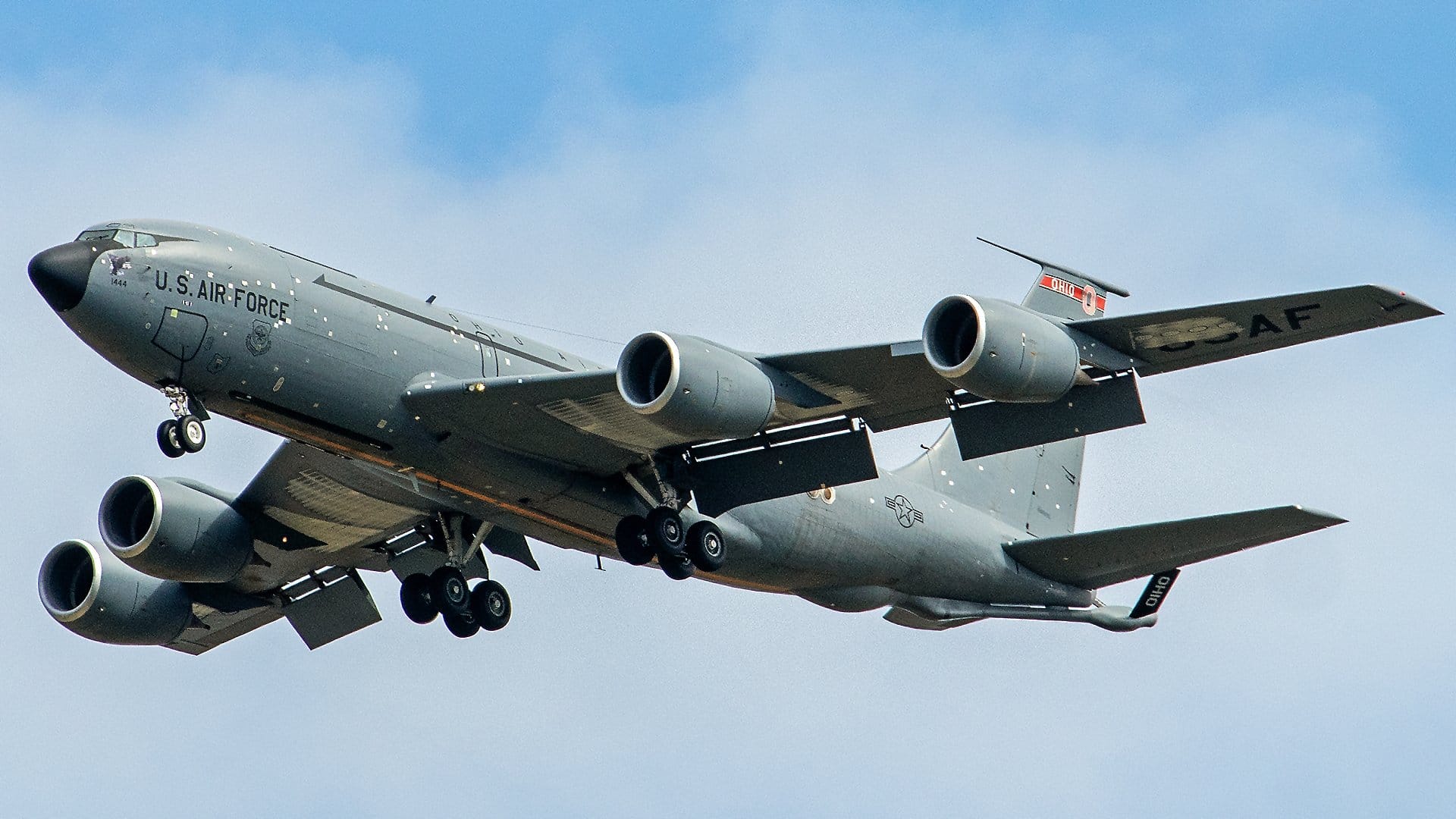
The U.S. Air Force’s KC-135 Stratotankers — the 60-year-old aerial refueling workhorses that keep American air power flying — are taking hits in the Iran war. Six aircraft have been damaged since the conflict began — a figure that covers aircraft damaged but not destroyed — and the photos tell the story: riveted shrapnel patches, repaired skin panels, and aircraft flying combat missions with visible battle scars.
Five KC-135s were damaged on the ground during the Iranian ballistic missile strike on Prince Sultan Air Base in Saudi Arabia. A sixth suffered damage in a midair collision on March 12, when the other aircraft — itself a KC-135R — went down, killing all six crew aboard.
Damaged: 6 KC-135s total — 5 at Prince Sultan AB (missile strike), 1 midair collision (March 12)
Casualties: 6 KIA from the midair collision (a second KC-135 destroyed)
Repairs: Most lightly damaged aircraft already flying again; heavily damaged ones need 1–2 years
Replacement: KC-46A Pegasus (~105 delivered so far)
The Backbone Nobody Sees
Aerial refueling is the invisible foundation of American air power. Without tankers, fighters cannot reach their targets, bombers cannot loiter, and surveillance aircraft cannot maintain their orbits. Every major U.S. air operation since Vietnam has depended on tankers, and the KC-135 has been the primary platform for all of them.
The 376 remaining KC-135s — developed from the same Boeing 367-80 prototype that spawned the 707, first delivered in 1957 — still make up the bulk of the Air Force’s tanker fleet. Their average age exceeds 60 years. Some airframes have been in continuous service since the Eisenhower administration.
And now they are flying into a shooting war.
Prince Sultan: Five Tankers Hit
The Iranian missile strike on Prince Sultan Air Base in Saudi Arabia damaged five KC-135s on the ground. The base, which has hosted U.S. forces since the 1990s, was struck by a salvo of ballistic missiles in the opening phase of the conflict. While the attack targeted multiple assets, the tanker ramp took significant hits. A second missile and drone attack on March 27 destroyed or damaged further aircraft at the base, including at least one KC-135.
Photos that later circulated on social media and were confirmed by Air Force officials showed KC-135s with riveted aluminum patches over shrapnel damage — field repairs that allowed the less-damaged aircraft to return to flight operations relatively quickly.
“Most of the aircraft with lighter damage are already back flying missions. The ones with more significant structural damage — that’s going to take a year, maybe two years, to get through depot.”
— Gen Kenneth Wilsbach, USAF Chief of Staff
Midair Collision: Six Lives Lost
The sixth damaged KC-135 was involved in a midair collision on March 12 during refueling operations. The tanker survived with structural damage. The other aircraft — itself a KC-135R — went down, killing all six crew aboard.
The incident is under investigation by the Air Force Safety Center. Aerial refueling in a combat zone, with aircraft reportedly operating under emissions control (minimizing radar and radio use to avoid detection), is among the most demanding tasks in military aviation. The collision underscored the extreme operational tempo the tanker fleet is sustaining.
A Fleet Running on Borrowed Time
The KC-135 was never supposed to still be flying in 2026. The Air Force has been trying to replace it since the early 2000s, but the KC-46A Pegasus program — Boeing’s long-delayed replacement — has delivered around 105 aircraft after years of technical problems with its remote vision system.
That means the KC-135 fleet, despite its age, remains indispensable. Losing even a handful of airframes to combat damage creates real operational pressure. Each tanker taken offline for months of depot repair is one fewer aircraft available for the daily air tasking order.
The numbers are unforgiving. The Iran war has required near-continuous tanker support for strike packages, combat air patrols, and surveillance missions across a theater stretching from the Red Sea to the Persian Gulf. Some KC-135 crews are flying multiple sorties per day.
Patching Sixty-Year-Old Airplanes in a War Zone
The field repairs visible in the post-strike photos tell their own story. Maintenance crews at Prince Sultan patched shrapnel holes with riveted aluminum sheets — a technique as old as aviation itself. These are not cosmetic fixes; they are structural repairs that allow the aircraft to be pressurized and flown safely.
But there is a limit. The KC-135’s airframe, designed in the 1950s, was engineered for a certain number of flight hours and pressurization cycles. Decades of service life extension programs have kept the fleet airworthy, but battle damage introduces stress concentrations that accelerate fatigue. Every patch is a conversation between getting the aircraft back in the fight today and preserving its structural life for tomorrow.
The Tanker Gap
The Iran war has made the tanker shortfall impossible to ignore. The Air Force’s own analysis has long identified aerial refueling as a critical capacity gap for a major conflict, particularly in the Pacific, where distances are vast and tanker demand would be enormous.
With KC-135s taking battle damage and the KC-46A still ramping up deliveries, the Air Force is operating with less margin than at any point since the Gulf War. The old Stratotankers are doing what they have always done — keeping American air power in the fight. But at 60 years old and counting, the question is how much longer they can keep it up.
Sources: Air & Space Forces Magazine, The War Zone, Defense One, Air Force Magazine, Aviation Week
Open-source investigators have identified Russian-made cluster munitions used in an airstrike in northern Mali, according to a Bellingcat investigation published May 26, 2026. The findings add to mounting evidence that Russian forces operating alongside Mali's...
When Iranian ballistic missiles slammed into Al Udeid Air Base in the early weeks of the war, they hit the most important building on the base: the Combined Air Operations Center. The CAOC — the nerve center that coordinates every U.S. and coalition aircraft across...
The Iran war burned through America's cruise missile stockpile faster than anyone planned. Now the Pentagon is buying 10,000 replacements — and it wants them cheap. On May 13, the Department of Defense awarded framework agreements to four companies for the Low-Cost...

 English
0 Comments