
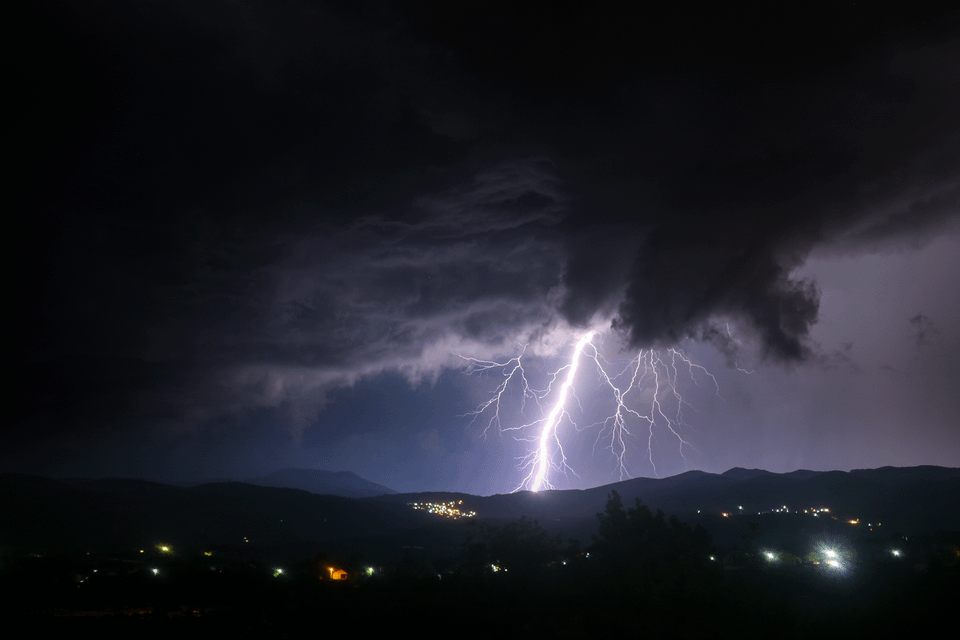
A blinding flash. A sound like the earth splitting open. Your coffee cup rattles. The cabin lights flicker. Then everything goes back to normal. Most passengers sleep through it. Statistically, commercial aircraft get struck by lightning roughly once or twice every year. Your airline won’t announce it. Your pilot won’t make a dramatic PA. But it happened, and everyone on board is flying through a phenomenon that would instantly vaporize an unprotected human being.
The good news? Modern jets survive lightning strikes with casual indifference. A 200,000-ampere bolt carrying 54,000 degrees Fahrenheit of energy courses through the aircraft, and passengers arrive at their destination never knowing they just survived what should have been unsurvivable.
The Faraday Cage That Flies
The Boeing 737, the Airbus A320, and every commercial jet you’ve ever boarded are, in essence, large metal Faraday cages. A Faraday cage is a concept that dates back to the 1700s: an enclosed conductive material that redistributes electrical charge around its exterior while protecting the interior.
When lightning strikes an aircraft’s fuselage, the electrical energy doesn’t penetrate. Instead, it travels along the aluminum skin—the conductive structure of the plane itself—distributing the massive current across the entire surface area. It’s like water flowing over a rock instead of through it. The energy dissipates, exits through static wicks on the trailing edges and wingtips, and the aircraft continues its trajectory unharmed.
Pilots, avionics, fuel systems, and passengers remain isolated from the electrical cascade happening millimeters outside the aluminum walls. The lightning never penetrates. It never gets its chance.
The Catastrophe That Changed Everything
December 8, 1963. A Pan Am Boeing 707 was holding at 5,000 feet near Elkton, Maryland, in heavy rain, frequent lightning, and winds gusting to 50 mph. The pilots were waiting to land when lightning struck. No warning light. No dramatic cockpit alert. Just a bolt that ignited fuel vapor inside a fuel tank.
The wing exploded. The final transmission from the captain: \”Mayday mayday mayday, Clipper 214 out of control. Here we go.\” All 81 people aboard died. It was the first time lightning had been definitively linked to an aircraft crash, and it shocked the aviation industry awake.
The Civil Aeronautics Board investigation concluded that the lightning strike had ignited volatile fuel vapors in the fuel tank—a catastrophic failure of containment and protection. The accident became the catalyst for a complete redesign of how aircraft managed and protected their fuel systems.
Modern Lightning Protection: Layers of Defense
Modern aircraft employ multiple defense systems working in concert. The Faraday cage effect is foundational, but it’s now augmented by sophisticated bonding—metal straps and connections ensuring that every component remains electrically connected to the fuselage so no isolated part becomes a lightning trap.
Fuel tanks are now inerted: all vapors inside are replaced with nitrogen gas, eliminating any flammable mixture that lightning could ignite. Avionics and flight control systems are shielded with braided metal foil and surge protection devices that prevent transient voltages from cascading through sensitive electronics. Static wicks—small conductive brushes that protrude from wing and fuselage surfaces—provide graduated discharge paths, bleeding electrical charge gradually rather than allowing a single catastrophic arc.
What Passengers Experience
If you’re awake during a lightning strike, what you notice is surprisingly mundane. A brilliant flash that turns the cabin blue-white for a fraction of a second. A sound—sometimes a loud bang, sometimes more of a crack or pop. The overhead lights might flicker. An announcement might come from the flight deck: \”Folks, we just had a lightning strike, everything is normal, we’ll continue to our destination on schedule.\”
There’s no turbulence caused by the strike itself. No loss of power. No dramatic emergency descent. The aircraft absorbs the electrical energy and keeps flying, because that’s precisely what it was designed to do. The lightning strike is, for the aircraft, merely a weather event. For the passengers, it’s often the only proof that they just encountered something that in any other context would be instantly fatal.
A Complete Absence of Recent Disasters
Here’s the remarkable statistic that proves the engineering works: no commercial jet has been lost to a lightning strike in more than five decades. Pan Am Flight 214 in 1963 was the last fatal aircraft accident in the United States directly caused by lightning. Everything engineered and designed after that incident—every Faraday cage refinement, every fuel tank inert system, every static wick—has held.
Modern aviation is a triumph of learned lessons. A tragedy in 1963 killed 81 people and became the template for protection that has since saved tens of thousands. Lightning still strikes aircraft with casual frequency—once or twice per aircraft per year—and the aircraft absorb it with indifference. The pilots and passengers are protected by physics, engineering, and the memory of a catastrophe that must never happen again.
Sources: CThru Metals, Airways Magazine, USC Viterbi, Flight Safety Foundation, AeroMugs, AeroTime


 English
0 Comments