A company that did not exist seven years ago just raised $350 million to build unmanned aircraft that fly faster than any operational military jet on Earth. Hermeus, a defence aviation startup founded in 2018, closed its Series C round on April 7, 2026, reaching a $1 billion post-money valuation. The money will fund the transition from prototype testing to mission-ready hypersonic platforms — aircraft designed to cruise above Mach 5.
The round was led by Khosla Ventures, with backing from Founders Fund, RTX Ventures, and In-Q-Tel — the CIA’s venture capital arm. When the intelligence community’s investment fund is writing cheques, the Pentagon is paying attention.
Quick Facts
Company: Hermeus Corporation
Founded: 2018, Atlanta, Georgia (HQ moving to El Segundo, California)
Series C: $350 million ($200M equity + $150M debt)
Target speed: Mach 5+ (future variants with ramjet propulsion)
Quarterhorse: An F-16-Sized Hypersonic Testbed
Hermeus builds its aircraft around a concept that most aerospace engineers would call audacious: a turbine-based combined cycle engine. The idea is to use a conventional jet engine for takeoff and acceleration to supersonic speeds, then transition to a ramjet for the push to Mach 5 and beyond. It is the same principle that powered the SR-71 Blackbird’s J58 engines in the 1960s, but updated with modern materials and digital design.
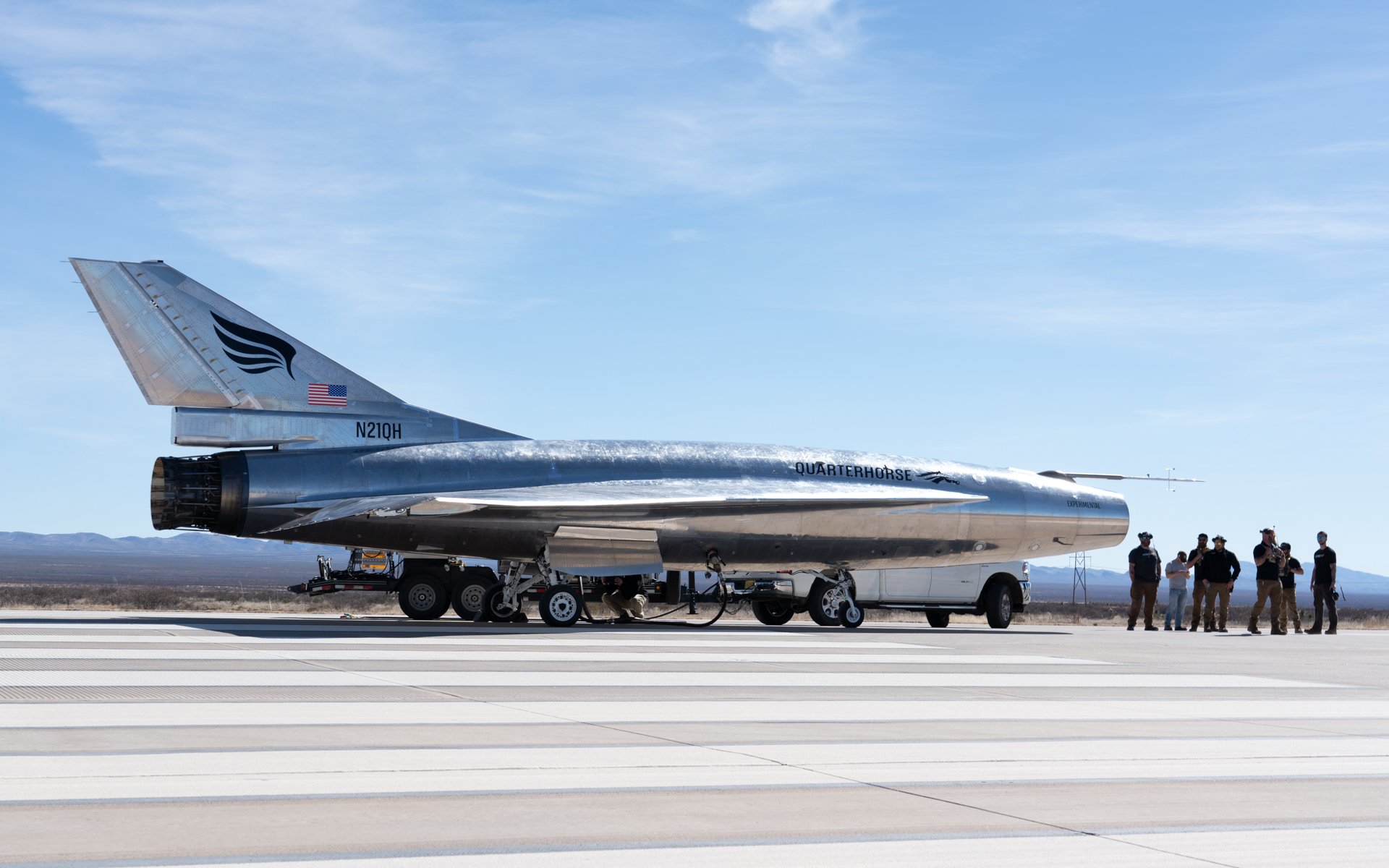
The company’s current test aircraft, the Quarterhorse Mk 2.1, is roughly the size of an F-16 Fighting Falcon. It is powered by a Pratt & Whitney F100 — the same engine family that has pushed F-15s and F-16s through the sky for decades. The F100 is the starting point. Future versions will integrate the ramjet that takes the aircraft beyond what any turbofan can achieve.
Hermeus has already completed flight testing with the Quarterhorse Mk 2.1, and supersonic flight is described as imminent. The company is not building a paper airplane. It is building a real one, and it is flying.
Why the Pentagon Wants Hypersonics That Take Off From Runways
Hypersonic weapons already exist. The United States, China, and Russia all field hypersonic missiles — weapons that fly above Mach 5 on a one-way trip. What makes Hermeus different is reusability. A Quarterhorse takes off from a standard runway, flies its mission at hypersonic speed, and lands again. It can be refuelled, reloaded, and sent back up.
The Hermeus Quarterhorse Mk 2 with its ground crew. Roughly the size of an F-16, the unmanned aircraft is powered by a Pratt & Whitney F100 engine. Photo: Hermeus
For the military, this solves a problem that hypersonic missiles cannot. Missiles are expensive, single-use, and limited in number. A reusable hypersonic drone can perform reconnaissance at speeds that make interception nearly impossible, strike time-sensitive targets before air defences can react, and return to do it again the next day. In a Pacific conflict scenario — where distances are vast and targets fleeting — that capability could be decisive.
The unmanned aspect is equally important. At Mach 5, the aerodynamic loads and thermal stresses are extreme. Removing the pilot allows designers to push the aircraft harder, pull tighter turns, and accept higher risks. Hermeus is not building a cockpit. It is building a weapon.
From Atlanta Garage to Billion-Dollar Valuation
Hermeus was founded by four former Generation Orbit and SpaceX engineers in Atlanta. The company demonstrated a turbine-based combined cycle engine running from zero to Mach 5-equivalent conditions in a ground test in 2020 — just two years after founding. That demonstration, more than any pitch deck, is what attracted early defence investment.
The $350 million Series C brings total capital raised above $500 million. The financing splits into $200 million in equity and $150 million in debt. Hermeus is moving its headquarters to El Segundo, California — the heart of American aerospace — though Atlanta will remain a production hub.
The speed of Hermeus’s rise mirrors the speed of its aircraft. Seven years from founding to billion-dollar valuation. Prototype flying. Supersonic flight imminent. It is the kind of trajectory that traditional defence primes — companies that measure programmes in decades — are watching with a mixture of admiration and anxiety.
Sources: Hermeus, TechCrunch, SiliconANGLE, AeroTime
The dream is universal. You look up at a passing airplane and think: I could do that. And the first question — always the first question — is: how much does it cost? The answer is more complicated than any flight school brochure admits. The FAA minimum for a Private...
Turbulence is the number one fear of nervous flyers. It causes white-knuckled armrest gripping, panicked glances at flight attendants, and enough anxiety medication to stock a pharmacy. Social media makes it worse — every shaky cabin video goes viral, every "severe...
The handle is between your legs. You have trained for this. You have watched the videos, studied the diagrams, memorised the sequence. But nothing prepares you for the moment you actually pull it — especially when the ocean is rushing up to meet you. Ejecting over...




 English
0 Comments