The Death Rattlers lost a jet on Saturday.
A Marine Corps F/A-18D Hornet from VMFA-323 slammed into terrain near Rimrock Lake in Washington’s Cascade Mountains around noon on June 13, igniting a wildfire and sending a column of smoke visible for miles across Yakima County. The pilot ejected safely and walked away with minor injuries — which, given the alternative, counts as a very good day at the office.
The crash happened along Visual Route 1355, one of the military’s most demanding low-level training corridors winding through the Cascades east of Mount Rainier. It is the same route where a Navy EA-18G Growler from VAQ-130 crashed in October 2024, killing both crew members — Lt. Cmdr. Lyndsay Evans and Lt. Serena Wileman. Two jets lost on the same mountain route in less than two years.
Quick Facts — VMFA-323 F/A-18D Crash
Date: June 13, 2026, ~12:00 PDT
Location: Near Rimrock Lake, Yakima County, Washington
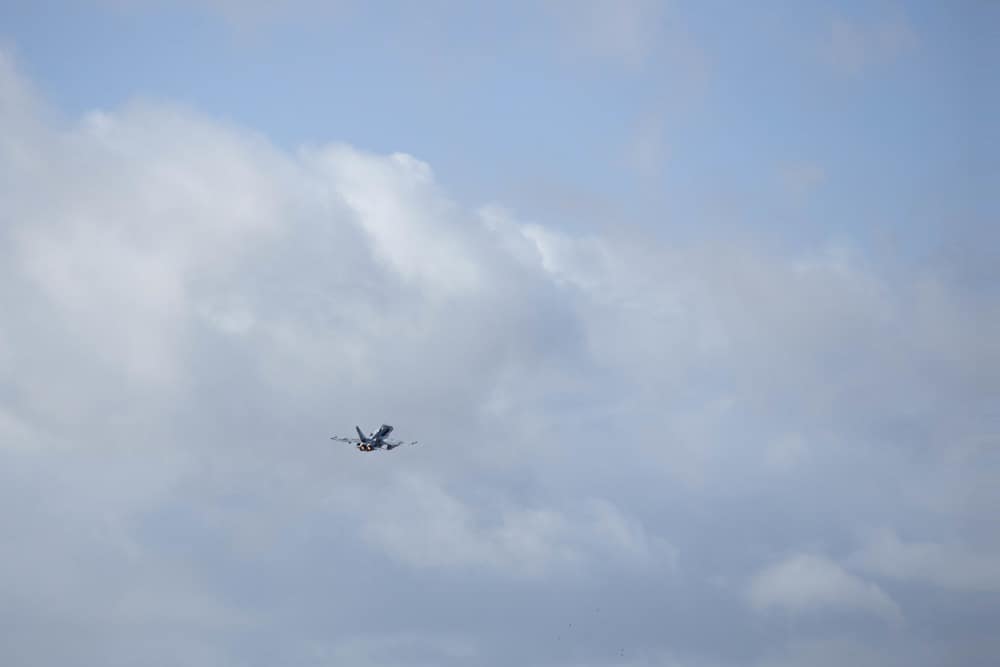
Aviation spotters didn’t need long. The aircraft — Bureau Number 165412, tail code WS-415, callsign SNAKE 21 — was one of four VMFA-323 Hornets that had staged out of King County International Airport (Boeing Field) for the training sortie. Only three flew home.
Evergreen Intel’s identification confirmed what the Marine Corps took hours to announce publicly: the missing jet belonged to the Death Rattlers, one of the most storied fighter attack squadrons in Marine aviation. VMFA-323 completed the Corps’ final F/A-18 Hornet carrier deployment aboard USS Nimitz in February 2021 — a distinction that makes every remaining airframe in their stable a piece of living history.
“Popping Sounds” Over Rimrock Lake
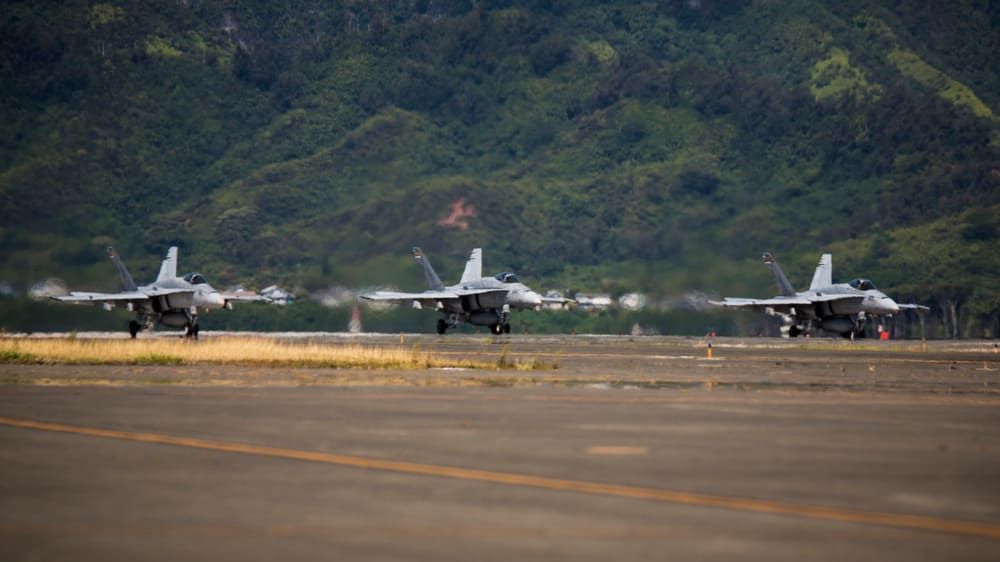
VMFA-323 F/A-18 Hornets from MAG-11 during flight operations. USMC photo by Sgt. Dominic Romero / DVIDS
Witnesses at the lake heard the jet before they saw the smoke. Tina Liniger, who was camping near Rimrock, told reporters that several jets had already flown over during the afternoon. Then one sounded different.
“A couple of jets had already buzzed over the lake. We heard another one coming, but it made popping sounds,” Liniger said. “We thought it was just air noise from the jet. When we walked down to the lakefront, we could see the smoke.”
The impact ignited the Pine Tree Fire, which grew to roughly two acres by late afternoon. U.S. Forest Service helicopters and ground crews from the Okanogan-Wenatchee National Forest attacked the blaze from above while the Naches Fire Department evacuated nearby campgrounds and set up structure protection around the Bear Creek cabins. A water tender remained on scene overnight.
A Familiar and Deadly Route
VR-1355 is known among military aviators as the “million dollar ride” — a scenic, aggressive low-level route through the Cascade Mountains that tests pilot skill against unforgiving terrain. But the corridor has now claimed two aircraft in under two years.
The October 2024 EA-18G Growler loss killed Lt. Cmdr. Evans and Lt. Wileman, both experienced electronic warfare officers. That crash prompted a temporary halt to Navy and Marine Corps training along the route while safety procedures were reviewed. The fact that another jet has now gone down on VR-1355 will inevitably reignite questions about whether the route’s risk profile matches its training value.
The Legacy Hornet’s Final Chapters
The F/A-18D is the two-seat variant of the Legacy Hornet — the original McDonnell Douglas design that entered Marine service in the 1980s. The type has been steadily giving way to the F-35B Lightning II, and the Marine Corps is in the final years of Legacy Hornet operations. VMFA-323 itself is slated to transition to the F-35 in coming years.
Losing an airframe now, with the fleet already shrinking, stings more than it would have a decade ago. Every Legacy Hornet that drops off the roster is one that can’t be replaced — the production line closed in 2000.
The 3rd Marine Aircraft Wing released a terse statement: “The cause of the mishap is currently under investigation. To preserve the integrity of the investigation, no additional details are available at this time. Mishap investigations can take several months to complete.”
That’s standard boilerplate. What isn’t standard is losing jets on training routes that have already killed people. The investigation will take months. The questions won’t wait that long.
Sources: The Aviationist, Task & Purpose, NBC News, CBS News, Yakima Herald-Republic, Naches Fire Department
Every fighter pilot trains for it. Most pray they'll never experience it. The moment a jet engine — the machine that keeps you flying at 500 knots and 30,000 feet — stops working. Whether it's a compressor stall that sounds like a cannon going off behind your seat, a...
Luca Parmitano has lived two lives that most people only dream about. In the first, he was a fighter pilot — flying AMX Ghibli attack jets for the Italian Air Force, deployed to Afghanistan, trained to fly low and fast into hostile territory. In the second, he became...
Before the Rafale, before the Mirage 2000, before the Mirage F1 — there was the Mirage III. Dassault's first supersonic fighter was a revelation when it entered service in 1961: a sleek, tailless delta that could break Mach 2, carry a nuclear bomb, and outfight...



 English
0 Comments