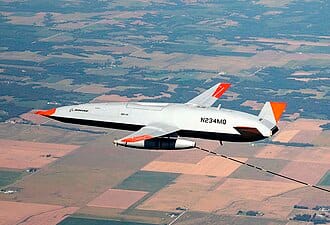
Boeing’s MQ-25A Stingray completed its maiden flight on 25 April at MidAmerica St. Louis Airport, flew for two hours, and demonstrated something no carrier-based drone has done before: autonomous taxi, takeoff, flight, and landing under ground-controller command. Three weeks later, the Navy cleared it for low-rate initial production. The drone that could redefine carrier aviation is no longer a concept. It is a production aircraft.
Quick Facts — MQ-25A Stingray
Manufacturer: Boeing
Role: Carrier-based unmanned aerial tanker
First flight: 25 April 2026, MidAmerica St. Louis Airport
Flight duration: ~2 hours
Milestone C: 19 May 2026 (cleared for LRIP)
LRIP Lot 1: 3 aircraft, contract expected summer 2026
IOC: FY2029 (slipped from 2026)
Programme cost: $15.9B (~$209M per aircraft)
The Range Problem
Every carrier air wing has the same constraint: the Super Hornets that do the fighting burn a third of their fuel just getting to the fight and back. A carrier in the Western Pacific operating against Chinese anti-ship missile batteries has to stay at least 1,000 nautical miles from the coast to survive. That puts most of its strike range beyond the combat radius of an F/A-18E/F carrying weapons.
The MQ-25 solves this by moving the tanking mission off manned aircraft. Currently, Super Hornets fly “buddy store” tanker missions for each other — which means 20-30% of a carrier’s strike fighters are not fighting at all, but hauling fuel for the ones that are. An unmanned tanker frees those jets for combat.
From Test to Production
The 25 April maiden flight took off at 10:49 AM CDT from MidAmerica. Both Boeing and Navy pilots controlled the aircraft from a Lockheed Martin MDCX-integrated ground control station. The Stingray demonstrated autonomous taxi, takeoff, manoeuvring, and landing — the full envelope — in a single sortie.
Milestone C approval followed on 19 May, clearing the MQ-25A for Low-Rate Initial Production. Lot 1 will deliver three aircraft, with priced options for Lot 2 (three more) and Lot 3 (five). Boeing invested $200 million in its MidAmerica production facility in 2024 to prepare for series manufacturing.
“The MQ-25A demonstrated the ability to autonomously taxi, take off, fly and land — validating years of engineering and integration work.”
NAVAIR — Official statement, April 2026
The Pacific Equation
Initial operational capability has slipped to FY2029 — originally it was this year aboard USS Theodore Roosevelt (CVN-71). The delay is frustrating but not surprising for a programme this complex: the MQ-25 has to operate from a carrier deck, refuel fighters at altitude, and do both autonomously. Getting it right matters more than getting it fast.
When it does arrive, the math changes fundamentally. A carrier air wing with MQ-25 tankers can extend its effective strike radius by hundreds of nautical miles without sacrificing a single fighter to the tanking role. In the Pacific, where distance is the defining operational problem, that is not an incremental improvement. It is a strategic shift.
Sources: USNI News, Boeing, NAVAIR, Air & Space Forces Magazine
The engine that will power America's autonomous combat drones does not exist yet — but six companies are now racing to build it. The US Air Force has awarded medium-thrust engine design contracts to GE Aerospace and Rolls-Royce for the Autonomous Collaborative...
Ukrainian long-range drones struck St. Petersburg overnight on 3 June, setting an oil terminal ablaze and damaging a guided-missile corvette at Kronstadt naval base — all of it roughly 1,100 kilometres from the nearest Ukrainian-held territory, and hours before...
On 10 May 1972, Major Robert "Bob" Lodge was flying an F-4D Phantom over North Vietnam when enemy fire disabled his aircraft. He had the knowledge to eject. He had the time. He chose not to. Lodge carried classified information about tactics, capabilities, and...
0 Comments