
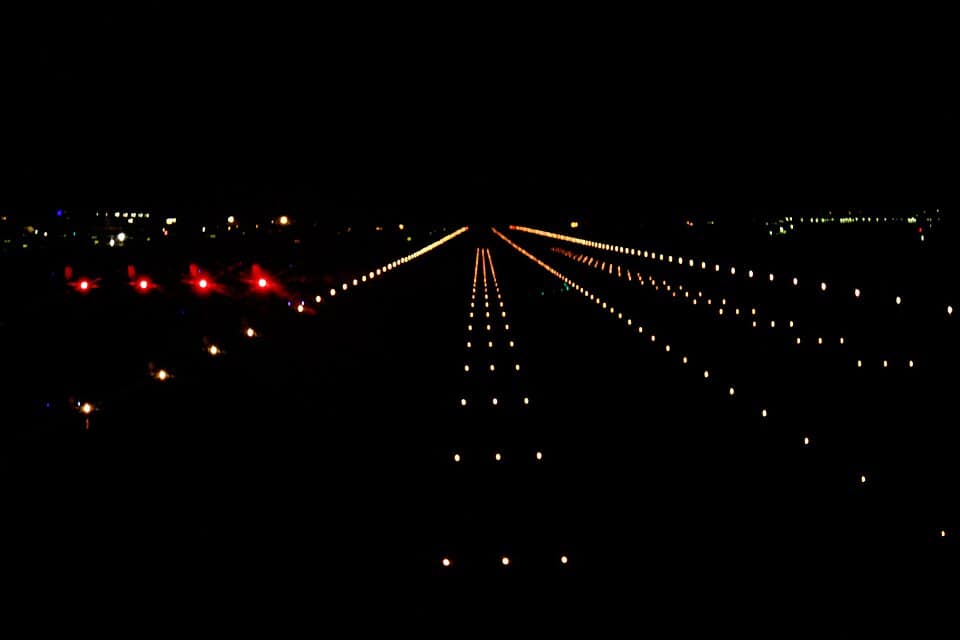
You’re on a three-mile final. The runway lights are visible — two neat rows of white dots floating in a sea of black. Everything looks normal. You hold the descent. Then, 200 feet above the ground, something feels off. The VASI lights are screaming red. You’re way too low. The trees you couldn’t see are now directly ahead. You jam the throttle forward and go around with your heart in your throat.
Welcome to night visual approaches — the phase of flight where perfectly competent pilots suddenly fly like they’ve never seen an airplane before. It’s not a skill problem. It’s a perception problem. And it has killed more experienced pilots than most people realize.

The Black Hole That Eats Pilots
The phenomenon has a name: the black hole approach. It happens when you’re flying toward a lit runway surrounded by unlit terrain — water, open fields, desert, or simply a rural airport with no city lights nearby. Your brain, desperate for visual references, does what it always does: it guesses. And at night, it guesses wrong.
Without a visible horizon, your eyes interpret the runway lights as the only reference. Your brain constructs a false picture of your glide path. Specifically, it overestimates your altitude. You think you’re high, so you descend. You keep descending because the visual picture still looks “high.” By the time the ground appears in your landing light, you’re out of altitude and out of options.
Research from the International Journal of Applied Aviation Studies found that pilots consistently underestimate their descent rate during black hole approaches. The illusion is so powerful that even airline crews with thousands of hours have flown into terrain on perfectly clear nights.
Your Eyes Lie — Trust the Instruments
The fix sounds simple: use your instruments. In practice, it goes against every VFR instinct. You’ve spent your entire training looking outside. The visual approach is supposed to be the easy part — you can see the runway, what more do you need? At night, the answer is: a lot more.
First, use every electronic aid available. A VASI or PAPI on the runway is your single best defence. Two red, two white means you’re on a proper three-degree glide path. All red means you’re dangerously low. All white means you’re too high — but at night, too high is survivable. Too low is not. If the airport has an instrument approach, fly it, even if conditions are technically VFR.
Second, cross-check your altitude against distance. At three miles out on a standard three-degree glide path, you should be at roughly 1,000 feet AGL. At two miles, about 600 feet. At one mile, 300 feet. If your altimeter disagrees with this math, your eyes are lying.
The Other Night Illusions
Black hole approaches get the headlines, but they’re not the only trap. A runway on a slope creates false perspective — an upslope runway looks farther away than it is, tempting you to fly too low. A wider-than-normal runway makes you think you’re closer than you are, so you flare too early and drop in hard.
Rain on the windscreen scatters runway lights and makes them appear farther away. Ground fog creates a false horizon that can be offset from the real one by several degrees — enough to put you in a bank you don’t notice. And city lights behind the runway can make it impossible to distinguish the approach end from the urban glow.
Then there’s autokinesis — stare at a single light source long enough in darkness, and your brain will make it move. A tower beacon starts drifting left. A star appears to descend. You correct for motion that doesn’t exist, and now you’re the one drifting.
How to Survive Your First Night Approach
The best training happens before the flight. Study the airport diagram during the day. Note the terrain, obstacles, lighting systems. Know whether the runway has VASI, PAPI, or nothing. If it has nothing and the approach is over unlit terrain, consider choosing a different airport.
During the approach, keep the scan moving: airspeed, altitude, vertical speed, runway picture. Don’t fixate on the lights. Use the attitude indicator as your primary pitch reference on final — yes, even on a VFR approach. The six-pack doesn’t care if it’s dark outside.
And the most important rule of night flying: if it doesn’t feel right, go around. The go-around at night is always safer than forcing an approach into a visual picture you don’t trust. There is no shame in a missed approach. There is plenty of shame in the NTSB report that reads “continued descent into terrain during a visual approach at night.”
Sources: AOPA Air Safety Institute, FAA Spatial Disorientation Safety Briefing, Pilot Institute, California Aeronautical University



 English
0 Comments