
| Quick Facts | |
|---|---|
| Manoeuvre | Pugachev’s Cobra |
| Pilot | Viktor Pugachev, Soviet test pilot |
| Aircraft | Sukhoi Su-27 (first demonstration); later performed in MiG-29 |
| First Public Demo | 1989 Paris Air Show, Le Bourget |
| Angle of Attack | 90–120 degrees — nose pulled past vertical |
| Airspeed at Peak | Near zero |
| Significance | Revealed Soviet supermaneuverability to the West for the first time |

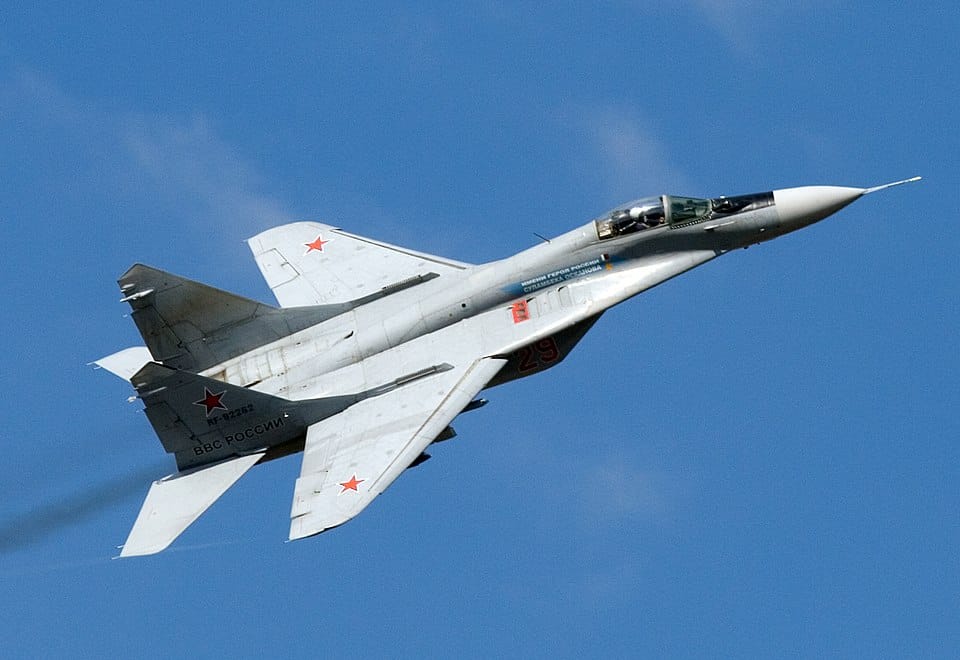
The crowd at Le Bourget didn’t understand what they were seeing. One moment, a Soviet fighter was flying straight and level over the Paris Air Show at moderate speed. The next, its nose pitched violently upward — past 45 degrees, past vertical, past 90 degrees — until the aircraft was momentarily flying backwards, hanging in the sky like a fish leaping from water. Then the nose fell through, the engines caught the air again, and the jet accelerated away as if nothing had happened.
The year was 1989. The Cold War had weeks to live. And Viktor Pugachev had just shown the West something its aerodynamic engineers said was aerodynamically impossible.
What the Cobra Actually Is
The Pugachev Cobra is a dynamic deceleration manoeuvre. The pilot pulls the nose past vertical to an angle of attack between 90 and 120 degrees — meaning the aircraft’s fuselage is momentarily pointed straight up or even slightly backward relative to its direction of travel. The aircraft bleeds nearly all its kinetic energy in seconds, airspeed dropping to near zero, before the nose pitches back down and the engines restore normal flight.
From the outside, it looks like the aircraft stalls in mid-air, hangs for a heartbeat, then recovers. It shouldn’t work. At extreme angles of attack, conventional aircraft experience complete loss of lift, uncontrollable pitch-up, and deep stall conditions from which recovery is impossible. Every Western fighter of the era had strict angle-of-attack limiters specifically to prevent pilots from reaching these regimes.

The Soviet aircraft didn’t have those limiters. They were designed to go there.
How Soviet Design Made It Possible
The Sukhoi Su-27 and its cousin the MiG-29 were built around a design philosophy the Soviets called “supermaneuverability” — the ability to fly controllably at angles of attack far beyond the limits of conventional aerodynamics. This wasn’t accidental. It was a deliberate engineering response to a tactical problem.
Soviet doctrine anticipated close-range dogfights against American F-15s and F-16s. In a turning fight, the ability to rapidly decelerate and point the nose at an opponent — even momentarily — could create a firing opportunity for a heat-seeking missile. The Cobra was the extreme expression of this idea: a way to slam on the brakes in mid-air, force an overshooting attacker to fly past, and reverse the engagement.
The aerodynamic trick lies in the wing-body blending of the Su-27 and MiG-29 families. The wide lifting body between the engines generates lift even at extreme angles of attack. The twin vertical stabilisers remain effective when a single fin would be blanked by the fuselage. And the aircraft’s centre of gravity sits in a position that allows the nose to pitch up rapidly without entering an unrecoverable deep stall.
The Paris Shock
The 1989 Paris Air Show was the first time Western audiences saw Soviet fighters perform in person. The Cold War was ending, and the Soviet Union was using air show appearances as both diplomatic signalling and — frankly — advertising. The Su-27 and MiG-29 were available for export, and potential buyers needed to be impressed.
They were. Western test pilots and engineers in the crowd watched Pugachev’s demonstration in stunned silence. The manoeuvre broke every assumption about what a fighter aircraft could do at extreme angles of attack. American and European fighters were designed to avoid this regime at all costs. The Soviets had turned it into a party trick.

The intelligence implications were immediate. If Soviet fighters could operate at angles of attack where Western aircraft would depart controlled flight, the assumptions underlying NATO air combat doctrine needed revision. Missile engagement envelopes, turning performance models, and tactical planning — all of it was built on the premise that both sides operated within similar aerodynamic limits. The Cobra proved they didn’t.
Tactical Reality vs. Airshow Drama
The debate about the Cobra’s combat utility has raged for 37 years. Critics argue that the manoeuvre bleeds all the aircraft’s energy, leaving it slow, vulnerable, and unable to manoeuvre until it re-accelerates. In beyond-visual-range combat — where engagements happen at 40 miles with radar-guided missiles — the Cobra is irrelevant. You don’t need to point your nose at a target when an AIM-120 can do it for you.
Defenders counter that the Cobra was never meant to be a combat manoeuvre by itself. It was a demonstration of an aerodynamic capability — supermaneuverability — that manifests in dozens of ways during a close-range fight. An aircraft that can reach 90 degrees angle of attack can also sustain 50 degrees in a turning engagement, pull tighter instantaneous turns, and exploit flight regimes that energy fighters cannot follow into.

The truth, as usual, sits between the two camps. The Cobra itself is an airshow move. The capability it represents — controllable flight at extreme angles of attack — is genuine and tactically relevant in the close-range engagements that still occur when radar missiles miss or rules of engagement demand visual identification.
A Moment That Changed Aviation
Pugachev’s Cobra didn’t change the outcome of the Cold War. By the time he flew it, the Berlin Wall was months from falling. But it changed how the West thought about fighter design. The F-22 Raptor — designed in the late 1980s and early 1990s — incorporated thrust vectoring that gave it its own supermaneuverable capability, directly influenced by what the Soviets had demonstrated.
Every modern fifth-generation fighter since — the F-35, the Su-57, the J-20 — has been designed with post-stall manoeuvrability as a consideration. The era of flight-envelope limits as hard boundaries ended the moment Pugachev pulled that stick back and the MiG kept flying.
One pilot. One manoeuvre. One afternoon in Paris. And the textbooks had to be rewritten.
Sources: Federation Aeronautique Internationale, Jane’s Defence, Aviation History

 English
0 Comments