
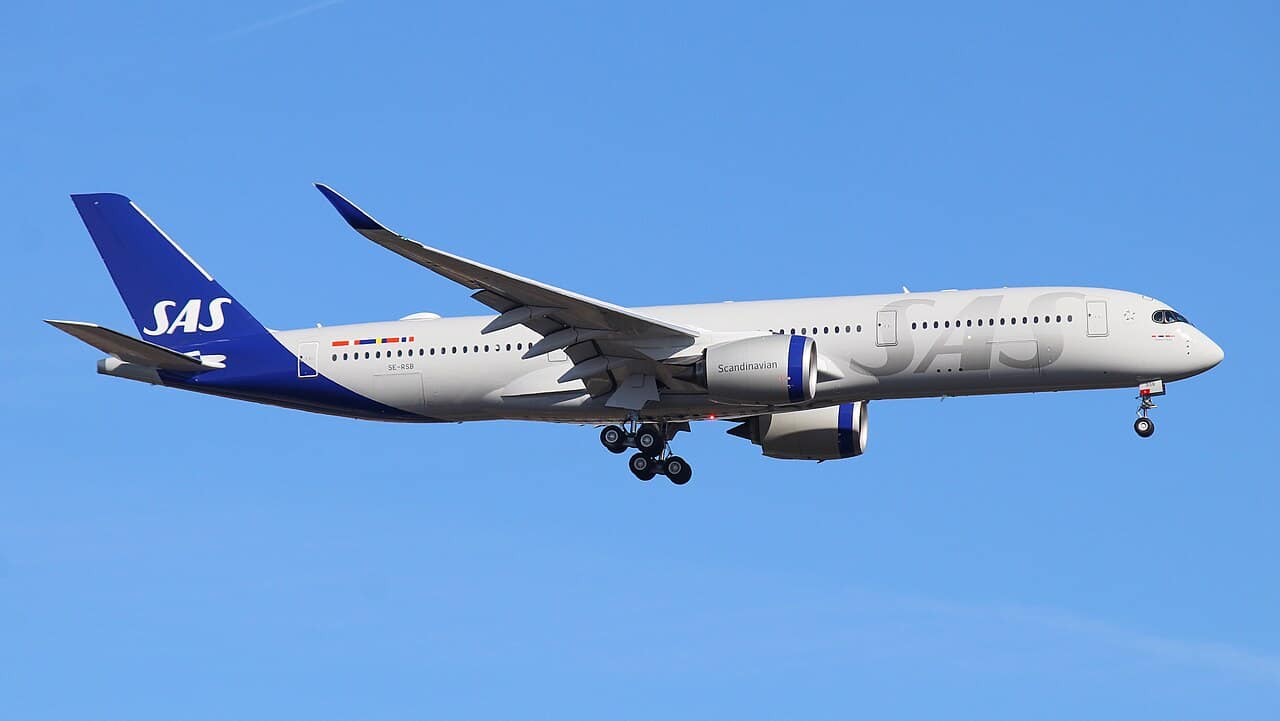
SAS at 80: From Polar Pioneer to Unlikely Survivor
| QUICK FACTS |
|---|
| Founded: August 1, 1946 | Founders: Denmark, Norway, Sweden (Tripartite) | First Intercontinental: Stockholm-New York, Sept 1946 | Polar Pioneering: 1954 (first regular transpolar routes) | Milestone: Invented modern business class | Crisis: Chapter 11 bankruptcy, 2022 | Acquisition: Air France-KLM, 2024 | Hubs: Copenhagen, Stockholm, Oslo |
Eighty years ago, on a summer morning in 1946, a Douglas DC-4 lifted off from Stockholm with a radical idea: that you could fly nonstop from Europe to New York. Today, such flights are routine. Then, they were audacious. SAS—the product of a tripartite merger between Danish, Norwegian, and Swedish airlines—had just made aviation history.
Scandinavian Airlines System marked its 80th birthday on August 1, 2026. Few airlines survive eight decades. Fewer still remain culturally and operationally relevant. SAS did both—and then nearly didn’t. Its journey from polar pioneer to near-bankruptcy to uncertain survival under Air France-KLM ownership is a masterclass in how global forces, brilliant leadership, terrible decisions, and Nordic stubbornness intersect in aviation.
The Founding: Tripartite Ambition
Post-World War II Europe was shattered. Nations were rebuilding. Aviation was emerging as the transport revolution. Denmark, Norway, and Sweden saw opportunity: if they pooled their national carriers—DDL (Danish), DNL (Norwegian), and ABEA (Swedish)—they could create a carrier with sufficient scale to compete against the British, Americans, and Dutch.
It worked. In one move, SAS became Scandinavia’s gateway to the world. The first intercontinental flight departed September 17, 1946, just six weeks after the airline’s founding. A DC-4 lumbering across the Atlantic with 30 passengers aboard. To modern eyes, it’s charming. To 1946 eyes, it was technology that rewrote geography.
But SAS was thinking bigger than New York. The Scandinavian founders understood geography. They sat at the crossroads between the Americas and Asia. Why force all flights down the tropical routes? Why not fly north? Over Greenland. Over the Arctic. Over the North Pole itself.
The Polar Gambit: 1954 and Beyond
In 1954, SAS became the first airline to offer regular scheduled service over the North Pole. This wasn’t a stunt. It was navigation genius. Flying from Copenhagen to Tokyo via the Arctic reduced flight time by 40% compared to southern routes. A journey that once took 20+ hours now took 12. That’s not incremental—that’s revolutionary.
Operating over the North Pole meant flying over territory with no emergency landing fields. If an engine failed, you’d land on ice or bail out into the Arctic Ocean. SAS trained crews specifically for polar operations. It invested in high-frequency radio systems that could reach ground stations across Greenland. It pioneered navigation techniques that became industry standard.
For nearly two decades, SAS had an exclusive on these routes. Asia-bound travelers didn’t go through London, Frankfurt, or Rome. They went through Copenhagen or Stockholm. SAS became the bridge between East and West—literally the airline that flew over the top of the world.

The Cold War context is crucial. SAS was operating transpolar routes while the Soviet Union controlled the airspace below. Every flight skirted the edge of hostile territory. Pilots developed a reputation for ice-calm professionalism. SAS became synonymous with Nordic competence—and that reputation stuck for decades.
The Nordic Difference: Class and Service
SAS wasn’t just flying routes. It was inventing a service model. In the 1970s and 1980s, business travel was dominated by suits in 30-row cabins packed with identical seats. SAS asked: what if premium travel deserved premium treatment?
SAS introduced what became known as “SAS Scandinavian”—a cabin class that was better than economy but cheaper than first. They separated it from coach with a divider wall. Added direct aisle access. Served better meals. It sounds quaint now, but at the time it was radical. SAS didn’t invent business class—that honor belongs to others—but SAS evangelized it and made it an industry expectation.
This stemmed from Nordic culture itself. Scandinavians were egalitarian but also quality-conscious. SAS reflected that. It didn’t coddle wealthy passengers with extravagant luxury. But it respected their time and dignity. Clean design. Efficient service. No pretense. That aesthetic became SAS’s brand identity.
“SAS didn’t just survive 80 years. It pioneered routes, invented service concepts, and proved that a small regional carrier could compete globally. Then it nearly destroyed itself.”
The Jan Carlzon Era: Management Legend
In 1980, a visionary named Jan Carlzon became CEO of SAS. He found a bloated, bureaucratic, loss-making airline. Within five years, he’d transformed it into one of Europe’s most profitable carriers. His secret wasn’t technology or routes. It was management philosophy.
Carlzon wrote a book called “Moments of Truth.” The central insight: an airline is just vehicles and fuel. What customers remember are the interactions—the check-in agent’s smile, the flight attendant’s professionalism, the punctuality of departure. Every contact point is a “moment of truth” where the airline either reinforces or undermines its brand.
He empowered frontline employees to make decisions without asking headquarters. A gate agent could rebook a delayed passenger on a competitor’s flight if it got them there faster. A flight attendant could offer a complimentary drink to smooth over a staffing mistake. Decision-making pushed down to people closest to customers. Revolutionary in the 1980s. Standard in the 2010s. SAS proved it worked first.
Carlzon’s SAS became a business school case study. Management thinkers from around the world studied how a legacy airline had transformed itself through culture change, not just cost-cutting. SAS’s reputation soared. For two decades, it was the benchmark for aviation excellence.
Star Alliance and Going Global
In 1997, SAS helped found Star Alliance alongside Lufthansa, United Airlines, Air Canada, and Thai Airways. This was clever strategy. Star Alliance became the global airline network—a coalition of carriers coordinating schedules, sharing frequent-flyer miles, and effectively offering global coverage without needing to fly every route themselves.
SAS was a founder-member, signaling its continued relevance. But it was also a symptom: the era of small independent airlines was ending. To survive globally, you needed to plug into a larger network. SAS chose well. Star Alliance thrived.
But this also created vulnerability. SAS was no longer a standalone actor. It was part of a constellation. That made it stronger in some ways—access to global capacity. Weaker in others—less autonomy, less ability to differentiate, trapped in the Star Alliance pricing structure.
Military Aviation’s Arctic Role
Throughout SAS’s history, its operations overlapped intensely with military aviation. The Royal Danish Air Force, Norwegian Air Force, and Swedish Air Force operated from many of the same bases as SAS. In the early decades, SAS and the military shared infrastructure, sometimes even shared pilots during national emergencies.
SAS’s expertise flying polar routes was invaluable to NATO. During the Cold War, the ability to project power across the Arctic was a strategic imperative. SAS pilots trained alongside military aviators. The airline’s navigation techniques were declassified and used to develop military protocols. SAS’s Arctic route expertise informed how NATO planned potential Arctic operations.
This deep integration between SAS and Scandinavian air forces created a cultural bond that lasted decades. SAS wasn’t just a commercial carrier—it was a tool of national defense and strategic projection. That gave it prestige beyond its size and profitability. It also made Scandinavian governments willing to support it through rough patches that might have bankrupted other airlines.
The Decline: 2000-2020
Then things fell apart. The post-9/11 recession, low-cost carriers, fuel price volatility, pilot strikes, aircraft lease commitments that became unsustainable—SAS faced headwinds that would have destroyed smaller carriers. But SAS was also trapped by its past success.
It had a large fleet of aging aircraft that still complied with regulations but burned fuel like 1990s machines. It had labor agreements that reflected the Carlzon era’s generous philosophy. Ticket prices had been undercut by low-cost carriers that didn’t offer business class or frequent-flyer miles. SAS couldn’t compete on price. It also wasn’t premium enough to command luxury pricing.
Leadership lurched between ambitious restructuring and muddling through. Every CEO promised a turnaround. Few delivered lasting results. SAS became a regional airline that once flew polar routes, now struggling to compete with Ryanair on one end and Lufthansa on the other.
The 2022 Bankruptcy: Reality Arrives
In September 2022, SAS filed for Chapter 11 bankruptcy protection. Eighty-year-old national icon, filing for bankruptcy. It was shocking—and inevitable. The airline couldn’t service its debt. Too many aircraft. Too high costs. Too little revenue. SAS was insolvent on paper, even if it could still operate flights.
Bankruptcy lasted only months, but it forced restructuring. Aircraft were released. Lease obligations were renegotiated. The airline was streamlined. By late 2023, SAS was flying again, leaner and angrier.
But independence was over. No single Scandinavian country could support a national airline anymore. The market had moved beyond national champions to multinational alliances and low-cost operators. SAS was stuck in the middle—too small to be a legacy giant, too bound by labor costs to be a true budget carrier.
The Air France-KLM Acquisition: 2024
In 2024, Air France-KLM acquired SAS, delisting it from the stock exchange. The deal was inevitable but still heartbreaking. A carrier that had been independent—that had founded an airline alliance—was now a subsidiary of a French-Dutch conglomerate.
Strategically, it makes sense. SAS gives Air France-KLM access to Scandinavian markets, Copenhagen and Stockholm hubs, and routes that serve AF-KLM’s network. For SAS, it provides capital to modernize, scale without the burden of independence, and integration into a global giant.
But culturally, something was lost. SAS will continue to operate from Copenhagen, Stockholm, and Oslo. It will still employ Scandinavian crews. But decisions will be made in Paris. Pricing will follow AF-KLM algorithms. The carrier that pioneered polar routes and invented modern business class is now a regional subsidiary.
Eighty Years: Lessons
SAS survived 80 years by doing hard things first. It flew over oceans when conventional wisdom said it was impossible. It pioneered routes when others waited for demand. It invented service concepts that defined an industry. It proved that management philosophy mattered as much as route networks.
But it couldn’t escape the fundamental truth that Jan Carlzon understood: in aviation, margins are thin and scale matters. SAS was always medium-sized. Never large enough to be a true global powerhouse. Never small enough to be nimble. It occupied a zone that commercial aviation has been squeezing for decades.
The bankruptcy and acquisition weren’t failures of strategy or execution. They were failures of physics. An airline that operates from expensive Scandinavian bases, employs well-compensated Nordic labor, and competes against low-cost carriers and legacy giants cannot remain independent indefinitely. SAS lasted 80 years. That’s remarkable—most airlines last 50.
Happy 80th birthday, SAS. You proved a regional carrier could become an industry pioneer. Then you proved the limits of that pioneering.
 English
0 Comments