
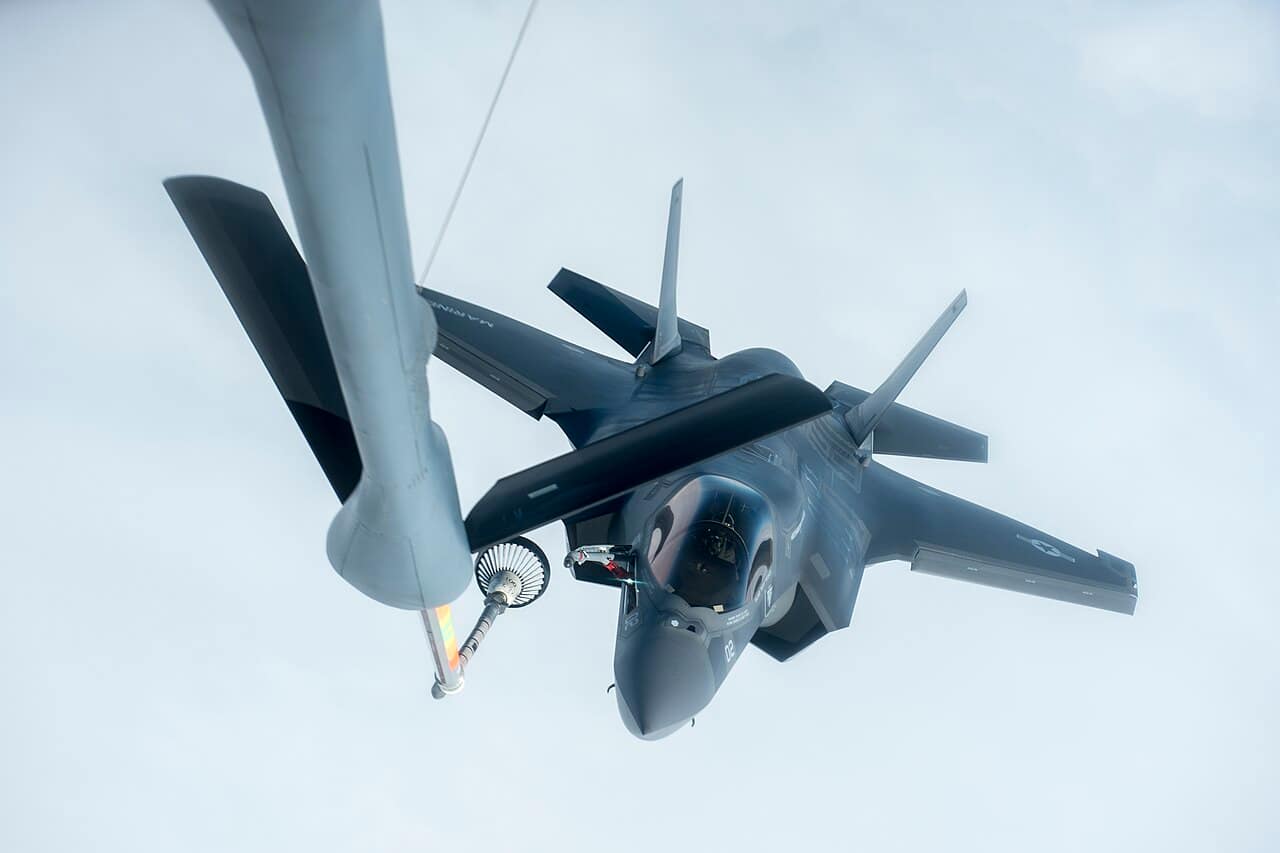
At the Future Investment Priority Summit in Miami on March 28, Donald Trump made it official: “For the very first time, we agreed to sell Saudi Arabia perhaps the most capable fighter jet ever built, the F-35.” With that sentence, the stealth monopoly in the Middle East — held exclusively by Israel since 2017 — ended.
The deal puts 48 F-35A Lightning IIs in Saudi hands. It’s part of a $142 billion defense package, the largest in history between the two nations. No delivery before 2029. Full operational capability not until the early 2030s. But the geopolitical shockwave is immediate.
Saudi Arabia becomes the first Arab nation ever approved to operate the F-35 and only the second country in the Middle East after Israel. For a region where air superiority has historically defined the balance of power, this is seismic.
Not the Same F-35 Israel Flies
The Saudi jets will be deliberately constrained. No access to source code. No ability to independently integrate domestically developed weapons or electronic warfare systems without American approval. Tighter controls on networking and cryptographic features. Less advanced electronic warfare libraries and mission data sets.
Israel’s F-35I Adir, by contrast, is the most customized variant in existence — modified with Israeli-built electronic warfare systems, communications suites, and mission computers. The Israelis can plug in their own weapons and sensors. The Saudis will fly what Lockheed Martin gives them, configured the way Washington approves.
“The software restrictions are significant, but the airframe is still a fifth-generation platform,” said Bilal Khan, a defense analyst at Quwa Defence News. “Once the Saudis have stealth jets, the regional air defense calculus changes regardless of which software block they’re running.”

Israel’s Qualitative Military Edge
U.S. law requires that any major arms sale to the Middle East must not undermine Israel’s “qualitative military edge” — a legal standard codified in 2008. The Israeli Air Force submitted formal objection papers to the political leadership, expressing concern that the sale erodes air superiority Israel has held unchallenged for decades.
Netanyahu publicly stated that the U.S. would ensure Israel’s edge remains intact. Behind closed doors, the conversation is more complicated. Israel’s advantage has always rested on being the only regional power with stealth aircraft. That advantage has an expiration date now — sometime around 2032, when Saudi pilots complete their conversion training and the first operational F-35 squadron stands up in the Kingdom.
The Pentagon’s intelligence community has raised another concern: China. A classified assessment reportedly warns that Beijing could acquire F-35 technology through espionage or through its existing security partnership with Riyadh. The fear isn’t just about Saudi Arabia having stealth fighters — it’s about who else might eventually learn their secrets.
Building a Stealth Air Force from Scratch
Saudi Arabia already operates one of the most formidable air forces in the region: F-15SA Eagles with AESA radar, Eurofighter Typhoons, aging but capable Tornado strike jets, E-3 Sentry AWACS aircraft, and a defense budget of $70 to $80 billion per year — one of the highest on earth. The Royal Saudi Air Force fields 384 combat aircraft and roughly 30,000 personnel.
Adding 48 F-35As transforms this force from a powerful conventional air force into a fifth-generation one. The Lightning II brings sensor fusion, networked warfare capability, and the ability to strike deep into adversary territory without being detected. Against Iran — which fields a mix of aging American F-14s, Russian Su-35s, and indigenous designs — the F-35 represents a generational overmatch.
Congressional opposition is fierce. Progressive lawmakers have attacked the sale on human rights grounds, pointing to Saudi Arabia’s execution record and restrictions on press freedom. No formal notification has been submitted to Congress yet — only F-15 sustainment packages and Patriot missile components are publicly listed. The F-35 notification, when it comes, will trigger a narrow window for lawmakers to draft a resolution of disapproval.
Whether Congress can muster the votes to block a deal of this magnitude — during an active war with Iran, with Saudi Arabia as a key regional partner — is the political question of the moment. The smart money says the jets will fly. The only question is what the Middle East looks like when they do.
Sources: The Hill; Breaking Defense; Defence Security Asia; Air & Space Forces Magazine
 English
0 Comments