
| Quick Facts | |
|---|---|
| Aircraft | Boeing RC-135V/W Rivet Joint |
| Role | Signals intelligence (SIGINT) and electronic surveillance |
| Spotted | Over Greenville, Texas — photographed with paint completely stripped |
| Facility | L3Harris maintenance depot, Greenville–Majors Airport |
| Fleet Size | 17 RC-135V/W aircraft in USAF service |
| Overhaul Cycle | Full tip-to-tail refresh every four years |
| Heritage | RC-135 variants have been in service since the early 1960s |

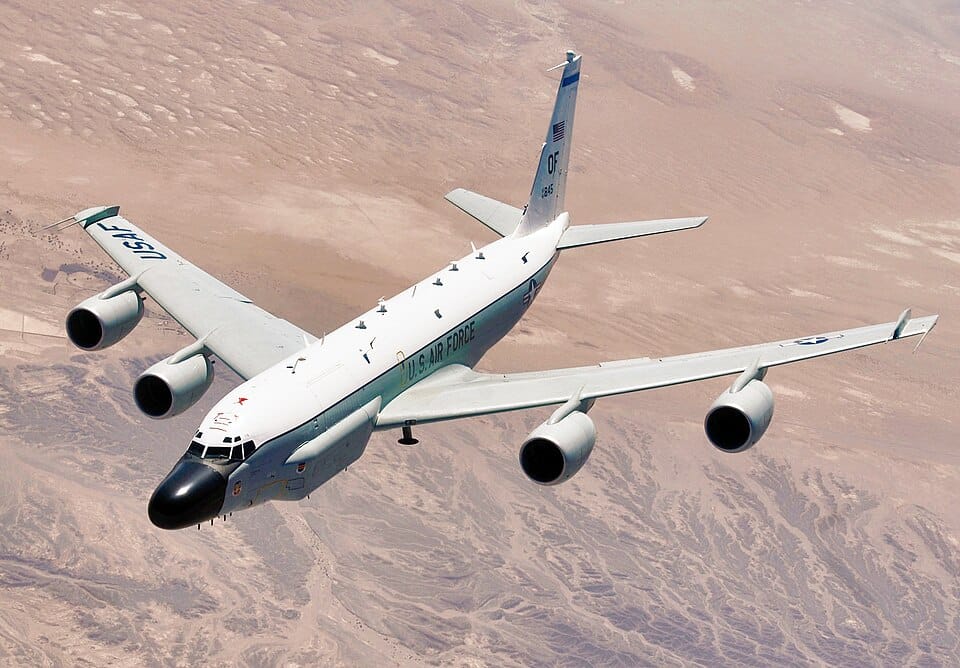
Normally, you would never know what lurks beneath the paint of America’s most capable signals intelligence aircraft. The RC-135V/W Rivet Joint looks like any other four-engine jet in Air Force grey — a modified Boeing 707 with an unremarkable silhouette. Then a photographer in Greenville, Texas, caught one with its skin exposed.
The aircraft was spotted flying over Greenville–Majors Airport with its paint completely stripped, revealing a green anticorrosion primer and something far more interesting: the sheer number of antennas, blisters, fairings, and sensor housings that dot the fuselage from nose to tail. In its clothed state, the Rivet Joint looks like a transport plane. Naked, it looks like what it is — a flying electronic intelligence laboratory.
The sighting was no accident of maintenance neglect. L3Harris Technologies operates a major depot at Greenville where Rivet Joints and other RC-135 variants undergo deep overhauls, including full airframe inspections, technology upgrades, and the inevitable strip-and-repaint that comes with every four-year maintenance cycle.
What the Stripped Skin Reveals
With the paint gone, details normally invisible to the casual observer become strikingly clear. The dorsal fuselage — the top of the aircraft from cockpit to tail — bristles with antenna arrays of varying sizes and shapes. Some are flush-mounted blade antennas for communications intercept. Others are bulged fairings housing direction-finding equipment that can triangulate the source of an electronic emission from hundreds of miles away.
The cheek fairings along the forward fuselage — the Rivet Joint’s most distinctive external feature — are clearly visible as separate structures bolted to the airframe. These house the aircraft’s primary SIGINT collection arrays, capable of hoovering up communications, radar emissions, and electronic signals across a vast swath of the electromagnetic spectrum.
In its painted state, all of this hardware blends into the aircraft’s surface. Stripped bare, the Rivet Joint reveals just how heavily modified it is compared to the commercial 707 it once was. Almost nothing about the airframe is standard anymore.

The Rivet Joint Mission
The RC-135V/W Rivet Joint is the US Air Force’s premier airborne signals intelligence platform. Operating from bases worldwide — Offutt in Nebraska, Mildenhall in the UK, Kadena in Japan, and wherever the current crisis demands — these aircraft fly along the edges of contested airspace, silently cataloguing every electronic emission they can detect.
Inside the windowless cabin, up to 30 electronic warfare officers, linguists, and intelligence analysts work at rows of consoles, monitoring and recording communications in real time. They can identify radar systems by their unique electronic signatures, geolocate transmitters, and relay intelligence directly to commanders on the ground or in the air. In a combat scenario, a Rivet Joint can tell a strike package exactly which air defence radars are active, where they are, and what frequency they operate on.
The current fleet of 17 aircraft represents the latest evolution of RC-135 variants that first entered service in the early 1960s. The airframes are old — some were built in the 1960s as KC-135 tankers before being converted — but the technology inside them is constantly updated. That’s what the four-year depot cycle at Greenville is for: tearing the aircraft down to bare metal, inspecting every rivet, and installing the latest generation of sensors and processing equipment.
A Rare Glimpse
Photographs of stripped military aircraft are unusual. Most depot-level maintenance happens behind closed hangar doors, and the Air Force is not in the habit of showcasing the sensor architecture of its most sensitive intelligence platforms. The Greenville sighting was a product of geography and timing — the aircraft had to fly between facilities, and someone with a camera was looking up at the right moment.
For aviation enthusiasts and intelligence analysts alike, the images are a rare treat: a look at the bones of an aircraft that spends its life hiding in plain sight, doing some of the most consequential work in modern warfare without ever firing a shot.
Sources: The War Zone, DEFCROS News


 English
0 Comments