
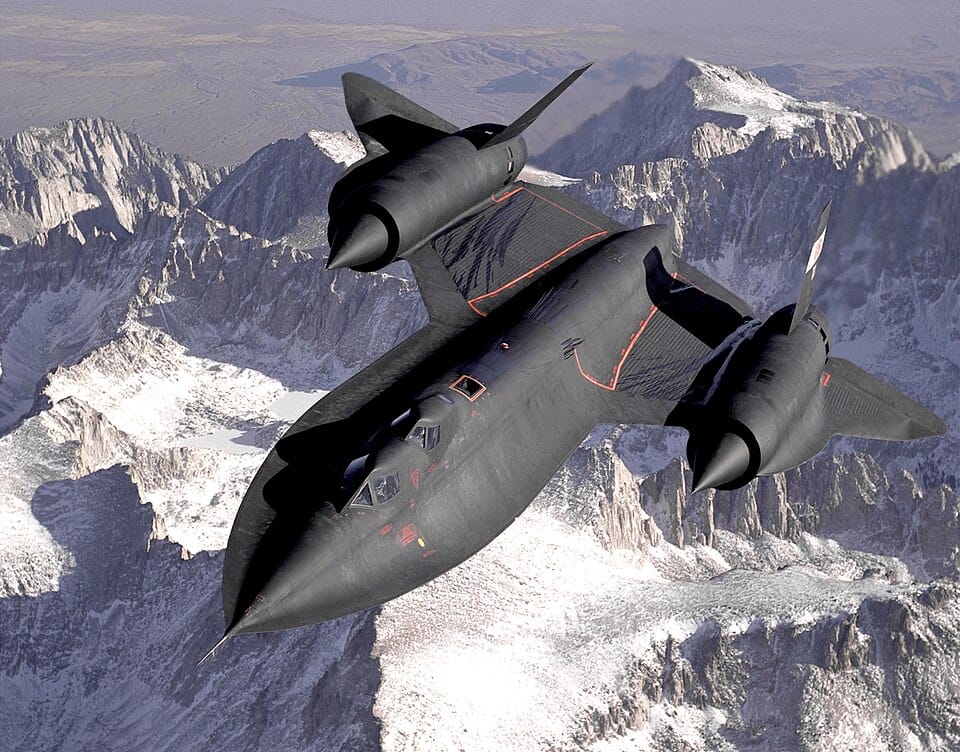
Ordered March 1967, by the U.S. Air Force
Quantity 30 pistols
Modifications Threaded 5-inch barrel, slide lock mechanism, factory-fitted sound suppressor, extra magazines
Special Feature Oxford white-dot illuminated sight, installed by Olympic gold medallist Art Cook
Purpose Survival kit for SR-71 Blackbird crews — silent defence and foraging behind enemy lines
Aircraft Lockheed SR-71A Blackbird (Mach 3.3+, ceiling 85,000 ft)

In March 1967, the United States Air Force sent an unusual order to Smith & Wesson’s factory in Springfield, Massachusetts. It wasn’t for combat sidearms. It wasn’t for military police revolvers. It was for thirty .22 calibre target pistols — each one fitted with a threaded barrel, a slide lock, and a sound suppressor. The destination: the survival kits of the most secretive aircraft in the American arsenal.
The SR-71 Blackbird flew higher and faster than anything else in the sky. At Mach 3.3 and 85,000 feet, its crews operated so deep inside hostile airspace that a bailout would put them hundreds of miles behind enemy lines — farther than any downed pilot in history. If an SR-71 crew ejected over the Soviet Union or China, they wouldn’t be picked up in minutes. They’d be alone, on foot, in denied territory, with nothing but what they carried in their flight suit and survival kit.
The Air Force decided those kits needed a very specific kind of weapon. Not a loud one. Not a powerful one. A quiet one.
A Target Pistol Goes to War
The Smith & Wesson Model 41 is, in civilian life, a competition pistol. It’s a semi-automatic .22 Long Rifle — accurate, reliable, beautifully made, and about as far from a combat weapon as you can get. The .22 LR round is what you teach kids to shoot with. It’s what farmers use on raccoons. In a military context, it is almost comically underpowered.
But that was precisely the point. The Air Force didn’t want their Blackbird crews fighting their way out. They wanted them surviving quietly. A suppressed .22 is nearly silent. It can take small game for food without announcing your position to search parties. And in a last-resort defensive scenario, a quiet pistol at close range beats no pistol at all.
The thirty Model 41s were factory-modified with 5-inch threaded barrels designed to accept a purpose-built suppressor — what Smith & Wesson delicately called a “sound depressor” in the paperwork. Each pistol came with a slide lock mechanism that held the action closed during firing, eliminating the metallic clack of the slide cycling and making the gun even quieter. Extra magazines were included in the survival kit.

The Olympic Touch
The modifications didn’t stop at the barrel and suppressor. Each of the thirty pistols received a factory-fitted Oxford white-dot illuminated sight — a cutting-edge precision optic for 1967. The sights were installed by Art Cook, an Olympic gold medallist in shooting who worked under contract with Smith & Wesson on military precision modifications. When your pistol is your last line of defence behind the Iron Curtain, you want the sight picture to be perfect, even in low light.
These weren’t mass-produced military sidearms. They were hand-fitted, individually tuned instruments. The irony is striking: a competition pistol, modified by an Olympic champion, packed into the survival kit of the fastest airplane on Earth — just in case the pilot who was photographing Soviet missile sites at 85,000 feet suddenly found himself on the ground with a 200-mile walk to friendly territory.
The Model 41 wasn’t the only sidearm associated with the SR-71 programme. Some sources indicate that Blackbird survival kits also contained either an Air Force version of the Smith & Wesson Model 12 or a Colt Aircrewman — both lightweight aluminium revolvers chambered in .38 Special, offering substantially more stopping power than the little .22. The Model 41, however, was the quiet option. The one you used when you didn’t want anyone to hear.

Deeper Behind the Lines Than Anyone
The survival planning for SR-71 crews reflected a sobering reality. At operational speed, the Blackbird covered a mile every 1.6 seconds. An engine failure or missile hit at Mach 3 wouldn’t leave the crew anywhere near friendly forces. They’d be deep in the USSR, deep in China, deep in North Korea — wherever the mission profile had taken them. Standard CSAR (Combat Search and Rescue) assets couldn’t reach them. Helicopter rescue was out of the question. These pilots were on their own.
That’s why every detail of the survival kit mattered. The food rations, the water purification tablets, the signal mirror, the first-aid kit — and the suppressed pistol. Each item was chosen for a scenario no pilot wanted to think about: days, possibly weeks, evading capture on foot in enemy territory.
No SR-71 crew ever had to use the Model 41 in anger. The Blackbird was never shot down — not by missiles, not by interceptors, not by anything. In over 3,500 missions during its 34-year career, the aircraft’s best defence was always the same: outrun everything. But the thirty suppressed pistols sitting in those survival kits tell a story about what the Air Force thought could happen, and how seriously they prepared for the worst.
Today, the surviving Model 41 “Pilot Survival Pistols” are among the rarest and most sought-after Smith & Wesson collectibles in existence. Only thirty were ever made. Most are in private collections or museums. Each one is a small, elegant reminder that the fastest airplane ever built needed a very slow, very quiet backup plan.
Sources: The War Zone, Smith & Wesson historical records, The Armory Life, LSB Auctions


 English
0 Comments