
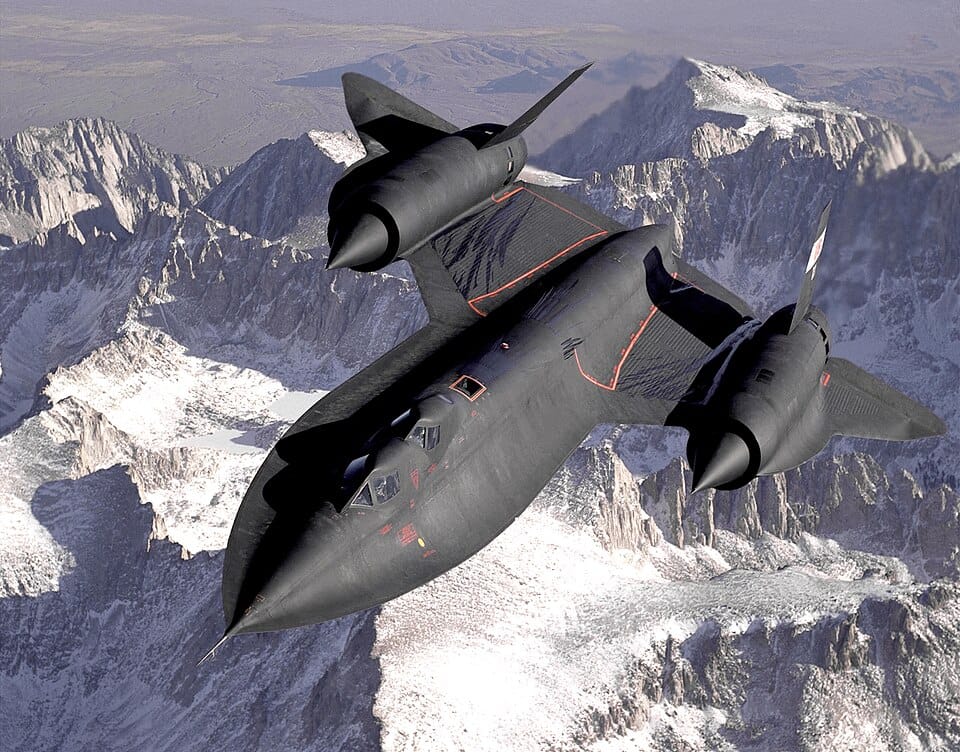
Aircraft Lockheed SR-71A Blackbird (tail number 61-7972)
Record Los Angeles to Washington, D.C. in 64 minutes 20 seconds
Date March 6, 1990 (final operational flight)
Distance 2,299 miles (3,701 km)
Average Speed 2,145 mph (Mach 3.2+)
Crew Lt. Col. Ed Yeilding (pilot) and Lt. Col. Joseph Vida (RSO)
Altitude 80,000+ feet (24,384 m)
Record Status Still unbroken after 36 years

On March 6, 1990, an SR-71 Blackbird took off from a runway in California for the last time. The crew had orders to fly to Washington, D.C., where the aircraft would be delivered to the Smithsonian’s National Air and Space Museum. They decided to make the delivery memorable. Sixty-four minutes and twenty seconds later, they were on the ground at Dulles Airport — having crossed the entire continental United States at an average speed of Mach 3.2.
That record stands today. No aircraft has matched it. No aircraft is likely to match it anytime soon. In 36 years of aerospace advancement — stealth technology, unmanned systems, hypersonic research — nothing built since has been able to cruise faster for longer than a machine designed with slide rules in the early 1960s.
The SR-71 wasn’t just fast. It was impossibly, absurdly, physics-defyingly fast. And on its final flight, it proved it one last time.
The Retirement Flight
Lieutenant Colonel Ed Yeilding and his reconnaissance systems officer, Lieutenant Colonel Joseph Vida, knew this was the end. The SR-71 programme was being shut down — a casualty of post-Cold War budget cuts and the rise of satellite reconnaissance. Their aircraft, tail number 61-7972, was headed to a museum. But first, it was going to set four speed records in a single flight.
They took off from Palmdale, California, refuelled from a KC-135Q tanker, and accelerated. The first record fell over the West Coast: Los Angeles to Washington, D.C. in 64 minutes 20 seconds. Then the splits: St. Louis to Cincinnati in 8 minutes 32 seconds. Kansas City to Washington in 25 minutes 59 seconds. Each segment was a standalone record. Each has endured.
At Mach 3.2, the aircraft’s titanium skin heated to over 600°F. The cockpit windows, made of quartz, glowed warm to the touch. Fuel sloshed in tanks that were intentionally built loose — they leaked on the ground but sealed tight as the airframe expanded in flight. At 80,000 feet, the crew could see the curvature of the Earth. The sky above them was deep blue, almost black. Commercial aircraft floated 40,000 feet below like specks.
Built for Speed, Sustained by Genius
The SR-71 was conceived at Lockheed’s legendary Skunk Works under the direction of Clarence “Kelly” Johnson, the most brilliant aircraft designer of the 20th century. The challenge was unprecedented: build a manned aircraft that can fly at Mach 3+ for hours, at altitudes above 80,000 feet, while surviving surface-to-air missiles and interceptors. Nothing in existence could do any one of these things, let alone all of them simultaneously.
Johnson’s solutions were radical. The airframe was built primarily from titanium — an exotic material so difficult to work with that Lockheed had to invent new manufacturing techniques to shape it. The engines, Pratt & Whitney J58s, were a hybrid design that functioned as turbojets at low speed and ramjets at Mach 3+ — the first and only engines ever to sustain continuous supersonic cruise by transitioning between two propulsion modes in flight.
The fuel itself was special. JP-7, a custom formulation with a flash point so high it could barely be ignited with a match, was necessary because standard jet fuel would have exploded in tanks that reached hundreds of degrees during sustained Mach 3 flight. To start the engines, a separate chemical ignition system injected triethylborane (TEB) — a compound so volatile it ignites spontaneously on contact with air. Each engine carried only 16 TEB shots. Once they were gone, the engine couldn’t be restarted in flight.
Why Nobody Has Matched It
Hypersonic research vehicles like NASA’s X-43 and X-51 have briefly exceeded Mach 5 — but for seconds, not hours. Scramjet technology can go faster than the SR-71, but it can’t sustain it. The Blackbird’s defining achievement wasn’t reaching Mach 3.2. It was staying there, controllably, for hours at a time, with a human crew, while conducting reconnaissance missions.
The economics killed it, not the technology. Each SR-71 cost roughly $34 million in 1960s dollars — over $300 million in today’s money. Operating costs were enormous: specialised fuel, dedicated tankers, custom maintenance facilities, and a support footprint that dwarfed the aircraft itself. Spy satellites could cover the same targets without the cost, the risk, or the diplomatic complications of overflying sovereign airspace.
But satellites can’t surprise anyone. An SR-71 could be over a target in hours from the moment a president picked up the phone. That responsiveness, that terrifying speed, has never been replicated. Thirty-six years after Ed Yeilding and Joseph Vida delivered their Blackbird to the Smithsonian, their coast-to-coast record still stands — a monument to what happens when engineering ambition meets unlimited Cold War funding and a total disregard for what’s supposed to be possible.
Sources: Lockheed Martin, Smithsonian National Air and Space Museum, “Skunk Works” by Ben Rich, NASA Dryden Flight Research Center
 English
0 Comments