
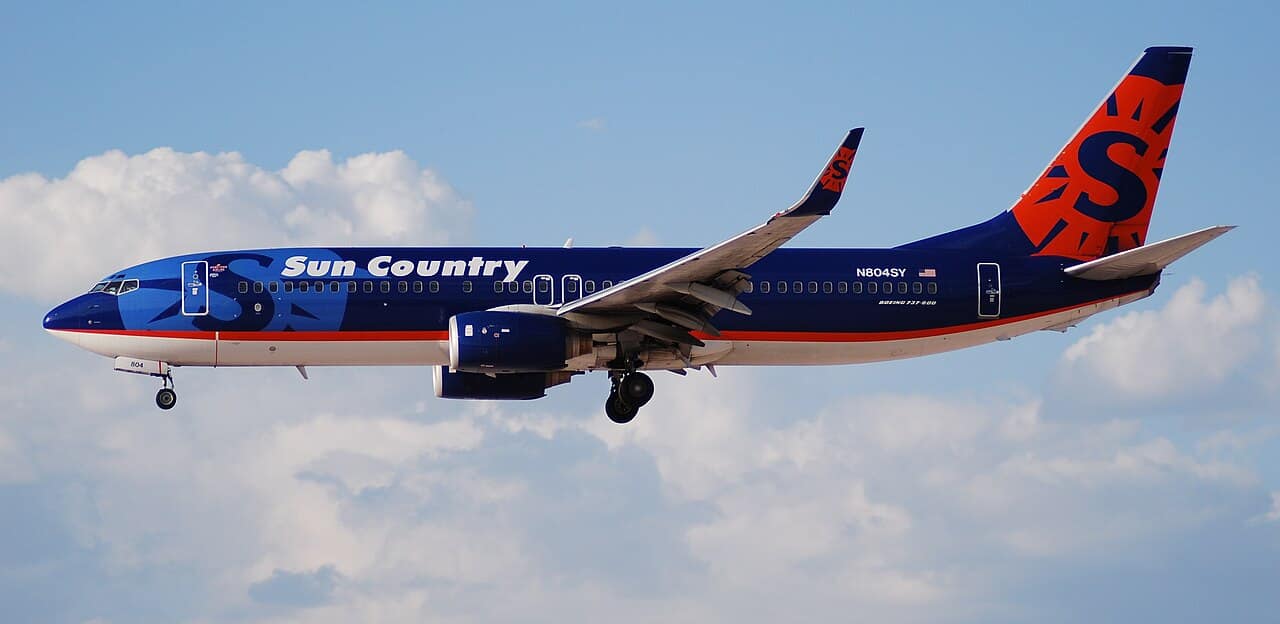
Sun Country Airlines never expected to become an airline-industry case study. Founded in 1982 by laid-off Braniff pilots, it spent thirty years quietly running ski charters out of Minneapolis–Saint Paul, Las Vegas package tours, and the occasional NCAA bowl-game ferry flight. The aircraft were ageing 727s and DC-10s. The whole operation felt — and looked — like a flying Holiday Inn.
This week Sun Country unveiled a Boeing 737-800 (registration N826SY) in a retro scheme inspired by its 1994 livery: sweeping red-and-orange nineties stripes, a throwback Sun Country look, and the airline's current compass logo on the tail. The jet celebrates the carrier's 43-year story and is dedicated to co-founder and first president Jim Olsen, who died in April 2026. AvGeek social media lit up immediately. Sometimes a paint job is the whole story.
| Airline | Sun Country Airlines (SY) |
| Aircraft | Boeing 737-800 (single aircraft) |
| Livery | Retro scheme inspired by the 1994 red-orange-and-white design, with the current compass tail logo |
| Unveiled | 12 May 2026, Minneapolis–Saint Paul (MSP) — Boeing 737-800 N826SY |
| Sun Country today | Hybrid charter/scheduled/cargo carrier operating ≈ 60 Boeing 737s |
| Cargo customer | Amazon Air (since 2020) |
A second life as Amazon's favourite airline
Sun Country very nearly went away. The airline suspended operations and went into Chapter 11 bankruptcy in the aftermath of 9/11, in December 2001, and filed again in October 2008 when its then-owner, Petters Group, collapsed in a fraud scandal. Each time it emerged a smaller carrier. Private equity firm Apollo Global Management acquired it in late 2017, simplified the business model, and pivoted the airline's overnight aircraft utilisation into something nobody had tried before: a dedicated cargo operation for Amazon Air, under which Sun Country crews fly Boeing 737-800BCF freighter conversions for Amazon's rapid-delivery network.
The result is one of the most distinctive aircraft utilisation patterns in U.S. commercial aviation. Sun Country flies its passenger Boeing 737s on scheduled leisure services, operates a separate sub-fleet of 737 freighters for Amazon cargo, and layers charter flying on top wherever capacity allows. The airline's aircraft sit on the ground less than almost any other U.S. carrier — and the operating cost is amortised across three distinct revenue streams.
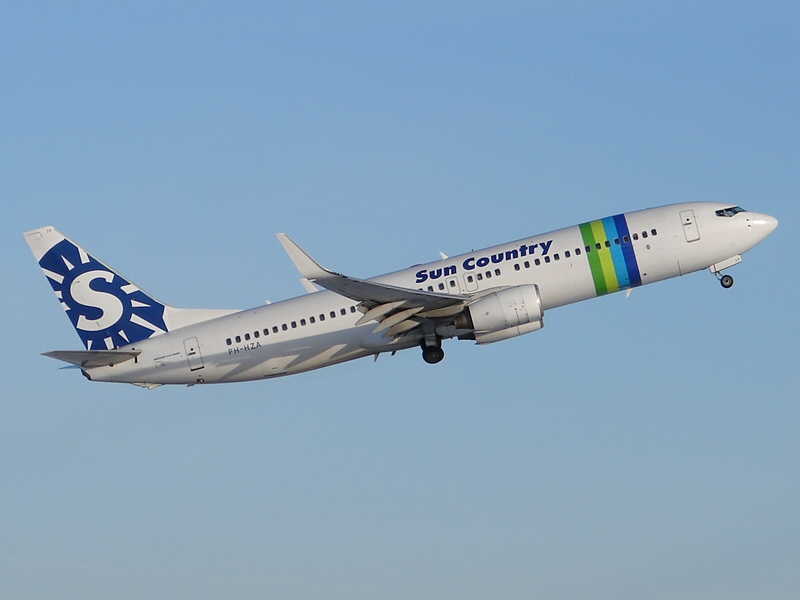
Why the retro livery matters
Heritage liveries are one of the most reliable marketing investments any commercial airline can make. Lufthansa has flown a 747-8 in its 1950s-style retro crane scheme, and American Airlines maintains a whole family of heritage jets — from the polished-metal "Astrojet" look to the liveries of merged carriers such as TWA and US Airways. The attention these aircraft draw routinely outstrips what the cost of a paint job could buy in conventional advertising.
Sun Country is much smaller than any of those carriers, but the calculus is the same. A retro livery costs roughly the same as a regular re-paint at the C-check interval — perhaps $250,000 — and it generates social-media reach that is, for an airline of Sun Country's scale, essentially impossible to buy through conventional means. For a carrier that has just reinvented itself as a hybrid passenger/cargo operator and is trying to claim mind-share with leisure passengers, the timing is shrewd.
A nineties throwback
The 1994 design is loud in the way only mid-1990s commercial design can be: sweeping red-and-orange stripes running along the fuselage and a logotype that places the airline firmly in the charter-holiday era it came from. It is exactly the kind of design that ages first into kitsch and then into iconic. Three decades later, the red-and-orange is a visual signature that nobody else can claim. That is precisely why the airline brought it back.
The repainted aircraft will fly Sun Country's normal scheduled route network out of Minneapolis–Saint Paul through 2026. It will not be hidden in a hangar for special occasions. The airline wants the retro stripes visible at every leisure airport it serves, from Anchorage to Cancún. If you have a window seat at a U.S. domestic gate this summer, this is the aircraft you want to spot.
Sources: Scramble, AeroTime, Simple Flying.
Related Questions
What is Sun Country Airlines?
Sun Country Airlines (SY) is a US carrier based at Minneapolis-Saint Paul, founded in 1982 by laid-off Braniff pilots. For decades it ran ski charters, Las Vegas package tours and sports-team ferry flights before evolving into a hybrid low-cost passenger and cargo operator flying the Boeing 737.
What is Sun Country's retro livery?
Sun Country unveiled a Boeing 737-800 (registration N826SY) painted in a retro scheme inspired by its 1994 design — sweeping red-and-orange nineties stripes paired with the airline's current compass tail logo. The jet celebrates the carrier's 43-year history and honours co-founder and first president Jim Olsen, who died in April 2026.
Why do airlines paint retro or heritage liveries?
Airlines use retro liveries to mark anniversaries, build goodwill and generate free publicity, since AvGeeks and media share heritage jets widely. A single nostalgic paint job tells a brand's story instantly — much like Lufthansa putting a 1950s Super Star design on a modern A321.
Who founded Sun Country Airlines?
Sun Country was founded in 1982 by a group of pilots laid off from Braniff International. Its first president, Jim Olsen, was among the co-founders; the airline's 2026 retro 737 was dedicated to him following his death in April 2026. The carrier has been based in Minnesota throughout its history.
What aircraft does Sun Country fly?
Sun Country today operates a fleet built around the Boeing 737-800, used for both scheduled passenger flights and cargo work. In its early decades the airline flew older types such as the Boeing 727 and the McDonnell Douglas DC-10 on charter and package-tour routes.
0 Comments