
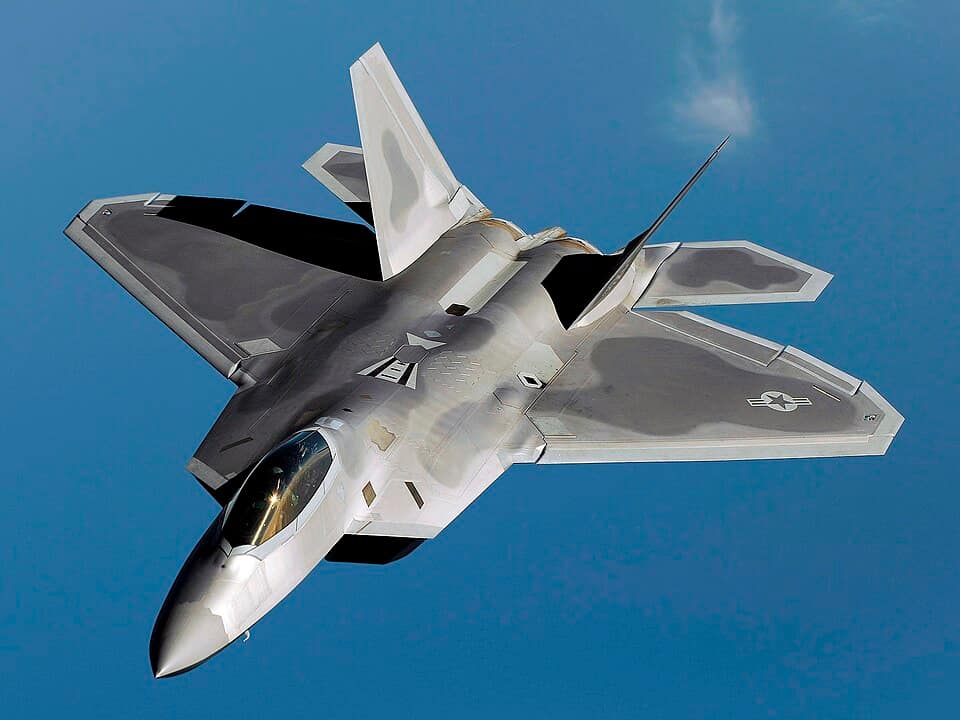
| Quick Facts: Supercruise | |
|---|---|
| Definition | Sustained supersonic flight without afterburner |
| First Operational Fighter | F-22 Raptor (2005) |
| Supercruise Speed | Mach 1.5+ (approx. 1,000 mph / 1,600 km/h) |
| Engine | 2x Pratt & Whitney F119-PW-100 |
| Thrust (each, dry) | ~26,000 lb (est.) |
| Fuel Savings vs. Afterburner | Up to 40% less fuel burn at supersonic speeds |

Most fighters can break the sound barrier. Flip the afterburner switch, dump raw fuel into the exhaust, and the jet surges past Mach 1 in a blaze of orange flame. But there is a catch: afterburners devour fuel at roughly three times the normal rate. A supersonic dash becomes exactly that — a sprint with a timer on it.
The F-22 Raptor plays a different game entirely. Its two Pratt & Whitney F119 engines push the jet past Mach 1.5 on dry thrust alone — no afterburner, no fuel penalty, no time limit. Lockheed Martin calls it supercruise. It is the single most underappreciated advantage in modern air combat.
Where every other fighter must choose between speed and range, the Raptor gets both. It can cross a battlefield supersonic, arrive before the enemy expects it, and still have enough fuel to fight and come home. That changes everything.
What Supercruise Actually Means
The term is precise. Supercruise is sustained supersonic flight without the use of afterburner. Any jet can briefly exceed Mach 1 by lighting its afterburner — the F-15, F-16, Eurofighter, and Su-35 all do it daily. But the moment they shut off the afterburner, drag pulls them back below the sound barrier. They cannot sustain it.
Supercruise requires an engine with enough baseline thrust to overcome transonic drag without the brute-force boost of reheat. That means a fundamentally different powerplant — not just a bigger afterburner bolted onto an old design. The F119 was built from scratch for this purpose, and it remains the gold standard.
The Eurofighter Typhoon can sustain brief periods above Mach 1 without afterburner under certain conditions — clean configuration, light fuel load, high altitude. But pilots and engineers draw a clear line between that partial capability and the F-22, which supercruises as a matter of routine at combat weight with a full weapons bay.

The Engine That Changed the Equation
The Pratt & Whitney F119-PW-100 is the most powerful fighter engine ever fitted to a production aircraft. Each unit produces an estimated 26,000 pounds of dry thrust and over 35,000 with afterburner. The exact figures remain classified, but what matters is the ratio: the F119 generates extraordinary power before the afterburner even lights.
That dry thrust, combined with the F-22 airframe design — low drag, carefully shaped for minimal supersonic wave resistance — pushes the jet past Mach 1.5 in military power. Some pilots have hinted the actual supercruise speed is higher, but the Air Force keeps the precise number under wraps.
The engineering achievement is staggering. During the Advanced Tactical Fighter competition in the late 1980s, both Lockheed and Northrop were required to demonstrate supercruise. Lockheed paired the YF-22 with the F119; Northrop flew the YF-23 with both the F119 and General Electric YF120. The YF-23 was arguably faster — some estimates place its supercruise above Mach 1.6 — but Lockheed won the contract on overall capability. The F119, however, was the clear winner either way.
Why It Matters in Combat
Speed is energy. Energy is options. A fighter arriving at Mach 1.5 has dramatically more kinetic energy than one arriving at Mach 0.9. That translates directly into missile range — a missile launched from a supercruising F-22 inherits the launch platform speed, extending its effective range by dozens of miles compared to the same missile fired from a subsonic jet.
It also compresses the enemy decision loop. If your radar picks up an inbound fighter at 600 knots, you have a certain number of seconds to react. If that same fighter is closing at 900+ knots — and you cannot see it on radar because it is also stealthy — those seconds evaporate. The F-22 combines supercruise with the lowest radar cross-section of any fighter in service. The combination is devastating.
Then there is the fuel math. An F-15 lighting its afterburner to dash supersonic burns through fuel at a terrifying rate. It might sustain Mach 1.2 for a few minutes before it must throttle back or head home. The F-22, supercruising at Mach 1.5, burns roughly the same fuel per hour as a conventional fighter at subsonic military power. It can stay fast indefinitely.

Before the Raptor: Concorde and the SR-71
The F-22 was not the first aircraft to cruise supersonically. Concorde sustained Mach 2.04 across the Atlantic for 27 years, though it relied on afterburners (called reheat in British parlance) during the transonic acceleration phase. The SR-71 Blackbird cruised at Mach 3.2, but its J58 engines operated as ramjets at speed — a fundamentally different propulsion concept.
What makes the F-22 unique is doing it in a fighter-sized package, at fighter altitudes, with a full combat load, while remaining stealthy. Concorde was a 185-foot airliner with a massive radar signature. The SR-71 was unarmed and flew above 80,000 feet to avoid threats. The Raptor operates in the thick of contested airspace and fights while supercruising.
Who Else Can Do It?
The honest answer: almost nobody, at least not to the same standard. The Eurofighter Typhoon can sustain low-supersonic speeds in clean configuration. The Dassault Rafale has demonstrated brief supercruise under ideal conditions. The Saab Gripen E may have limited supercruise capability with its GE F414 engine.
Russia and China both claim supercruise for their fifth-generation programs. The Su-57 with its planned Izdeliye 30 engine is designed for it, though the current AL-41F1 interim engines likely fall short. China claims the J-20 can supercruise with its WS-15 engine, but that powerplant has faced years of development delays.
The F-35 Lightning II — the F-22 stablemate — cannot supercruise. Its single F135 engine is the most powerful fighter engine ever built by raw thrust, but the aircraft drag profile and single-engine configuration do not allow sustained supersonic flight without afterburner. This was a deliberate trade-off: the F-35 prioritized sensor fusion, range, and affordability over outright speed.
The Advantage Nobody Talks About
Supercruise does not make headlines the way stealth does. There are no dramatic photos of it — a supercruising F-22 looks exactly like a subsonic one. No visible flame, no shock diamonds, no vapor cone. It is an invisible advantage, which may be why it gets overlooked in public discussions of air superiority.
But fighter pilots do not overlook it. In exercises, Raptor drivers routinely describe the ability to dictate the terms of every engagement — to choose when to close, when to extend, and when to disengage, all while maintaining speeds that other fighters can only reach in short, fuel-guzzling bursts. Speed is the oldest advantage in air combat. The F-22 simply made it sustainable.
Sources: U.S. Air Force, Lockheed Martin, Pratt & Whitney, Air & Space Forces Magazine
 English
0 Comments