
| Quick Facts | |
|---|---|
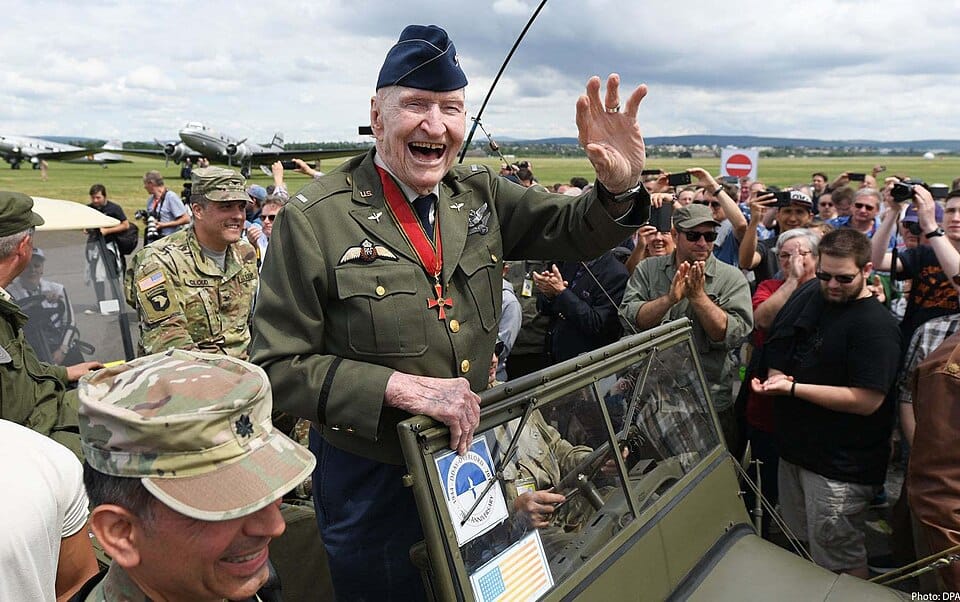
| Pilot | 1st Lt. Gail S. Halvorsen, USAF |
| Operation | Berlin Airlift (Operation Vittles), 1948–1949 |
| Aircraft | Douglas C-54 Skymaster |
| Nickname | “Candy Bomber” / “Uncle Wiggly Wings” / “Rosinenbomber” (Raisin Bomber) |
| What He Did | Dropped candy on tiny handkerchief parachutes to Berlin’s children |
| Airlift Duration | June 26, 1948 – September 30, 1949 (462 days) |
| Total Flights | Over 277,000 flights into West Berlin |
| Cargo Delivered | 2.3 million tons of food, coal and supplies |

He had two sticks of Wrigley’s gum in his pocket. That’s all it took to start one of the most human stories in aviation history. Two sticks of gum, a crowd of children behind a fence at Tempelhof Airport, and a 27-year-old American pilot who couldn’t stand to see kids with nothing.
It was July 1948. Berlin was under siege. The Soviet Union had cut every road, railway and waterway into the western sectors of the city, starving two million people into submission. The only way in was by air — and the only thing standing between West Berlin and Soviet control was a continuous stream of cargo aircraft flying coal, flour and medicine through three narrow air corridors, 24 hours a day, seven days a week.
First Lieutenant Gail Halvorsen was one of hundreds of pilots flying that lifeline. He was about to become the most famous one — not for what he carried in his hold, but for what he dropped from his cockpit window.
Two Sticks of Gum
Halvorsen had walked to the edge of Tempelhof’s perimeter fence with a hand-held movie camera, hoping to film the landings. A group of about 30 children stood on the other side, watching the C-54 Skymasters thunder in every few minutes. They didn’t beg. They didn’t push through the fence. They just watched.
He talked with them. They spoke a little English. They told him they knew the coal and flour were keeping them alive. They were grateful. They didn’t ask for anything. That’s what struck Halvorsen hardest — children in a city slowly starving, and they didn’t ask for a single thing.
He reached into his pocket and broke two sticks of Doublemint gum in half. Four pieces for 30 children. The ones who got a piece held it like treasure. The ones who didn’t tore the wrappers into strips and passed them around so everyone could smell it. He watched them press the foil to their noses and inhale, and something shifted in him that never shifted back.
He told the children to come back tomorrow. He’d drop candy from his aircraft. They’d know it was him because he’d wiggle his wings.
Operation Little Vittles
That night, Halvorsen and his crew tied candy bars and packets of gum to handkerchief parachutes. The next day, on approach to Tempelhof, he rocked the wings of his C-54 and dropped the tiny bundles out of the flare chute in the cockpit. Below, the children scrambled and cheered. He could see them from the air.
He did it again the next day. And the day after that. The crowd of children grew. Letters began arriving at Tempelhof addressed to “Uncle Wiggly Wings” and “The Chocolate Flier” — children who didn’t know his name but knew his aircraft by the waggle of its wings.

Halvorsen hadn’t told his commanding officer. He was operating on impulse and handkerchiefs. When his squadron commander, Colonel James R. Grubb, eventually found out — partly because the operation had been noticed by the press — Halvorsen expected to be grounded. Instead, Grubb told him to keep going and expand it.
What started as one pilot’s two sticks of gum became Operation Little Vittles — an officially sanctioned programme that ultimately dropped over 23 tons of candy into West Berlin. Confectionery companies across America donated chocolate and gum by the crate. Schoolchildren across the United States made parachutes and sent them to the airlift bases. The tiny silk and handkerchief canopies floated down over a city under siege, carrying something no C-54 cargo manifest could quantify: hope.
The Airlift That Defied Stalin
The Berlin Airlift was the first great confrontation of the Cold War — and the first time air power was used not to destroy, but to sustain. Over 462 days, Allied aircraft flew more than 277,000 flights into West Berlin, delivering 2.3 million tons of cargo. At its peak, a transport aircraft was landing at Tempelhof every 30 seconds. The logistics were unprecedented. The flying was relentless. The weather was terrible — Berlin’s winters brought fog, ice and crosswinds that turned every approach into a test of skill.
Seventy-eight people died during the airlift — mostly in aircraft accidents caused by the brutal pace and conditions. They are among the least remembered casualties of the Cold War, pilots and crew who died delivering coal to a city they’d been bombing three years earlier.
The Soviets eventually lifted the blockade in May 1949, having calculated — correctly — that they could not starve West Berlin into surrender while American, British and French aircraft kept the city alive from the air. The airlift continued until September to build a safety stockpile, then wound down. It had proven that air power could feed a city of two million people indefinitely. No one had thought that was possible.
A Legacy of Handkerchief Parachutes
Gail Halvorsen became the most famous pilot of the airlift — more famous than the generals who planned it or the logistics officers who made it work. His story resonated because it was human-scale in the middle of something geopolitical. The airlift was about geostrategy and containment doctrine. The candy drops were about a man who couldn’t walk past hungry children.
Halvorsen continued to serve in the Air Force for decades, retiring as a colonel. He returned to Berlin repeatedly, greeted by adults who had been the children at the fence. The Germans gave him a name that stuck: Rosinenbomber — the Raisin Bomber. Streets were named after him. Schools invited him. He became a living symbol of the idea that military power could be wielded with compassion.
He passed away in February 2022 at the age of 101 — the last link to a moment when two sticks of gum changed how a city saw an occupying air force, and how that air force saw itself.
Sources: U.S. Air Force Historical Research Agency, Berlin Airlift Historical Foundation
 English
0 Comments