
| Quick Facts | |
|---|---|
| Invention | The rocket-powered ejection seat |
| Lives Saved | Over 12,000 worldwide (all manufacturers combined) |
| First Use (Combat) | January 1945 — Luftwaffe pilot in a Heinkel He 162 |
| Leading Manufacturer | Martin-Baker (UK) — 7,700+ lives saved, seats in 93 air forces |
| Ejection Speed | 0 to 200 ft in under 1 second |
| G-Force on Pilot | 14–20 G during ejection |
| Zero-Zero Capability | Modern seats can save a pilot at zero altitude and zero airspeed |

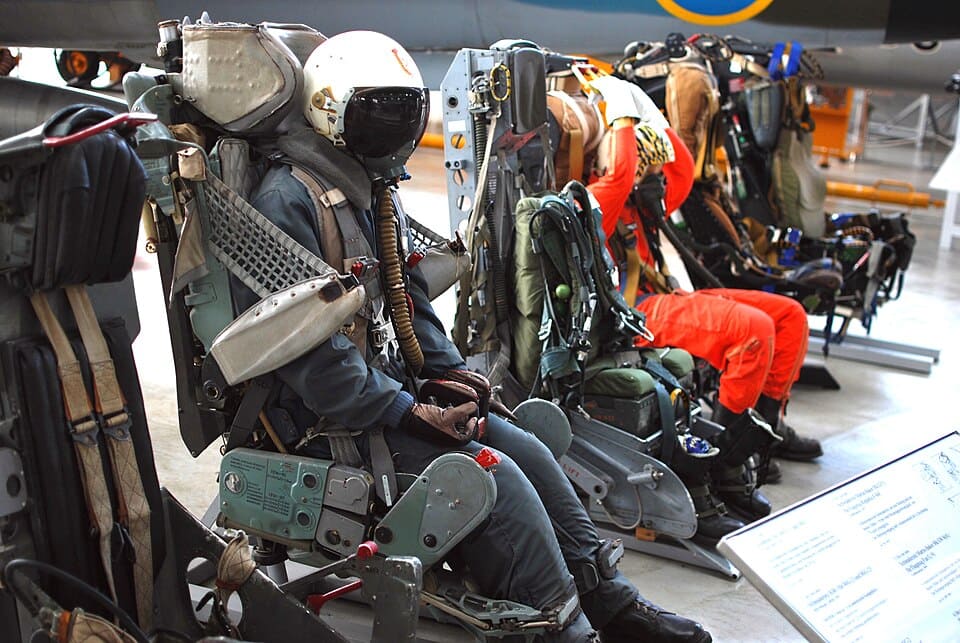
Pull the handle. In one-tenth of a second, the canopy blows off. A fraction later, a rocket motor ignites beneath the seat and accelerates the pilot upward at 14 to 20 times the force of gravity. Within one second, the pilot is 200 feet above the aircraft, tumbling, decelerating, and — if everything works — alive.
The ejection seat is the most violent life-saving device ever built. It routinely breaks vertebrae, compresses spines, and leaves pilots with injuries that end careers. And every pilot who has ever pulled that handle will tell you the same thing: it was the best decision they ever made.
Over 12,000 aircrew have been saved by ejection seats since the technology was first used in combat in 1945. That number grows by dozens every year. No single invention in military aviation history has saved more lives.
Born From Desperation
Early in World War II, bailing out of a crippled fighter meant climbing out of the cockpit and jumping into the slipstream — a process that took several seconds and became nearly impossible at the speeds jet aircraft were approaching. As planes got faster, the old method of simply climbing out became a death sentence. The wind blast at 400 mph could snap a limb or slam a pilot into the tail.
Germany got there first. In January 1945, a Luftwaffe pilot ejected from a Heinkel He 162 Volksjager using a compressed-air powered seat — the first known combat ejection. The technology was crude: a cartridge fired, the seat shot up a rail, and the pilot separated at the top of the arc. It worked, barely.
After the war, Sweden, Britain, and the United States all began developing their own systems. But it was a small British company, Martin-Baker, that would come to dominate the field — and change the equation between aircraft loss and crew survival forever.

Martin-Baker: The Company That Counts Every Life
Sir James Martin founded Martin-Baker Aircraft in the 1930s. After his business partner and close friend Captain Valentine Baker was killed in a crash, Martin became obsessed with crew escape systems. He devoted the rest of his career to building seats that could get pilots out alive.
The first live test of a Martin-Baker seat took place on July 24, 1946, when Bernard Lynch was shot out of a modified Gloster Meteor at several hundred feet. It worked. Lynch survived. Martin-Baker never looked back.
Today, Martin-Baker seats equip fighters in 93 air forces worldwide, including every Western frontline jet from the F-35 to the Eurofighter Typhoon. The company maintains a meticulous record of every life saved — over 7,700 and counting — and issues each surviving pilot a special tie and lifetime membership in the Ejection Tie Club. It is the only club in the world where the price of admission is nearly dying.
How It Works
A modern ejection seat is not just a chair with a rocket. It is a fully autonomous escape system that must work in conditions ranging from zero altitude and zero airspeed (a parked aircraft) to Mach 2 at 50,000 feet. The sequence, once initiated, runs entirely on its own.
The pilot pulls a handle between their legs. The canopy jettisons or shatters. A rocket motor fires, propelling seat and pilot clear of the aircraft. A drogue parachute deploys to stabilise the seat and prevent tumbling. Sensors measure altitude and airspeed. At the right moment, the seat releases the pilot, and the main parachute opens. A survival kit, oxygen bottle, and emergency beacon descend with the pilot. The entire sequence from handle-pull to parachute deployment takes about two to three seconds.

The Price of Survival
Ejection saves your life. It does not save your spine. The forces involved — 14 to 20 G sustained over a fraction of a second — routinely cause compression fractures of the vertebrae. Many ejection survivors never fly again. Some walk with a limp for the rest of their lives. The trade-off is simple and brutal: a compressed spine or a coffin.
Modern seats have reduced injury rates significantly through better rocket motors, smarter sequencing, and seats that adjust to the pilot’s weight. But the fundamental violence of the event cannot be eliminated. You are being shot out of a machine at 200 feet per second. Physics demands a price.
Twelve thousand pilots have paid that price and lived. The alternative was paying a much higher one. That is the ejection seat’s legacy: the most violent act of mercy in aviation.
Sources: Martin-Baker, RAF Museum, National Air and Space Museum, Aviation History
 English
0 Comments