The Grumman F11F-1 Tiger — the aircraft type that made aviation history by shooting itself down. (U.S. Navy photo, public domain)
On a late September afternoon in 1956, Grumman test pilot Tom Attridge pointed the nose of his F11F-1 Tiger into a shallow dive over the Atlantic, pushed the throttle into afterburner, and squeezed the trigger. Eleven seconds later, he flew into his own bullets.
It remains one of the most bizarre incidents in aviation history — the only confirmed case of a jet fighter shooting itself down with its own gunfire. No enemy. No malfunction. Just physics, speed, and spectacularly bad luck.
The Test Flight
Attridge, a 33-year-old Korean War veteran working as a test pilot for Grumman Aircraft, was conducting a routine weapons test over the ocean off Long Island, New York. The objective was straightforward: fire the Tiger’s four 20mm Colt Mk 12 cannons in a high-speed dive and record the results.
He began at 20,000 feet, nosed the Tiger into a 20-degree dive, and lit the afterburner. As the altimeter unwound past 13,000 feet, he fired a four-second burst. Three seconds of cooling. Then a second burst.
The rounds left the muzzle at roughly 3,400 feet per second — vastly faster than the aircraft. What happened next defied intuition.
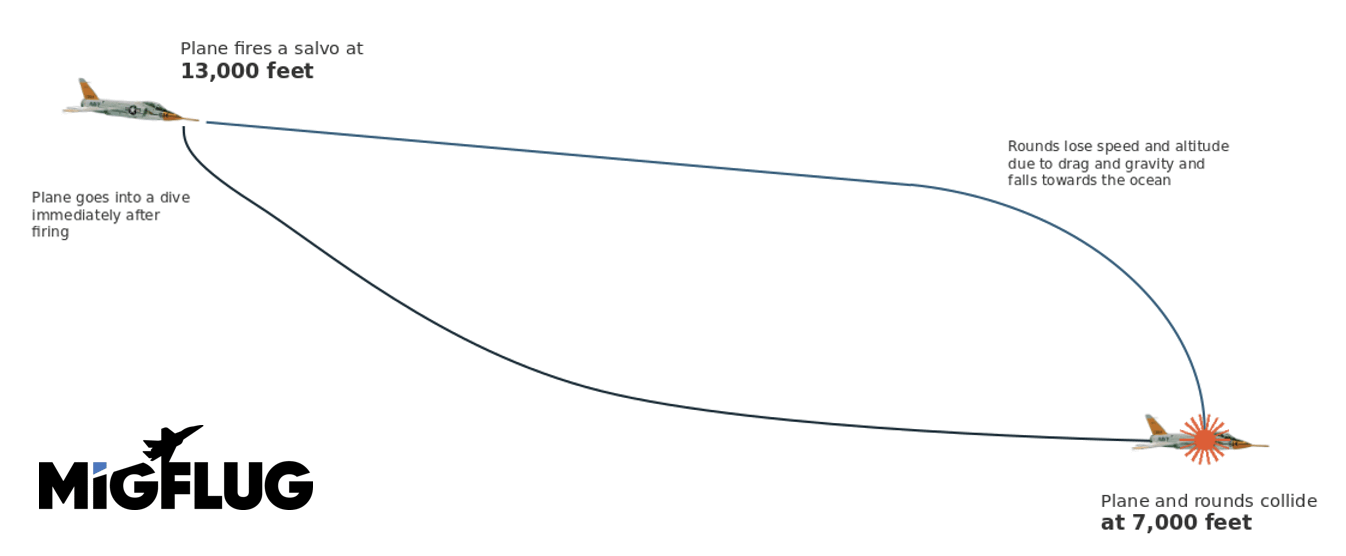
The geometry of the incident: how the Tiger descended into the path of its own 20mm rounds.
Outrunning a Bullet
As the 20mm rounds streaked ahead of the Tiger, air resistance immediately began slowing them. A bullet has no engine. Once it leaves the barrel, drag is the only force acting on it — and at altitude, drag wins quickly. The rounds decelerated from roughly 2,300 mph to around 400 mph within seconds, and their trajectory curved downward in a ballistic arc.
Meanwhile, Attridge was doing the opposite. In a steep dive with afterburner blazing, the Tiger accelerated through Mach 1 — roughly 880 mph at that altitude. The aircraft was getting faster while its bullets were getting slower.
“At the speeds we’re flying today, it could be duplicated any time.”
— Tom Attridge, after the incident
By 7,000 feet, eleven seconds after firing, the descending Tiger caught up with its own decelerating rounds. Three 20mm shells struck the aircraft — one hit the windshield, one pierced the right engine intake lip, and one buried itself in the nose cone. The engine, damaged by the ingested round, began losing power rapidly.
A NASA Schlieren photograph reveals shockwaves around a supersonic jet — the same physics that allowed the F11F Tiger to overtake its own bullets. (NASA, public domain)
The Crash Landing
With the engine producing barely 78 percent power and dropping fast, Attridge turned back toward Grumman’s runway at Calverton, Long Island. The damaged windshield meant he couldn’t push the throttle — at higher speeds, it might shatter completely.
He nursed the crippled Tiger as far as he could, but a quarter mile short of the runway, the engine gave out. The aircraft settled into a stand of trees, plowing through the canopy before coming to rest. Attridge survived, but not unscathed: he suffered a broken leg and three fractured vertebrae.
True to test pilot form, he didn’t eject. Test pilots protect their aircraft — and the data it carries — even when the airframe is trying to kill them.
The Investigation
When investigators reached the wreckage, they found the evidence embedded in the Tiger’s skin. One of the 20mm rounds was still lodged in the engine intake. Ballistic analysis confirmed what seemed impossible: the pilot had shot himself down with his own cannon.
The geometry was precise. In the shallow dive, the rounds and the aircraft followed nearly parallel paths — the bullets arcing downward under gravity while slowing, the jet accelerating into the same descending corridor. At a specific altitude and speed, the two paths converged.
Grumman engineers calculated that the convergence was not a freak event. Any fighter in a sufficiently steep, sustained, supersonic dive could theoretically catch its own rounds — a sobering realization in an era when jet speeds were climbing fast.
What Happened Next
Attridge spent six months recovering. He returned to Grumman as a project engineer and went on to work on some of the most consequential programs in aerospace — including the Lunar Module that carried Apollo astronauts to the Moon’s surface.
The F11F Tiger itself had a short but notable career. The Navy operated it from 1957 until the early 1960s, and the Blue Angels flew it as their demonstration aircraft from 1957 to 1969. Only 201 were built.
And in 1973, Attridge was proven right when a Grumman F-14 Tomcat, during a test fire of its weapons systems, was struck by its own AIM-7 Sparrow missile — a different weapon, the same physics.
Sources: Task & Purpose, Simple Flying, The Aviation Geek Club, U.S. Naval History and Heritage Command
The world’s two busiest Middle East hubs seized up in early March 2026. Dubai International, the planet’s top airport for international passengers, went from processing 200,000 travelers a day to canceling flights by the thousands. Hamad International in Doha, the...
On November 12, 1996, two aircraft occupied the same point in Indian airspace. In the seconds that followed, 349 people ceased to exist. It remains the worst midair collision in human history—a catastrophe born from language barriers, miscommunication, and a chain of...
On December 26, 2025, Turkey’s Baykar proved something crucial about the future of warfare: precision-guided munitions fired from unmanned platforms now match anything launched from manned aircraft. The Bayraktar AKINCI, a 6-ton heavy combat drone, completed live-fire...




 English
0 Comments