
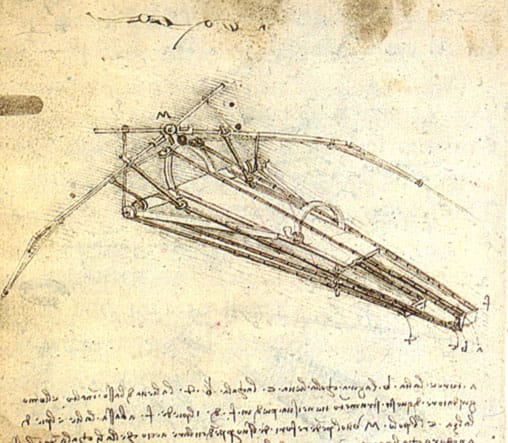
He never built it. The notebooks where he sketched it weren’t even published until 1797 — nearly three centuries after his death. But the flying machines Leonardo da Vinci drew in the late 1400s show a mind that grasped the fundamental problem of aviation 400 years before anyone else solved it.
Between roughly 1485 and 1505, Leonardo filled dozens of pages in what would become the Codex Atlanticus and Codex on the Flight of Birds with obsessive observations about flight — the mechanics of bird wings, the physics of air resistance, and detailed engineering drawings for machines he hoped would carry a human being through the sky. He got some things wrong. He got a startling number of things right.

The Man Who Watched Birds Like an Engineer
Leonardo’s approach to flight was scientific before science had a formal method. He didn’t start with the question “how do I fly?” He started with “how does a bird fly?” and spent years answering it. His notebooks show drawings of birds’ wing joints, analyses of how different feather angles affect lift, and careful observations of how birds use their tails as rudders and air brakes.
From this, he deduced the core principle: wings must push air downward to generate upward force. He understood that a curved wing surface creates more lift than a flat one — a principle that wouldn’t be formally described until the Bernoulli equation of 1738. He understood that the wing’s angle to the airflow — what we now call the angle of attack — determines whether a wing generates lift or stalls. These were not guesses. They were conclusions drawn from careful observation.
“Once you have tasted flight, you will forever walk the earth with your eyes turned skyward.”
— Attributed to Leonardo da VinciThe Ornithopter — and Why It Couldn’t Work
Leonardo’s most famous flying machine concept was the ornithopter — a device with flapping wings, modelled on bird flight. His designs show a pilot lying prone on a wooden frame, operating the wings through a combination of arm cranks and foot pedals. The wings were constructed from pine frames covered with starched taffeta, the lightweight fabric of the time.
It wouldn’t have worked. Not because the concept was wrong — ornithopters do fly, and working models have been built — but because a human being doesn’t have the power-to-weight ratio needed to flap wings large enough to lift a person. Birds have hollow bones, dedicated flight muscles making up 25–35% of their body weight, and a metabolism running hot enough to sustain the enormous energy cost. A human lying on a wooden frame, no matter how hard they pedal, simply cannot generate that power output sustainably.
Leonardo may have realised this. Some historians believe his later designs — particularly the aerial screw, a precursor to the helicopter, and a glider concept with fixed wings — represent a shift away from flapping flight toward alternative approaches. The aerial screw, if scaled down and powered by an engine rather than human muscle, is recognisably a rotor. That wouldn’t become real for another 450 years.
The Things He Got Right
What’s remarkable about Leonardo’s aviation notebooks is not the machines themselves but the underlying physics he worked out. He correctly identified that air has weight and resistance. He described how a wing creates a high-pressure zone below and a low-pressure zone above — the fundamental mechanism of lift. He noted that a bird can soar without flapping by finding rising columns of warm air — what we now call thermals. He even sketched what appears to be a primitive hang glider, a fixed-wing vehicle with the pilot suspended below the centre of mass.
He also designed a parachute — a pyramid-shaped linen canopy that, when tested by Swiss skydiver Adrian Nicholas in 2000, worked exactly as Leonardo described. “It keeps a man from any great fall,” Leonardo wrote. He was right. Nicholas jumped from a hot air balloon at 3,000 metres and descended safely under a parachute built to Leonardo’s 500-year-old specifications.
The Notebooks Nobody Saw
Here is where history turns bittersweet. Leonardo’s notebooks were not published during his lifetime. After his death in 1519, they passed to his student Francesco Melzi, who kept them private. After Melzi’s death, they scattered — sold, gifted, lost, and eventually rediscovered across centuries. The Codex on the Flight of Birds wasn’t published until 1893. The full Codex Atlanticus wasn’t widely available until the 20th century.
Which means that George Cayley, Otto Lilienthal, and the Wright Brothers — the actual pioneers of aviation — never read Leonardo’s work. They arrived at many of the same conclusions independently, through their own observation and experiment. Leonardo had a 400-year head start and no one knew it.
The story of Leonardo da Vinci and flight is not really about what he built. It’s about what he understood — and how completely that understanding was lost before anyone else was ready to use it. He was, in the deepest sense, a man born centuries too early. The sky he dreamed of conquering would eventually be conquered, but not by him, and not by his ideas. Only by people who had to figure it all out again, from scratch.
Sources: Leonardo da Vinci, Codex on the Flight of Birds (c. 1505); Domenico Laurenza, Leonardo on Flight (2004); Michael White, Leonardo: The First Scientist (2000)

 English
0 Comments