
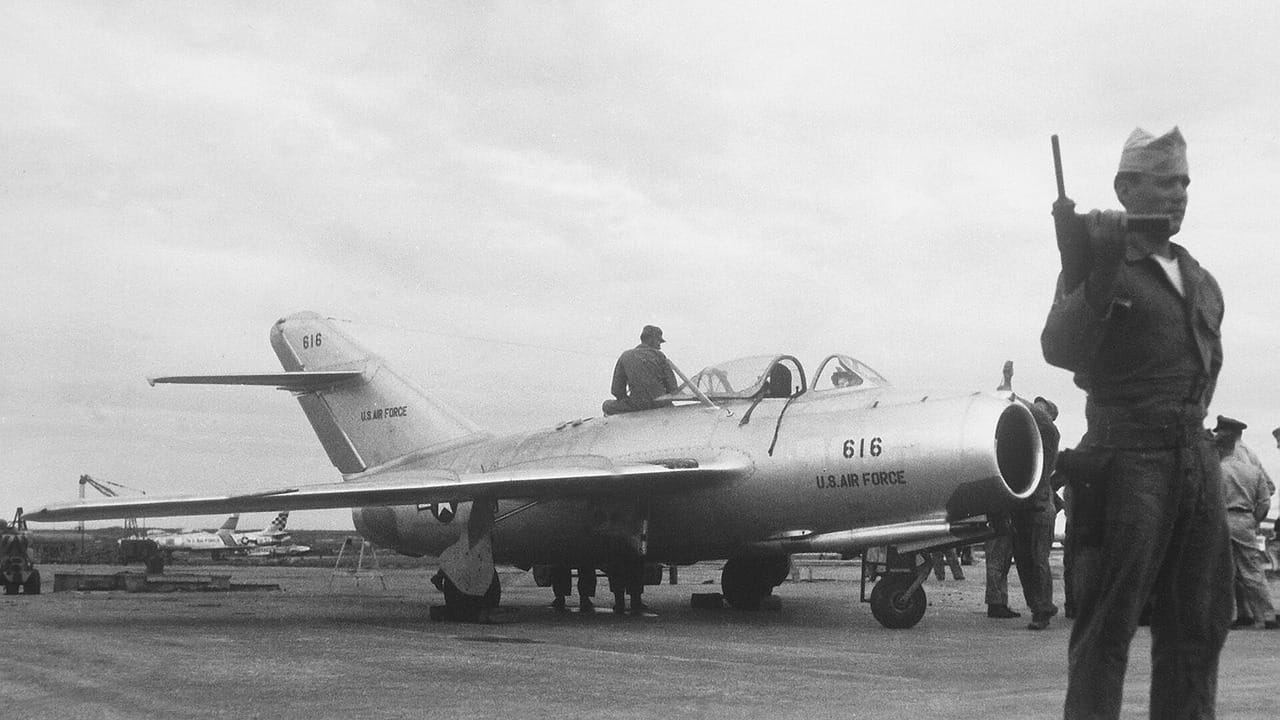
On the morning of 21 September 1953, a 21-year-old Senior Lieutenant of the Korean People’s Army Air Force named No Kum-Sok climbed into his MiG-15bis at Sunan air base outside Pyongyang. His mother had been evacuated to South Korea by the US Navy in December 1950; an uncle had since told him she had been killed in a bombing raid. When he started the engine of the MiG, taxied out, and accelerated down the runway, he had no intention of ever coming back.
Seventeen minutes later he landed at Kimpo Air Base in South Korea, sweating through his summer flight suit, holding his hands above his head as American military police ran toward the still-hot aircraft. He had no idea that the United States government had been quietly offering one hundred thousand dollars to any communist pilot who would defect with an intact MiG-15. He had not heard of Operation Moolah. He had simply decided, after a year of watching his country, that he could not live there.
| Pilot | Sr Lt No Kum-Sok (later Kenneth H. Rowe, US citizen) |
| Defection date | 21 September 1953 (56 days after the Korean armistice) |
| Aircraft | Mikoyan-Gurevich MiG-15bis (s/n 2057), Korean People’s Army Air Force |
| Route | Sunan (DPRK) → Kimpo Air Base (ROK) |
| Flight time | 17 minutes, top speed ≈ 1,000 km/h |
| US bounty under Operation Moolah | $100,000 (≈ $1.2 million today) — paid |
| Aircraft fate | Test-flown by Chuck Yeager at Kadena AB, then transferred to Wright-Patterson AFB; now on display at the National Museum of the USAF |
The MiG that haunted MiG Alley
The MiG-15 was the United States Air Force’s problem. From late 1950 to mid-1953, the swept-wing Soviet fighter — flown by North Korean, Chinese, and frequently Soviet pilots — outclassed every American aircraft over the Yalu River corridor that became known as MiG Alley. Only the F-86 Sabre could give it a fight, and the Sabre had its hands full. The MiG flew higher, climbed faster, and carried heavier cannon armament than its rivals. Above all, it could escape combat by climbing — the one thing no American fighter at the time could match.
The United States desperately wanted an intact example to take apart. Throughout the war, USAF intelligence officers reconstructed MiG-15 wreckage piece by piece from shot-down examples, but no complete airframe had been recovered. In April 1953, three months before the armistice, United Nations Command commander General Mark Clark authorised Operation Moolah — a propaganda and bounty programme dropping leaflets over Communist airfields offering $100,000 in cash and political asylum to any pilot who delivered an operational MiG to UN territory.

A son who hated his country
No Kum-Sok was born in Sinhung, in the north-east of what would become North Korea, in 1932. His father, a senior official in a Japanese fertiliser factory, despised the Soviet occupation forces who arrived after Japan’s surrender. The family fled south briefly but was forced to return. When the Korean People’s Army Air Force took over the north’s military aviation, the young No — a brilliant student of mathematics and natural science — was selected for jet pilot training in Manchuria with the Soviet 64th Independent Fighter Aviation Corps. He learned to fly the MiG-15 from a Soviet major who, by his own later account, did not realise how much No hated him.
By 1953 he had flown more than 100 combat sorties against US and South Korean aircraft over the Yalu. He had not, by his own account, ever shot anything down. He had been planning his defection for almost a year. The armistice on 27 July complicated everything — the regular combat sorties stopped, and he no longer had a routine flight schedule that would let him “wander” toward South Korea unnoticed. He decided to take a training sortie south anyway.

Seventeen minutes south
No took off from Sunan in mid-morning, climbed away from the cratered runway, and pointed his MiG at the 38th parallel. He pushed the throttle full forward. The aircraft accelerated to roughly 1,000 km/h — Mach 0.85 at altitude. At the parallel he pushed the nose over and accelerated further on the descent. By extraordinary luck, the US air defence radar near Kimpo had been shut down that morning for routine maintenance. No one tracked his crossing and no one scrambled to intercept him — until the moment he landed, the allied air defence network had no idea a MiG was coming.
He landed downwind, against the flow of traffic — and nearly collided head-on with an F-86 Sabre of the 4th Fighter-Interceptor Wing landing in the opposite direction; its pilot, Captain Dave Williams, veered out of the way. No taxied to a stop among the parked Sabres, climbed out with his hands up, and was taken into custody. The MiG-15bis was inspected, photographed, partially disassembled, loaded onto a C-124 Globemaster, flown to Okinawa, and test-flown there by Major Chuck Yeager and Captain “Tom” Collins of the USAF Test Pilot School. Within a week, the United States knew exactly what the MiG-15 could do.

The bounty he did not know about
When American officers told No about Operation Moolah, he did not believe them. The Korean People’s Army Air Force had blocked every Western broadcast and confiscated every leaflet. He had defected because of conditions inside North Korea, not because of any reward. Nonetheless, the United States paid him the full $100,000 — equivalent to roughly $1.2 million today. He used the money to put himself through the University of Delaware, where he earned degrees in mechanical and electrical engineering, and to start a new life as Kenneth H. Rowe. His mother, who had reached South Korea during the war, joined him in the United States in 1957.
He worked as an aeronautical engineer for Lockheed, Boeing, Westinghouse, and DuPont, taught engineering at Embry-Riddle Aeronautical University, and lived in Florida until his death in December 2022 at age 90. The aircraft he flew south is on permanent display at the National Museum of the United States Air Force in Dayton, Ohio.
Sources: National Museum of the USAF, Operation Moolah CIA declassified files, A MiG-15 to Freedom (No Kum-Sok memoir, McFarland 1996), Smithsonian Air & Space Magazine.
 English
0 Comments