
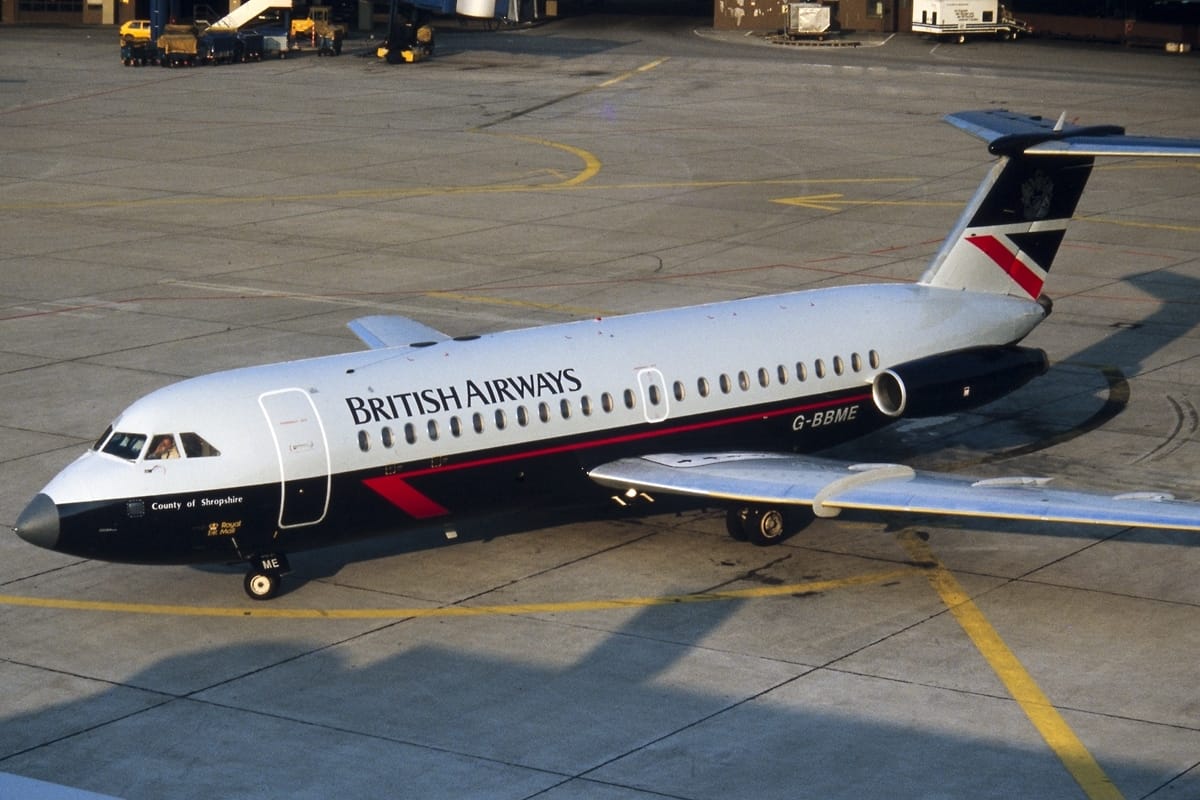
On the morning of 10 June 1990, British Airways Flight 5390 was climbing through 17,300 feet over the Cotswolds, on its way from Birmingham to Málaga. The aircraft was a BAC One-Eleven 528FL, the cabin crew were serving breakfast, and in the cockpit Captain Tim Lancaster had just unfastened his shoulder harness to make himself more comfortable. Co-pilot Alastair Atchison was monitoring instruments. The cabin pressure system had just stabilised. It was a routine Sunday morning charter departure.
At 0733 local time, the entire left-hand cockpit windscreen detached from the aircraft. The decompression pulled Tim Lancaster out of the cockpit, through the opening, and laid him backwards along the top of the fuselage with his shoulders against the front of the cabin roof and his legs trapped over the control column. He was still attached to the aircraft. He was, by the time anyone in the cockpit had registered what had happened, almost certainly unconscious. The airliner was now flying itself, autopilot off, with a half-decapitated cockpit and a man trapped face-down against the airframe at 320 knots.
| Flight | British Airways Flight 5390 |
| Date | 10 June 1990 |
| Aircraft | BAC One-Eleven 528FL, registration G-BJRT |
| Route | Birmingham (BHX) → Málaga (AGP) |
| Altitude at failure | ≈ 17,300 ft |
| Cause | 84 of 90 windscreen retaining bolts undersized by 0.026 inches; fitted by night-shift maintenance technician 27 hours earlier |
| Diversion | Southampton Airport (SOU) |
| Captain | Tim Lancaster — survived, returned to flying |
| Passenger injuries | None |
The half-second that broke the windscreen
The British Aircraft Corporation One-Eleven was a 1960s narrow-body airliner of straightforward design. Its cockpit windscreens were retained from the outside, with the bolts installed under the windscreen frame, so that air pressure during flight would push the windscreen against the airframe rather than blow it out. This is the standard design philosophy for any pressurised cockpit. The retaining bolts had to be exactly the right size. If they were too small, the windscreen would lift off the frame.
Twenty-seven hours before Flight 5390 departed Birmingham, a night-shift Birmingham International Airport maintenance technician had replaced the left-hand cockpit windscreen during an overnight check. He had used a torque wrench to fit 90 retaining bolts. He had taken the bolts from the same parts bin as the maintenance technician who had fitted the windscreen the time before — and the time before that. The bolts in the bin were of the wrong specification. 84 of the 90 bolts he installed were 0.026 inches too small in diameter. They held the windscreen in place on the ground. They could not hold it against 4.8 pounds per square inch of cabin overpressure at 17,300 feet.
What changed
The Air Accidents Investigation Branch published its formal report in March 1992. Beyond the immediate cause — the wrong bolts — the AAIB identified institutional failures in night-shift maintenance procedures at British Airways line maintenance. The technician who had fitted the windscreen had been working alone, without a second pair of eyes, at the end of an extended shift. The parts bin he had selected the bolts from contained mixed specifications. The maintenance card he had been working from did not require cross-checking of bolt diameters against specification.
The recommendations of AAIB Report 1/92 were adopted by every major UK airline within eighteen months. Two-person sign-off on safety-critical maintenance tasks became standard. Parts bins were segregated and labelled by part number. Maintenance cards now require explicit cross-checking of fastener specifications. The accident has since been studied as a case in human-factors engineering, in maintenance procedural design, and in cabin-crew emergency response. The captain who was pulled out of the windscreen wrote a brief account of the incident in his retirement. He titled it, simply, “Held.”
Sources: UK Air Accidents Investigation Branch Report 1/92, Smithsonian Channel Air Disasters, AeroTime, Wikipedia.
 English
0 Comments