

| Pilot | Colonel Chuck Yeager, USAF — the first human to break the sound barrier (1947) |
| Aircraft | Lockheed NF-104A Aerospace Trainer — an F-104 Starfighter modified with a 6,000-lb thrust Rocketdyne AR2-3 rocket motor |
| Date | December 10, 1963 |
| Peak Altitude | 108,700 feet (33,130 m) — roughly 20.6 miles above the Earth |
| What Went Wrong | The aircraft entered an unrecoverable flat spin at extreme altitude where aerodynamic controls were useless |
| Outcome | Yeager ejected at approximately 8,500 feet after falling for over a minute — the ejection seat’s rocket exhaust melted his helmet visor and set his flight suit on fire |
Everyone knows Chuck Yeager broke the sound barrier. It is the single fact that follows his name in every obituary, every documentary, every mention. But sixteen years after that October day in 1947, Yeager climbed into something far more dangerous than the X-1 — a rocket-boosted F-104 Starfighter aimed straight up at the edge of space — and nearly died in the most violent way imaginable.
The story of the NF-104A ride is the story Chuck Yeager almost did not survive. And unlike the sound barrier, it is a story most people have never heard.
The Rocket Starfighter
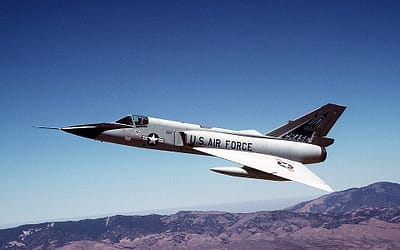
The Lockheed NF-104A was not a normal aircraft. It was a standard F-104 Starfighter — already the fastest fighter in the world, a missile with wings, famously unforgiving — modified with a 6,000-pound-thrust Rocketdyne AR2-3 rocket motor bolted to the base of the tail. The idea was to create an aerospace trainer: an aircraft that could zoom-climb from conventional altitudes into the thin upper atmosphere where aerodynamic controls stop working and reaction control thrusters — tiny hydrogen peroxide jets in the nose and wingtips — take over.
The NF-104A was designed to teach test pilots how to fly at the boundary between aviation and spaceflight. It was, in essence, a bridge between the X-15 and the emerging astronaut programme. And in late 1963, the Air Force Aerospace Research Pilot School at Edwards Air Force Base was pushing the aircraft to its limits.
Yeager, then the school’s commandant, had already flown the NF-104A to 108,700 feet on a previous flight — a record for the type. On December 10, he intended to go higher.
The Climb
The profile was a zoom climb: accelerate in level flight at around 40,000 feet, light the rocket motor, pull into a steep climb, and ride the combined thrust of the jet engine and rocket toward the edge of space. Above 80,000 feet, the atmosphere is so thin that conventional control surfaces — ailerons, elevators, rudder — become almost useless. The reaction control thrusters must keep the aircraft oriented. If they fail, or if the pilot loses attitude awareness, the aircraft will tumble.
Yeager reached approximately 108,700 feet. The jet engine, starved of oxygen in the near-vacuum, had flamed out. The rocket motor had burned out. The aircraft was coasting on momentum, nose high, decelerating rapidly. This was the critical moment: the nose had to be pushed over smoothly from the near-vertical climb attitude into a descent attitude before the aircraft ran out of energy and began to fall, uncontrolled.
The nose did not come over. The NF-104A, losing airspeed rapidly, entered a flat spin.
The Fall
A flat spin at extreme altitude is one of the most dangerous situations in aviation. The aircraft rotates around its vertical axis like a Frisbee, with the nose high and no forward airspeed. At 100,000 feet, there is almost no air for the control surfaces to bite into. The reaction control thrusters — the only tools available — were either depleted or insufficient to break the rotation. Yeager fought the spin for over a minute as the aircraft fell through 80,000, 60,000, 40,000 feet, the controls sluggish and then gradually gaining authority as the air thickened — but never enough to recover.
At approximately 8,500 feet — roughly one mile above the Mojave Desert — Yeager ejected. What happened next was almost as dangerous as the spin itself.
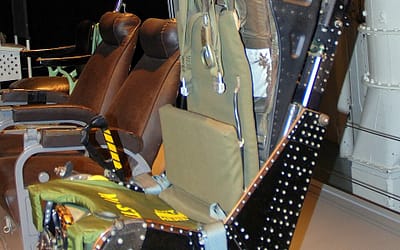
The ejection seat used a rocket catapult to blast clear of the aircraft. The rocket’s exhaust plume hit Yeager’s helmet visor and melted through the Plexiglas. Molten material dripped onto the left side of his face and ignited the rubber seal of his helmet and the neck of his flight suit. Yeager was falling through the desert sky, his parachute deploying, with his helmet on fire.
He survived. His face was badly burned — particularly around the left eye — but he retained his vision and, after treatment, returned to flying status. The NF-104A was destroyed on impact with the desert floor.
Why It Matters
The NF-104A incident is revealing not because Yeager failed — the aircraft’s reaction control system was known to be marginal at the altitudes he was reaching — but because of what it tells us about the man and the era. Yeager was 40 years old, a colonel, a school commandant. He did not need to fly the mission. Other test pilots at Edwards had flown the NF-104A. But Yeager had spent his career pushing harder, going higher, flying faster than anyone said was possible. The NF-104A was no different.
There is a reading of the incident — popularised in Tom Wolfe’s “The Right Stuff” — that frames it as Yeager competing with the astronaut programme, trying to prove that a pilot could reach space without a capsule. Whether that interpretation is fully accurate or partly mythologised, it captures something true about the culture of test flying at Edwards in the 1960s: these men did not stop pushing until the machine gave out or they did.
Yeager walked away from the Mojave Desert with burns on his face and a destroyed airplane behind him. Within months, he was flying again. He went on to command fighter wings in Southeast Asia, train a generation of combat pilots, and live to 97 — dying in December 2020 as the most famous test pilot in history.
But on December 10, 1963, falling through 60,000 feet in a flat spin with a dead engine and a rocket motor that had burned itself out, Chuck Yeager was not famous. He was just a man in a machine that had stopped working, doing the only thing a test pilot can do: trying everything, in order, until something works or the ground arrives.
The ground almost arrived first.
Sources: NASA Dryden Flight Research Center Archives, Edwards AFB History Office, “Yeager: An Autobiography” by Chuck Yeager and Leo Janos, Tom Wolfe’s “The Right Stuff,” Air & Space / Smithsonian Magazine
 English
0 Comments