
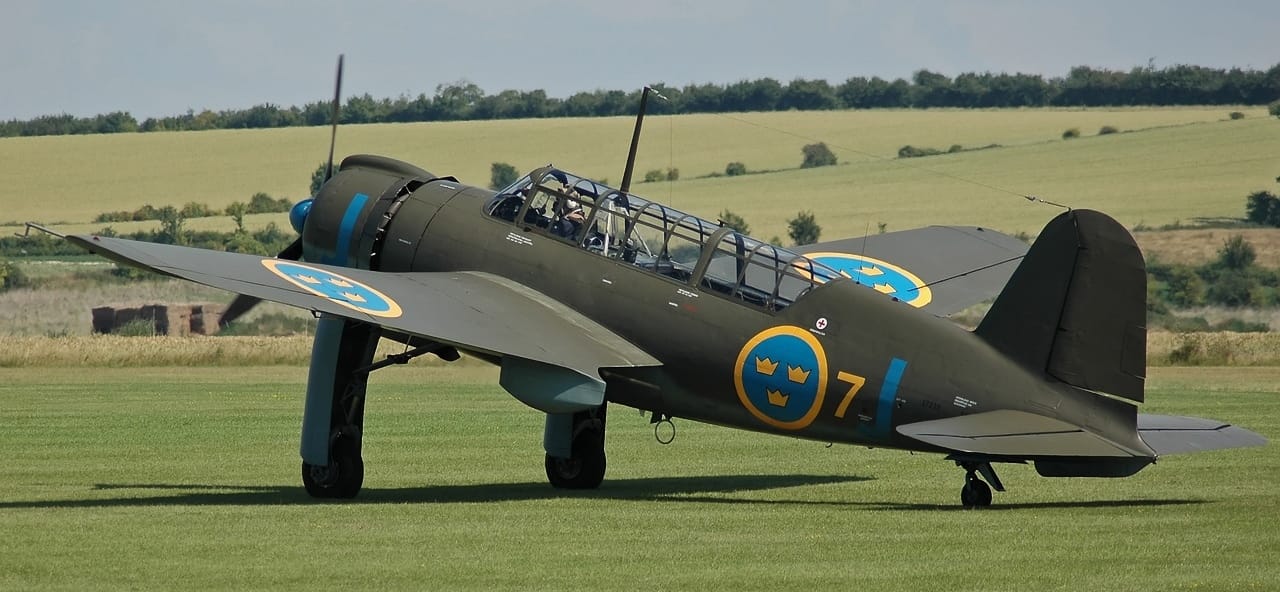
On 18 May 1940 — exactly 86 years ago today, and a week after the German invasion of the Netherlands — a single-engined dive bomber lifted off the runway at Linköping, Sweden, and entered an aviation history that almost nobody outside Sweden remembers. The aircraft was the Saab 17. It would become the first all-metal stressed-skin aircraft developed in Sweden, the workhorse of the Swedish Air Force during the Second World War, and — eventually — the first Saab export. It would also be the first time the modest Linköping aircraft factory became a name that meant something in international aviation.
Sweden was officially neutral throughout the war. The Saab 17 was the aircraft that made neutrality credible: a reconnaissance bomber, fast enough to escape interceptors and ranged enough to reach any approaching threat. It was the first time Sweden could defend itself without buying foreign aircraft. And it set the template — domestic design, world-class engineering — that would lead to the Tunnan, the Lansen, the Draken, the Viggen, and eventually the Gripen.
| Aircraft | Saab 17 (Swedish military designations B 17 and S 17) |
| Manufacturer | Svenska Aeroplan Aktiebolaget (Saab), Linköping |
| First flight | 18 May 1940 (prototype L 10) |
| Crew | 2 (pilot + observer/gunner) |
| Engines used | Bristol Mercury XXIV / Pratt & Whitney R-1830 / Piaggio P.XIbis |
| Total built | 326 (including two prototypes) |
| Variants | B 17 (bomber), S 17 (reconnaissance, with wheels, skis, or floats) |
| Service life | 1940 – 1977 (Ethiopia kept them flying long after Sweden) |
A Swedish aircraft for a Swedish war that never happened
Sweden in 1939 had a problem. Its Royal Swedish Air Force, the Flygvapnet, had been formed only in 1926 and was reliant on imported British, German, and American aircraft. As war loomed, every country Sweden bought from suddenly needed its own aircraft and refused export licenses. The Flygvapnet faced the prospect of being grounded by supplier embargo at precisely the moment Sweden’s strategic situation looked most exposed.
Saab — formally founded only in 1937 — was asked to design a domestic dive bomber from scratch. The brief was demanding: all-metal stressed-skin construction (Sweden had little aluminium-aircraft fabrication experience), capable of carrying a 500-kilogram bomb load, capable of operating from short, rough Swedish airfields, capable of being adapted for the reconnaissance role. The aircraft had to be designed, built, and in operational service within thirty months. Chief designer Frid Wänström delivered.

The clever bit: a landing gear that doubled as a dive brake
The most distinctive engineering feature of the Saab 17 is also the cleverest. Unlike its fixed-gear dive-bomber contemporaries — the Junkers Ju 87 Stuka and the Aichi D3A — the Saab 17 had retractable main gear, which folded rearwards into prominent underwing fairings. And the gear served a dual purpose: extended in the dive, the undercarriage and its large fairings acted as a dive brake during the bombing run. When the pilot recovered, the gear retracted back into its streamlined position.
It was a beautifully Swedish solution. Instead of adding weight by fitting dedicated underwing dive brakes, as the Stuka did, Saab made the landing gear do the job. The result was an aircraft slightly faster than its German rival, with comparable dive-bombing accuracy and significantly lower weight. It was the first time a Saab engineering team showed the kind of sideways thinking that would later define the Draken and Viggen.
War on skis, war on floats
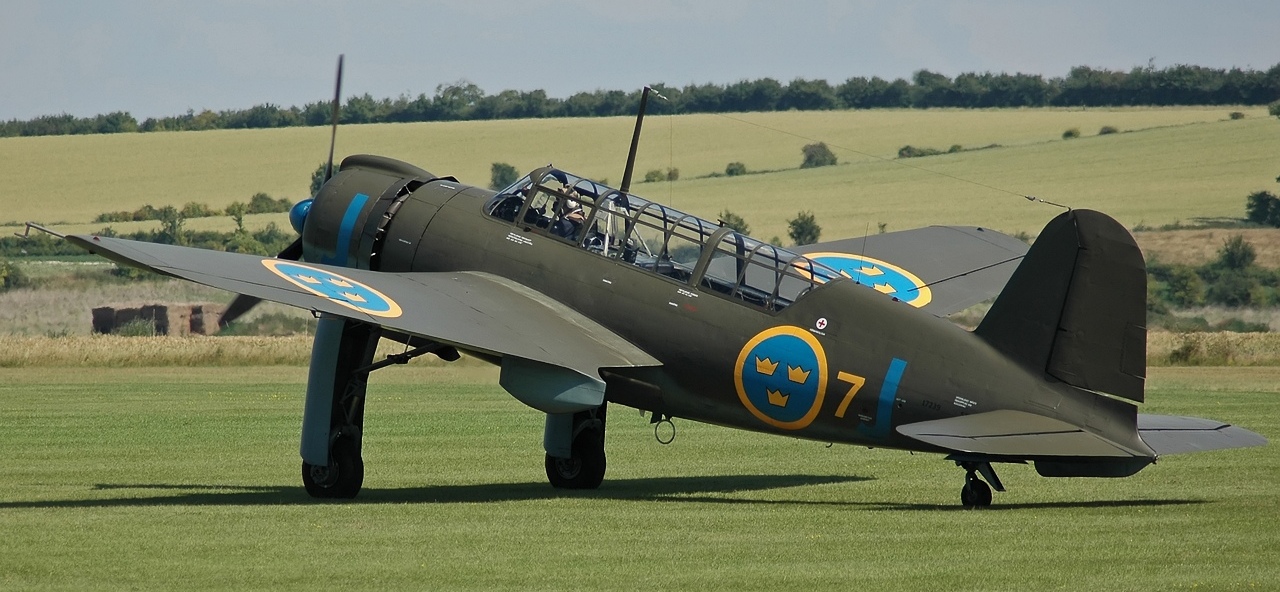
Swedish geography is brutal. The Flygvapnet needed an aircraft that could operate from forward dispersal airfields in winter — when most of Sweden’s northern airbases are snow-covered and runways unusable — and from coastal sites where the only available “runway” was a sheltered fjord. Saab adapted the 17 for both. The S 17BS variant fitted twin floats for water operations; the S 17BL variant fitted skis for snow operations. Both were operational by mid-1942. No other contemporary single-engined bomber was offered in three undercarriage configurations from the same airframe.
The Flygvapnet flew the Saab 17 across the war years primarily on training, patrol, and photo-reconnaissance missions. The aircraft saw no combat — Sweden remained neutral — but its presence in deployable numbers gave the Swedish government negotiating leverage with both the Allies and the Axis. The number of Soviet, German, and Allied aircraft that violated Swedish airspace during the war was significant; the number that did so without being intercepted by a Saab 17 was, eventually, almost none.
Sold to Finland, sold to Ethiopia, retired by Sweden
When jet aircraft entered Flygvapnet service in the late 1940s, the Saab 17 became surplus. Sweden sold 47 examples to Ethiopia from 1947, which used them as the backbone of the Imperial Ethiopian Air Force’s strike capacity into the 1970s. A small number went to Finland and Denmark. The last Saab 17s in active military service were Ethiopian airframes, retired in 1977 — thirty-seven years after the type’s first flight.
One Saab 17 remains airworthy today. A single B 17A — registration SE-BYH, serial 17239, flown today by the Swedish Air Force Historic Flight — flies at airshows across Scandinavia. It is the only example of an aircraft type that taught Saab how to be Saab. Every Gripen, every Viggen, every Draken, every Tunnan traces its institutional ancestry back to a single-engined dive bomber that first flew in May 1940, when the only thing Sweden could be sure of was that it could no longer rely on anybody else.
Sources: Flygvapenmuseum Linköping, Saab AB historical archive, FlightGlobal, Swedish Air Force Historical Society.
 English
0 Comments