
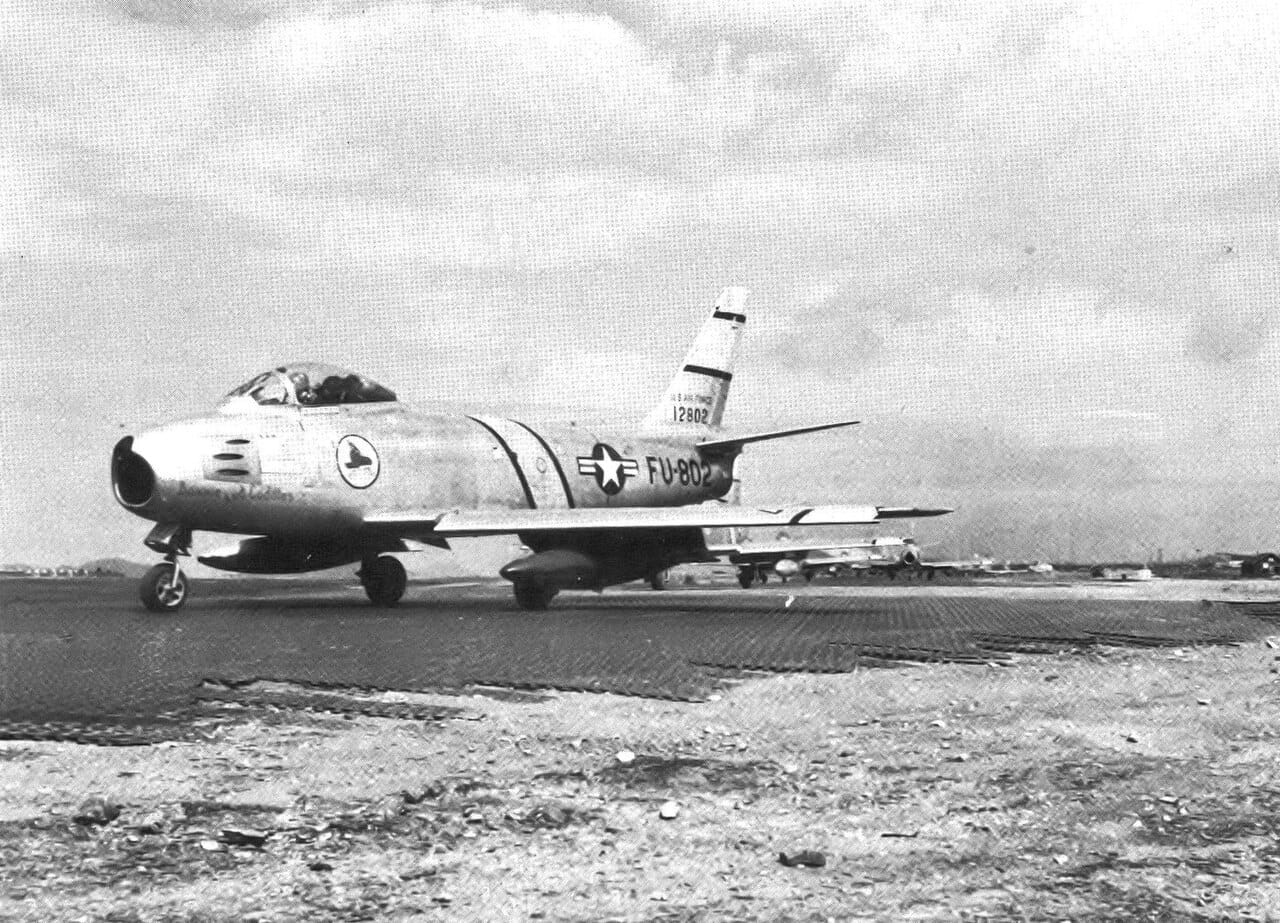
In the summer of 1951, American F-86A pilots over North Korea were dying. Not because the MiG-15 was faster. Not because the North Korean and Chinese pilots were better. They were dying because at around Mach 0.86 — the speed at which the Sabre’s tail control surfaces became ineffective — the aircraft stopped responding. Pilots called it “stick freeze.” You pulled back and nothing happened. A MiG-15, with its swept tail and different control geometry, had no such problem. In the contested airspace above the Yalu River known as MiG Alley, this difference was costing lives.
The fix was deceptively simple. And it changed fighter aviation forever.
The Problem at the Speed of Sound
As an aircraft approaches the sound barrier, shock waves form on its control surfaces. On a conventional tail — where elevators are hinged panels that deflect to pitch the nose up or down — those shock waves move to the hinge line and effectively lock the surface in place. The pilot pushes or pulls the stick and gets nothing. At high speed, close to transonic flight, the F-86A’s elevator was useless.
The solution was to eliminate the hinge entirely. The F-86E introduced the “flying tail” — a stabilator, where the entire horizontal tail surface rotates as one piece, driven by hydraulic actuators that are powerful enough to overcome any shock wave. There is no hinge to freeze. The pilot pulls back and the whole tail moves. At any speed. Through any shock wave.
MiG Alley Changes
When the F-86E arrived in Korea in 1951, the balance in MiG Alley shifted. American pilots could now chase MiGs into the transonic regime — the high-speed slashing attacks and diving escapes that the MiG-15 had used to survive — and maintain full control throughout. The MiG-15 still had advantages: a higher service ceiling, a heavier cannon armament, and a superior rate of climb. But the F-86E could fight at speeds where the MiG’s pilots were increasingly cautious, and where American pilots now held a decisive edge in control authority.
The final Korean War kill ratio — contested by historians, with estimates ranging from 2:1 to 10:1 in favour of the Sabre — reflects many factors. Pilot quality, tactics, experience. But underlying all of it was a piece of engineering: a tail that moved as a single surface, giving the pilot full authority where it mattered most.
The Invention That Never Went Away
Every modern fighter jet in the world uses an all-flying tail. The F-16, the F-35, the Eurofighter Typhoon, the Su-35 — all stabilators, all derived from the principle first proven in combat over Korea in 1951. It is one of those foundational innovations in aerospace that became so universal it ceased to be noticed.
The F-86A pilots who died in MiG Alley in 1950 didn’t have it. The pilots who flew the “E” model had it — and they knew exactly what it meant. MiG Alley was still dangerous. But at least now the tail moved when you pulled.
Sources: National Museum of the United States Air Force; This Day in Aviation; Air Force Magazine
 English
0 Comments