
On June 3, 1973, roughly 250,000 spectators gathered at Le Bourget Airport for the Paris Air Show watched the most dramatic aviation disaster in air show history unfold in real time. A Tupolev Tu-144 — the Soviet Union’s answer to the Concorde — disintegrated in mid-air during a demonstration flight and fell in pieces onto the town of Goussainville, killing all six crew members and eight people on the ground.
What caused it remains debated more than fifty years later. What isn’t debated is that the crash marked the beginning of the end for the Soviet supersonic dream — and that the rivalry between the Tu-144 and Concorde may have played a direct role in the disaster.
- First Flight: December 31, 1968 — two months before Concorde
- Top Speed: Mach 2.3 (2,430 km/h / 1,510 mph)
- Cruise Altitude: 16,000 m (52,000 ft)
- Length: 65.7 m (215.6 ft)
- Total Built: 16 aircraft
- Passenger Flights: 55 scheduled services (1977-1978)
- Crash Date: June 3, 1973, Le Bourget, Paris
- Casualties: 6 crew + 8 on the ground
The Concordski: Born in Espionage
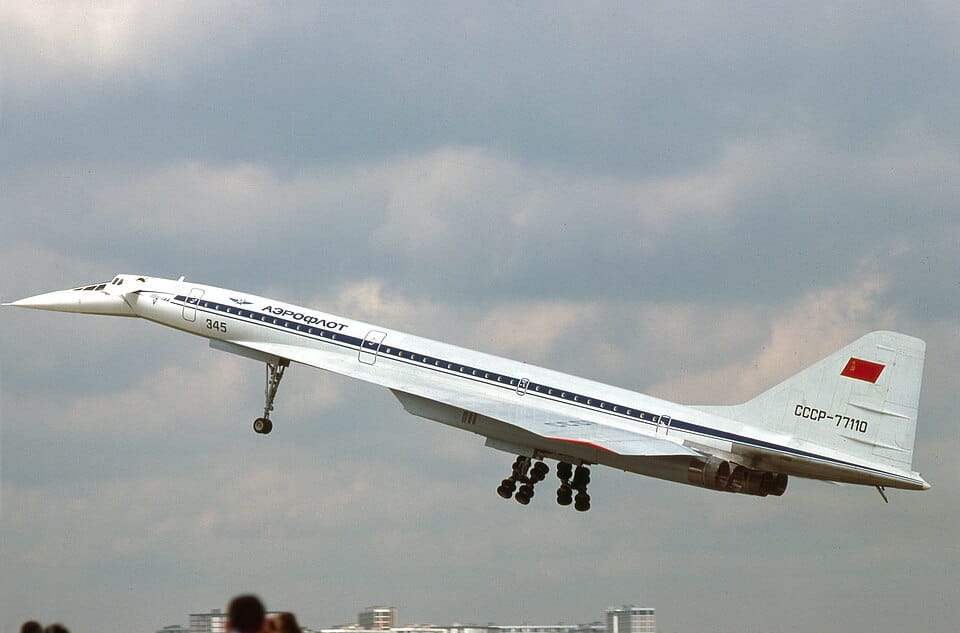
The Tu-144’s resemblance to Concorde was so striking that Western observers immediately dubbed it the “Concordski.” The aircraft’s delta wing, drooping nose, and overall configuration bore an uncanny similarity to the Anglo-French design — and with good reason. Soviet industrial espionage against the Concorde program was extensive, and in 1965 a Soviet spy ring targeting Concorde was exposed in France, resulting in the expulsion of several Soviet officials.
But the Tu-144 was no mere copy. It was larger, heavier, and in some ways more ambitious than Concorde. At 65.7 meters long with a wingspan of 28.8 meters, it was the bigger aircraft. It flew first — December 31, 1968, two months before Concorde’s maiden flight. It went supersonic first. And on May 26, 1970, it became the first commercial transport to exceed Mach 2. In the Cold War race for supersonic prestige, the Soviet Union was winning every milestone.
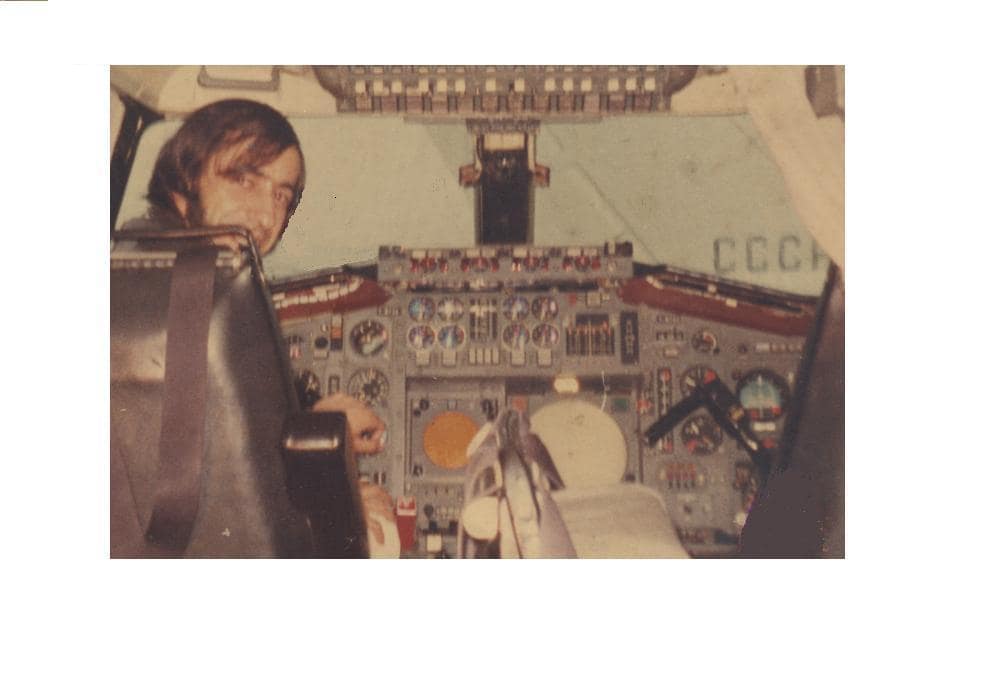
Beneath the surface, however, the Tu-144 was a fundamentally rougher machine. Its engines were less fuel-efficient, requiring afterburners for supersonic cruise where Concorde could supercruise without them. The cabin was notoriously loud — passengers seated next to each other reportedly had to communicate by passing handwritten notes. And its range on a full fuel load was significantly shorter than Concorde’s, limiting practical routes.
June 3, 1973: Disaster at Le Bourget
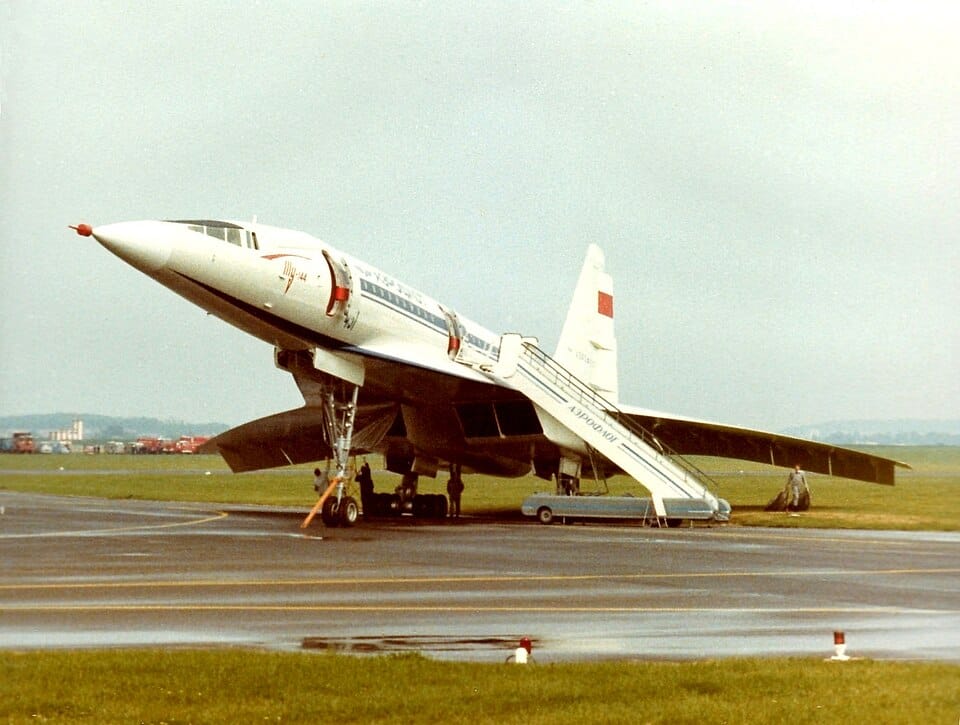
The 1973 Paris Air Show was supposed to be the Tu-144’s triumph. Concorde had already flown an impressive demonstration earlier that day, and the Soviet crew was determined to outperform it. According to multiple accounts, the Tu-144’s pilot, Mikhail Kozlov, had openly stated his intention to put on a more spectacular show than the Concorde team.
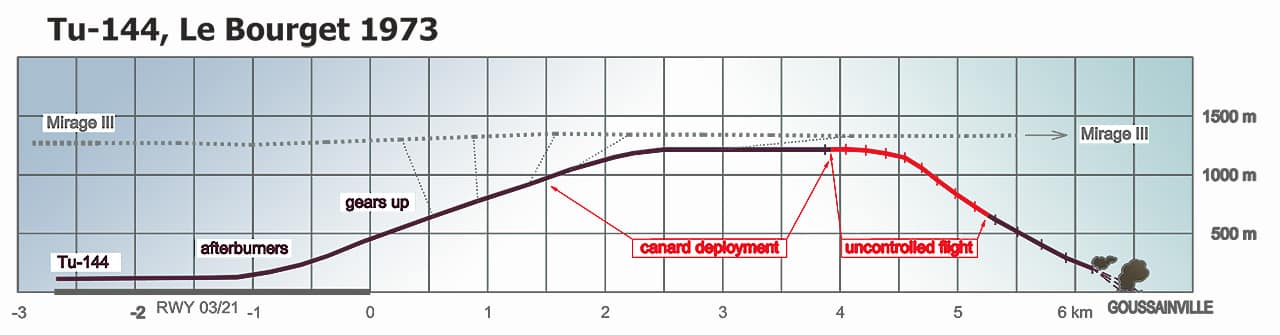
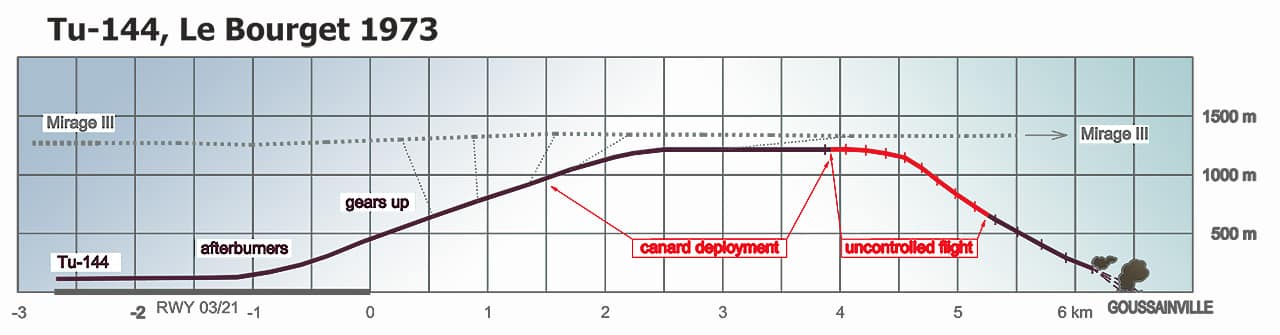
The demonstration began normally enough. The Tu-144 made a high-speed pass above the runway with landing gear deployed and retractable canard foreplanes extended — a configuration designed to show low-speed handling. Then, with all four Kuznetsov NK-144 engines at full power, Kozlov pulled the aircraft into a steep, aggressive climb.
What happened next took fewer than ten seconds. At under 2,000 feet, the Tu-144 stalled. The nose dropped sharply. As Kozlov attempted to recover, pulling back hard with engines at maximum thrust, the airframe couldn’t withstand the forces. The entire left wing outboard of the engines tore away. The aircraft snapped into an inverted roll, the fuselage fractured forward of the wing, and the fuel ignited.
Wreckage rained down on the town of Goussainville, destroying 15 houses and killing eight residents, including three children. All six crew members — pilot Mikhail Kozlov, co-pilot Valery Molchanov, navigator Georgy Bazhenov, deputy chief designer Vladimir Benderov, senior engineer Boris Pervukhin, and flight engineer Anatoly Dralin — died instantly.
The Mystery That Won’t Go Away
The official French-Soviet inquiry produced a hypothesis but no definitive conclusion. The leading theory involves a Dassault Mirage III reconnaissance jet that was photographing the demonstration from above. According to this account, the Tu-144 crew unexpectedly spotted the Mirage during their climb and reacted instinctively with an evasive push-over — even though the two aircraft were never on a collision course. The abrupt negative-G maneuver at low altitude left no room for recovery.
The Mirage theory has supporters, but it has never been conclusively proven. The French government initially denied a Mirage was in the area, then acknowledged its presence but insisted it posed no threat. Soviet investigators suspected the French of deliberately disrupting their demonstration, though no evidence supports this claim.
Alternative theories focus on mechanical failure — specifically the possibility that the retractable canard foreplanes, a feature unique to the Tu-144, malfunctioned at a critical moment. Others point to the aggressive flight profile itself, suggesting that Kozlov was pushing the aircraft beyond its tested envelope in his determination to outperform Concorde.
The Aftermath: A Program That Never Recovered
The Paris crash was devastating for the Tu-144 program, though the Soviet Union pressed on. A redesigned version entered limited passenger service on November 1, 1977, flying the Moscow-to-Almaty route. But the aircraft’s problems were never fully resolved. Over 55 scheduled passenger flights, the Tu-144 proved unreliable, expensive to operate, and uncomfortable.
When another Tu-144 crashed during a pre-delivery test flight on May 23, 1978, passenger services were permanently suspended. The aircraft continued as a cargo carrier for a brief period before being retired entirely. Of the 16 Tu-144s built, none would fly commercially again. Concorde, by contrast, operated successfully for another 26 years before its own retirement in 2003.
In a final chapter, NASA leased a modified Tu-144 in the 1990s for supersonic research — a collaboration between former Cold War rivals that would have been unthinkable in 1973. The aircraft, designated Tu-144LL, flew 27 research flights before the program ended in 1999, providing data that influenced the design of next-generation supersonic concepts that are only now beginning to take shape.
Original 1973 newsreel footage of the Tu-144 breaking apart in mid-air over Goussainville at the Paris Air Show.


 English
0 Comments