
The North American XB-70 Valkyrie was supposed to be the future of strategic bombing — a six-engine colossus that could outrun anything in the sky at three times the speed of sound. Instead, it became one of aviation's most expensive might-have-beens, and its story ended not in combat or budget cuts, but in a senseless mid-air collision during a publicity photo shoot.
Two prototypes were built. Two pilots died. And $700 million in 1960s money — billions in today's terms — vanished in a fireball over the Mojave Desert. This is the story of the fastest bomber ever built, and the PR stunt that killed it.
- Top Speed: Mach 3.08 (2,020 mph / 3,250 km/h)
- Maximum Altitude: 74,000 feet (22,555 m)
- Engines: Six General Electric YJ93-GE-3 afterburning turbojets, 30,000 lbs thrust each
- Length: 185 feet (56.4 m)
- Cost Per Prototype: Over $700 million (1960s dollars)
- Prototypes Built: 2
- Crash Date: June 8, 1966
- Survivor: AV-1 at the National Museum of the USAF, Dayton, Ohio
Designed to Ride Its Own Shockwave
The XB-70 was born from a Cold War requirement that reads like science fiction even today: a bomber that could cruise at Mach 3 above 70,000 feet, beyond the reach of Soviet interceptors and surface-to-air missiles, carrying nuclear weapons deep into enemy territory and returning home before anyone could react.
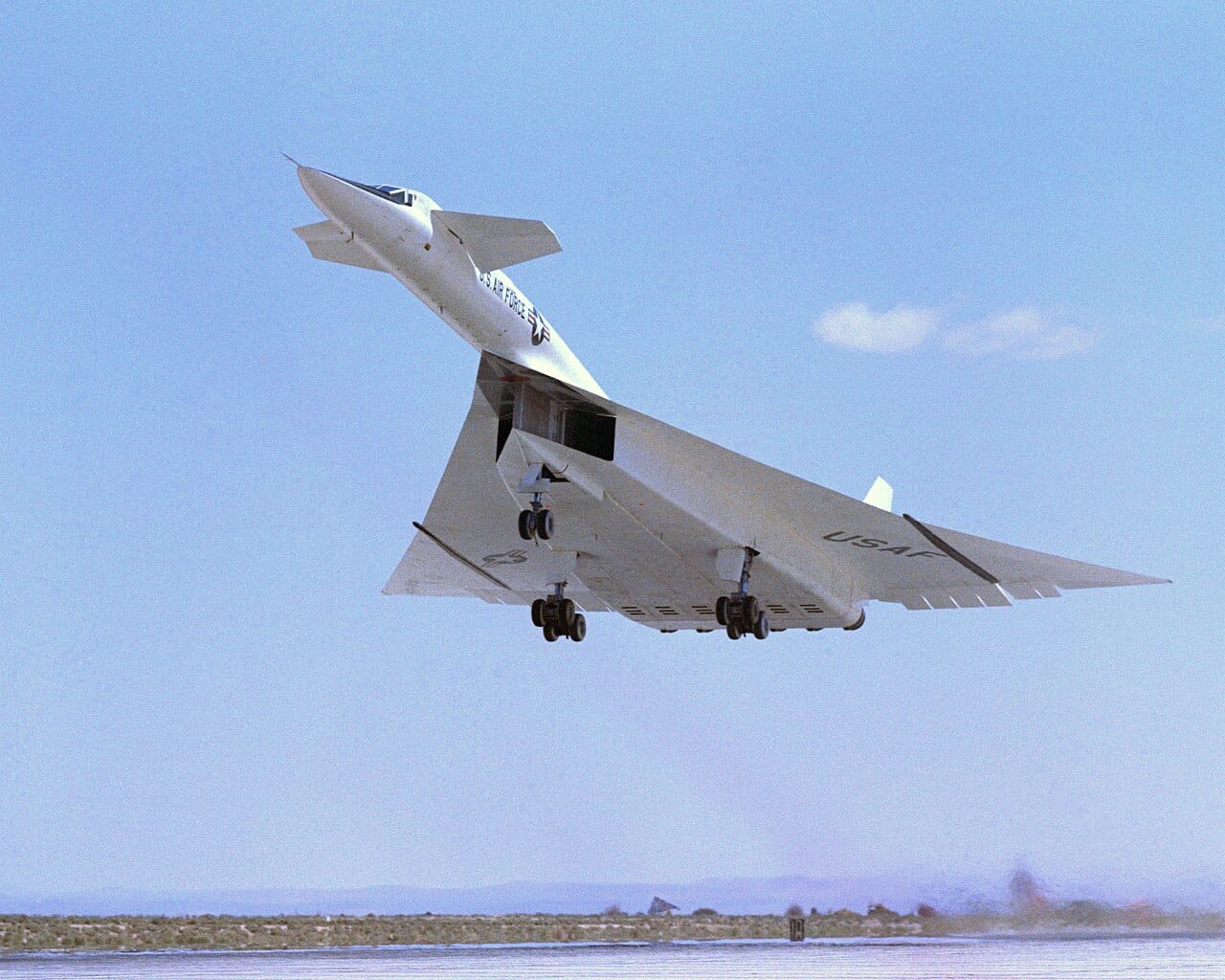
North American Aviation's solution was breathtaking in its ambition. The Valkyrie was designed to literally ride on its own shockwave — the compressed air beneath the aircraft at supersonic speed would provide additional lift, a phenomenon called compression lift. The bomber's wingtips could fold downward up to 65 degrees at high speed, capturing this shockwave energy beneath the delta wing like a surfboard riding a wave.
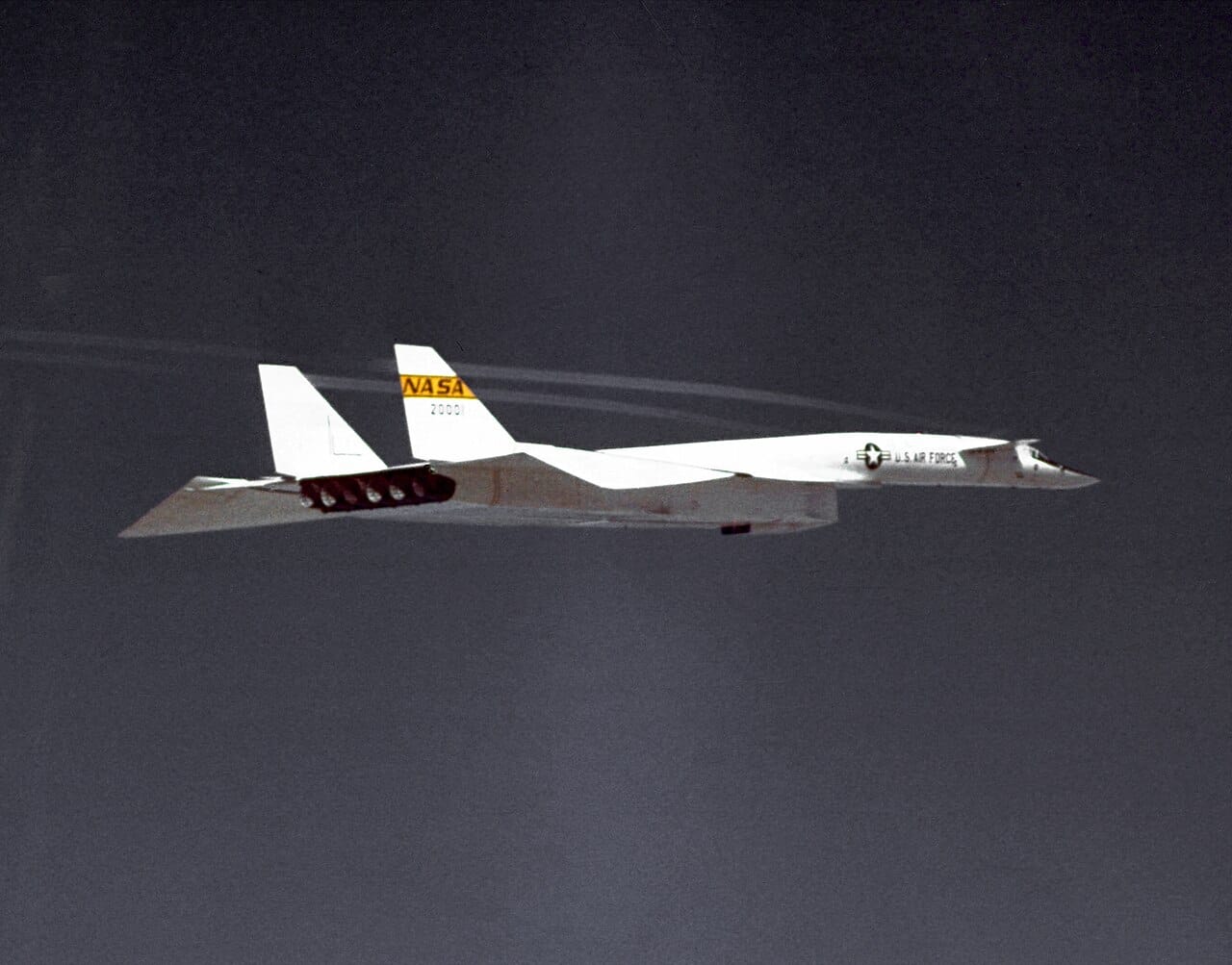
At 185 feet long and powered by six General Electric turbojet engines producing 180,000 pounds of combined thrust with afterburners, the Valkyrie was the largest aircraft ever designed to fly at Mach 3. Its airframe was constructed from stainless steel honeycomb panels and titanium to withstand temperatures exceeding 330°C at cruise speed. Fuel was circulated through heat exchangers to cool the crew compartment before being fed to the engines.
The Fastest Bomber That Never Was
The first XB-70 took to the skies on September 21, 1964, and soon proved the design concept worked. On October 14, 1965, prototype AV-1 exceeded Mach 3 for the first time, though the extreme heat damaged some honeycomb panels and left two feet of the leading edge missing from the left wing.
The second prototype, AV-2, was even faster. It sustained Mach 3 flight for 33 consecutive minutes — a record for an aircraft of its size that has never been broken. At full speed, the Valkyrie covered a mile every 1.8 seconds. Pilots reported that at Mach 3, the curvature of the Earth was visible, the sky turned dark blue, and the aircraft seemed to be standing still while the planet rotated beneath it.
But the Valkyrie was already dying before it crashed. Soviet advances in surface-to-air missiles — particularly the SA-2 that shot down Gary Powers' U-2 in 1960 — proved that flying high and fast was no longer a guarantee of survival. President Kennedy reduced the B-70 program to research-only status in 1961, and ICBMs offered a cheaper, more survivable nuclear deterrent. The production bomber would never be built.
June 8, 1966: A PR Stunt Turns Fatal
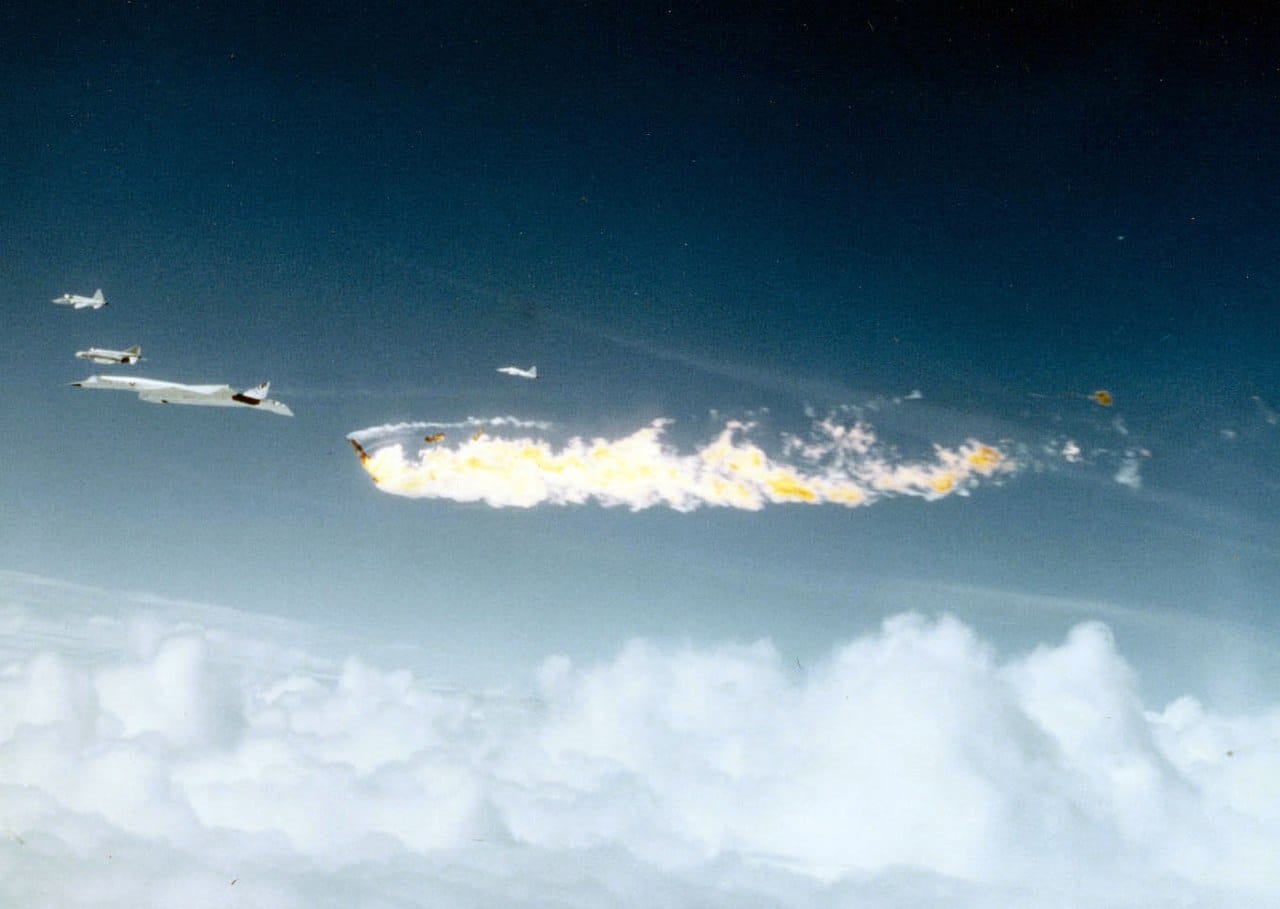
On a clear June morning over the Mojave Desert, five aircraft powered by General Electric engines formed up for a publicity photo shoot: the XB-70A AV-2, an F-104N Starfighter, an F-4 Phantom, an F-5 Freedom Fighter, and a T-38 Talon. A chase aircraft — a Learjet owned by Frank Sinatra — flew alongside to capture the formation.
NASA chief test pilot Joe Walker was at the controls of the F-104N, flying just off the Valkyrie's right wingtip. Without warning, Walker's Starfighter was drawn toward the bomber — pulled in by the massive wingtip vortex that the XB-70's enormous delta wing generated at cruise speed. The phenomenon was poorly understood at the time.
The F-104 rolled over the top of the Valkyrie's right wing, struck both vertical stabilizers, and exploded. Walker died instantly. For sixteen seconds, the crippled XB-70 flew straight and level as if nothing had happened. Then, with its vertical stabilizers gone, the bomber rolled into an inverted spiral and began breaking apart.
North American test pilot Al White managed to eject from the spinning aircraft using the XB-70's escape capsule — a clamshell enclosure designed for high-speed bailout. He survived but was severely injured — his elbow was nearly caught in the closing clamshell, and the capsule’s impact-attenuation airbag failed to inflate, making for a brutally hard landing. Air Force Major Carl Cross, in the co-pilot's seat, could not activate his escape capsule. He died in the crash.
The Wake Vortex Nobody Understood
The investigation revealed that the crash was caused by wake vortex — the powerful rotating air currents that trail from any aircraft's wingtips. The XB-70's massive delta wing produced vortices of extraordinary strength, and Walker's F-104 had drifted close enough to be caught in the rotational flow.
The tragedy had a lasting impact on aviation safety. Wake turbulence separation standards were significantly tightened in the years following the crash, and the phenomenon is now a major consideration in air traffic control worldwide. Every pilot who maintains spacing behind a heavy aircraft at an airport today is benefiting from lessons learned over the Mojave Desert in 1966.
The surviving prototype, AV-1, continued flying as a research aircraft until February 4, 1969, logging 83 flights in all. Across the entire program, the two Valkyries spent a combined 108 minutes — less than two hours — at Mach 3. It made its final flight to Wright-Patterson Air Force Base, where it remains on display at the National Museum of the United States Air Force — a monument to an era when engineers believed they could outrun anything, and a reminder that some of aviation's worst disasters begin with the simplest words: "Let's take a photo."
The History Guy: Death of a Valkyrie — the full story of the 1966 mid-air collision with archival footage.
Related Questions
What was the XB-70 Valkyrie?
The North American XB-70 Valkyrie was an American experimental bomber capable of Mach 3.08 — over three times the speed of sound — at 70,000+ feet. Built in the 1960s to outrun any defence, only two were made, and the programme ended after one was lost in a mid-air collision.
How did the XB-70 Valkyrie crash?
One XB-70 was destroyed on 8 June 1966 during a General Electric publicity photo shoot. Flying in tight formation for the cameras, an accompanying F-104 chase plane collided with the Valkyrie's wingtip, sending both aircraft down and killing two pilots.
How fast was the XB-70 Valkyrie?
The Valkyrie reached Mach 3.08 — about 2,020 mph (3,250 km/h) — at altitudes up to 74,000 feet. Six afterburning turbojets of 30,000 lbs thrust each let the huge bomber cruise faster than almost any aircraft ever built.
How did the XB-70 fly at Mach 3?
It used compression lift, riding its own shock wave: at Mach 3 the aircraft's folded-down wingtips trapped the shock wave beneath the wing, generating extra lift. This let the enormous 185-foot bomber sustain three times the speed of sound efficiently.
Where is the surviving XB-70 today?
The sole surviving XB-70, the first prototype (AV-1), is preserved at the National Museum of the United States Air Force in Dayton, Ohio. The second aircraft was destroyed in the 1966 collision, ending the programme.
0 Comments