
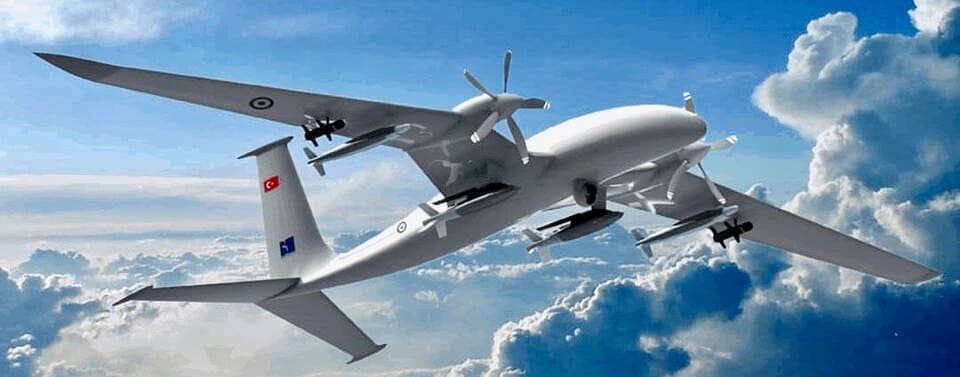
On December 26, 2025, Turkey’s Baykar proved something crucial about the future of warfare: precision-guided munitions fired from unmanned platforms now match anything launched from manned aircraft. The Bayraktar AKINCI, a 6-ton heavy combat drone, completed live-fire tests that included direct hits with three different indigenous guided weapons systems. No near misses. No adjustments needed. Bull’s eyes, three times running.
The test wasn’t just a technical milestone. It announced that Turkey has closed the gap between Western drone technology and Turkish innovation. What started as reverse-engineering success stories with the TB2 has evolved into a complete indigenous weapons ecosystem. AKINCI doesn’t just carry munitions anymore—it carries precision munitions designed, built, and tested by Turks.

The Platform: 24 Hours Aloft
The AKINCI is the heavy-hitter in Turkey’s drone arsenal. With a maximum takeoff weight of 6,000 kg and a payload capacity of 1,500 kg, it matches the weight class of older fighter aircraft like the A-6 Intruder. But where it dominates is endurance: AKINCI stays aloft for more than 24 hours without refueling, cruises at 40,000 feet, and carries enough fuel to loiter over a target area for hours before striking.
The drone’s range is 7,500 kilometers—roughly the distance from Istanbul to Singapore. That means Turkey can operate AKINCI from home territory and strike targets across the Mediterranean, the Middle East, and into Central Asia without forward basing. Two turboprop engines power redundant systems. Dual satellite communication ensures command links stay live. This isn’t a kamikaze platform—it’s a persistent airborne weapons system.
An unmanned platform that can loiter for 24 hours, carrying 1.5 tons of guided munitions, at 40,000 feet range—that’s a paradigm shift in regional airpower.
The Weaponry: Turkish-Made Precision
The December test demonstrated three guided systems, each achieving direct hits on target. The LAÇİN-82 is a guidance kit that converts unguided 82mm rocket-assisted projectiles into precision munitions using GPS and inertial navigation. The TEBER-82 is a winged guidance kit with similar capabilities but extended range. And the MAM-T is a complete smart munition designed from scratch as an air-to-ground weapon.
What makes this significant is autonomy. These aren’t remote-controlled weapons requiring a pilot to see the target. They’re semi-autonomous systems that receive a GPS coordinate, fly themselves to it, and adjust in flight based on real-time guidance updates from satellite or ground-based systems. Fire and forget, but with precision comparable to Tomahawk cruise missiles.
The older KGK-82 guidance kits that preceded these systems proved the concept. Now the MAM-T and newer guidance packages represent Turkish engineers asking: why license foreign systems when we can build better ones ourselves? And the answer, apparently, is: we can’t—we already have.
The Global Arms Race Shift
Turkey’s success with AKINCI and indigenous munitions changes the calculus of regional power. For decades, countries that wanted precision air-to-ground capability had to buy from the U.S., Europe, or Israel. Now Turkey has built an ecosystem that matches Western capabilities and offers it to allies at lower cost and without the political strings attached.

Baykar is ramping up production toward 120 AKINCI aircraft by the end of 2026. Saudi Arabia has ordered the platform. Pakistan is interested. Other NATO allies are watching. And every other drone manufacturer on Earth is taking notes: the advantage of Western platforms is shrinking. Turkey proved that with enough engineering talent and state support, you can build a heavy combat drone ecosystem that competes directly with anything in the American or European arsenal.
The Future of Unmanned Warfare
AKINCI with precision munitions represents the next evolution of drone warfare: moving beyond the Predator era toward persistent, high-endurance, heavily-armed platforms that operate with minimal human intervention. The drone doesn’t just scout targets anymore—it identifies them, plans the strike, and executes with precision measured in meters, not hundreds of meters.
For regional powers, that changes everything. A country without air superiority can now project precision firepower across vast distances without risking pilots. For NATO allies, it complicates defense planning—you now have to defend against platforms that are smaller than fighters, more persistent than cruise missiles, and more autonomous than either.
Turkey just proved that in the 2020s, precision air-to-ground dominance isn’t reserved for superpowers anymore. It’s accessible to any nation with engineering talent and the will to build it. The bull’s-eye test on December 26 was more than a technical achievement. It was a warning that the global arms market just shifted, and unmanned platforms are now the arena where that competition will be won.
Sources: Army Recognition, AeroTime, Interesting Engineering, Defense Security Asia, Baykar


 English
0 Comments