
| Quick Facts | |
|---|---|
| Flight | United Airlines Flight 232, Denver to Chicago |
| Date | July 19, 1989 |
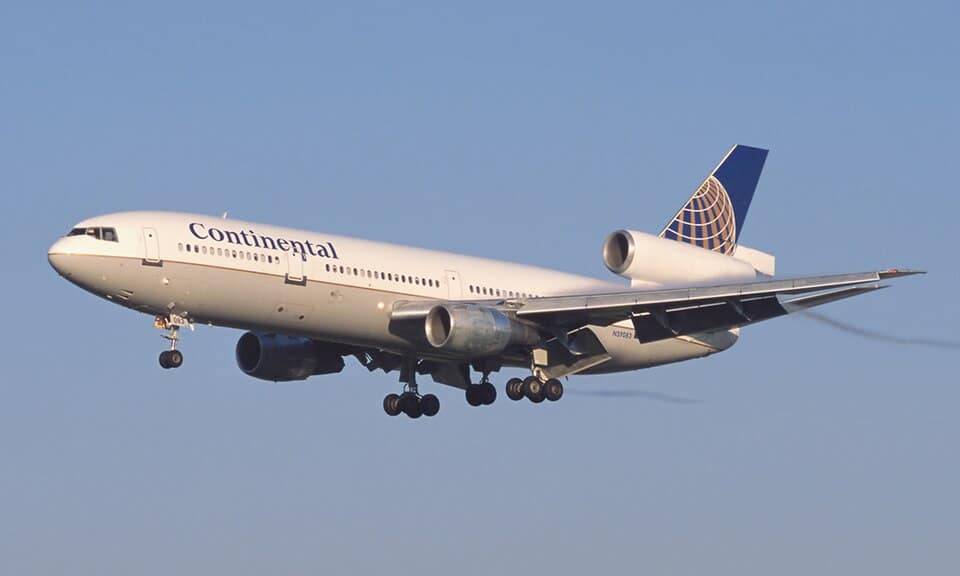
| Aircraft | McDonnell Douglas DC-10-10 (N1819U) |
| Crew | Captain Al Haynes, First Officer Bill Records, Flight Engineer Dudley Dvorak, plus off-duty instructor Captain Dennis Fitch |
| Failure | Uncontained failure of #2 (tail) engine fan disk severed all three hydraulic systems |
| Control Method | Differential thrust only — varying power on engines #1 and #3 to steer |
| On Board | 296 people (285 passengers + 11 crew) |
| Outcome | 185 survived (62.5%), 111 died — engineers had predicted zero survivors |
| Landing Site | Sioux Gateway Airport, Sioux City, Iowa — Runway 22 (closed runway) |

At 37,000 feet over Iowa, the tail engine of a DC-10 tore itself apart. Shrapnel from the disintegrating fan disk sliced through the fuselage and severed all three independent hydraulic systems — something the designers had considered so improbable it wasn’t even in the failure analysis. In an instant, Captain Al Haynes and his crew lost every flight control on the aircraft. No ailerons, no rudder, no elevators, no flaps, no slats. A 180-ton jet carrying 296 people was flying, but no one was steering it.
What happened next is the most extraordinary display of airmanship in commercial aviation history.
The Impossible Failure
The DC-10 has three hydraulic systems — a deliberate redundancy designed so that losing any one, or even two, still leaves enough control authority to fly and land. But the #2 engine’s fan disk didn’t just fail. It exploded. Titanium fragments ripped through the horizontal stabiliser and the tail section at supersonic speed, severing hydraulic lines from all three systems in a single catastrophic moment.
The probability of losing all three systems simultaneously had been calculated at a billion-to-one. McDonnell Douglas hadn’t designed a procedure for it. There was no checklist. There was no simulator scenario. When Flight Engineer Dudley Dvorak reported “all three hydraulic systems — we have no quantity, no pressure,” the crew was facing a situation no airline pilot in history had ever confronted in flight.
The aircraft immediately began a right-rolling, nose-down phugoid — a series of long, oscillating pitch-and-bank cycles that, left uncorrected, would eventually spiral the jet into the ground. Haynes and First Officer Bill Records fought the control column, but it was dead. Moving the yoke did nothing. The DC-10 was flying on aerodynamics alone.

The Fourth Pilot
Dennis Fitch was an off-duty United Airlines training captain who happened to be sitting in first class. He was also a DC-10 instructor. When the cabin crew told him the situation, he walked to the cockpit and offered to help. Haynes put him on the throttles.
What Fitch did next had never been attempted on a commercial aircraft. He used differential thrust — increasing power on one wing engine while reducing it on the other — to control the DC-10’s bank and heading. More thrust on the left engine turned the aircraft right. More on the right turned it left. By asymmetrically adjusting the two remaining engines, Fitch could make the jet turn. By adding power to both, he could make it climb. By reducing both, it descended.
It was not precise. The phugoid oscillations continued — the aircraft would climb, slow, drop its nose, accelerate, and climb again in sickening 1,000-foot cycles. But Fitch, working the throttles with both hands, gradually wrestled the DC-10 into something resembling controlled flight. He later described it as trying to balance on a beach ball.
44 Minutes to Sioux City
For 44 minutes, the four-man crew flew a crippled trijet toward Sioux Gateway Airport in Sioux City, Iowa — the nearest airport with emergency services capable of handling a wide-body crash. Haynes worked the radios. Records backed up Fitch on the throttles. Dvorak monitored what was left of the systems. ATC cleared every runway and rolled every fire truck in northwestern Iowa.
They couldn’t control airspeed with any precision. They couldn’t deploy flaps to slow down for landing. They couldn’t lower the landing gear hydraulically — it dropped by gravity when Dvorak pulled the emergency release. They lined up on Runway 22, a closed runway that happened to be roughly aligned with their approach path. They were coming in at 240 knots — nearly twice the normal landing speed — with a sink rate that was far too high and a slight right bank they couldn’t correct.

The Crash That Saved 185 Lives
At 4:00 PM local time, the DC-10 slammed into the runway threshold. The right wing hit first. The aircraft cartwheeled, broke apart, and burst into flames. The cockpit separated from the fuselage. Sections of the cabin were flung across the airfield. The tail section, containing the failed engine, ended up inverted in a cornfield.
One hundred and eleven people died. One hundred and eighty-five survived — including all four cockpit crew members, who were pulled from the wreckage alive. When engineers later attempted to replicate the scenario in simulators, they crashed every single time. Not one test pilot, given the same failure, managed to get the aircraft to the runway. The universal conclusion: what Haynes, Fitch, Records, and Dvorak accomplished was, by every engineering measure, impossible.
Al Haynes never accepted the word “hero.” He credited the outcome to cockpit resource management — the then-new concept that all crew members contribute to decision-making, not just the captain. He also credited luck. But the 185 people who walked away from a burning cornfield in Iowa knew better.
The Legacy
Flight 232 changed aviation. The NTSB investigation led to mandatory fan disk inspections, redesigned hydraulic system routing to prevent common-cause failures, and accelerated the adoption of CRM training across the airline industry. The concept of propulsion-controlled aircraft — flying on throttles alone — became a formal emergency procedure studied in military and civilian programmes.
Haynes spent the rest of his life giving lectures on crew resource management and human factors. He died in 2019 at age 87. Fitch died in 2012. Their names may not be as famous as Sully Sullenberger’s, but what they did was harder. Sullenberger had flight controls. Haynes had two throttle levers and 44 minutes to figure out how to use them.
The next time you hear someone say a situation is impossible, remember Sioux City. Remember four pilots, a dead stick, and 185 reasons why you never give up.
Sources: NTSB Accident Report AAR-90/06, Aviation Safety Network, Smithsonian Air & Space
 English
0 Comments