

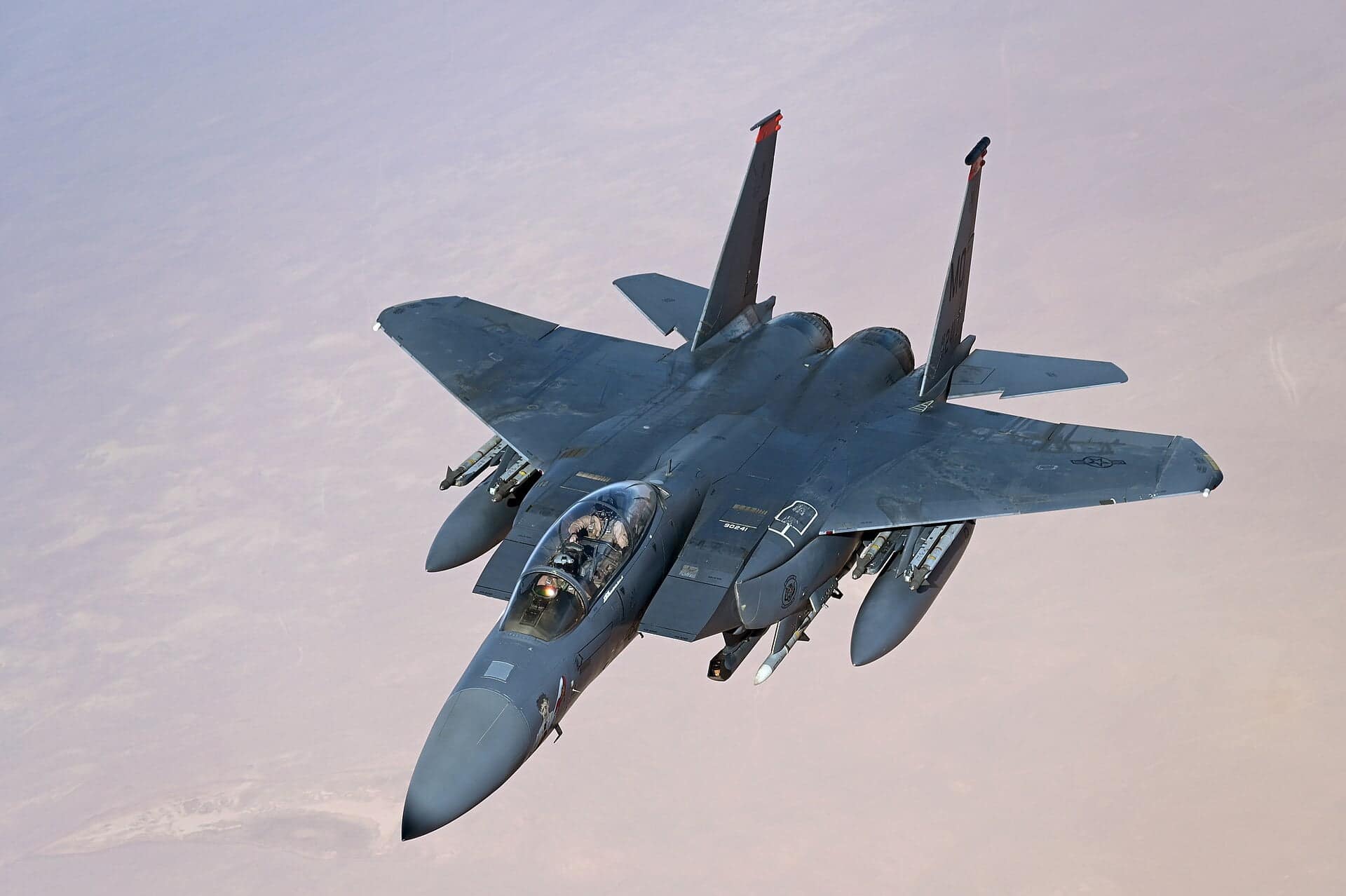
The phrase the Air Force uses is “speedline.” It is the polite way to say: this is taking too long, we are going to do it differently, in one building, faster than the regular depot pipeline can manage. On 26 May 2026, the service stood one up at Warner Robins Air Logistics Complex in Georgia — and its only job is to bolt new electronic-warfare suites into F-15E Strike Eagles.
The reason is not a mystery. The 40-day air war over Iran was the most contested electronic environment American fighters have flown into since Desert Storm. More than 40 American aircraft were damaged or destroyed in the war, by The War Zone’s tally of known losses. And inside Air Combat Command, the conclusion was that the F-15E’s existing Tactical Electronic Warfare System — designed in the 1980s — was simply no longer enough.
Quick Facts
Established: 26 May 2026, Warner Robins Air Logistics Complex, Georgia
Programme: Eagle Passive Active Warning Survivability System (EPAWSS)
Built by: BAE Systems
Fleet: ~218 USAF F-15E Strike Eagles + F-15EX
Why now: Iran war exposed survivability gaps in legacy F-15E EW kit
What EPAWSS actually does
EPAWSS — the Eagle Passive Active Warning Survivability System — is BAE Systems’ digital, broadband-tunable replacement for the F-15E’s original TEWS. Where the old system was good at handling a known threat library, EPAWSS is built to handle threats whose radar parameters change in flight. It detects, identifies, geolocates and jams modern integrated air-defence radars, all from inside the airframe rather than from external pods.
Crucially, it gives the Strike Eagle situational awareness the original 1980s suite simply cannot reproduce: a 360-degree threat picture, integrated into the cockpit displays, automatic countermeasure dispensing, and the bandwidth to handle the agile-waveform radars that Russian and Chinese late-generation SAM batteries now field.
Why a “Speedline”
The Air Force has been planning the EPAWSS retrofit for years. The problem is geography and queue. EPAWSS installs have so far been done during the F-15E’s regular Programmed Depot Maintenance cycles at Robins, at the same time as airframe-level overhauls. That means jets sit in queue behind their scheduled depot slots — and some aircraft are not due for depot maintenance for another five to seven years.
A Speedline is the Air Force’s answer: a dedicated, single-purpose line that takes a Strike Eagle in, swaps the legacy TEWS modules for EPAWSS kit, integrates the software, and rolls the jet back out — without waiting years for a scheduled depot slot. The Air Force Life Cycle Management Center is running it out of Warner Robins under the F-15 Program Office.
The F-15EX Eagle II, the new-build successor, already comes off the Boeing line with EPAWSS installed. The F-15E retrofit is the harder problem: existing wiring, existing mission computer architecture, existing antenna locations have to be reworked aircraft by aircraft.
Iran is the proximate cause
The Strike Eagle has done the dirtiest work of every American air campaign since 1991. Over Iraq, the Balkans, Afghanistan, Syria, Yemen and now Iran, it has flown the deep-strike, the SCUD hunt, the SAM kill, the runway crater. But Operation Epic Fury — the 40-day campaign against Iranian nuclear infrastructure and IRGC bunkers — saw F-15Es taking SAM shots from far more capable systems than the early-2000s S-200s and Hawks they were used to ducking.
More than 40 US aircraft were damaged or destroyed in the war, according to The War Zone’s tally of known losses. The EPAWSS rollout will not bring those crews back. But the speedline at Warner Robins is the Air Force admitting, quietly and concretely, that the next time the Strike Eagle goes over a defended border, it is going to need a better set of ears and a better set of jammers than the ones it walked into Iran with.
Sources: The Aviationist, Air & Space Forces Magazine, Air Force Life Cycle Management Center.


 English
0 Comments