
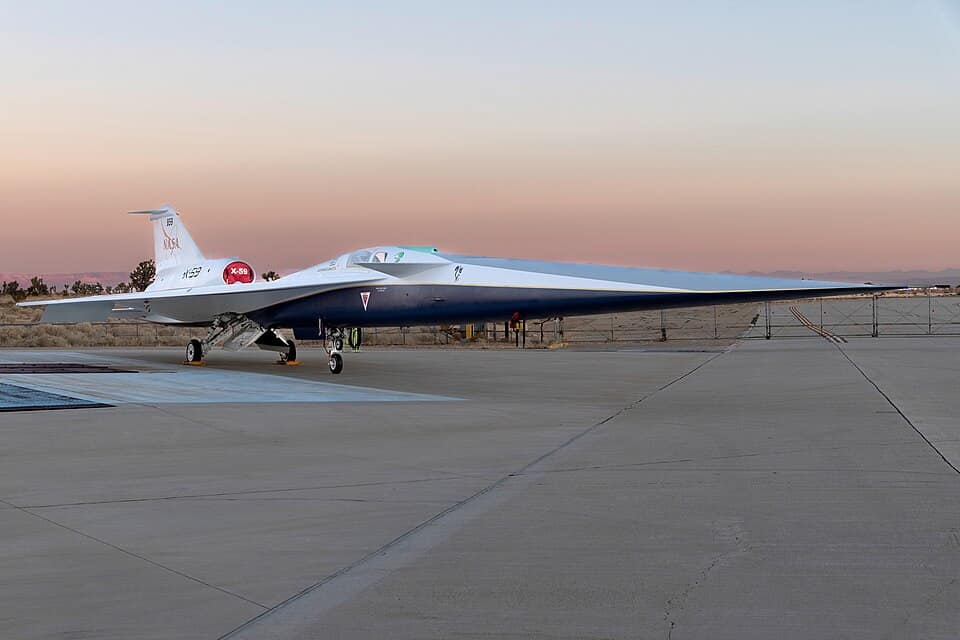
A cockpit warning light flashes. Nine minutes into just its second flight ever, NASA test pilot Jim “Clue” Less brings the X-59 back to the runway at Edwards Air Force Base. The flight is over — but the setback is temporary. Within days, engineers confirm the warning was a false positive. And on March 26 and 27, the X-59 flies twice more, back to back, pushing deeper into its envelope expansion programme.
The dream of quiet supersonic passenger travel just took another step forward.
The X-59 is the centrepiece of NASA’s Quesst mission — short for Quiet SuperSonic Technology. Built by Lockheed Martin’s legendary Skunk Works, the aircraft exists to answer a single question: can you break the sound barrier without the window-rattling sonic boom that got Concorde banned from flying over land?

Shaping the Shockwave
Every aircraft that flies faster than the speed of sound produces shockwaves that merge into the explosive double-crack of a sonic boom. The X-59’s radical design — a needle-like nose stretching nearly 30 metres, with the single engine mounted on top of the fuselage and a cockpit so embedded in the airframe that the pilot uses cameras instead of forward-facing windows — is engineered to prevent those shockwaves from merging.
Instead of a boom, people on the ground should hear something more like a car door closing down the street. NASA calls it a “sonic thump.” If the data proves the concept works, it could lead to new international regulations permitting supersonic flight over land — something that has been banned since 1973.
The stakes are enormous. The ban on overland supersonic flight effectively killed the economics of the Concorde and has kept every subsequent supersonic project grounded. Remove it, and the door opens for a new generation of commercial aircraft that could cut transatlantic flight times in half.

Pushing the Envelope
The X-59 made its maiden flight on October 28, 2025, with NASA pilot Nils Larson at the controls. That first sortie stayed subsonic and low, focused purely on validating that the aircraft was safe to fly. The second flight on March 20, 2026 — piloted by Less with Larson flying chase in an F/A-18 — kicked off Phase 1: envelope expansion.
Over the coming months, NASA will take the X-59 progressively faster and higher. The target: Mach 1.4 at 55,000 feet. That is roughly 925 mph — faster than any airliner has ever cruised. Dozens of test flights are planned for 2026 alone, each one nudging the aircraft closer to its design limits while engineers monitor every vibration, temperature reading, and structural load.
“Although the flight duration was abbreviated due to a technical issue, the team was able to collect information that will inform future tests.”
— NASA, on the X-59’s second flight
Phase 2 will be the real test. Once envelope expansion is complete, NASA plans to fly the X-59 over select American communities and measure what people on the ground actually hear. That acoustic data will be submitted to the FAA and international regulators. If the numbers confirm that the “thump” is acceptable, the decades-old ban could finally be revised.
A New Supersonic Age?
The X-59 is not a prototype airliner. No one will ever buy a ticket to ride in it. But the technology it validates could reshape commercial aviation. Companies like Boom Supersonic are already developing passenger aircraft designed to exploit exactly the kind of regulatory change the X-59 is built to justify.
For now, the action is at Edwards — the same stretch of California desert where Chuck Yeager first broke the sound barrier in 1947. Nearly 80 years later, the question is no longer whether we can go supersonic. It is whether we can do it quietly enough for the rest of the world to let us.
Sources: NASA, Aviation Week, Space.com
 English
0 Comments