
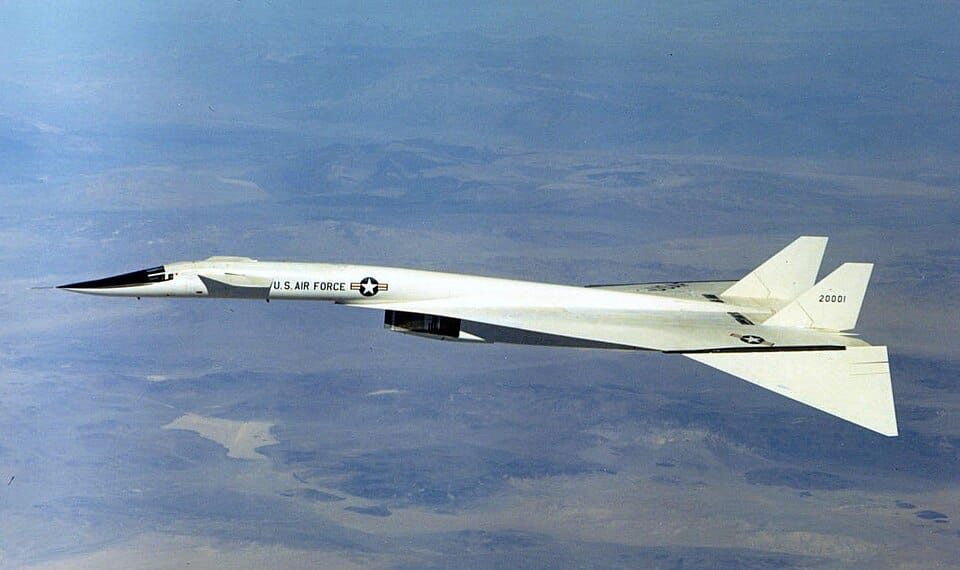
Quick Facts
- Aircraft: North American XB-70A Valkyrie — Mach 3+ strategic bomber prototype
- First flight: September 21, 1964
- Top speed: Mach 3.1 (2,056 mph / 3,309 km/h)
- Ceiling: 77,350 feet
- Engines: 6× General Electric YJ93-GE-3 turbojet, 28,800 lbf each with afterburner
- Length: 185 ft (56.4 m) — longer than a Boeing 727
- Crash: June 8, 1966 — midair collision with F-104N during photo formation
- Killed: NASA test pilot Joseph A. Walker and USAF co-pilot Major Carl S. Cross
- Survivor: Pilot Alvin S. White ejected with severe injuries
The XB-70 Valkyrie — Mach 3, drop-tip wings, space suits required. Via @blueprint.art on Instagram
Built for a War That Changed
The Valkyrie was conceived in the mid-1950s, when Strategic Air Command believed that speed and altitude were the keys to nuclear delivery. The B-52 could be intercepted. The B-58 Hustler was fast but limited in range. What SAC wanted was a bomber that could fly at Mach 3 above 70,000 feet — too fast for any interceptor, too high for any missile — and deliver thermonuclear weapons to targets deep inside the Soviet Union. North American Aviation won the contract in 1957 and began building something unprecedented. The XB-70 used compression lift — the supersonic shockwave generated by the aircraft’s delta wing at Mach 3 was captured and redirected beneath the fuselage by folding wingtips, effectively riding its own shockwave like a surfer on a wave. The airframe was made from stainless steel honeycomb sandwich panels and titanium, materials that could withstand the 330°C skin temperatures generated by sustained Mach 3 flight. The six YJ93 engines were themselves revolutionary — the first military turbojets designed from the outset for sustained Mach 3 cruise, burning a special high-thermal-stability fuel called JP-6. But by the time the first XB-70 flew in September 1964, the strategic landscape had shifted beneath it. The Soviet Union had deployed the SA-2 Guideline missile — the same weapon that shot down Gary Powers’ U-2 in 1960. ICBMs were replacing bombers as the primary nuclear delivery system. And the Kennedy administration, sceptical of manned bombers in the missile age, cut the programme from a planned fleet to just two research prototypes.Sixteen Seconds
The crash on June 8 remains one of the most documented aviation disasters in history, because a Learjet photographer was filming the formation from above when it happened. Five aircraft flew in close formation alongside the Valkyrie for a promotional photograph commissioned by General Electric — maker of the engines in all five types. An F-4 Phantom, an F-5 Freedom Fighter, a T-38 Talon, and Joseph Walker’s F-104N Starfighter tucked in around the enormous bomber. The formation was tight. Too tight. Walker’s F-104 was flying just feet from the XB-70’s right wingtip. At some point during the photo pass, the Starfighter drifted into the wingtip vortex — the powerful, invisible tornado of spinning air shed by every aircraft in flight. The vortex rolled the F-104 inverted and flipped it across the top of the Valkyrie’s fuselage. The Starfighter’s fuselage struck both vertical stabilisers, tearing them away completely, before the F-104 exploded against the left wing. The Valkyrie, impossibly, flew straight and level for sixteen seconds. Pilot Alvin White and co-pilot Carl Cross initially may not have realised the extent of the damage. Then the bomber yawed, rolled inverted, and entered a flat spin from which no recovery was possible. White managed to eject and survived with severe injuries. Cross did not eject. Walker was killed instantly in the collision.The Dream That Died Twice
The remaining XB-70, Ship One, continued flying as a NASA research aircraft until February 1969, accumulating valuable data on supersonic aerodynamics, sonic boom effects, and high-altitude atmospheric conditions. It completed 83 flights. Much of the data it generated was later used in the development of the Concorde and the B-1 Lancer. But the Valkyrie never became what it was designed to be. The combination of changing nuclear strategy, the rise of ICBMs, advancing Soviet air defences, and the devastating loss of Ship Two sealed its fate. The concept of a Mach 3 strategic bomber would not resurface until the B-1A programme in the 1970s — and even that aircraft was scaled back from Mach 2.2 to Mach 1.25 in its production B-1B form. The surviving XB-70 sits today in the National Museum of the United States Air Force at Wright-Patterson AFB, Ohio. It remains the largest aircraft ever to fly at Mach 3. Sixty years later, nothing has replaced it.Sources: This Day in Aviation, Wikipedia, Aviation Geek Club, Super Sabre Society


 English
0 Comments