
| Quick Facts | |
|---|---|
| Steam Catapult (C-13) | 0 to 165 mph in under 2 seconds; uses 1,200 lbs of steam per launch |
| EMALS (Electromagnetic) | 0 to 180+ mph; uses linear induction motor instead of steam |
| Aircraft Weight | Up to 100,000 lbs (F/A-18E: ~66,000 lbs loaded) |
| Catapult Stroke | ~310 feet (94 meters) |
| G-Force on Pilot | 3–4g for 2–3 seconds |
| Launch Rate | One aircraft every 20 seconds at surge tempo |
| EMALS Ships | USS Gerald R. Ford (CVN-78), USS John F. Kennedy (CVN-79) |

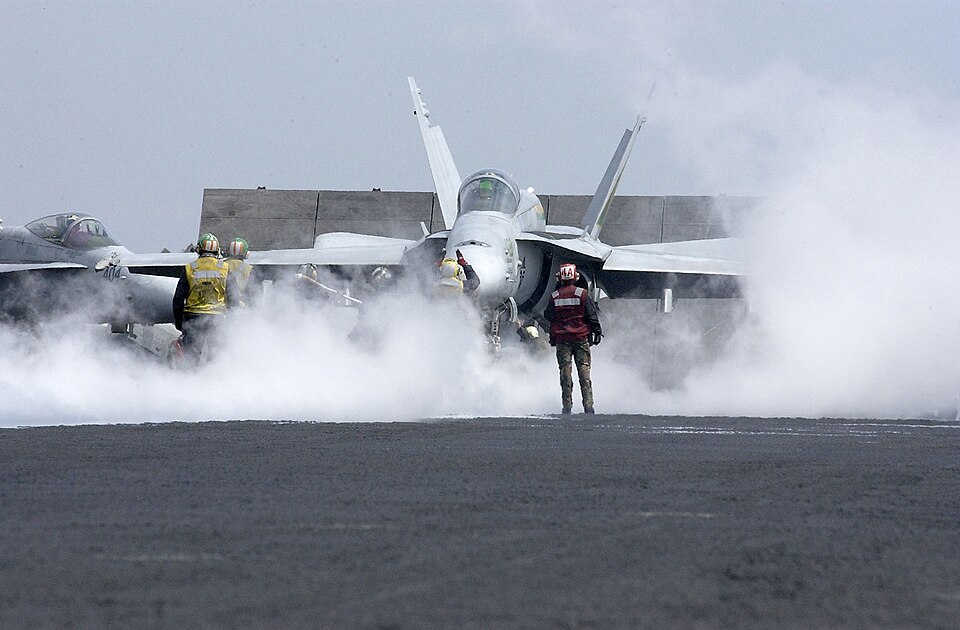
The pilot shoves the throttles to full military power. The engines scream to maximum dry thrust — 22,000 pounds per engine on an F/A-18E Super Hornet. The aircraft strains against the holdback fitting like a sprinter in the blocks. The catapult officer gives the signal. The holdback breaks. And in the next two seconds, the aircraft accelerates from zero to 165 miles per hour across 310 feet of flight deck.
Three to four g pushes the pilot into the seat. The ship’s bow disappears under the nose. The ocean fills the windscreen. And then — either the aircraft is flying or it isn’t. There is no second chance. The deck ends. Below it is the sea.
This happens roughly 100 times a day on a U.S. Navy carrier during flight operations. It is one of the most violent, precise and spectacular mechanical events in all of aviation.
Steam: The Old Way
For over 70 years, the steam catapult has been the standard launch system on American and French aircraft carriers. The principle is deceptively simple: superheated steam from the ship’s nuclear reactor is stored in accumulator tanks below the flight deck. When the catapult fires, that steam is released into a pair of cylinders that run beneath the deck. A piston inside each cylinder is connected to a shuttle — the metal fitting that hooks to the aircraft’s nose gear.
The steam expands explosively, driving the piston forward at enormous speed. The shuttle drags the aircraft along with it. In less than three seconds, a 66,000-pound Super Hornet has gone from stationary to takeoff speed. The energy required is equivalent to accelerating a pickup truck from zero to 150 mph in one second. The catapult does this with nothing but pressurised water vapour.
Each launch consumes roughly 1,200 pounds of steam. The accumulators refill in seconds from the ship’s reactor. At surge tempo, four catapults can launch an aircraft every 20 seconds — putting an entire carrier air wing airborne in minutes.
The Engineering Problem
Steam catapults work. They’ve launched hundreds of thousands of aircraft over seven decades. But they have limitations that become more pronounced with each generation of naval aircraft. The biggest: steam catapults deliver their energy in a single, violent pulse. The acceleration profile is front-loaded — maximum force at the start, tapering off as the steam expands and the piston reaches the end of its stroke.
This means the aircraft experiences peak stress at the very beginning of the launch, when the structural loads are highest. For robust, heavy fighters, this is manageable. For lighter aircraft — surveillance drones, unmanned tankers, electronic warfare platforms — the impulse can be damaging. You can’t easily dial down a steam catapult. It has two settings: full power and off.

Steam systems also require enormous amounts of fresh water (to make the steam), complex piping networks that run throughout the ship, and maintenance-intensive components that operate under extreme temperatures and pressures. The C-13 catapult has over a thousand individual parts, many of which must be replaced at regular intervals. On a carrier operating 7,000 miles from the nearest shipyard, that maintenance burden is significant.
EMALS: The Electromagnetic Revolution
The Electromagnetic Aircraft Launch System — EMALS — replaces steam with electricity. Instead of a piston driven by expanding gas, EMALS uses a linear induction motor: a series of electromagnets arranged along the length of the catapult track. When energised in sequence, they create a travelling magnetic field that accelerates a carriage along the track — silently, precisely, and with a controllable acceleration profile that can be tuned for each aircraft type.
The advantages are transformative. EMALS can vary its energy output from launch to launch — full power for a loaded F/A-18E, reduced power for a lightweight MQ-25 Stingray tanker drone. The acceleration is smoother, with peak loads distributed more evenly across the launch stroke. This reduces structural fatigue on the aircraft and extends airframe life. It also means the same catapult can launch everything from a 100,000-pound E-2D Hawkeye to a 20,000-pound drone without mechanical reconfiguration.
EMALS also weighs less, requires less maintenance, and draws its power from the ship’s electrical grid rather than a dedicated steam system. On the Ford-class carriers, the nuclear reactor generates electricity that feeds massive capacitor banks. When the catapult fires, those capacitors discharge their stored energy into the linear motor in a pulse that lasts less than three seconds.
What the Pilot Feels
Carrier pilots describe a cat shot as the most intense acceleration they’ve ever experienced outside of an ejection. The G-force hits instantly — 3 to 4g sustained for the full length of the stroke. Your head snaps back. Your arms are pinned. Your vision narrows. The instrument panel blurs. And your entire existence narrows to a single question: am I at flying speed when the deck runs out?
If the answer is yes, you’re flying. The aircraft clears the bow, settles momentarily as it transitions from catapult-assisted to self-sustained flight, and then climbs away. If the answer is no — a cold catapult, an engine failure at the worst possible moment — the aircraft goes off the bow and into the water. The pilot ejects. The plane sinks. It happens in seconds.

Night launches add another layer. The deck is lit only by dim blue taxi lights. The end of the bow is marked by a few green lights, then nothing — just blackness where the sea meets the sky. The pilot launches into a void, trusting instruments and procedure because the eyes have nothing to work with. It is, by every measurable standard, one of the most demanding things a human being can do in an aircraft.
And they do it every day. A hundred times. Because that’s how you project air power from the middle of an ocean.
Sources: U.S. Navy, Naval Air Systems Command, General Atomics (EMALS developer)


 English
0 Comments