

Fiat G.55 Centauro
Fast, tough and heavily armed, the Fiat G.55 Centauro is widely regarded as the finest fighter Italy fielded in the Second World War — a machine German test pilots reportedly rated the best in the Axis — yet it arrived too late and in far too few numbers to change anything.
The Fiat G.55 Centauro: Italy’s best fighter, built too late to matter
Give a talented Italian designer the same German engine the Luftwaffe used, wrap it in a big, strong airframe and hang three cannon on it, and you get the Fiat G.55 Centauro — the fighter many historians, and reportedly the German pilots who tested it, judged the best Italy produced in the whole of the Second World War.
By 1942 the Regia Aeronautica had spent three years learning a painful lesson: Italian designers could build beautiful, fine-handling fighters, but Italian industry could not give them the engines or the firepower to win. The nimble radial-engined Fiat CR.42 biplane and Fiat G.50 and Macchi C.200 monoplanes were all outclassed by the latest Spitfires and P-40s; even the excellent Macchi C.202 Folgore, powered by a licence-built Daimler-Benz DB 601, was chronically under-gunned. The obvious answer was more power, and Daimler-Benz had already provided it in the shape of the larger DB 605. Fiat took out a licence to build it in Italy as the Fiat R.A.1050 R.C.58 “Tifone” (Typhoon). Three Italian manufacturers each set out to build a world-class fighter around that engine — and the result was the trio of aircraft known as the “Serie 5.”
Fiat’s entry came from the drawing board of Giuseppe Gabrielli, the engineer whose earlier G.50 Freccia had been Italy’s first modern all-metal monoplane fighter. Gabrielli did not simply re-engine an old design as Macchi had done with the Folgore; he drew an essentially new, larger airframe optimised around the powerful Tifone. The prototype first flew on 30 April 1942, and it was clear at once that the Centauro — “Centaur” — was something special: fast, immensely strong, docile to fly and, unusually for an Italian fighter, stable and effective right up to very high altitude, where the massed Allied bomber streams flew.
The numbers backed up the impression. The production G.55 reached somewhere around 620 to 630 km/h (figures vary between sources and sub-variants), putting it firmly in the class of the Spitfire Mk IX and the P-51 Mustang it would meet in combat. Just as important, Gabrielli’s roomy airframe finally solved the firepower problem that had plagued every earlier Italian fighter. The definitive G.55/I carried three 20 mm MG 151/20 cannon — one firing through the propeller hub and one in each wing — backed by two 12.7 mm Breda-SAFAT machine guns in the cowling. For the first time an Italian fighter could hit as hard as it flew, and hit hard enough to knock down armoured four-engined bombers.
A world-class airframe, a licence-built German engine and three cannon — the Centauro was everything Italy’s earlier fighters should have been, and it came a year too late.
The aircraft’s reputation was sealed early in 1943 at a now-famous comparative trial. At the Guidonia test centre the three Serie 5 fighters were flown against captured or supplied examples of the German Messerschmitt Bf 109G and Focke-Wulf Fw 190. The G.55 came out extremely well: contemporary accounts describe it as the best all-round performer of the Italian trio, prized above all for its stability and controllability at every altitude, and German evaluators are widely reported to have rated it the best fighter in the Axis — praise all the more striking coming from the makers of the Bf 109 and Fw 190. The Germans thought highly enough of the Centauro that they later operated a number themselves and even studied building it under licence.
And yet the Centauro changed nothing, because there were almost none of them. The same complex Tifone engine that made the aircraft so good was desperately hard to mass-produce, Fiat’s factories were bombed and short of materials, and the design was more time-consuming to build than the re-engined Macchi. By the time Italy signed an armistice with the Allies on 8 September 1943, only around thirty G.55s had reached front-line units. Total wartime production is usually put at roughly 274 aircraft, though estimates range from barely a hundred to that figure — a rounding error beside the tens of thousands of Bf 109s, Spitfires and Mustangs. However good the Centauro was, it arrived far too late and in far too few numbers to matter strategically.
The armistice then split the aircraft, like the country, in two. In the German-occupied north, Mussolini’s rump fascist state raised a new air arm, the Aeronautica Nazionale Repubblicana (ANR), and its fighter groups flew the G.55 and the closely related Macchi C.205 against the overwhelming USAAF daylight raids of 1944, almost always heavily outnumbered. It was a bitter, losing defensive battle, and it burned through the small stock of Centauros quickly.
What makes the G.55’s story unusual is that it did not end in 1945. After the war Fiat simply restarted the line. Single-seat G.55A fighters and, cleverly, two-seat G.55B trainers rolled out of Turin; Argentina became the largest customer, and aircraft eventually reached Egypt and Syria. When surplus DB 605 engines ran out, Fiat re-engined the design with the Rolls-Royce Merlin as the G.59, which flew on into the 1950s. It was a strange, quiet afterlife for a fighter that had barely fought — the best aircraft of a lost cause, still earning its keep years after the war it was built for was over.
It is worth pausing on how good, and how frustrating, that story is. Italy had produced, in Gabrielli and his rivals at Macchi and Reggiane, engineers whose designs could genuinely stand comparison with anything in the world. The Guidonia trials proved it against the yardstick that mattered most — the Luftwaffe’s own front-line fighters. And yet the country could not translate that talent into aircraft on the flight line. The Centauro is the sharpest possible illustration of the gap between design brilliance and industrial reality: a fighter that was, by expert judgement, among the best in the world, and that made almost no difference to the war because Italy could build so few of them, so slowly, so late.
That is why the Centauro matters far more to history than its combat record alone would suggest. It is remembered not for what it did — it did very little — but for what it was, and for what it represented: proof that Italian aeronautical engineering was never the problem, and a poignant symbol of a nation whose reach in the air always exceeded its industrial grasp. The pages that follow trace how the aircraft was designed, how it was armed, the brief and bitter war it fought on both sides of Italy’s own divide, and the strange, long peacetime afterlife that kept the Centauro flying for another decade.
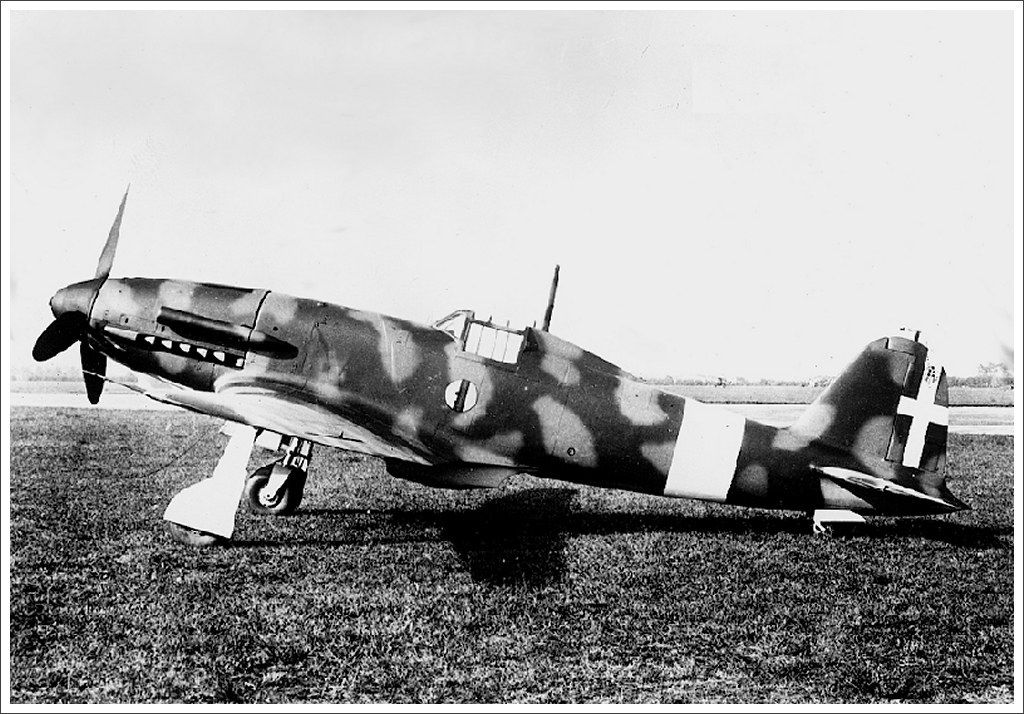
01The Fiat G.55 Centauro and the “Serie 5”: Italy’s three best fighters
The Centauro is impossible to understand in isolation, because it was one of three fighters conceived around the same engine. When Fiat obtained the licence to build the Daimler-Benz DB 605 as the R.A.1050 R.C.58 Tifone, three manufacturers each designed a new fighter around it: Fiat’s G.55 Centauro, the Macchi C.205 Veltro and the Reggiane Re.2005 Sagittario. Collectively these are Italy’s “Serie 5” — the fifth-series fighters, and by common consent the finest the country produced.
Each took a different approach. Macchi re-engined its existing C.202 Folgore, which meant the Veltro could reach the front fastest but inherited a smaller airframe. Reggiane drew the most aerodynamically radical machine, with a beautiful elliptical wing, but built almost none. Fiat’s Gabrielli split the difference: an all-new, larger, structurally very strong airframe that gave up a little in low-level agility but excelled at altitude and could carry a heavier standard armament. In the 1943 Guidonia fly-off the three were tested against the Bf 109G and Fw 190, and the G.55 emerged as arguably the best-balanced of the Italian trio — good enough that its reputation as “the best Italian fighter of the war” has largely stuck ever since.
02The Fiat G.55 Centauro’s engine: a licence-built Daimler-Benz DB 605
The heart of the Centauro was the Fiat R.A.1050 R.C.58 Tifone — not an Italian design but a licence-built copy of the German Daimler-Benz DB 605A, an inverted V12 of roughly 35.7 litres producing about 1,475 hp (1,475 PS) for take-off. It was the same engine, from the same family, that powered the Bf 109G and the sister Macchi C.205 Veltro, which is exactly why those three fighters are so often compared.
Licence production is also the key to the whole tragedy of the type. The DB 605 was a sophisticated, tightly toleranced engine, and Fiat could never build the Tifone in anything like the numbers Italy needed. Engine supply — not airframe design — was the real ceiling on Centauro production. When Germany later evaluated building the G.55 under licence itself, one attraction was precisely that it would use an engine the Germans already mass-produced. After the war, when surplus DB 605s finally ran out, Fiat kept the airframe alive by fitting the Rolls-Royce Merlin instead, creating the G.59.
The Tifone drove the Centauro through a three-bladed constant-speed propeller and was cooled by radiators mounted beneath the wings and fuselage, a layout that kept the fighter’s frontal area small and its nose slim — the classic silhouette of the inline-engined fighter, and the quickest way to tell the Serie 5 machines from the radial-engined fighters that preceded them. The inverted-V configuration of the DB 605, with its cylinder banks pointing downward, also gave the pilot a better view over the nose than an upright engine would have allowed, a small but real advantage in the deflection shooting that decided most dogfights.
03The Fiat G.55 Centauro’s armament: three cannon that finally bit
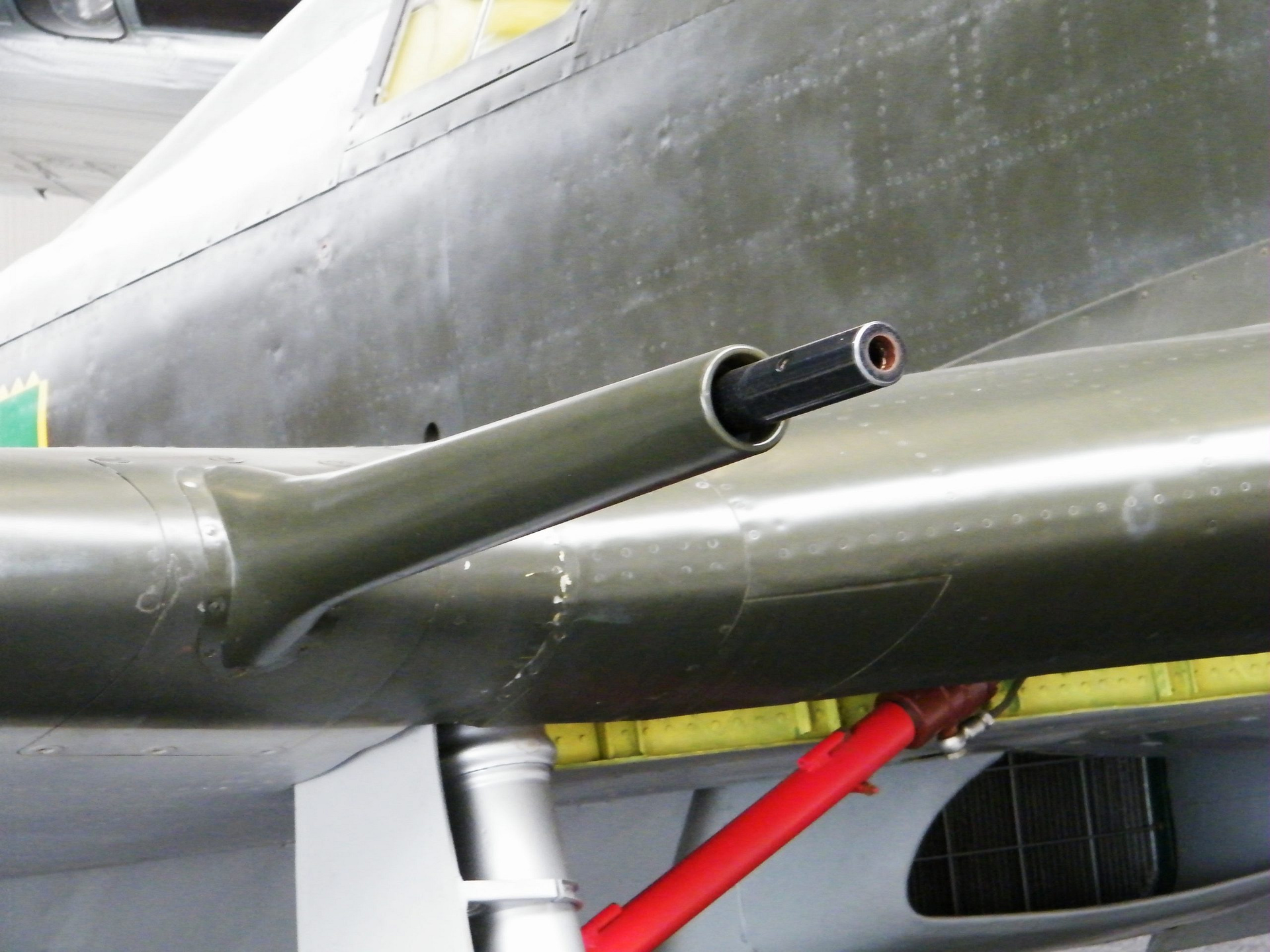
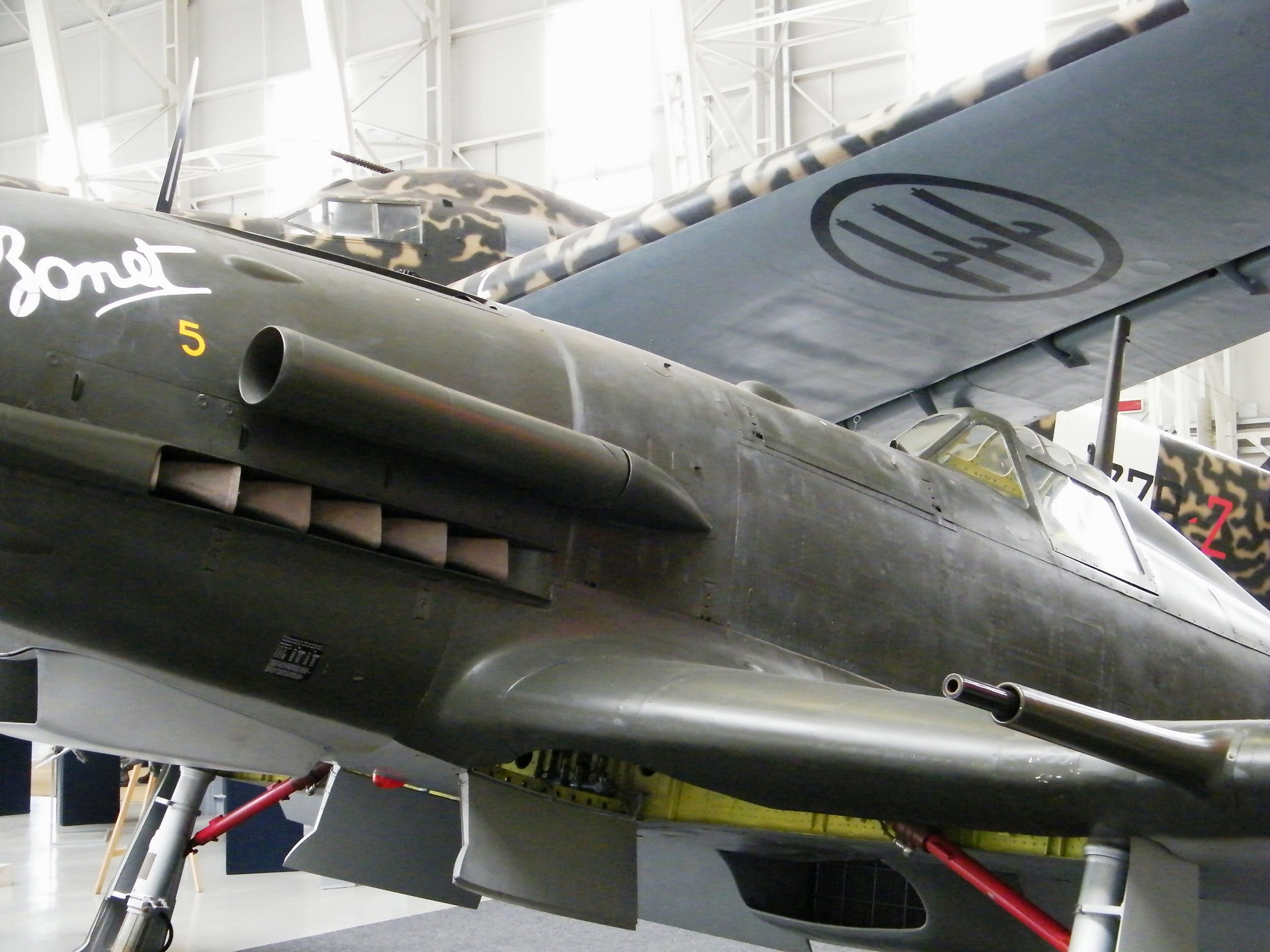
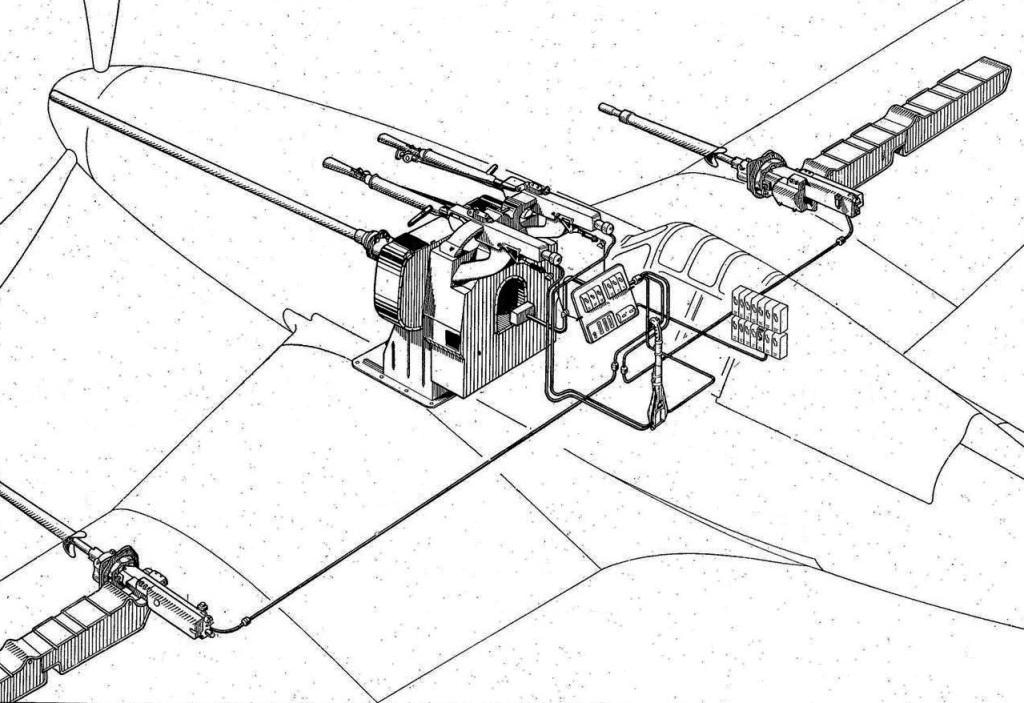
The single most important thing Gabrielli’s big airframe bought was room for guns. Where the Macchi C.202 and the earliest cannon-less fighters had made do with a pair of 12.7 mm Breda-SAFAT machine guns, the definitive G.55/I carried three 20 mm MG 151/20 cannon — one firing through the propeller-hub spinner and one in each wing — plus two 12.7 mm guns in the upper cowling. That is a genuinely heavy battery for a 1943 single-seat fighter, and the MG 151 was the same excellent weapon carried by the Bf 109 and Fw 190.
Some very early airframes were completed to a lighter standard while the wing-cannon installation was perfected, so as with the Veltro it is worth distinguishing the definitive three-cannon aircraft from the handful of early ones. An experimental G.55/II went further still, deleting the cowling machine guns in favour of five 20 mm cannon, but it did not enter series production. The heavy, hub-and-wing cannon armament of the standard Centauro is one of the features that set it apart from — and in firepower slightly ahead of — its Serie 5 stablemate the Macchi C.205.
The hub-mounted cannon deserves special mention, because it is both a signature feature and a genuine advantage. Firing straight down the aircraft’s centreline through the hollow propeller-shaft spinner, a hub cannon needs no synchronisation gear and suffers none of the convergence problems of wing guns, whose fire crosses at only one set distance. Combined with the two wing cannon and two cowling machine guns, it gave the Centauro a concentrated, hard-hitting punch that was ideally suited to its most important 1944 task: bringing down the heavily built, well-defended American four-engined bombers that the ANR was thrown against.
04Who designed the Fiat G.55 Centauro? Giuseppe Gabrielli and the Fiat fighter line
The Centauro was the masterpiece of Giuseppe Gabrielli, Fiat’s long-serving chief designer, whose fighters were all designated with his initial “G.” His G.50 Freccia of the late 1930s had been Italy’s first modern stressed-skin monoplane fighter, but it was hamstrung by a low-powered radial engine and open (later enclosed) cockpit, and it fought a losing battle against faster Allied types.
Gabrielli’s route to the Centauro ran through experiments with fitting inline engines to G.50 developments, but the G.55 was in the end an essentially new aircraft designed from the outset around the powerful Tifone. It is important not to confuse it with Fiat’s earlier fighters: the Centauro is a big, sleek, inline-engined monoplane, worlds apart from the radial-engined CR.42 Falco biplane or the stubby G.50. After the war Gabrielli went on to design jets, including the G.91 that won a NATO light-fighter competition — but the G.55 remained the finest piston fighter to carry his name.
What made the Fiat G.55 Centauro so good
Three things set the Centauro apart: a big, immensely strong airframe that stayed effective at high altitude, a powerful licence-built German engine, and a heavy three-cannon armament that let it destroy what it caught.
A strong, high-altitude airframe
Gabrielli’s all-metal airframe was larger and heavier than its Serie 5 rivals, but exceptionally strong and — crucially — stable and controllable right up to very high altitude, exactly where the massed Allied bombers flew. Pilots praised its steadiness as a gun platform.
The Tifone engine
The licence-built Daimler-Benz DB 605, made in Italy as the Fiat R.A.1050 R.C.58 Tifone, gave roughly 1,475 hp and a top speed around 620–630 km/h — closing the gap with the Spitfire Mk IX and P-51, and matching the engine in the Bf 109G.
Three cannon
The definitive G.55 carried three 20 mm MG 151/20 cannon (hub and wings) plus two 12.7 mm machine guns — a heavier standard battery than the Macchi C.205, and enough to knock down armoured four-engined bombers.
05The Fiat G.55 Centauro at Guidonia: judged the best fighter in the Axis
The Centauro’s towering reputation rests largely on a single event: the comparative fighter trials held at the Regia Aeronautica’s Guidonia test centre in early 1943. There the three Serie 5 fighters — the G.55, the Macchi C.205 and the Reggiane Re.2005 — were flown alongside the German Messerschmitt Bf 109G and Focke-Wulf Fw 190. The purpose was partly to help decide which types Italy (and potentially Germany) should build in quantity.
Accounts of the results are consistent on the essentials. The Macchi C.205 shone at low and medium altitude but fell away higher up; the Reggiane was very fast at height but plagued by production troubles; and the Fiat G.55 impressed above all with its stability, controllability and effectiveness across the whole altitude band. German evaluators are widely reported to have come away rating the G.55 the best fighter available on the Axis side. It is worth hedging the exact wording — reports of the trial have been retold many times and some superlatives have hardened in the retelling — but the substance is not in doubt: serious German testers, with the Bf 109 and Fw 190 to compare it against, thought the Centauro genuinely excellent.
The verdict had practical consequences. Impressed by what they saw, the Germans not only used a number of Centauros themselves after the armistice but seriously examined building the type in Germany, precisely because it used an engine they already produced in quantity. For a nation as confident in its own aircraft as wartime Germany to weigh adopting a foreign fighter is, in itself, one of the strongest testimonials the G.55 ever received — and it is the root of the type’s enduring “best Italian fighter of the war” reputation.
06The Fiat G.55 Centauro versus the Bf 109, the Spitfire and the Mustang
On paper and in the air the Centauro could live with the best fighters of 1943. Its top speed of around 620–630 km/h was competitive with the Spitfire Mk IX and the P-51, and its high-altitude stability and heavy cannon armament made it a dangerous bomber-destroyer. Against the Bf 109G it shared the same engine but offered a roomier, stronger airframe and, in standard form, heavier firepower, at the cost of a little agility and climb.
The honest caveats are the same ones that shadow the whole Serie 5 story. The Centauro was heavier than its rivals, so its rate of climb and low-speed turn were good rather than dominant; its radios and some systems lagged Allied standards; and, above all, it was available in tiny numbers against air forces that fielded hundreds of aircraft on a single mission. A superb fighter flown by a handful of veterans can win individual dogfights but cannot win command of the sky. That, in one sentence, is the Centauro: as good as almost anything it met, and almost never there.
07Why so few Fiat G.55 Centauros were built
For all its quality, only around 274 Centauros are commonly cited as completed during the war, and even that figure is disputed — some sources put wartime output as low as roughly a hundred, and only about thirty-one aircraft had reached units by the armistice of 8 September 1943. Compare that with roughly 34,000 Bf 109s and the scale of Italy’s problem is obvious.
The bottleneck was never Gabrielli’s design. It was the engine and the state of Italian industry in 1943: the complex licence-built Tifone was slow and difficult to manufacture; raw materials were scarce; Fiat’s Turin plants were bombed; and the September 1943 armistice threw the whole industrial base into chaos, splitting it between the German-occupied north and the Allied south. The G.55 is the classic example of a war-winning design that a losing industrial situation could never deliver in war-winning quantities. It is also why the type’s most interesting production story is actually the post-war one, when Fiat could finally build it in peace.
08The Fiat G.55 Centauro versus its Serie 5 rival, the Reggiane Re.2005 Sagittario
The third member of the Serie 5 trio was the Reggiane Re.2005 Sagittario (“archer”), and comparing it with the Centauro sharpens what made Gabrielli’s design the more practical machine. On paper the Re.2005 was arguably the most beautiful and aerodynamically advanced of the three, with an elegant elliptical wing reminiscent of the Spitfire and superb performance at altitude. At the Guidonia trials it was noted as very fast high up.
But beauty came at a price. The Re.2005 was structurally complex and slow to build, and Reggiane — a smaller firm than Fiat or Macchi — completed only a tiny handful, on the order of forty-odd aircraft. The G.55, by contrast, offered nearly comparable high-altitude ability in a much stronger, more producible airframe, with a heavier standard armament of three cannon. In the brutal arithmetic of 1943 that made the Centauro the more useful weapon: not quite as exquisite as the Sagittario, but tougher, better armed and — relatively speaking — buildable. That the G.55 still reached the front in only small numbers says everything about how desperate Italy’s industrial situation had become.
The Fiat G.55 Centauro’s war: 1943, the armistice, and a post-war afterlife
The Centauro’s front-line career was brief and came at the worst possible moment — but the aircraft’s story runs on for years afterwards, through an Italian civil war, an export drive, and a Rolls-Royce-engined second life.
When the first G.55s reached the Regia Aeronautica in the spring of 1943, Italy was already losing. The Axis position in North Africa had collapsed, Sicily was about to be invaded, and Allied bombers were ranging ever deeper into Italian skies. Into that desperate situation came a fighter Italian pilots had been waiting years for: fast, strong, effective at altitude and, at last, heavily armed. But there were only a handful of them. The Centauro flew defensive sorties over Rome, Naples, Sardinia and the industrial north, and where it met the enemy it acquitted itself well — yet a trickle of aircraft could do nothing to blunt an Allied air offensive measured in the thousands.
Then, on 8 September 1943, Italy signed an armistice with the Allies, and the aircraft’s story fractured along with the country. In the German-occupied north, Mussolini’s new fascist republic raised the Aeronautica Nazionale Repubblicana (ANR). Its fighter groups — men who had chosen to keep fighting alongside Germany — took the G.55 and the Macchi C.205 into a grinding defensive battle against the USAAF’s massed daylight raids of 1944, almost always outnumbered many times over. The ANR’s Centauro pilots earned respect even from the Luftwaffe alongside which they flew, but their war was one of steady attrition against impossible odds, and it consumed the small stock of aircraft quickly.
The Germans themselves took a serious interest. Having rated the G.55 so highly at Guidonia, the Luftwaffe operated a number of Centauros through German-controlled units in Italy, and there were even proposals — never realised at scale — to build the type in Germany, since it used an engine German factories already produced. It is a striking curiosity: a German air arm flying an Italian fighter powered by a licence-built German engine and armed with German cannon, the DB 605 and MG 151 having come full circle.
For the ANR’s pilots the reality of that 1944 fight was grim and repetitive. Wave after wave of American heavy bombers, hundreds strong and shielded by long-range escorts, crossed the Alps and the Apennines to hit northern Italian industry, railways and cities. Against them the ANR could put up only a handful of Centauros and Veltros at a time. The Italian fighters, fast and well-armed, could reach the bombers and hurt them — the three-cannon G.55 was a genuine bomber-killer — but each interception cost aircraft and irreplaceable veteran pilots, and the trickle of new Centauros from the disrupted factories could not keep pace. By late 1944 many ANR units were converting to German Bf 109s simply because they could be supplied; the home-grown Centauro, for all its quality, was being starved out of its own war.
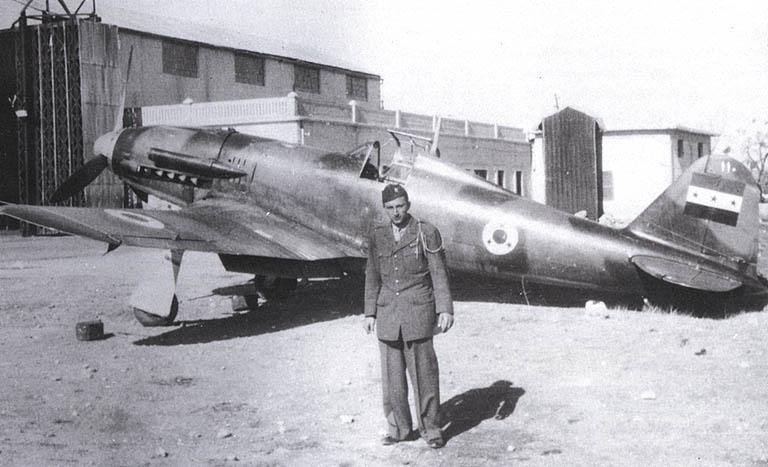
What happened next is what makes the Centauro unusual among wartime fighters: production did not really stop, it paused. With the war over, Fiat restarted the line at Turin, building single-seat G.55A fighters and — making shrewd use of the type’s roomy fuselage — two-seat G.55B advanced trainers. Argentina became the largest export customer, ordering around thirty G.55A fighters and fifteen G.55B trainers in the late 1940s. When relations shifted, a batch of ex-Argentine Centauros found their way back to Europe and on to Syria, while Egypt too acquired Fiat fighters around the time of the 1948 Arab-Israeli War. The exact numbers and routes are tangled and the sources disagree, but the broad shape is clear: an Italian fighter that had barely fought its own war ended up serving air forces from South America to the Middle East.
The final twist was mechanical. As stocks of the wartime DB 605 / Tifone engine ran dry, Fiat re-engined the design with the readily available Rolls-Royce Merlin, producing the G.59 in both single- and two-seat forms. G.59s served the Italian Air Force as trainers into the 1950s and were themselves exported — Syria received a batch of Merlin-engined machines. It is why, confusingly, several of the aircraft displayed today as “G.55s” are strictly speaking the Merlin-powered G.59 development: the same Gabrielli airframe, a different engine, and a service life that stretched a full decade beyond the war the Centauro was designed to fight.
09The Fiat G.55 Centauro in ANR service: the units and pilots who flew it
After the armistice, the men who chose to keep fighting alongside Germany formed the fighter arm of the Aeronautica Nazionale Repubblicana. Its groups — among them the Gruppi that would become famous in the ANR’s short history — re-equipped with a mix of the Fiat G.55 and the Macchi C.205, the best fighters Italy could still produce, and threw them against the American bomber offensive rolling up through Italy in 1944.
Their war was almost unwinnable. A typical interception might pit a dozen or two Centauros and Veltros against hundreds of B-17s and B-24s and their swarming P-51 and P-38 escorts. The ANR pilots — many of them veterans of North Africa and the Mediterranean — fought with skill and considerable courage, and their combat claims were respectable, but attrition was relentless and replacements few. As the Centauros were used up and new engines failed to arrive, ANR units increasingly re-equipped with German Bf 109s. The G.55’s front-line career with the ANR was therefore intense but brief: a last, defiant flourish of Italian fighter design flown in a cause already lost.
10The Fiat G.55 and the Luftwaffe: the fighter Germany nearly built
Germany’s interest in the Centauro was serious and practical. Having watched the G.55 perform at Guidonia, the Luftwaffe not only operated a number of the aircraft through German-controlled units in Italy but also studied the possibility of building the type in Germany. The logic was compelling: the G.55 already used a licence-built DB 605, an engine German factories produced in huge quantity, so a German-built Centauro would not compete for the scarce engines that constrained Italian production.
In the event nothing came of large-scale German production — the war situation, the demands of standardising on the Bf 109 and Fw 190, and the sheer disruption of 1944–45 saw to that. But the very fact that Germany considered adopting an Italian fighter is a measure of how highly the G.55 was rated. It remains one of the great “what ifs” of the air war: a Centauro built in German numbers, with a reliable engine supply, might have been a genuinely significant fighter rather than a magnificent footnote.
11The Fiat G.55 Centauro’s legacy: why a fighter that barely fought is so admired
By any measure of impact the G.55 was a minor aircraft: too few, too late, on the losing side. And yet it is remembered and admired out of all proportion to the numbers built. The reason is that it stands for a genuine possibility — proof that Italian designers, given the right engine, could build a fighter the enemy itself judged the best in the Axis. Historians reach for the Centauro whenever they want to show that Italy’s aeronautical talent was never in question; capacity, materials, strategy and timing were.
For enthusiasts the appeal is also aesthetic and human. The Centauro is a handsome, purposeful aircraft with a dramatic, tragic story: a thoroughbred that reached the starting line just as the race was lost, that was then torn between the two halves of a broken nation, and that finally found a quiet second career flying for foreign air forces long after the cause it was built for had vanished. That combination of excellence and might-have-been is exactly why the Fiat G.55 Centauro earns a place in a museum devoted to the greatest aircraft ever flown — even though only a handful survive, and none has flown for decades.
Fiat G.55 Centauro full specifications
Figures are for the definitive wartime G.55/I and are drawn from established reference sources; several are approximate and vary between references and sub-variants, so contested values are flagged.
| Экипаж | 1 (pilot) |
|---|---|
| Двигатель | Fiat R.A.1050 R.C.58 Tifone — licence-built Daimler-Benz DB 605A, inverted V12 |
| Power | ~1,475 hp (1,475 PS) for take-off |
| Максимальная скорость | ~620–630 km/h (~385–391 mph) at altitude (varies by source) |
| Служебный потолок | ~12,700–12,750 m (~41,800 ft) |
| Диапазон | ~1,200 km (~745 mi) — figures vary |
| Скорость подъема | ~6,000 m in ~7 minutes (approx.) |
| Armament (definitive G.55/I) | 3 × 20 mm MG 151/20 cannon (1 hub, 2 wings) + 2 × 12.7 mm Breda-SAFAT (cowl) |
| Armament (experimental G.55/II) | 5 × 20 mm cannon (cowl guns deleted) — did not enter series production |
| Bomb load | Up to 2 × 160 kg bombs or drop tanks (optional) |
| Длина | 9.73 m (31 ft 11 in) |
|---|---|
| Размах крыльев | 11.85 m (38 ft 10 in) |
| Высота | 3.13 m (10 ft 3 in) |
| Зона крыла | ~21.1 m² (227 sq ft) |
| Пустой вес | ~2,630 kg (estimate) |
| Loaded / max take-off weight | ~3,718 kg (estimate) |
| First flight | 30 April 1942 (prototype) |
| Service entry | March 1943 (Regia Aeronautica) |
| Number built | ~274 wartime + ~75 post-war (figures vary widely; ~349 total) |
| Designer | Giuseppe Gabrielli |
| Производитель | Fiat, Turin (Italy) |
| Unit cost | Not reliably recorded (WWII) |
| Cost per flight hour | Not applicable — no airworthy example |
Values marked “estimate” or “varies” should be treated as approximate. Speed, weight, range and production figures in particular differ between references and between the many G.55 and post-war G.55A / G.55B / G.59 sub-variants.
12The Fiat G.55 Centauro’s variants: G.55/I, G.55/II, G.55S, G.55A, G.55B and the Merlin G.59
Few piston fighters spawned as many variants relative to numbers built. The wartime production aircraft was the G.55/I with three 20 mm cannon; the experimental G.55/II raised this to five cannon. A dedicated torpedo-carrying version, the G.55S (silurante), was developed to carry an aerial torpedo, though it saw little use. There were also reconnaissance and lightened sub-types proposed as the war situation demanded.
The richer story is post-war. Fiat resumed production with the single-seat G.55A fighter and the two-seat G.55B advanced trainer — the latter making excellent use of the Centauro’s large fuselage. When wartime DB 605 engines ran out, Fiat fitted the Rolls-Royce Merlin to create the G.59, again in single-seat (G.59-1A, G.59-4A) and two-seat (G.59-2A, G.59-4B) forms. These Merlin-engined machines served the Italian Air Force into the 1950s and were exported. It is why several airframes displayed today as “G.55s” are in fact G.59s: the same Gabrielli design, a different engine.
13The Fiat G.55 Centauro’s post-war export career: Argentina, Egypt and Syria
With the Italian market saturated and the type out of front-line fashion, Fiat looked abroad. Argentina was the biggest customer, ordering around thirty G.55A single-seat fighters and about fifteen G.55B two-seat trainers in the late 1940s, which served the Fuerza Aérea Argentina before being retired as jets arrived.
The Middle East proved the other market. Around the time of the 1948 Arab-Israeli War, Egypt acquired Fiat fighters, and a batch of roughly seventeen ex-Argentine Centauros was transferred to Syria in 1948. Syria later also bought Merlin-engined G.59s — commonly cited as about twenty-six single-seat and four two-seat aircraft. The precise numbers, dates and aircraft identities are genuinely tangled and sources disagree, so these totals should be read as approximate; what is not in doubt is that the Centauro and its G.59 derivative flew in several air forces well after 1945.
This export career is one of the reasons so few original wartime G.55s survive: many of the airframes that outlived the war were flown hard as trainers and second-line fighters overseas, then scrapped when jets replaced them, rather than being preserved. It also explains a common source of confusion — a photograph captioned “Fiat G.55” taken in Argentine, Egyptian or Syrian markings may show a late-production or post-war airframe, or even a Merlin-engined G.59, rather than a wartime Regia Aeronautica or ANR machine.
14The Fiat G.55 Centauro’s operating costs: why there is no cost-per-hour figure
Unlike the modern jets in the MiGFlug fleet, the Centauro has no meaningful operating-cost figure. Wartime unit costs for Italian fighters were not reliably or consistently recorded, and the currency and economic chaos of 1943–45 Italy makes any single number misleading.
More to the point, there is no airworthy Fiat G.55 anywhere in the world. Every surviving original is a static museum exhibit, so there is no fuel bill, no maintenance cost and no cost-per-flight-hour to quote — the honest entry in the specifications table is simply “not applicable.” If you want to know what flying a genuine fighter actually costs today, the aircraft MiGFlug operates are a far better guide than a fighter that has not flown for over half a century.
15How to tell a Fiat G.55 Centauro from the Macchi C.205, the CR.42 and the G.50
The Centauro is easy to confuse with its relatives if you do not know the tells. Against the earlier Fiat fighters the distinction is stark: the CR.42 Falco is a fabric-and-strut biplane with a radial engine, and the G.50 Freccia is a small, stubby radial-engined monoplane. The G.55 is a large, sleek, inline-engined monoplane — a completely different generation of aircraft, even though all three carry Gabrielli’s “G.”
The harder call is against the Macchi C.205 Veltro, because the two share the same DB 605 / Tifone engine and a similar slim inline nose. Here the tells are size and detail: the G.55 is noticeably larger and heavier, with a broader wing; it carries a cannon firing through the propeller hub and a cannon in each wing (three in all), where the standard Veltro has two wing cannon; and the two wear different national and unit markings in most museum settings. Manufacturer is the ultimate answer — a Fiat is a G.55, a Macchi is a C.205 — but the hub cannon and the larger airframe are the quickest visual cues.
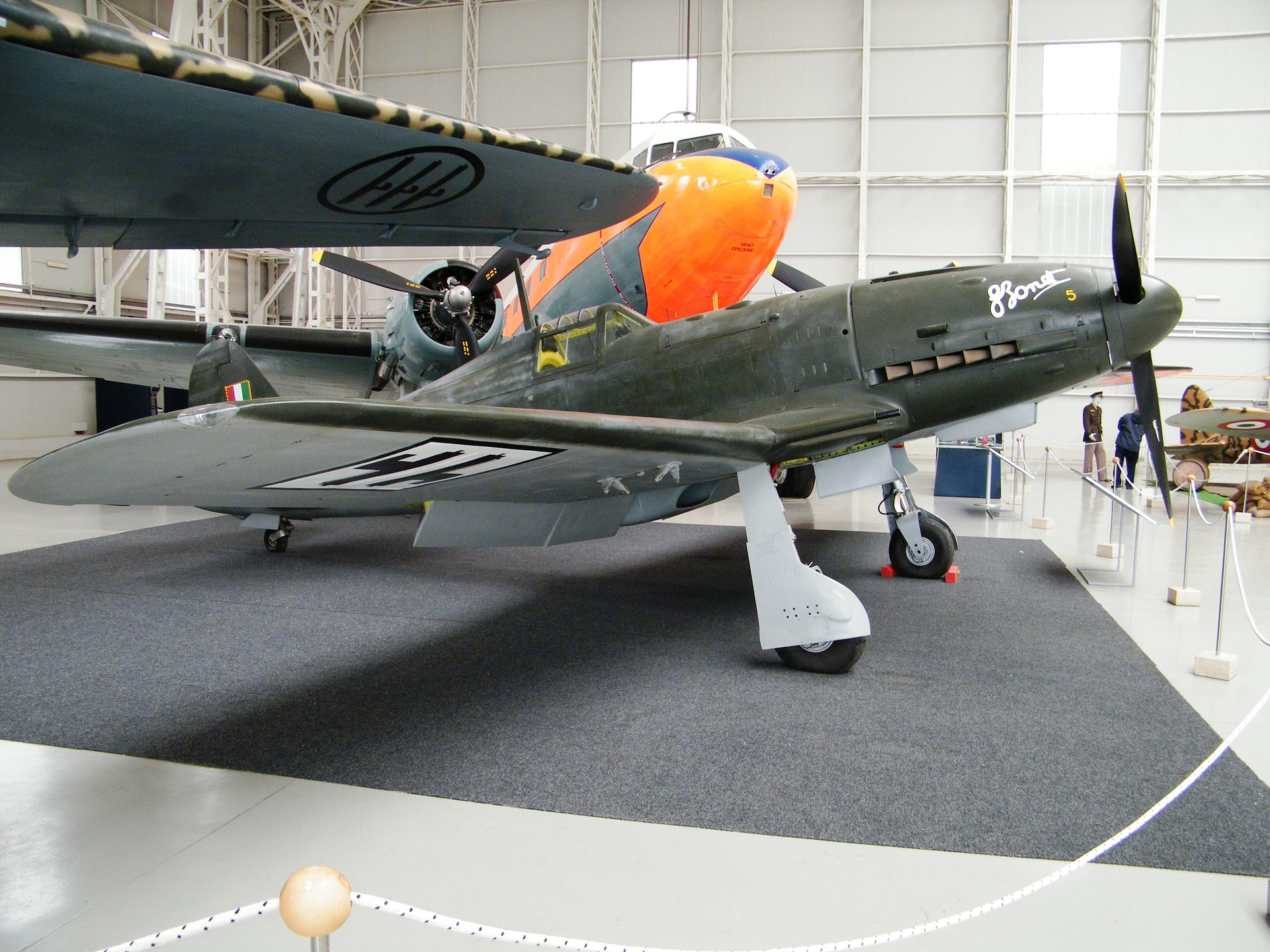
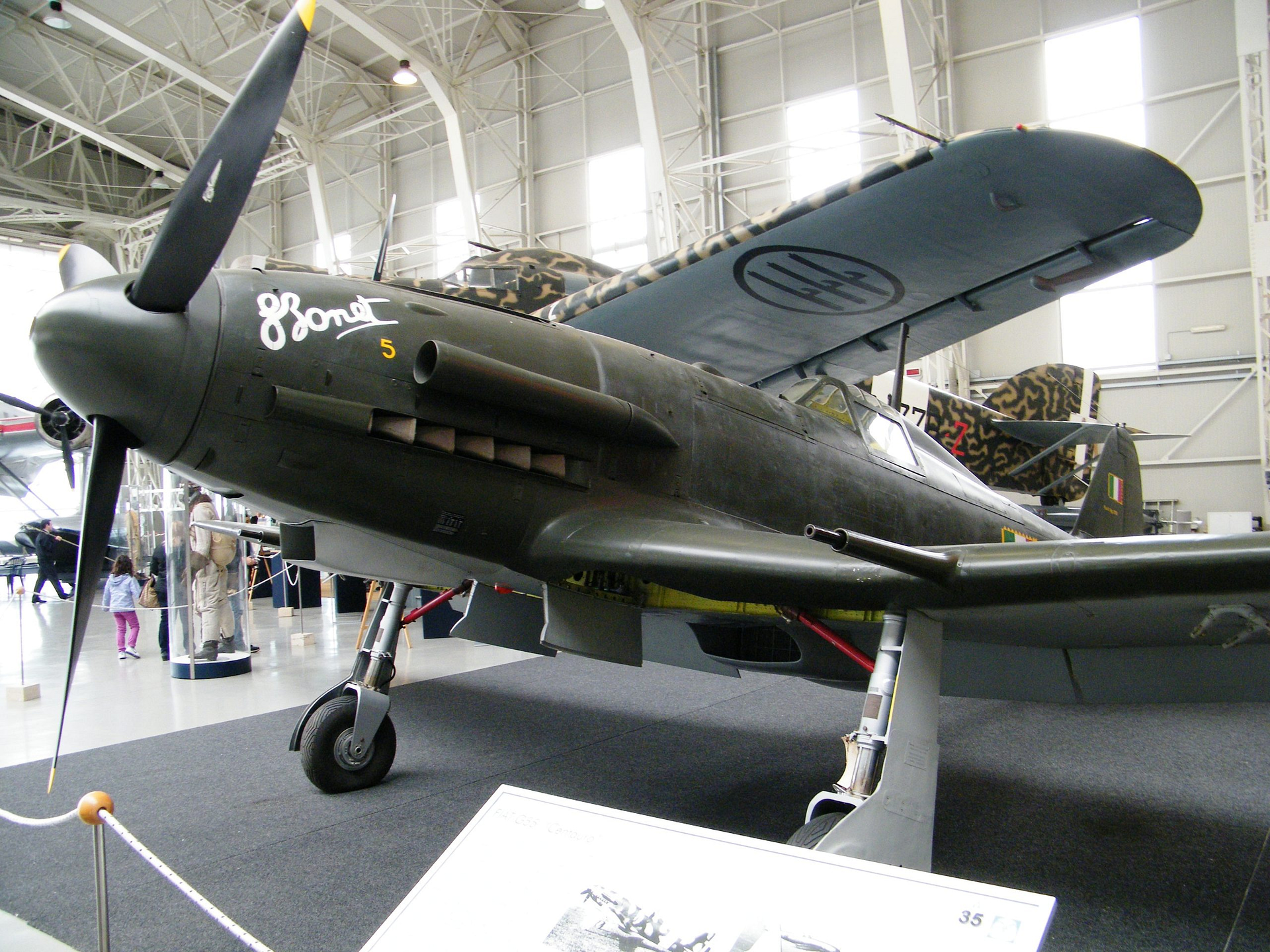
One more trap catches the unwary at museums: the post-war G.59. Because Fiat re-engined the Centauro with the Rolls-Royce Merlin, and because several preserved airframes are in fact G.59s, an aircraft labelled or remembered as a “G.55” may actually have the longer, differently shaped nose of the Merlin installation, or be a two-seater. If the cockpit has room for two, it is a G.55B or G.59 trainer, not a single-seat wartime fighter. When you want to be sure you are looking at a genuine wartime Centauro, the surest example is the single-seat aircraft in ANR markings at Vigna di Valle.
The Fiat G.55 Centauro: a short war and a long afterlife
Gabrielli’s first fighters. Fiat’s G.50 Freccia gives Italy its first modern monoplane fighter, but a weak radial engine leaves it outclassed.
The Tifone licence. Fiat begins licence production of the Daimler-Benz DB 605 as the R.A.1050 R.C.58 Tifone, the engine shared by all three “Serie 5” fighters.
First flight. The G.55 prototype takes to the air — an all-new, large, strong airframe built around the powerful Tifone.
The Guidonia trials. The G.55 is flown against the Macchi C.205, Reggiane Re.2005, Bf 109G and Fw 190; German evaluators reportedly rate it the best fighter in the Axis.
Into service. The first G.55s reach the Regia Aeronautica, armed with three 20 mm cannon and two machine guns.
Combat. Centauros fly defensive sorties over Rome, Naples, Sardinia and northern Italy against Allied raids — but only a few are available.
The armistice. Italy changes sides. Only around thirty-one G.55s have reached units. The fleet and the country split in two.
The ANR’s fight. The fascist Aeronautica Nazionale Repubblicana flies the G.55 and C.205 against massed USAAF daylight raids over northern Italy, heavily outnumbered.
German use. The Luftwaffe operates a number of Centauros in Italy and studies building the type, which uses an engine Germany already produces.
Post-war revival. Fiat restarts production: G.55A fighters and G.55B trainers. Argentina buys ~30 fighters and ~15 trainers; aircraft reach Egypt and Syria.
The Merlin G.59. With DB 605 engines exhausted, Fiat re-engines the design with the Rolls-Royce Merlin as the G.59, which serves and is exported into the 1950s.
Survivors. Only a small number of originals survive, notably at the Italian Air Force Museum at Vigna di Valle; none is airworthy.
Twelve things worth knowing about the Fiat G.55 Centauro
Scroll through the episodes and details that make the Centauro one of the most admired — and most poignant — fighters of the war.
One engine, three fighters
The Centauro was born from a national bet: build a world-class fighter around the licence-produced Daimler-Benz DB 605. Three firms tried at once — Fiat, Macchi and Reggiane — creating the “Serie 5” trio. Fiat’s Giuseppe Gabrielli drew an all-new, larger airframe rather than re-engining an old one, and it paid off in strength and high-altitude performance.
Centauro — the Centaur
Fiat’s fighter carried a mythological name to match Italy’s tradition of evocative titles — alongside the Macchi Veltro (greyhound) and Reggiane Sagittario (archer). The centaur, half-man and half-horse, suited a big, powerful machine that combined brute strength with agility, and it looked the part: long, muscular and purposeful. All three were designed around the same licence-built German engine, which is why they are grouped together as the Serie 5.
30 April 1942
The prototype flew in the spring of 1942 and impressed immediately. But turning a fine prototype into front-line aircraft meant building the complex Tifone engine in quantity, and that took most of a year — a delay that proved fatal to the type’s wartime impact, because by the time it was ready Italy’s strategic position had already collapsed. Service entry came only in March 1943, with the Allies already closing on Sicily.
Best in the Axis
At the 1943 Guidonia trials the G.55 was flown against the Bf 109G and Fw 190. It impressed the German evaluators so much that they reportedly judged it the best fighter in the Axis — an extraordinary verdict on an Italian design from the men who built the Luftwaffe’s own front-line fighters.
A German heart, built in Italy
The Fiat R.A.1050 R.C.58 Tifone was a licence-built Daimler-Benz DB 605, the very engine that powered the Bf 109G. It gave the Centauro about 1,475 hp — and it was also its curse, because Fiat could never build the sophisticated engine fast enough to matter. When even licence-built DB 605s ran short after the war, Fiat kept the airframe alive by fitting the Rolls-Royce Merlin instead, creating the G.59.
Three cannon and two machine guns
Gabrielli’s roomy airframe finally solved Italy’s chronic firepower problem. The definitive G.55 carried three 20 mm MG 151/20 cannon — one through the propeller hub, one in each wing — plus two 12.7 mm machine guns: enough to tear apart the armoured four-engined bombers pounding Italy. The hub cannon fired straight down the centreline, with no synchronisation gear and no convergence problems — the ideal bomber-killing weapon.
Thirty-one by the armistice
For all its quality, only about thirty-one G.55s had reached units when Italy signed the armistice on 8 September 1943. Total wartime production is usually put around 274, though estimates run lower. However good the aircraft was, there were simply never enough to change the course of the air war. The Centauro is the ultimate example of quality defeated by quantity — a fighter that could out-fly the enemy one aircraft at a time, in a war decided by thousands.
A fighter of the civil war
The armistice tore Italy — and its air force — in two. In the German-aligned north the fascist ANR flew the Centauro; in the Allied south other Italian units flew what survivors they had. The G.55 became a fighter of Italy’s own civil war, in the skies over its own cities — Italians fighting Italians in the same type of aircraft, a tragedy few other nations’ fighters ever shared.
The ANR’s outnumbered defenders
In 1944 the Aeronautica Nazionale Repubblicana threw its G.55 and C.205 fighters against the USAAF’s vast daylight bomber streams over northern Italy. Almost always heavily outnumbered, the ANR pilots fought a bitter, losing battle that earned respect even from the Luftwaffe alongside which they flew. As Centauros were used up and new engines failed to arrive, many ANR units re-equipped with German Bf 109s.
Flown, and nearly built, by the Luftwaffe
Having rated the Centauro so highly, the Germans operated a number themselves in Italy and even weighed building it in Germany — attractive because it used the DB 605 they already mass-produced. It is a curious full circle: a German engine, in an Italian fighter, back in German hands. That a confident air power would consider adopting a foreign design is among the strongest testimonials the G.55 ever received.
Argentina, Egypt and Syria
Peace, not war, is when the Centauro was finally built in numbers. Fiat restarted the line for G.55A fighters and G.55B trainers; Argentina bought around thirty fighters and fifteen trainers, and aircraft reached Egypt and Syria, including a batch of ex-Argentine machines transferred to Syria in 1948. An Italian fighter that had barely fought its own war ended up serving from South America to the Middle East.
A second life as the G.59
When wartime DB 605 engines ran out, Fiat fitted the Rolls-Royce Merlin and created the G.59, in single- and two-seat forms. G.59s trained Italian pilots into the 1950s and were exported to Syria — which is why several aircraft displayed today as “G.55s” are really the Merlin-powered development. The same Gabrielli airframe thus flew on for a full decade after the war it was designed for had ended.
Fiat G.55 Centauro in photographs
Wartime images and the surviving museum aircraft. Click any photograph to enlarge. All images are public domain or Creative Commons, credited in the captions.
The Fiat G.55 Centauro on video
A detailed, well-researched history of the Centauro from the aviation channel IHYLS, covering the type’s development, its heavy armament and the industrial failure that kept it from mattering.
“How Fiat Sabotaged A (Slightly) Better Fighter: Fiat G.55 Centauro” — IHYLS (an established aviation-history channel), published May 2025, roughly 44,000 views at the time of writing. The G.55 is an obscure type, so no single documentary reaches the millions of views a Spitfire video might; this is among the most thorough dedicated treatments available.
Where the Fiat G.55 Centauro flew
Origin and manufacture in Italy, wartime service with the Regia Aeronautica and the fascist ANR (plus German evaluation), the post-war exports to Argentina, Egypt and Syria, and where surviving airframes are preserved. Hover (or tap on mobile) a country for details; use the buttons to toggle categories.
The Fiat G.55 Centauro by the numbers
The Centauro’s story is one of quality against scarcity: a first-rate fighter available in tiny numbers, flown in 1943–45 by the Regia Aeronautica, the fascist ANR and the Luftwaffe, then built in greater numbers post-war for Argentina, Egypt and Syria and re-engined with the Merlin as the G.59.
Fiat G.55 Centauro: your questions answered
Can I fly in a Fiat G.55 Centauro?
No. There is no airworthy Fiat G.55 Centauro anywhere in the world — every surviving original is a static museum exhibit, and MiGFlug does not offer flights in this aircraft. However, you can fly in several genuine military jets and fighters today. MiGFlug flies aircraft such as the Hawker Hunter, MiG-29 Fulcrum, MiG-15, L-39 Albatros, F-104 Starfighter and T-33 Shooting Star. See the full list and prices at migflug.com/flights-prices.
Was the Fiat G.55 Centauro the best Italian fighter of WWII?
It has a very strong claim. The G.55 is widely regarded as the finest fighter Italy fielded in the Second World War, and at the 1943 Guidonia trials German evaluators reportedly rated it the best fighter in the Axis, tested against the Bf 109G and Fw 190. Its stablemates the Macchi C.205 Veltro and Reggiane Re.2005 were also excellent, so “best” is partly a matter of taste — but the Centauro is almost always in the conversation, prized for its strength, high-altitude performance and heavy armament.
What engine did the Fiat G.55 Centauro use?
The Fiat R.A.1050 R.C.58 Tifone, which was a licence-built copy of the German Daimler-Benz DB 605 inverted V12. It produced roughly 1,475 hp and gave the Centauro a top speed of around 620–630 km/h. The same engine family powered the Bf 109G and the sister Macchi C.205 Veltro.
How fast was the Fiat G.55 Centauro?
Its top speed is usually given as around 620–630 km/h (about 385–391 mph) at altitude, though figures vary between sources and sub-variants. That put it in the same performance class as the best Allied fighters it faced in 1943, such as the Spitfire Mk IX and the P-51 Mustang.
What was the Fiat G.55 Centauro’s armament?
The definitive wartime G.55/I carried three 20 mm MG 151/20 cannon — one firing through the propeller hub and one in each wing — plus two 12.7 mm Breda-SAFAT machine guns in the cowling. That is a heavier standard armament than the Macchi C.205, and enough to destroy armoured four-engined bombers. An experimental G.55/II raised this to five 20 mm cannon but did not enter series production.
How many Fiat G.55 Centauros were built?
Estimates vary widely. Wartime production is commonly cited at around 274 aircraft, though some sources put it much lower, and only about thirty-one had reached front-line units by the September 1943 armistice. Fiat then built more after the war — roughly 75 further aircraft are often quoted — for a total of about 349, before the Merlin-engined G.59 development continued the line.
Did German pilots really praise the Fiat G.55?
Yes. At the Guidonia comparative trials in early 1943 the G.55 was flown against the Messerschmitt Bf 109G and Focke-Wulf Fw 190, and German evaluators are widely reported to have judged it the best fighter available on the Axis side, singling out its stability and effectiveness at all altitudes. The Germans thought highly enough of it to operate a number themselves and to study building it under licence. The exact wording of the praise has been retold many times, so it is worth treating the superlatives with a little caution — but the substance is well attested.
Did the Fiat G.55 fight on both sides after the armistice?
In effect, yes. After Italy’s armistice with the Allies on 8 September 1943, the Centauro served with the fascist Aeronautica Nazionale Repubblicana (ANR) in German-aligned northern Italy, fighting the USAAF’s daylight raids in 1944. The Luftwaffe also evaluated and operated a number of them. As with the Macchi C.205, the type became caught up in Italy’s civil war, flying over its own country against former allies.
Who used the Fiat G.55 after the war?
Fiat restarted production after 1945, building single-seat G.55A fighters and two-seat G.55B trainers. Argentina was the biggest customer, taking around thirty fighters and fifteen trainers; aircraft also reached Egypt and Syria (including roughly seventeen ex-Argentine machines transferred to Syria in 1948). Fiat then re-engined the design with the Rolls-Royce Merlin as the G.59, which also served Italy and Syria. The precise export numbers are disputed between sources.
How did the Fiat G.55 compare to the Messerschmitt Bf 109?
They were closely matched, which is part of why the G.55 is so admired. Both used the same Daimler-Benz DB 605 engine — licence-built in Italy as the Tifone — so their raw performance was similar. Against the Bf 109G the Centauro offered a larger, stronger airframe, better stability and gun-platform steadiness at high altitude, and a heavier standard armament of three cannon, at the cost of a little agility and climb. German evaluators who flew both at the 1943 Guidonia trials reportedly rated the G.55 the best fighter in the Axis — high praise given that the Bf 109 was their own front-line fighter.
Did the Fiat G.55 Centauro see much combat?
Very little, which is central to its story. Only around thirty-one aircraft had reached front-line units by the September 1943 armistice, so the Regia Aeronautica flew the type operationally for just a few months in 1943. Its main combat use came afterwards, with the fascist ANR in northern Italy through 1944, where small numbers of Centauros fought the massed USAAF daylight raids against overwhelming odds. Post-war, exported G.55s served with Argentina, Egypt and Syria, but again saw only limited action. The G.55 is a fighter remembered for its quality, not for a large combat record.
What is the difference between the Fiat G.55 and the Macchi C.205?
They are two of Italy’s three “Serie 5” fighters and share the same licence-built DB 605 (Tifone) engine, which is why they are so often compared. The key differences are the manufacturer and airframe: the C.205 is a Macchi design, a re-engined C.202 Folgore with a smaller airframe and two wing cannon; the G.55 is an all-new, larger, stronger Fiat design by Giuseppe Gabrielli, with better high-altitude performance and a heavier armament of three cannon (including one firing through the propeller hub).
What was the Fiat G.59?
The G.59 was the post-war, Rolls-Royce Merlin-engined development of the G.55. When surplus wartime DB 605 / Tifone engines ran out, Fiat fitted the readily available Merlin instead, keeping Gabrielli’s airframe in production. G.59s were built in single- and two-seat forms, served the Italian Air Force as trainers into the 1950s, and were exported (notably to Syria). Several aircraft displayed today as “G.55s” are in fact G.59s.
Who designed the Fiat G.55 Centauro?
It was designed by Giuseppe Gabrielli, Fiat’s chief designer, whose fighters all carried his initial “G.” His earlier G.50 Freccia was Italy’s first modern monoplane fighter; the G.55 was an essentially new design built around the powerful licence-built DB 605 engine. After the war Gabrielli went on to design jets, including the successful G.91.
Are there any surviving Fiat G.55 Centauros?
Only a small number of originals survive, all as static museum exhibits — most notably at the Italian Air Force Museum (Museo storico dell’Aeronautica Militare) at Vigna di Valle, near Rome. Some other survivors are in fact the post-war Merlin-engined G.59 variant. None is airworthy, so the Centauro can only be seen on the ground.
Where can I see a Fiat G.55 Centauro today?
The best-known original is at the Italian Air Force Museum (Museo storico dell’Aeronautica Militare) at Vigna di Valle on Lake Bracciano, near Rome, where a Centauro is preserved in Aeronautica Nazionale Repubblicana markings. Other examples of the G.55 family, including Merlin-engined G.59s, survive elsewhere. All are static exhibits — there is no flying example anywhere in the world.
Fly a real fighter with MiGFlug
The Fiat G.55 lives only in museums now. But the thrill of a fast military aircraft is very much bookable today — from Cold War jets to warbird-era classics, flown with professional pilots.
Explore more fighters in the museum
Where the facts on this page come from