
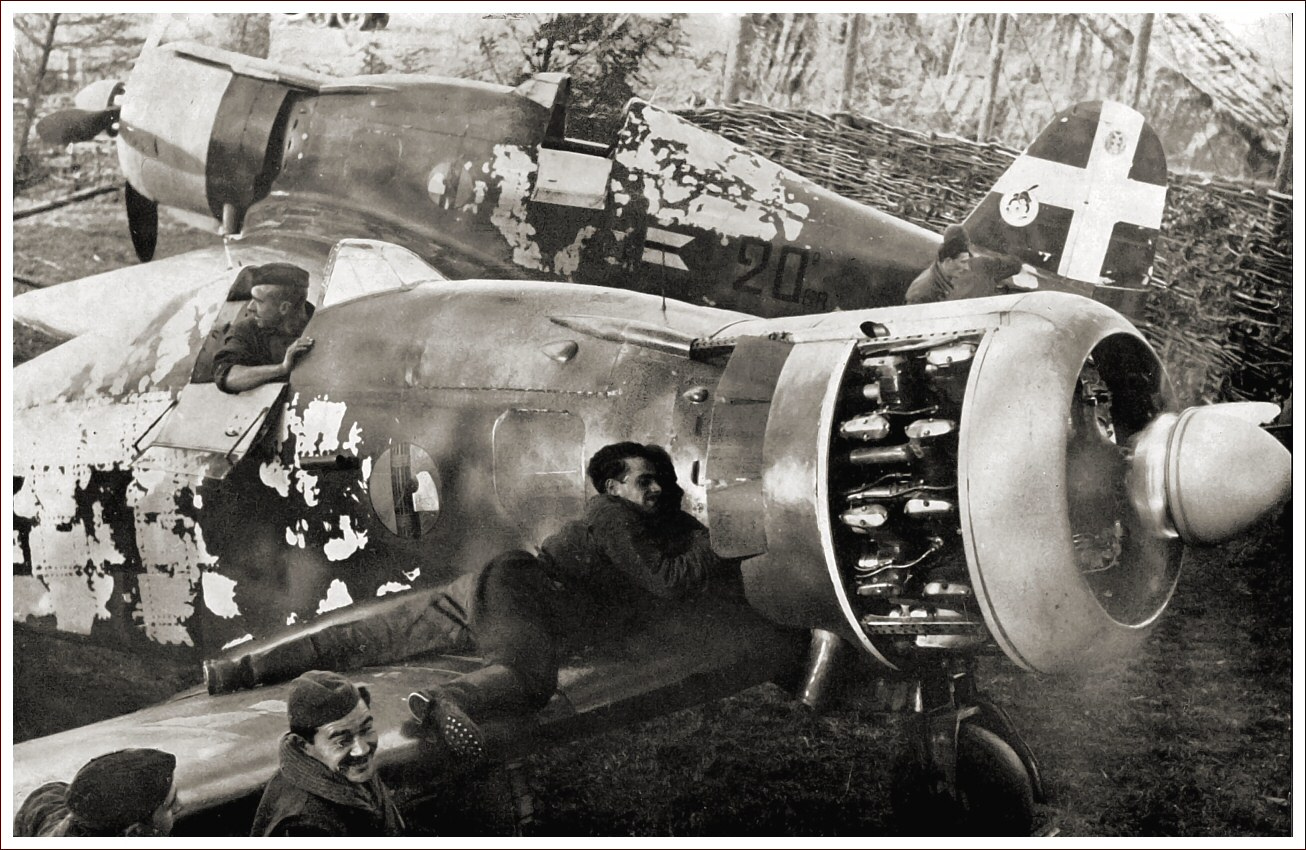
Fiat G.50 Freccia
Italy’s first modern monoplane fighter to reach service — an agile, strong little aircraft that pilots enjoyed flying, but one so under-armed and underpowered that it was outclassed almost from the day it arrived. Its finest hours came not over Italy, but in Finnish hands against the Soviets.
The Fiat G.50 Freccia: Italy’s first modern fighter, and its first hard lesson
The Fiat G.50 Freccia (“Arrow”) was the aircraft with which Italy stepped into the age of the modern fighter — all-metal, monoplane, with a retractable undercarriage and an enclosed cockpit. It was pleasant to fly and beautifully agile. It was also slow, feebly armed and, within a couple of years, thoroughly outclassed — the story of the whole Italian fighter arm in miniature.
In the mid-1930s the world’s air forces were changing shape. The fabric-covered biplane, with its fixed undercarriage and open cockpit, was giving way to the sleek stressed-skin monoplane: enclosed, retractable, fast. Britain was drawing the Hurricane and Spitfire; Germany the Messerschmitt Bf 109; the United States its early monoplane fighters. Italy, whose Regia Aeronautica still flew the nimble Fiat CR.32 and CR.42 biplanes with real affection, needed to make the same leap. The aircraft that carried it there was the Fiat G.50 Freccia, and it holds a genuine place in history as the first all-metal monoplane fighter of Italian design — with retractable gear and an enclosed cockpit — to enter Regia Aeronautica service.
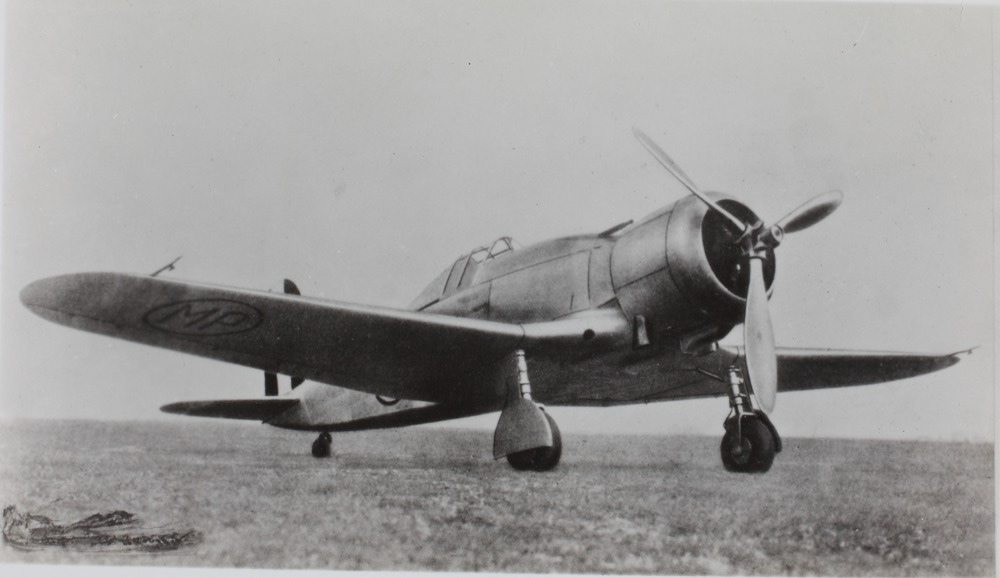
It came from the drawing board of Giuseppe Gabrielli, the Fiat engineer whose fighters all carried his initial “G.” The G.50 was his first fighter, and a bold one for a conservative air force: a low-wing cantilever monoplane of all-metal construction, with an inward-retracting undercarriage and, on the prototype and first production batch, a fully glazed sliding canopy. The prototype first flew on 26 February 1937, and the first handful of aircraft reached units at the end of 1938. On paper, Italy had joined the modern age.
The trouble was under the cowling. The Freccia was built around the Fiat A.74 RC38, a 14-cylinder air-cooled radial of about 840 horsepower. It was reliable and reasonably compact, but it was simply not powerful enough for a front-line fighter of the late 1930s, and its bluff radial frontage added drag that a slim inline engine would have avoided. The result was a top speed of only around 470 to 475 km/h (about 290–295 mph) — respectable in 1937, but slow beside the 550-plus km/h Bf 109s and Spitfires the G.50 would soon meet. The aircraft that was meant to drag Italy into the modern era was, from the moment it arrived, already a step behind.
The armament was worse. The Freccia carried just two 12.7 mm Breda-SAFAT machine guns in the upper cowling — and only about 150 rounds per gun. For a fighter expected to shoot down other fighters and, later, armoured bombers, two heavy machine guns were a feeble battery; the RAF’s Hurricanes and Spitfires carried eight guns apiece. This chronic under-gunning was not unique to the G.50 — it dogged almost every early Italian monoplane fighter — but on the Freccia it was especially telling, because the aircraft had so little performance in hand to make up for how lightly it hit.
Agile, strong and a joy to fly — and slow, feebly armed and outclassed. The Freccia is the Italian fighter paradox in a single airframe.
There is one detail about the G.50 that tells you almost everything about the gap between theory and practice in Italian fighter design. The prototype and the first forty-five or so production aircraft were built with that modern, fully enclosed sliding canopy — exactly the feature that marked the aircraft out as modern. Italian pilots, raised on the wind-in-the-face openness of the CR.32 and CR.42 biplanes, disliked it intensely. They complained about poor visibility, about the canopy framing, about feeling shut in and cut off from their aircraft, and there were worries about escaping in an emergency. So Fiat did something startling for a manufacturer trying to build a state-of-the-art fighter: it went backwards. The great majority of production Freccias were completed with an open or semi-open cockpit, the sliding hood deleted in favour of a low windscreen and a cut-down, partly faired-over rear canopy. A machine designed to be modern was, at its pilots’ insistence, made a little less so.
The cockpit story is worth pausing on because it is so revealing. Aircraft designers of the late 1930s understood perfectly well that an enclosed canopy cut drag, kept the pilot warm at altitude and was simply the way modern fighters were built. That the Regia Aeronautica’s pilots could nonetheless push a manufacturer into deleting the feature says a great deal about how recent the whole idea of the fast monoplane fighter still was, and how much of fighter flying in 1938 was still governed by the instincts of the open-cockpit biplane age. The Freccia was caught precisely on that dividing line — too modern for the men who flew it to be entirely comfortable, not modern enough to outfight what was coming.
What saved the Freccia from being merely a disappointment was how it handled. Almost everyone who flew it agreed that it was delightful — light, responsive, superbly manoeuvrable, structurally very strong and forgiving at the edges of the envelope. In the swirling, close-in dogfight that Italian pilots still favoured, a well-flown G.50 could out-turn faster, heavier opponents and was hard to catch in a tight fight. That agility, and the aircraft’s toughness, are the reason the Freccia is remembered with a certain fondness rather than contempt. It was not a bad aeroplane. It was a good aeroplane asked to do a job for which it was under-engined and under-armed — and sent to war a generation of engine development too early.
The Freccia’s combat career bore that out. It arrived too late to make a mark in the Spanish Civil War, flew a brief and largely futile campaign over the English Channel in the winter of 1940, and then soldiered on through the desert war in North Africa, the invasion of Greece and the battles over the Mediterranean — almost always outperformed by its opponents and soon supplemented, and then replaced, by the newer Macchi C.200 Saetta and the far superior DB 601-engined Macchi C.202 Folgore. And yet, in one theatre, flown by one air force, the Freccia was a quiet triumph: in Finland, where a small batch of G.50s fought the Soviet air force to a standstill and ran up one of the most lopsided victory ratios of any Italian fighter anywhere. The pages that follow trace how the Freccia was designed, why it fell short, the scattered war it fought for Italy, and the surprising success it found in the snows of the north.
01Why the Fiat G.50 Freccia matters: Italy’s first modern monoplane fighter
The Freccia’s importance is as much about what it represents as what it achieved. It was the aircraft with which the Regia Aeronautica crossed the line from the biplane era into the monoplane age — the first Italian-designed all-metal monoplane fighter, with a retractable undercarriage and (initially) an enclosed cockpit, to reach front-line service. Everything that Italy’s later, better fighters became — the Macchi C.200 and C.202, the Reggiane series, Gabrielli’s own superb Fiat G.55 Centauro — began with the lessons of the G.50.
It is worth being precise, because rival claims exist. The Macchi C.200 Saetta flew a little before the G.50 was ordered in quantity and is sometimes cited alongside it; the two are close contemporaries and entered service within months of each other. But the Freccia was ordered first, reached units first at the end of 1938, and is generally credited as the first modern stressed-skin monoplane fighter of Italian design to enter Regia Aeronautica service. Whichever way the fine print falls, the G.50 stands at the very front of Italy’s monoplane-fighter story — and it inherited all the teething problems of being first.
02The Fiat G.50 Freccia’s engine: the underpowered Fiat A.74 radial
At the heart of the Freccia’s problems was its engine. The Fiat A.74 RC38 was a 14-cylinder, two-row, air-cooled radial derived ultimately from American Pratt & Whitney practice, producing roughly 840 horsepower. It was dependable and not a bad engine in itself — the same basic powerplant drove the Macchi C.200 and the Fiat CR.42 — but 840 hp was modest for a monoplane fighter meant to fight into the 1940s, and the radial’s large frontal area added drag that penalised top speed.
The contrast with the aircraft’s rivals is stark. The Messerschmitt Bf 109 and the Supermarine Spitfire were built around liquid-cooled inline V12s of over 1,000 hp fitted into slim, low-drag noses; they were both faster and climbed better. Italy knew the answer was more power, and the eventual fix was to buy it from Germany: the Macchi C.202 Folgore took the same class of airframe as the C.200 and fitted a licence-built Daimler-Benz DB 601 inline, transforming it into a genuinely competitive fighter. The Freccia never received that transplant in service. It was stuck with the A.74, and with it the performance of a mid-1930s design fighting a mid-1940s war.
The engine did have virtues that mattered in the field. Air-cooled radials are simpler and more robust than liquid-cooled inlines, with no vulnerable radiator or coolant plumbing to be holed in combat, and they tolerated the dust and heat of North Africa and the cold of Finland better than many inline engines of the day. The Freccia was reliable and easy to service — qualities that counted for a great deal on primitive front-line strips, even if they could not make the aircraft fast.
03The Fiat G.50 Freccia’s armament: two machine guns and not enough bullets
If the engine left the Freccia slow, the armament left it toothless. The G.50 carried just two 12.7 mm Breda-SAFAT machine guns, mounted in the upper cowling and firing through the propeller arc. The Breda-SAFAT was a decent weapon — a heavy machine gun broadly comparable to the American .50 calibre — but two of them was a thin battery for a fighter, and the ammunition supply was famously meagre, on the order of only 150 rounds per gun. That gave a pilot just a few seconds of total firing time, with little margin for missed bursts.
By the standards of its opponents this was hopelessly light. A 1940 Hurricane or Spitfire carried eight rifle-calibre machine guns; German fighters mixed cannon with machine guns; even Italy’s later fighters moved toward 20 mm cannon. Against nimble opponents the Freccia’s two guns could score, but against armoured aircraft and, above all, against the multi-engined bombers it was sometimes asked to intercept, the battery simply lacked the punch to bring targets down quickly. It is one of the cruel ironies of the type that the same under-gunning which crippled it in the West mattered far less on the Finnish front, where the opposition was often older, lighter Soviet aircraft that two good machine guns could still destroy.
04The disliked cockpit: why Fiat gave the G.50 back its open canopy
One of the most revealing details of the whole Freccia story concerns its cockpit. The prototype and the first production batch — roughly the first forty-five aircraft — were fitted with a fully enclosed, rearward-sliding canopy, the very hallmark of the modern fighter Fiat was trying to build. It should have been an advance. Instead it became a case study in how hard it was to change a flying culture.
Italian fighter pilots of the late 1930s had grown up in open-cockpit biplanes, and many of them hated the closed hood. They complained that the framing and the quality of the transparent panels spoiled their view — the single most important thing to a fighter pilot — and that the enclosure left them feeling isolated from the aircraft and the air. There were also anxieties about baling out through or around the canopy in an emergency. The objections were strong enough, and widespread enough, that Fiat reversed course: most production G.50s were completed with an open or semi-open cockpit, the sliding canopy replaced by a small windscreen and a faired, cut-down rear decking.
It is easy to mock the decision with hindsight — going backwards, on the very feature that made the aircraft modern — but it captures something true about the period. The move from biplane to monoplane was not only a technical leap but a cultural one, and the men in the cockpits did not always want what the engineers offered. The Freccia’s open cockpit is a small, human monument to that friction: an air force reaching for the future with one hand while clinging, quite literally, to the open sky of the past with the other.
What the Fiat G.50 Freccia got right — and what it got wrong
The Freccia was a genuinely modern airframe wrapped around an inadequate engine and armament. Understand those three things — the good structure, the weak engine, the thin guns — and you understand the whole aircraft.
A modern, agile airframe
All-metal stressed-skin construction, a low cantilever wing, retractable undercarriage and an enclosed cockpit made the G.50 Italy’s first truly modern fighter. It was strong, forgiving and superbly manoeuvrable — pilots loved how it handled in a turning fight.
An underpowered engine
The 840 hp Fiat A.74 radial was reliable but weak for a late-1930s fighter, and its bluff frontal area added drag. Top speed was only around 470–475 km/h — well short of the inline-engined Bf 109 and Spitfire the Freccia had to face.
Feeble firepower
Just two 12.7 mm Breda-SAFAT machine guns, with only about 150 rounds each. Adequate against light opponents, but far too little against modern fighters and bombers — the same chronic under-gunning that plagued every early Italian monoplane fighter.
05The Fiat G.50 Freccia versus the Bf 109, the Hurricane and the Spitfire
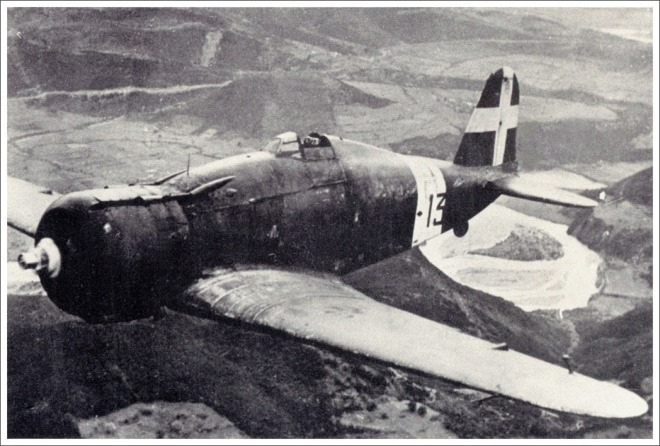
Placed beside the fighters it actually met, the Freccia’s limitations are plain. Against the Messerschmitt Bf 109E and the Hawker Hurricane and Supermarine Spitfire, the G.50 gave away 70–100 km/h in top speed, climbed less well, and carried a fraction of their firepower. In any fight decided by speed, climb, dive or weight of fire — which is to say most fights of 1940 onward — the Freccia was at a disadvantage before it started.
Where it could compete was in the turn. The G.50 was lighter and more manoeuvrable than the German and British fighters, and a skilled pilot who could drag an opponent into a slow, tight, turning contest could hold his own and sometimes win. That was exactly the kind of dogfight Italian pilots had trained for in their biplanes, and it is why Freccia pilots did score against better aircraft. But it was a losing strategic proposition: a faster enemy could always choose whether to fight, dive away from trouble, and come back on his own terms. Agility bought the Freccia respect and the occasional victory; it could not buy back the speed and firepower it lacked.
There was a tactical dimension to this as well. Against a faster, heavier opponent the Freccia pilot’s only real option was to stay slow and turn, because the moment he tried to run or climb away he was caught. But an enemy who refused to turn-fight — who used “boom-and-zoom” energy tactics, diving in from height, firing and climbing away again — could attack the G.50 almost at will and simply decline the turning contest the Italian wanted. As Allied pilots learned to fight this way, the Freccia’s one advantage was increasingly neutralised, and its lack of speed and firepower left it with no answer.
The honest verdict, then and now, is that the G.50 was a pleasant, well-made fighter that was simply a generation behind in the two things that mattered most. It is telling that the Regia Aeronautica itself did not wait for the Freccia to prove otherwise: even as the type entered service it was already pinning its hopes on the Macchi line, and within two years the DB 601-engined C.202 Folgore had shown what an Italian airframe could do once it was given a proper engine.
06The Fiat G.50 Freccia’s variants: G.50, G.50bis and the two-seat G.50B
For an aircraft built in only moderate numbers, the Freccia spawned a useful family. The initial production G.50 was followed by the definitive G.50bis, which addressed several service shortcomings: it introduced a redesigned, better-protected cockpit and windscreen, added armour and self-sealing fuel tanks, increased fuel capacity for greater range, and revised the rear fuselage and tail. The G.50bis was the most numerous version and the one most associated with the type’s later desert and Mediterranean service.
A dedicated two-seat trainer, the G.50B (biposto, “two-seat”), was produced in useful numbers and gave many Italian fighter pilots their first taste of a modern monoplane — a role in which the Freccia’s docile, forgiving handling made it genuinely valuable. There were also experimental and small-batch developments, including attempts to improve performance and a proposed navalised version, and the G.50 lineage fed directly into Gabrielli’s thinking for later, inline-engined Fiat fighters. Production is usually split between Fiat’s own Aviazione plant and the associated CMASA works, which is one reason totals differ between sources.
One development is especially worth noting as a signpost to the future. Gabrielli experimented with fitting an inline engine to a G.50 airframe — the route that Macchi took so successfully with the C.202 — and although Fiat’s own inline-engined fighter did not come from a simple re-engining of the Freccia, the exercise pointed straight at the powerful, DB 605-engined G.55 Centauro that would follow. In that sense the G.50 was not only Italy’s first modern fighter but the first rung of a ladder that led, in only five years, to one of the best. The variants matter less for what they achieved in service than for what they taught the men who built the aircraft that came next.
07Who designed the Fiat G.50 Freccia? Giuseppe Gabrielli and the Fiat “G.” line
The Freccia was the first fighter of Giuseppe Gabrielli, Fiat’s long-serving chief designer, whose aircraft all carried his initial “G.” Gabrielli was a gifted engineer working within hard constraints — above all the lack of a powerful Italian aero-engine — and the G.50 shows both his talent and those limits. The airframe was clean, strong and modern; the design was let down by the powerplant available to hang on the front of it.
Gabrielli’s career is itself a useful lens on the whole story. He was among the most versatile aeronautical engineers Italy produced, designing airliners, bombers, trainers and fighters across four decades, and after the war he led Fiat into the jet age. The constraint that shaped his wartime fighters was never a shortage of design talent; it was the chronic Italian inability to build a powerful, reliable, mass-produced aero-engine of home design. Give Gabrielli a good engine, as the licence-built Daimler-Benz units eventually did, and the results were outstanding. The Freccia is what his talent produced without one.
Gabrielli learned the lesson. His later G.55 Centauro, drawn around the powerful licence-built Daimler-Benz DB 605, was an entirely different class of aircraft — fast, heavily armed with three cannon, and reckoned by many the finest fighter Italy produced in the war. It is a striking measure of how far Italian fighter design travelled in half a decade that the same designer produced both the humble Freccia and the superb Centauro. The G.50 is where that journey started, and it should not be confused with the aircraft that followed: it is a small, stubby, radial-engined monoplane, worlds apart from the sleek, inline-engined G.55, and different again from Gabrielli’s post-war jets such as the G.91.
08How many Fiat G.50 Freccias were built?
Production figures for the Freccia vary between sources, but they cluster closely, and the differences are small. The most commonly cited totals are in the region of 780 to 785 aircraft, split between the Fiat Aviazione works and the CMASA plant. One frequently quoted breakdown gives two prototypes, around forty-five pre-production machines, some 200-odd initial-production G.50s, a little over 400 G.50bis, and roughly a hundred two-seat G.50B trainers — adding up to about 780. Other references put the grand total at 784.
Whatever the exact figure, it is a modest number by the standards of the war — a few hundred against the tens of thousands of Bf 109s, Spitfires and Hurricanes — and it reflects both Italy’s limited industrial capacity and the Regia Aeronautica’s early shift of priority toward the Macchi fighters. The Freccia was never going to be a war-winner in quantity any more than in quality; it was a first step, built in first-step numbers.
The Fiat G.50 Freccia at war: Spain, the Channel, the desert — and Finland
The Freccia fought across half of Europe and North Africa, almost always outclassed. But in Finland, in the hands of a single squadron, the same aircraft became one of the most successful fighters of the Continuation War.
It is worth setting the scene, because the Freccia went to war at the worst possible moment in the history of the fighter aircraft. Between the G.50’s design in the mid-1930s and its combat debut in 1940, fighter performance took one of the sharpest leaps in aviation history: engine power climbed past 1,000 and then 1,200 horsepower, speeds rose by a hundred kilometres an hour and more, and armament jumped from a pair of rifle-calibre guns to batteries of cannon. An aircraft conceived at the start of that leap and fighting at the end of it was always going to look dated, however good it had been on the drawing board. That is the essential context for everything that follows: the Freccia was not badly designed, it was overtaken.
The Freccia’s war began, quietly, in Spain. A batch of the first twelve G.50s was sent to the Spanish Civil War in January 1939 with the Italian Aviazione Legionaria, fighting for Franco’s Nationalists. They arrived so late in that war that they saw little combat and achieved almost nothing of note; the Spanish episode was really an operational shake-down rather than a campaign. It did, however, confirm the aircraft’s pleasant handling and its lack of punch, and the survivors remained in Spanish service for years afterward.
When Italy entered the Second World War in June 1940, the Freccia was one of the Regia Aeronautica’s front-line fighters, and it was thrown into action across several fronts at once. The most quixotic was the deployment of the Corpo Aereo Italiano (CAI) to German-occupied Belgium in the autumn of 1940, to join the Luftwaffe’s assault on Britain. Around fifty G.50bis fighters flew fighter sweeps over the Channel and the coast of south-east England in the closing stages of the Battle of Britain and the winter that followed. It was a near-total failure of employment: the short-ranged Freccia could barely reach England and had almost no endurance to fight once there, the winter weather was atrocious, and the whole Italian expedition — bombers and fighters alike — achieved next to nothing while suffering losses more to accidents and the elements than to the RAF. The Channel adventure is remembered chiefly as a demonstration of how unsuited both the aircraft and the plan were to the task.
The Freccia’s real war was fought in the Mediterranean and North Africa. From bases in Libya, G.50s and G.50bis flew escort, patrol and ground-attack sorties across the Western Desert through 1940 and 1941, tangling with RAF Hurricanes and Gladiators over Cyrenaica and Egypt. In the desert the aircraft’s ruggedness and its air-cooled engine were assets, and its agility earned it respect, but it remained outclassed by the Hurricane and hopelessly so once Spitfires and Kittyhawks arrived. G.50s also flew in the Italian invasion of Greece from late 1940, operating from Albania in appalling weather over the mountains, and covered the central Mediterranean including the long air siege of Malta.
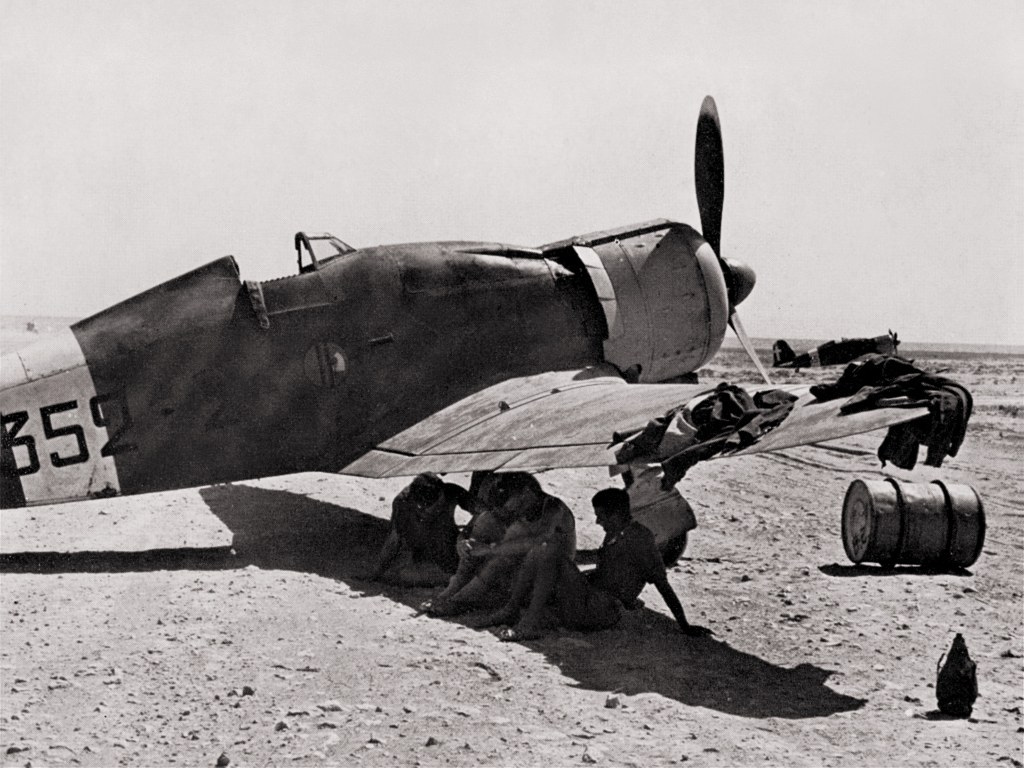
Everywhere it fought for Italy, the pattern was the same. The Freccia was too slow to force a fight or escape one, and too lightly armed to make its firing passes count. As newer aircraft arrived it was steadily pushed aside: the Macchi C.200 Saetta took over much of the fighter role, and the transformative Macchi C.202 Folgore — the same airframe philosophy but with a powerful German inline engine — showed everyone what the Freccia might have been. By 1942 the G.50 was increasingly relegated to secondary theatres, convoy escort, ground-attack and training, its front-line day already over.
And then there is Finland — the bright, improbable exception that runs against everything else in the Freccia’s record. In 1939–40 Finland, desperate for fighters to face the Soviet Union, bought a batch of thirty-five G.50s from Italy. Delivered from late 1939, they equipped Lentolaivue 26 (Fighter Squadron 26) and went to war in earnest during the Continuation War from 1941. In Finnish hands, against the older and often poorly flown Soviet aircraft they mostly met, the Freccia was a revelation. Finnish pilots exploited its agility, its reliability in savage cold, and their own superb tactics and gunnery to run up an extraordinary record: Fighter Squadron 26 is credited with roughly 88 aerial victories flying the type against only around eleven G.50s lost — and strikingly, only a couple of those losses were to enemy fighters, the rest to anti-aircraft fire and accidents. That is a kill-to-loss ratio of about eight to one, among the best achieved by any Italian fighter anywhere in the war.
The Finnish success does not overturn the honest verdict on the Freccia, but it sharpens it. The same aircraft that was outclassed over the Channel and the desert became a war-winner over Karelia, because there it was flown by an air force that knew exactly how to use it and was matched against opponents it could actually beat. The Freccia’s Finnish chapter is a reminder that a fighter’s reputation is made as much by circumstance — who flies it, and against whom — as by the numbers in its specification.
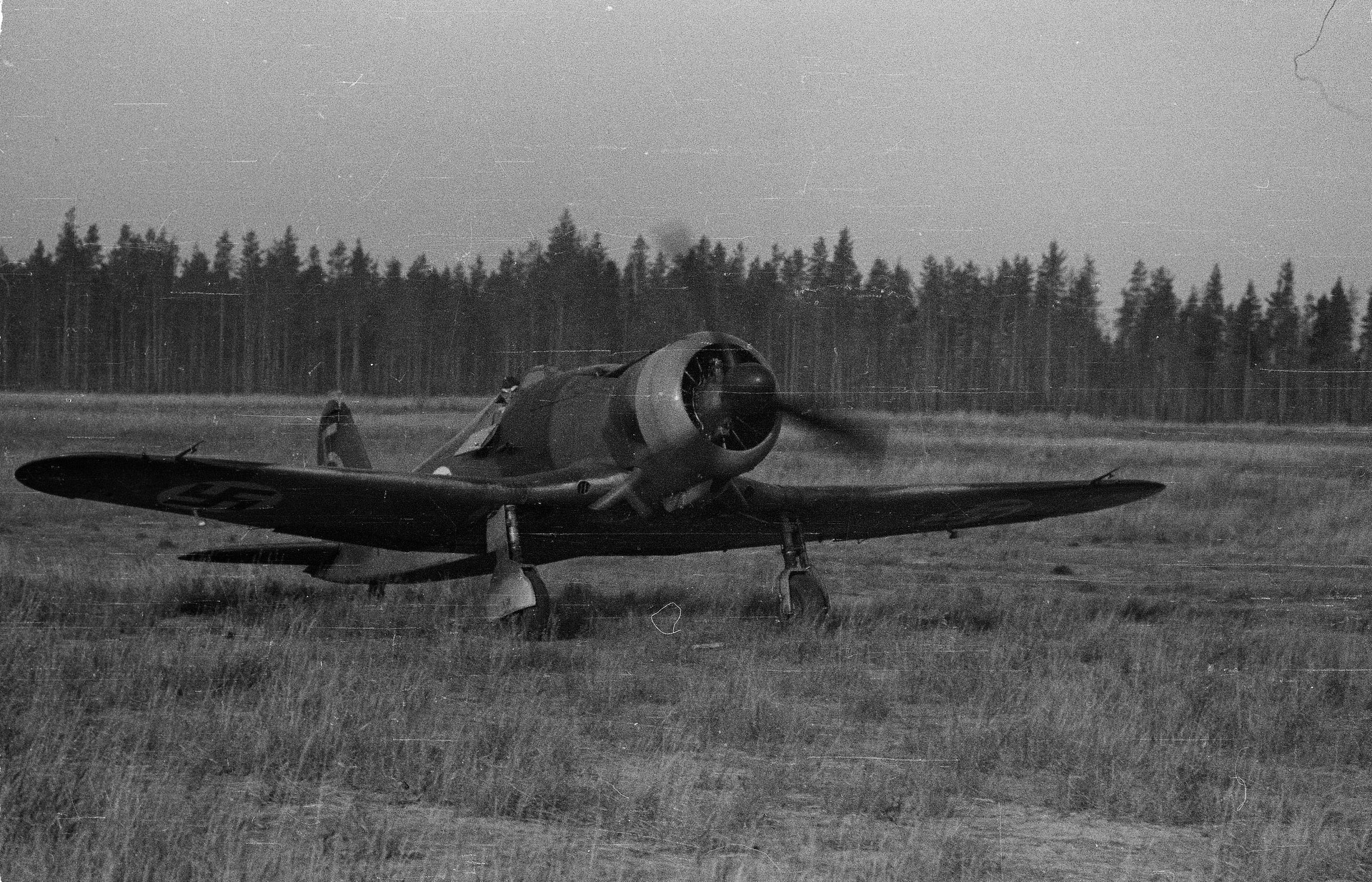
The Freccia had one more small export career. In 1943 Croatia’s air force received a handful of G.50bis fighters and a G.50B trainer, and operated them — along with a few ex-Luftwaffe machines — on anti-partisan and home-defence duties. It was a marginal footnote beside the Finnish story, but it extended the little fighter’s reach a bit further across wartime Europe. By the time Italy signed its armistice in September 1943, the G.50 was long obsolete as a front-line fighter; the surviving aircraft saw out the war in training and second-line roles on both sides of Italy’s divide, and in Finland flew on until 1944 and then as trainers until 1947.
09The Fiat G.50 Freccia over Britain: the Corpo Aereo Italiano’s failed Channel campaign
Few episodes better capture the mismatch between the Freccia and the war it was sent to fight than the Corpo Aereo Italiano. In the autumn of 1940, to show solidarity with Germany and share in what looked like an imminent victory over Britain, Italy dispatched an expeditionary air corps to bases in German-occupied Belgium. Its fighter element included around fifty Fiat G.50bis, alongside Fiat CR.42 biplanes and Fiat BR.20 bombers.
The campaign was a fiasco. The G.50 had neither the range nor the endurance for cross-Channel operations — it could barely reach the English coast, let alone loiter and fight — so its sweeps were brief and largely uneventful. The Belgian winter of 1940–41 was brutal, and the Italian units, unequipped for the cold and the weather, lost more aircraft to accidents, exposure and unfamiliar conditions than to the RAF. The CR.42 biplanes fared even worse. Militarily the CAI achieved almost nothing, and the whole expedition was quietly wound down. For the Freccia it was the clearest possible proof that a short-ranged, lightly armed dogfighter had no business over the grey, wide waters of the Channel.
10The Fiat G.50 Freccia in Finland: Lentolaivue 26 and an eight-to-one kill ratio
The Finnish Air Force bought thirty-five Freccias in the winter of 1939–40 as it scrambled for modern fighters to resist the Soviet Union. Delivered from December 1939, the aircraft — known in Finnish service by the type marking “FA” — equipped Lentolaivue 26 and became one of the squadron’s mainstays, defending the Karelian front and the approaches to Lake Ladoga.
What followed was the Freccia’s finest hour. Against the older Polikarpov fighters and assorted Soviet types they mostly encountered, Finnish pilots — among the most effective in the world, with a tradition of superb marksmanship and aggressive tactics — found the little Fiat ideal: agile, reliable in extreme cold, and armed just heavily enough for the job. Fighter Squadron 26 amassed on the order of 88 confirmed victories on the type for around eleven aircraft lost, only a couple of them to enemy fighters. The leading Finnish Freccia pilot, Oiva Tuominen, scored the majority of his early victories on the G.50 and was among the first Finns awarded the Mannerheim Cross, the country’s highest honour. The Finnish G.50s soldiered on in front-line service until 1944 and then as trainers to 1947 — a service life, and a combat record, that dwarfed anything the type achieved in Italian hands.
The Finns worked hard to keep the aircraft viable. The A.74 radial, robust as it was, needed careful nursing in temperatures that could fall far below freezing, and Finnish ground crews became expert at cold-weather starting and maintenance; skis were even considered for winter operations. Just as important, the Finnish approach to gunnery — holding fire until very close and making every one of those precious 150 rounds per gun count — turned the Freccia’s meagre ammunition supply from a fatal handicap into a discipline. It is a striking illustration of how the same aircraft, in the hands of an air force that understood its weaknesses and flew around them, could become something close to formidable. The Freccia did not change in Finland; the way it was used did.
11The Fiat G.50 Freccia’s legacy: the fighter that taught Italy how to build fighters
The Freccia will never be counted among the great fighters of the Second World War, and it is not remembered as one. But its place in history is secure for a different reason: it is the aircraft with which Italy learned to build modern fighters. Every shortcoming the G.50 exposed — the crippling lack of engine power, the feeble armament, the industrial inability to build in quantity — became a lesson that shaped what came next.
The answer to the underpowered radial was the German inline engine that made the Macchi C.202 Folgore competitive and the Fiat G.55 Centauro excellent. The answer to the thin armament was the move to 20 mm cannon on the “Serie 5” fighters. Gabrielli himself carried the Freccia’s lessons directly into the G.55, one of the finest piston fighters of the war. Seen that way, the humble G.50 is not a dead end but a beginning — a necessary, imperfect first draft. That, together with its genuinely delightful handling and the astonishing Finnish record, is why the Fiat G.50 Freccia still earns a place in a museum of the aircraft that mattered, even though it won few battles of its own.
Fiat G.50 Freccia full specifications
Figures are broadly representative of the production G.50 / G.50bis and are drawn from established reference sources. Several values are approximate and vary between references and sub-variants, so contested figures are flagged.
| Экипаж | 1 (pilot) |
|---|---|
| Двигатель | Fiat A.74 RC38 — 14-cylinder, two-row, air-cooled radial |
| Power | ~840 hp (~870 PS) for take-off |
| Максимальная скорость | ~470–475 km/h (~290–295 mph) at altitude (varies by source) |
| Служебный потолок | ~10,700–10,750 m (~35,000 ft), figures vary |
| Диапазон | ~445 km (G.50); ~1,000 km on the longer-range G.50bis (approx.) |
| Вооружение | 2 × 12.7 mm Breda-SAFAT machine guns (cowling) — ~150 rounds per gun |
| Bomb load | Light bombs on some G.50bis for ground-attack (limited) |
| Длина | ~7.8 m (25 ft 7 in) |
|---|---|
| Размах крыльев | ~10.99 m (36 ft 1 in) |
| Высота | ~2.96 m (9 ft 8 in) |
| Зона крыла | ~18.15 m² (195 sq ft) |
| Пустой вес | ~1,975–2,015 kg (estimate) |
| Loaded weight | ~2,400–2,530 kg (estimate) |
| First flight | 26 February 1937 (prototype) |
| Service entry | Late 1938 (Regia Aeronautica) |
| Number built | ~780–785 (figures vary; often cited ~778 or 784) |
| Designer | Giuseppe Gabrielli |
| Производитель | Fiat Aviazione & CMASA, Italy |
| Unit cost | Not reliably recorded (WWII) |
| Cost per flight hour | Not applicable — no airworthy example |
Values marked “estimate” or “varies” should be treated as approximate. Speed, weight, range and production figures in particular differ between references and between the G.50, G.50bis and G.50B sub-variants. Range especially varies widely, as the G.50bis carried substantially more fuel than the early G.50.
12The Fiat G.50 Freccia’s operating costs: why there is no cost-per-hour figure
Unlike the modern jets in the MiGFlug fleet, the Freccia has no meaningful operating-cost figure. Wartime unit costs for Italian fighters were not reliably or consistently recorded, and the currency and economic conditions of Italy in 1938–43 make any single number misleading.
More to the point, there is no airworthy Fiat G.50 anywhere in the world. Every surviving original is a static museum exhibit, so there is no fuel bill, no maintenance cost and no cost-per-flight-hour to quote — the honest entry in the specifications table is simply “not applicable.” If you want to know what flying a genuine fighter actually costs today, the aircraft MiGFlug operates are a far better guide than a fighter that has not flown for the best part of a century.
13Fiat G.50 versus Macchi C.200 Saetta: Italy’s two first monoplane fighters
The Freccia’s closest rival was not an enemy aircraft but a domestic one: the Macchi C.200 Saetta. The two were near-contemporaries, both radial-engined monoplanes built around the same 840 hp Fiat A.74, both entering service around 1939, and both suffering the same under-gunning of two 12.7 mm machine guns. They were, in effect, two answers to the same question.
The Macchi was slightly faster and is generally reckoned the better all-round fighter, and it was built in larger numbers and served longer in the front line. But the crucial difference lay in what each became. The Saetta’s airframe proved able to accept the powerful Daimler-Benz DB 601 inline, and that transplant produced the excellent Macchi C.202 Folgore — the fighter that finally made an Italian design competitive. The Freccia never made that jump in service, which is a large part of why the Macchi line eclipsed it. Both aircraft show the same truth from slightly different angles: the airframes were sound, and the engine was the ceiling.
14Surviving Fiat G.50 Freccias: where to see one today
Original Freccias are extremely rare — the type was built in only a few hundred examples, hard-used, and mostly scrapped — and the surviving airframes are few and their exact identities and originality sometimes debated. The best-known example in Italy is the restored G.50 displayed at the Italian Air Force Museum (Museo storico dell’Aeronautica Militare) at Vigna di Valle, on Lake Bracciano near Rome. In Finland, a Freccia is preserved at the country’s aviation museums, a lasting memorial to the type’s remarkable Finnish record, and a G.50bis has been the subject of a long restoration in Serbia.
Survivor identities can be genuinely tangled, and it is worth being honest about that. Because so few original airframes exist, some preserved “G.50s” are restorations that combine original and reconstructed parts, and the provenance of individual aircraft is sometimes debated among historians. This is common with very rare wartime types and should not diminish the survivors’ value — but it is a reason to treat confident claims about any single aircraft’s originality with a little caution.
What none of these survivors can do is fly. There is no airworthy Fiat G.50 anywhere in the world, and given the rarity of the type and its engine, there is unlikely ever to be one. The Freccia can be seen only on the ground, as a static exhibit — which makes the handful of preserved aircraft all the more valuable as the last physical traces of Italy’s first modern fighter.
15How to tell a Fiat G.50 Freccia from the CR.42, the C.200 and the G.55
The Freccia is easy to place among its Italian relatives once you know the tells. The Fiat CR.42 Falco, its stablemate, is an unmistakable biplane — two wings, fixed spatted undercarriage, an open cockpit; the G.50 is a single-wing monoplane with retractable gear, a clear generation newer. Against Gabrielli’s later Fiat G.55 Centauro the distinction is just as stark: the G.55 is a large, sleek, inline-engined fighter with a long pointed nose and three cannon, whereas the G.50 is small and stubby with the blunt cowling of an air-cooled radial.
The genuinely tricky comparison is with the Macchi C.200 Saetta, because the two are so alike — both compact radial-engined monoplanes of the same era, sharing the same engine and armament. The quickest tells are the manufacturer and the details of the canopy, tail and wing shape: the Saetta has a distinctive humped rear fuselage and a different fin, and the two wear different unit and national markings in most museum settings. If in doubt, remember the simplest rule of all: a Fiat is a G.50, a Macchi is a C.200. And if the aircraft has two seats, it is a G.50B trainer rather than a single-seat fighter.
The Fiat G.50 Freccia: from Italy’s first monoplane fighter to the Finnish front
The monoplane revolution. As Britain and Germany draw the Spitfire and Bf 109, Italy needs a modern fighter to replace its beloved biplanes. Fiat’s Giuseppe Gabrielli begins work on his first fighter design.
First flight. The G.50 prototype takes to the air — an all-metal cantilever monoplane with retractable undercarriage and an enclosed cockpit, Italy’s first truly modern fighter.
Into service. The first G.50s reach the Regia Aeronautica — but pilots dislike the enclosed canopy, and most production aircraft are completed with an open or semi-open cockpit.
Spain. The first twelve Freccias reach the Spanish Civil War with the Aviazione Legionaria — too late to achieve anything of note.
Finland buys in. Finland orders 35 G.50s to face the Soviet Union; deliveries begin in December 1939.
Italy at war. The Freccia is a Regia Aeronautica front-line fighter as Italy enters WWII — already outpaced by the latest Allied types.
The Channel fiasco. Around 50 G.50bis of the Corpo Aereo Italiano fly from Belgium against Britain, but lack the range and endurance to matter; weather and accidents take a heavier toll than the RAF.
Desert and Greece. Freccias fight in Libya, over the Western Desert, in the invasion of Greece from Albania, and across the central Mediterranean — agile but outclassed.
The Finnish triumph. Lentolaivue 26 flies the G.50 in the Continuation War, running up roughly 88 victories for about 11 losses — an eight-to-one ratio, the type’s finest record.
Eclipsed. The Macchi C.200 and the DB 601-engined C.202 Folgore take over the fighter role; the Freccia is pushed to secondary theatres, ground-attack and training.
Croatia and the armistice. Croatia receives a handful of G.50bis and a trainer. By Italy’s September 1943 armistice the type is long obsolete as a front-line fighter.
Last flights and survivors. Finnish G.50s serve to 1944 and train pilots until 1947. A few originals survive today — at Vigna di Valle, in Finland and under restoration in Serbia — but none is airworthy.
Twelve things worth knowing about the Fiat G.50 Freccia
Scroll through the episodes and details that make the Freccia one of the most instructive — and, in Finland, most surprising — fighters of the early war.
Italy’s first modern fighter
The Freccia was the aircraft that dragged the Regia Aeronautica out of the biplane age: the first Italian-designed all-metal monoplane fighter, with retractable undercarriage and enclosed cockpit, to enter service. Everything Italy’s later fighters became began with the lessons — good and bad — of the G.50.
Freccia — the Arrow
“Freccia” means “arrow” in Italian, part of the Regia Aeronautica’s tradition of evocative names. It suited a small, light, quick-turning fighter — even if the arrow, in the end, flew rather more slowly than the bows of its rivals.
Gabrielli’s first fighter
The G.50 was the first fighter of Giuseppe Gabrielli, whose aircraft all bore his initial “G.” He would go on to design the superb G.55 Centauro and, after the war, jets like the G.91. The Freccia is where that distinguished line began — talent working within the hard limits of Italian engine power.
The canopy pilots rejected
The prototype and first 45 aircraft had a modern enclosed canopy — and Italian pilots, raised on open biplanes, hated it. They complained of poor visibility and feeling shut in. So Fiat reversed course and built most Freccias with an open or semi-open cockpit: a fighter made deliberately less modern at its pilots’ insistence.
840 horses, and not enough
The Fiat A.74 radial gave about 840 hp — reliable, but weak for a monoplane fighter of the 1940s, and draggy at the front. Top speed was only around 470–475 km/h, well short of the Bf 109 and Spitfire. The lack of a powerful engine was the ceiling on the whole design.
Two guns, a few seconds of fire
The Freccia carried just two 12.7 mm Breda-SAFAT machine guns, with only about 150 rounds each — a few seconds of firing. Against the eight-gun Hurricanes and Spitfires it faced, that was a feeble battery, and it left the little fighter chronically short of punch.
A delight to fly
For all its faults, pilots loved the Freccia. It was light, superbly agile, strong and forgiving — a wonderful dogfighter in the old close-in style. A skilled pilot could out-turn faster, heavier opponents; the aircraft’s handling is the main reason it is remembered with affection rather than scorn.
The pointless war over Britain
In late 1940 around 50 G.50bis of the Corpo Aereo Italiano flew from Belgium to join the assault on Britain. The short-ranged fighter could barely reach England, the winter weather was brutal, and the whole Italian expedition achieved almost nothing — a textbook case of the wrong aircraft in the wrong place.
Outclassed over the sand
The Freccia’s real war was in North Africa and the Mediterranean, flying from Libya over the Western Desert, Greece and Malta. Its rugged air-cooled engine suited the desert, but it was outclassed by the RAF’s Hurricanes and hopelessly so once Spitfires arrived — and was soon supplanted by the Macchi fighters.
Eight-to-one over Karelia
The Freccia’s finest hour came far from Italy. Finland’s Lentolaivue 26 flew 35 G.50s against the Soviets and ran up roughly 88 victories for about 11 losses — only a couple to enemy fighters. Reliable in savage cold and flown by superb pilots, the little Fiat became one of the best fighters of the Continuation War.
Oiva Tuominen’s Freccia
Finland’s leading Freccia pilot, Oiva Tuominen, scored the bulk of his early victories on the G.50 and was among the first Finns awarded the Mannerheim Cross, the country’s highest honour. His success on a type dismissed elsewhere shows how much a fighter’s reputation depends on who is flying it, and against whom.
The first draft of a great fighter
The Freccia won few battles of its own, but it taught Italy how to build fighters. Its weaknesses — the underpowered engine, the thin armament — drove the moves to German inline engines and 20 mm cannon that produced the C.202 Folgore and Gabrielli’s own magnificent G.55 Centauro. The humble G.50 is where that road began.
Fiat G.50 Freccia in photographs
Wartime images from Italy, North Africa and Finland, and a surviving museum airframe. Click any photograph to enlarge. All images are public domain or Creative Commons, credited in the captions.
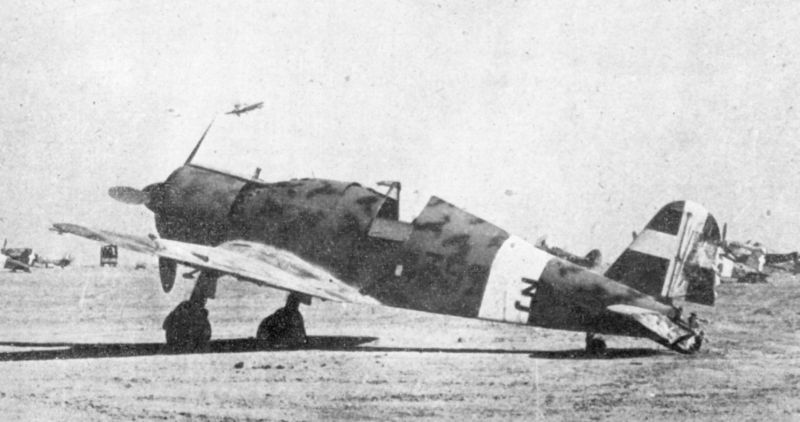
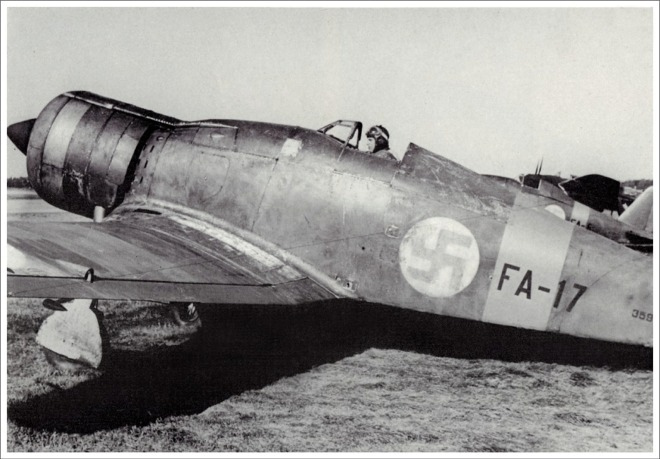
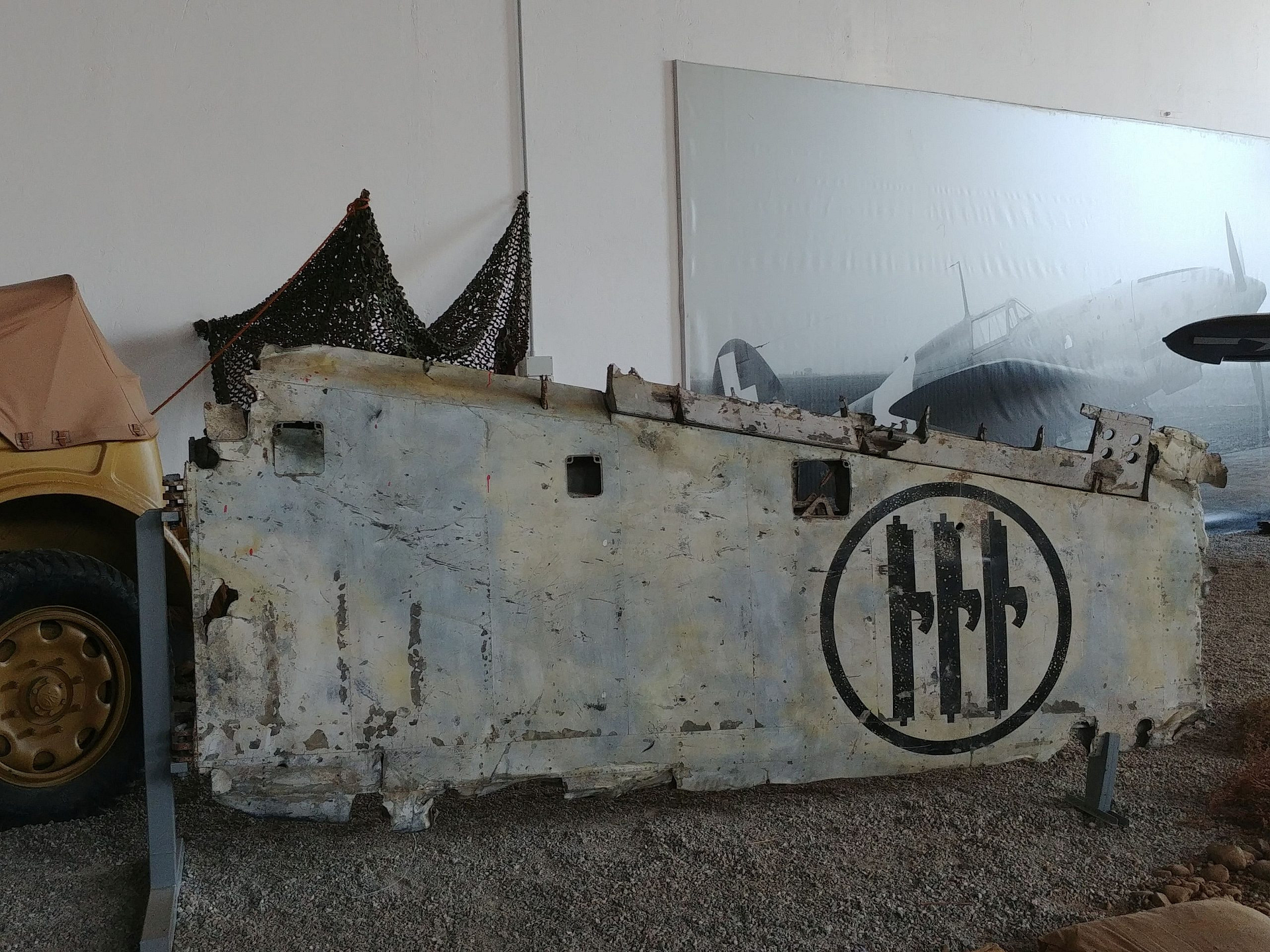
The Fiat G.50 Freccia on video
An honest, well-researched history of the Freccia from Plane Encyclopedia — covering the type’s modern airframe, its underpowered engine and thin armament, its scattered Italian war and its surprising Finnish success.
“All-Mediocre | Fiat G.50 Freccia” — Plane Encyclopedia (an established aviation-history reference channel), published December 2024, roughly 21,000 views at the time of writing and about 19 minutes long. The Freccia is an obscure type, so no single documentary reaches the millions of views a Spitfire video might; this is among the most thorough, honestly-titled dedicated treatments available.
Where the Fiat G.50 Freccia flew
Origin and manufacture in Italy, wartime service and theatres with the Regia Aeronautica (Spain, the Channel from Belgium, North Africa, Greece and the Mediterranean), the export operators Finland and Croatia, and where surviving airframes are preserved. Hover (or tap on mobile) a country for details; use the buttons to toggle categories.
The Fiat G.50 Freccia by the numbers
The Freccia’s record is a study in contrast: outclassed and largely ineffective in Italian hands over the Channel, the desert and the Mediterranean, yet a genuine success in Finnish service, where Lentolaivue 26 achieved roughly 88 victories for about 11 losses. Built in only a few hundred examples and never given the powerful engine it needed, it was soon supplanted by the Macchi C.200 and C.202.
Fiat G.50 Freccia: your questions answered
Can I fly in a Fiat G.50 Freccia?
No. There is no airworthy Fiat G.50 Freccia anywhere in the world — every surviving original is a static museum exhibit, and MiGFlug does not offer flights in this aircraft. However, you can fly in several genuine military jets and fighters today. MiGFlug flies aircraft such as the Hawker Hunter, MiG-29 Fulcrum, MiG-15, L-39 Albatros, F-104 Starfighter and T-33 Shooting Star. See the full list and prices at migflug.com/flights-prices.
Was the Fiat G.50 Freccia a good fighter?
It was a mixed aircraft, and honesty demands both sides. On the plus side, the Freccia was Italy’s first modern monoplane fighter, and it was genuinely delightful to fly — light, agile, strong and forgiving, a fine dogfighter in the close-in turning style. On the minus side, it was seriously under-armed (just two 12.7 mm machine guns) and underpowered and slow (top speed only around 470–475 km/h), which left it outclassed by the Bf 109, Hurricane and Spitfire it faced. The fairest summary is that it was a good airframe let down by a weak engine and thin firepower.
Was the Fiat G.50 Italy’s first monoplane fighter?
It is generally credited as the first all-metal monoplane fighter of Italian design — with a retractable undercarriage and an enclosed cockpit — to enter Regia Aeronautica service, at the end of 1938. The Macchi C.200 Saetta was a very close contemporary and is sometimes mentioned in the same breath, but the G.50 was ordered first and reached units first, so it is usually placed at the very front of Italy’s monoplane-fighter story.
Why did Italian pilots dislike the Fiat G.50’s cockpit?
The prototype and the first forty-five or so production aircraft had a fully enclosed sliding canopy, but Italian pilots — used to open-cockpit biplanes — disliked it, complaining of poor visibility and of feeling shut in, with some concern about baling out in an emergency. The objections were strong enough that Fiat reversed course and built most production Freccias with an open or semi-open cockpit. It is a telling detail: a fighter deliberately made less modern at its own pilots’ insistence.
How fast was the Fiat G.50 Freccia, and what was its engine?
The Freccia was powered by the Fiat A.74 RC38, a 14-cylinder air-cooled radial of about 840 hp. Its top speed was only around 470–475 km/h (about 290–295 mph), which was slow for a fighter of the early 1940s — roughly 70–100 km/h less than the Bf 109 and Spitfire. The engine was reliable and rugged, but simply not powerful enough for a competitive front-line fighter, and its bluff radial cowling added drag.
What armament did the Fiat G.50 carry?
Just two 12.7 mm Breda-SAFAT machine guns in the upper cowling, with only about 150 rounds per gun — a few seconds of firing time. This was a feeble battery by 1940 standards, when RAF fighters carried eight guns, and the under-gunning is one of the Freccia’s most serious weaknesses. It mattered less in Finland, where the opposition was often lighter, older Soviet aircraft that two good machine guns could still destroy.
Why was the Fiat G.50 so successful in Finland?
Finland bought 35 G.50s and flew them with Lentolaivue 26, which achieved roughly 88 aerial victories for only about 11 losses — a kill-to-loss ratio of around eight to one, the type’s best record anywhere. The reasons were circumstance and skill: the Freccia was reliable in extreme cold, Finnish pilots were among the best in the world with superb gunnery and tactics, and their Soviet opponents were often older, lighter aircraft the G.50 could actually beat. The same fighter that was outclassed over the Channel and the desert thrived over Karelia.
How did the Fiat G.50 compare to the Hawker Hurricane?
The Hurricane, the Freccia’s most common opponent in North Africa and the Mediterranean, held the advantage in almost every measurable way. It was faster, climbed better and carried a devastating eight-gun battery against the G.50’s two machine guns. Where the Freccia could compete was manoeuvrability: it was lighter and turned more tightly, so a skilled Italian pilot who could force a slow, close-in dogfight had a real chance. But the Hurricane pilot usually held the initiative — able to use his superior speed to choose whether to engage, dive away from trouble, and return on his own terms. Agility won the Freccia respect and the occasional victory; it could not close the gap in speed and firepower.
Did the Fiat G.50 achieve any success in Italian service?
Yes, but modestly. In the hands of good pilots the Freccia’s agility did score victories over North Africa, the Mediterranean and Greece, and its rugged, reliable air-cooled engine kept it flying from rough desert strips where more delicate types struggled. But it never dominated, because it was too slow to dictate a fight and too lightly armed to make its firing passes count, and it was steadily outclassed as better Allied aircraft arrived. Its Italian record is one of respectable, workmanlike service rather than triumph — the type’s only truly lopsided success came later, and in Finnish rather than Italian hands.
Did the Fiat G.50 fight in the Battle of Britain?
In a marginal way, yes. Around fifty G.50bis of the Corpo Aereo Italiano flew from bases in German-occupied Belgium against Britain in the autumn and winter of 1940, in the closing phase of the Battle of Britain and after. The campaign was largely ineffective: the short-ranged Freccia could barely reach England and had little endurance to fight, the winter weather was severe, and the Italian expedition lost more aircraft to accidents and the elements than to the RAF. It is remembered as a demonstration of the wrong aircraft in the wrong place.
How many Fiat G.50 Freccias were built?
Sources vary but cluster closely: the total is usually given as around 780 to 785 aircraft, often cited as about 778 or 784, split between the Fiat Aviazione and CMASA works. A common breakdown is two prototypes, roughly forty-five pre-production machines, some 200 initial G.50s, over 400 G.50bis and about a hundred two-seat G.50B trainers. Whatever the exact figure, it is a modest number by the standards of the war.
What is the difference between the Fiat G.50 and the Fiat G.55?
They are very different aircraft by the same designer, Giuseppe Gabrielli, separated by years of development. The G.50 Freccia (1937) is a small, stubby, radial-engined monoplane, underpowered and armed with only two machine guns. The G.55 Centauro (1942) is a large, sleek fighter built around the powerful licence-built Daimler-Benz DB 605 inline engine, armed with three 20 mm cannon, and reckoned one of the best fighters Italy produced in the war. In short, the G.55 is everything the G.50 could not be — the difference a proper engine makes.
Who else flew the Fiat G.50 besides Italy and Finland?
The main export operators were Finland (35 aircraft, with great success) and Croatia, whose air force received a handful of G.50bis fighters and a G.50B trainer in 1943, plus a few ex-Luftwaffe machines, for anti-partisan and home-defence duties. A dozen early Freccias were also sent to Nationalist Spain during the Spanish Civil War and remained in Spanish service afterward. The Luftwaffe used small numbers for training.
Are there any surviving Fiat G.50 Freccias?
Only a few, all as static museum exhibits — originals are extremely rare. A restored G.50 is displayed at the Italian Air Force Museum (Museo storico dell’Aeronautica Militare) at Vigna di Valle near Rome, a Freccia is preserved in Finland as a memorial to the type’s Finnish record, and a G.50bis has undergone a long restoration in Serbia. None is airworthy; there is no flying Fiat G.50 anywhere in the world.
Who designed the Fiat G.50 Freccia?
It was designed by Giuseppe Gabrielli, Fiat’s chief designer, whose fighters all carried his initial “G.” The Freccia was his first fighter. He learned from its shortcomings and went on to design the superb DB 605-engined G.55 Centauro, one of the finest Italian fighters of the war, and after the war the G.91 jet. The G.50 is where Gabrielli’s distinguished fighter line began.
Fly a real fighter with MiGFlug
The Fiat G.50 lives only in museums now. But the thrill of a fast military aircraft is very much bookable today — from Cold War jets to warbird-era classics, flown with professional pilots.
Explore more fighters in the museum
Where the facts on this page come from