
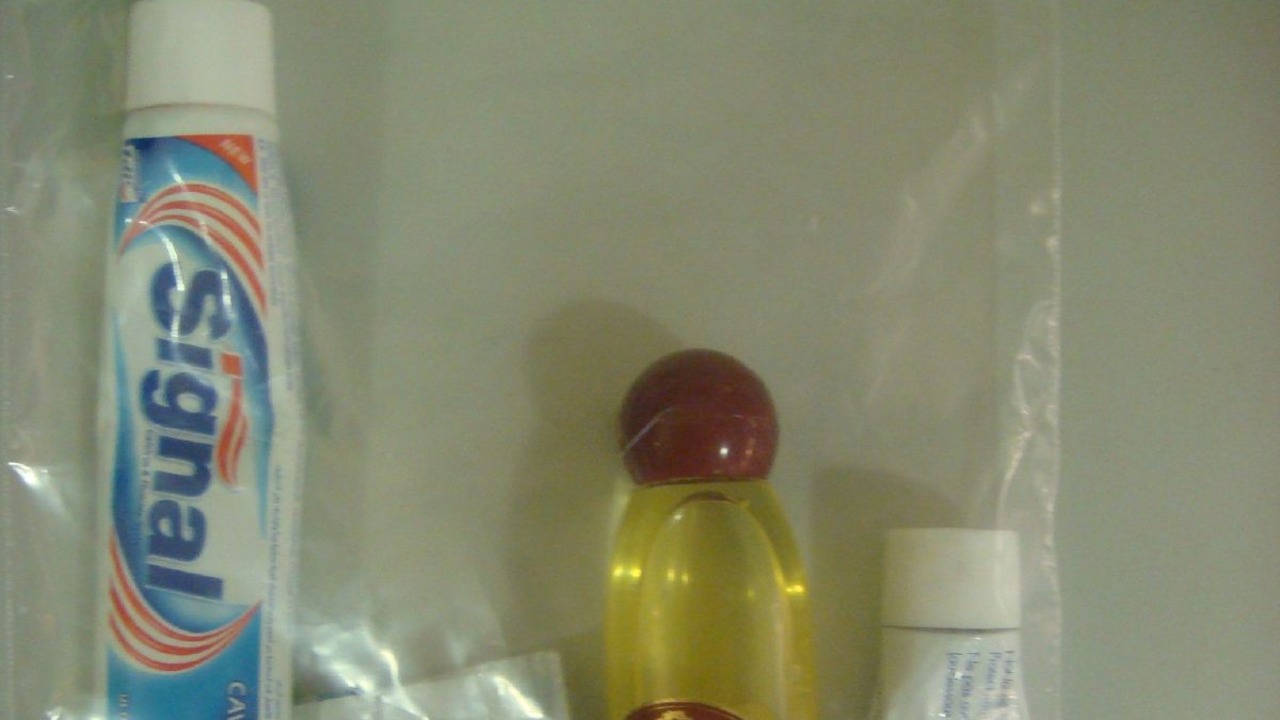
In the small hours of 10 August 2006, British police arrested around two dozen people. By the time most of the country woke up, hand baggage had effectively been abolished. Passengers at Heathrow were told to carry their documents in a clear plastic bag and nothing else. Not a book, not a bottle of water, not a laptop.
The emergency lasted weeks. The rule it produced has lasted twenty years, and it is the single most visible piece of counter-terrorism in most people’s lives: the little bag, the 100 millilitre bottles, the toothpaste in the bin.
What is strange is how it is ending. Not with an announcement, and not because the threat assessment changed, but one security lane at a time, according to which scanner happens to be installed in it. The British government, asked in October 2026 what the rule is, declines to say. Its official advice is that at most airports the limit still applies, that some airports allow two litres, and that you should check before you travel.
Quick Facts
Trigger: the 2006 transatlantic aircraft plot, arrests announced 10 August 2006
UK 100 ml regime proper began: 3 November 2006
US equivalent: TSA 3-1-1, announced 26 September 2006
Live EU instrument: Commission Implementing Regulation (EU) 2015/1998, point 4.1.2.2
The rule: containers of 100 ml or less, in one transparent resealable bag of no more than 1 litre
Exempt: medicines, baby food and milk, duty free sealed in a tamper-evident bag
Reimposed across the EU: 1 September 2024, by Regulation (EU) 2024/2108
Scanner configurations cleared for 2 litres today: one
The plot that changed what you can carry
The best record of what actually happened is not a news archive but a court judgment: R v Ahmed Ali and Others, the 2011 Court of Appeal decision that sets out the agreed facts. It is worth reading because so much of what circulates about this plot is wrong, and because it is routinely confused with the 1995 Bojinka plot, which was a different scheme in a different decade.
The conspirators had obtained about 40 litres of hydrogen peroxide, which the court found was "sufficient to make 20 IEDs", along with the ingredients for 20 HMTD detonators and at least two prototype detonators built for training. The delivery method is the detail that explains everything that followed: "Plastic bottles had been prepared for the surreptitious insertion of explosive material disguised as soft drinks so that they could be carried onto aircraft. The seal of each bottle had been left intact to avoid detection at airport security."
By 8 August 2006 the ringleader had selected seven flights, all leaving Heathrow within hours of each other: services to Chicago, New York, Washington, San Francisco, Toronto and Montreal, operated by United, American and Air Canada. No device was ever completed. No tickets were bought. No one boarded an aircraft.
Eleven people were originally indicted, and it took three trials to resolve. Only three men, Abdulla Ahmed Ali, Assad Sarwar and Tanvir Hussain, were ever convicted of conspiring to murder by detonating devices on aircraft, and that verdict did not arrive until September 2009. Others were convicted of the broader conspiracy to murder, and several were acquitted outright. The rule was in place for three years before anyone was convicted of the specific plot that produced it.
The Rest Is Classified on the race to stop the liquid bomb, the fourth part of its series on the plot.
What the rule actually says
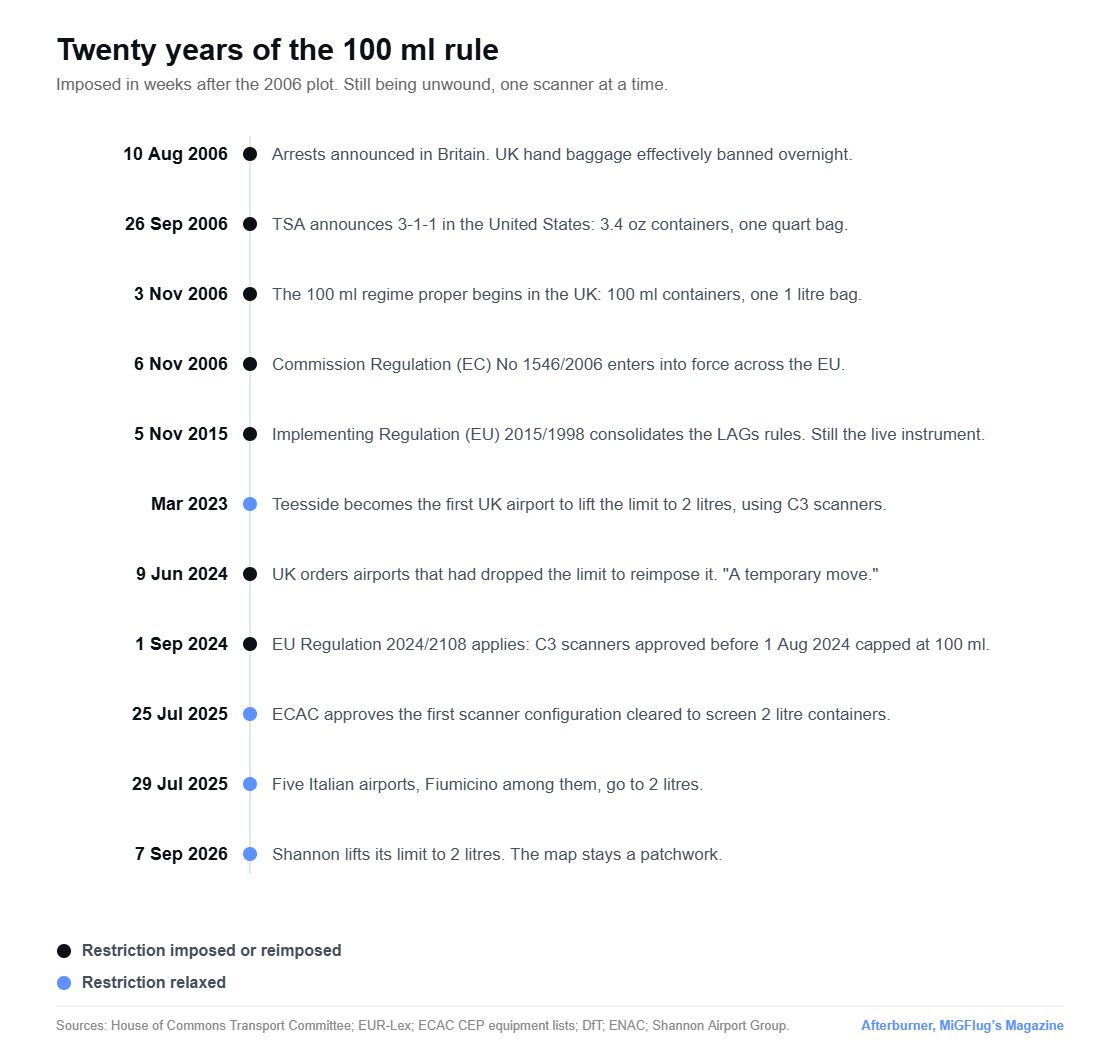
The response came in stages. On 10 August hand baggage was effectively banned outright. On 14 August passengers got one small bag back, still with no liquids. On 22 September the permitted bag size went up. The regime everyone now recognises began on 3 November 2006: liquids permitted only in containers of no more than 100 ml, those containers carried in a single transparent resealable bag of no more than one litre.
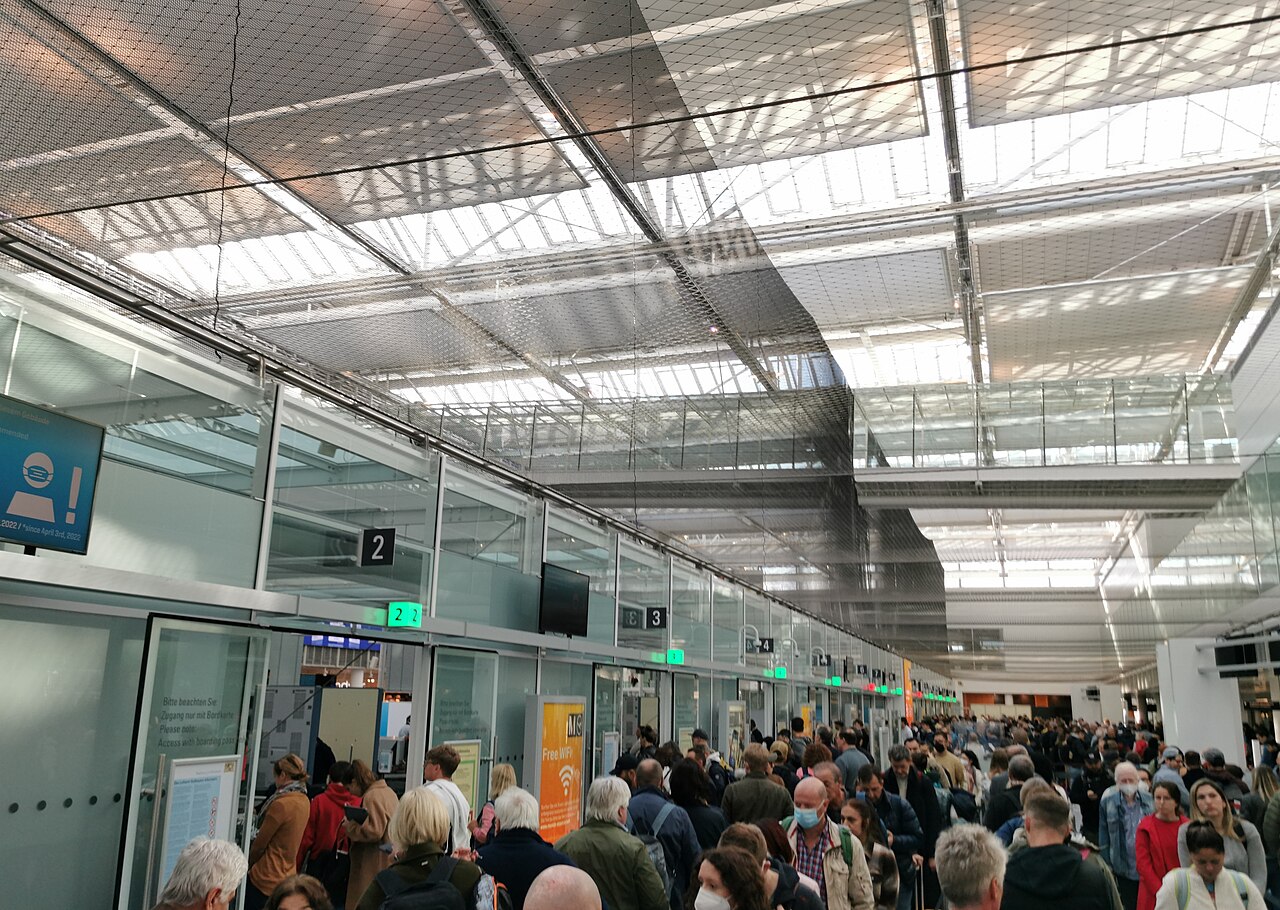
In Europe that became Commission Regulation (EC) No 1546/2006, adopted on 4 October 2006 and in force from 6 November. Several amendments later the live instrument is Commission Implementing Regulation (EU) 2015/1998, whose point 4.1.2.2 contains the whole thing in one sentence: passengers must present all liquids, aerosols and gels "in individual containers with a capacity not greater than 100 millilitres or equivalent in one transparent resealable plastic bag of a capacity not exceeding 1 litre, whereby the contents of the plastic bag fit comfortably and the bag is completely closed."
That final clause, about fitting comfortably and closing completely, is the one screeners and passengers argue about, and it is in the regulation rather than in some local interpretation. The exemptions are in there too: medicines, items for a special dietary requirement including baby food, and duty free sealed in a security tamper-evident bag.
The United States arrived at the same number by a different route. TSA announced its 3-1-1 formulation on 26 September 2006, as its then administrator later confirmed in writing: "We announced 3-1-1 on September 26, 2006 and that allowed travelers to go on overnight trips without having to check a bag."
Why 100 millilitres, specifically
This is the question every passenger has asked in a queue, and for most of twenty years the answer available online has been invented. There is, however, one published official rationale, and it comes from the TSA rather than from Europe. Kip Hawley, then the agency’s administrator, set it out on the official TSA blog in February 2008.
He described testing that "began the morning of August 10, 2006", the day the plot was made public, conducted by "multiple government agencies, National Laboratories and other nations", to establish a level at which liquid carried on board represented little risk. On the container itself he was specific: "A 100ml container limits the effect of, and even the ability of, a detonation. It also forces a more precise mix, and a lot more boost -- which makes it easier to detect from that side."
Hawley also explained the bag, which almost everyone assumes is a convenience for the X-ray operator. It is not. "The baggie gives us two benefits," he wrote. It limits quantity visibly, and it "serves to concentrate the vapor", because the substances used to make liquid explosives are volatile and emit fumes through sealed bottles. The detection equipment is built to exploit that concentration. The plastic bag is a sampling chamber.
What no regulator has ever published, anywhere, is a threshold quantity of liquid explosive sufficient to destroy an aircraft. Hawley said outright that "there are parts of the reason that are truly classified". The European Commission has never gone beyond saying the measure protects against the threat of liquid explosives. If an article offers you a precise millilitres-to-fuselage figure, it did not come from a regulator.
ITV News on the 2006 plot and how it was stopped.
The scanners that were supposed to end it
Computed tomography changed the arithmetic. A CT scanner builds a three-dimensional image of a bag and can characterise its contents well enough to clear a bottle without the bottle being taken out. The European Civil Aviation Conference grades the machines in three standards, and its own definitions are admirably plain. Standard C1 "requires the divestment of electronics and liquids, aerosols and gels". Standard C2 allows laptops and large electrical items to stay in the bag. Standard C3 allows laptops, large electrical items "and LAGs".
Britain moved first. In December 2022 the Department for Transport announced a programme with a June 2024 deadline and a new two-litre allowance. Teesside International became the first UK airport to drop the limit in March 2023, London City followed in April. Schiphol relaxed it after installing CT scanners. By 2024 a traveller could reasonably have believed the little bag was on its way out.
And then it came back
It came back in Britain first. From Sunday 9 June 2024, the DfT required the airports that had dropped the limit to reimpose it, describing the step as routine and not a response to any specific threat. "This temporary move is to enable further improvements to be made to the new checkpoint systems," the department said, "and will only affect a small number of passengers." Reporting at the time disagreed on exactly which airports were affected, naming five or six depending on the outlet.
Then Brussels followed. Commission Implementing Regulation (EU) 2024/2108, adopted on 29 July 2024 and applicable from 1 September, did something narrower and more consequential than a ban on scanners. It provided that C3 equipment which "has received the ‘EU Stamp’ marking or ‘EU Stamp pending’ marking before 1 August 2024 may only be used to screen LAGs with a screening limit of the maximum volume of individual LAG containers not to exceed 100 ml."
In other words, the restriction was keyed to an approval date, not to a manufacturer and not to a fault in any particular machine. In practice every C3 scanner then in service had been approved before that date, which is why it hit every airport that had relaxed the limit. The Commission described the cause as "a temporary technical issue" and stated that the measure was "not in response to any new threat". It named no manufacturer, and neither does the regulation. Any account that blames a specific vendor is going beyond the public record.
Schiphol put it to its own passengers with unusual candour: "This change is not related to any revision in threat levels. In taking this measure, the airports are following new guidelines from the European Commission."
The airports had a point about the money. ACI EUROPE put the cost of a C3 scanner at roughly eight times that of a conventional X-ray machine, with maintenance around four times higher. Airports had spent that money on the strength of an approval that was then narrowed.
One machine, one algorithm
The 2024 regulation left a door open, because it capped only equipment approved before 1 August 2024. ECAC then created an exceptional procedure for recognising external testing of C3 scanners at higher volumes, and on 25 July 2025 the first configuration came through it.
That configuration is a Smiths Detection HI-SCAN 6040 CTiX, Model S hardware, running detection algorithm 20-71-00, cleared to screen containers up to two litres. On the ECAC public equipment list as it stood on 18 September 2026, it is still the only one. Forty other C3 configurations, from Analogic, Leidos, Nuctech, Rapiscan, SST Labs and most of Smiths’ own range, remain capped at 100 ml.
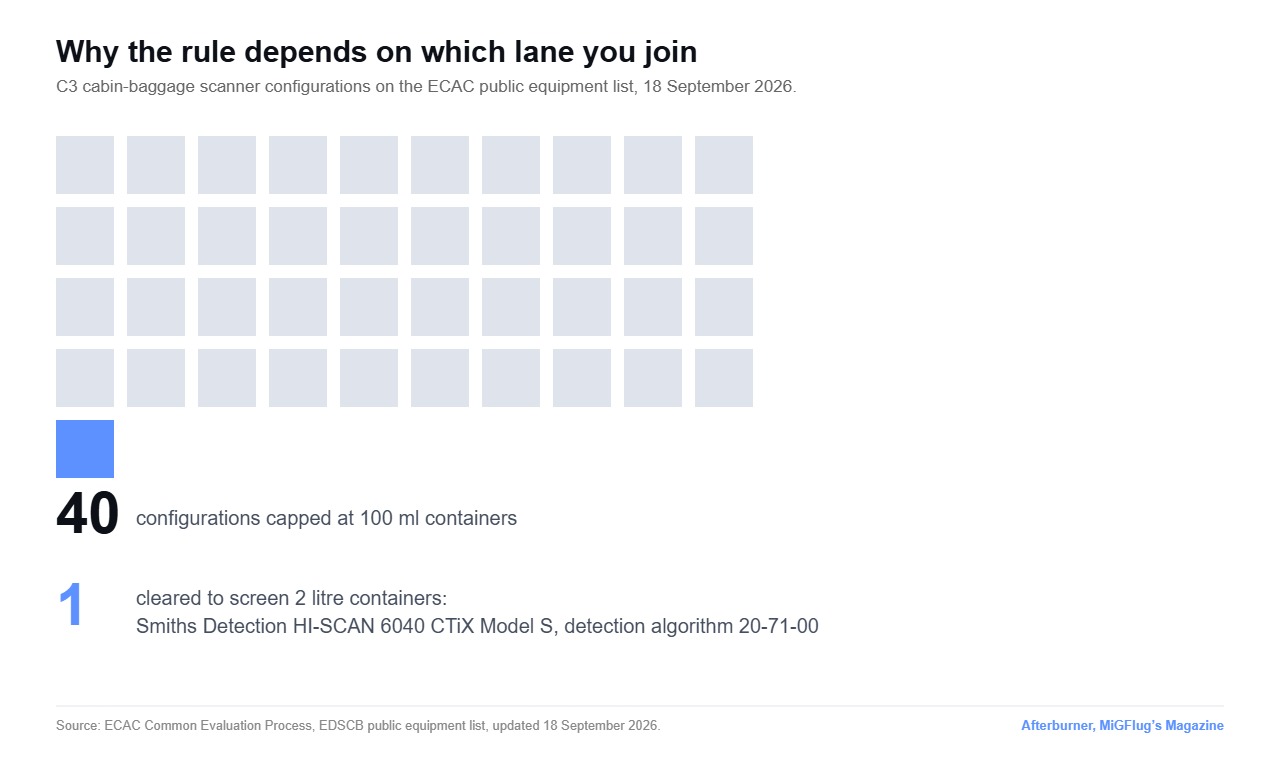
That single line in a spreadsheet explains the geography of the whole mess. Five Italian airports, Fiumicino, Linate, Malpensa, Bologna and Turin, went to two litres on 29 July 2025, four days after the approval, though ENAC kept the 100 ml limit on flights to the United States and Israel. Birmingham and Edinburgh became the first large UK airports to lift it, on 8 July 2025. Shannon joined them on 7 September 2026, using 3D scanners it had installed back in 2021 and then upgraded.
Smiths Detection’s own film of the HI-SCAN 6040 CTiX, the machine at the centre of the current European position.
Where that leaves you
Unsettled, and you should be suspicious of anyone who tells you otherwise. Surveys through 2026 disagree with each other about which airports have lifted the limit, partly because airports keep changing and partly because a converted terminal does not mean every lane is converted. Munich and Frankfurt run mixed checkpoints. Several airports that lifted the rule in 2023 were back on 100 ml by 2025.
The practical advice is the British government’s own, and the fact that it is the government’s advice is the story: "At most airports, you cannot take liquids in containers larger than 100ml through security." "Some airports may allow you to take liquid in containers that hold up to 2 litres." "Before you travel, check the rules." Two litres for medicines, dietary requirements and baby food still goes through every UK airport, as it always has.
One quirk worth knowing if you are an optimist with a flask: even at a two-litre airport, a vacuum flask usually has to be emptied, because the scanner cannot read through double-walled insulation.
There is something fitting about the ending. A limit arrived at in a national laboratory on the morning of the arrests, defended for nineteen years as a matter of first principle, is now being dismantled not by a security judgement but by a certification queue. The threat assessment has not changed. The machines have. And whether you have to decant your shampoo tomorrow depends on which lane you are waved into.
Sources: R v Ahmed Ali and Others [2011] EWCA Crim 1260; House of Commons Transport Committee, Eighth Report of Session 2006-07; Commission Implementing Regulation (EU) 2015/1998; Commission Implementing Regulation (EU) 2024/2108 and the European Commission statement of 31 July 2024; ECAC Common Evaluation Process EDSCB public equipment lists; UK Department for Transport and gov.uk hand luggage guidance; TSA blog, February 2008; ACI EUROPE; Schiphol; ENAC; Shannon Airport Group.


0 Comments