
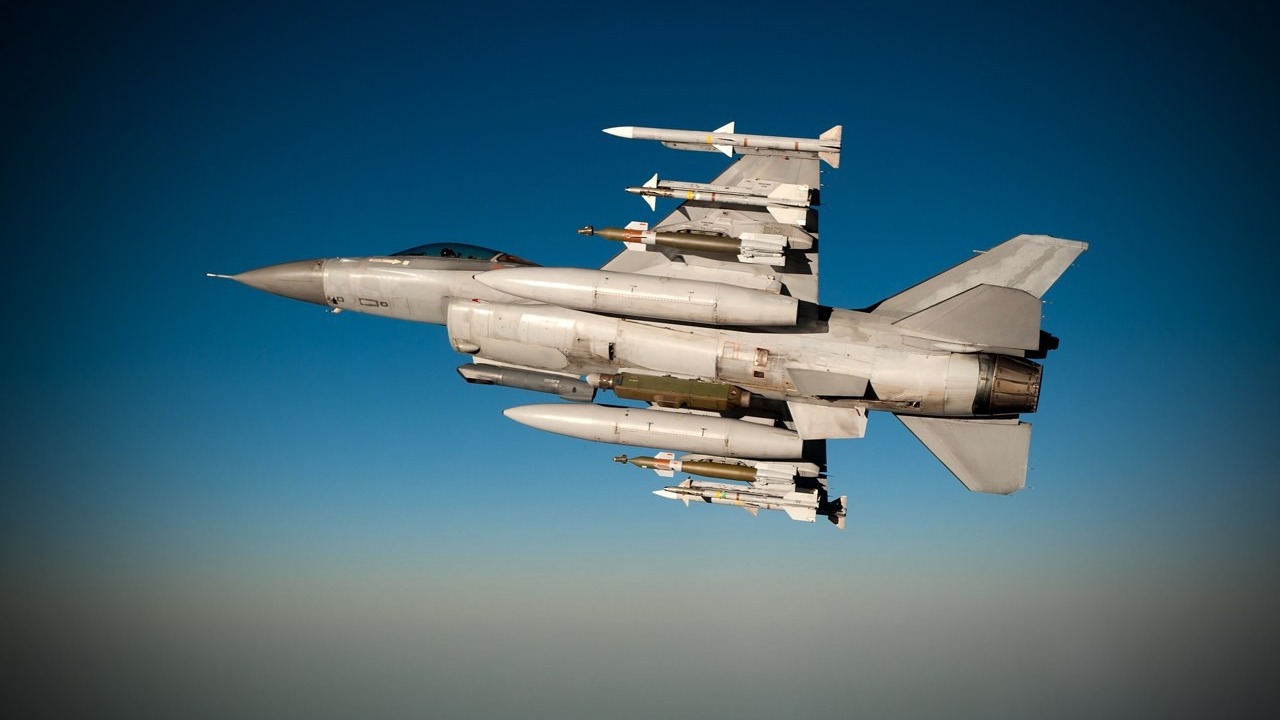
The Kuwait theatre, early 1991, after dark. Two F-111Fs circle at medium altitude over a sixty-by-thirty-mile box of desert. In the right seat, a weapon systems officer stares at a small black-and-white screen where the sand has gone cool and grey and the dug-in tanks are still glowing white with the heat of the day. He puts a crosshair on one, a laser fires, and a few seconds later a 500-pound bomb arrives exactly where the crosshair is.
The crews called it tank plinking, after shooting tin cans with an air rifle. What made it possible was not the aeroplane or the bomb. It was a pod about the length of a small car, stowed in the weapons bay on a rotating cradle, called Pave Tack.
Thirty-five years on, that pod has shrunk to a slim cylinder under the intake of almost every strike fighter in the world. Here are targeting pods explained: what is inside them, how they see, measure and mark, why their video changed close air support, and how the idea grew out of Vietnam.
Quick Facts
What a targeting pod does: Finds, identifies and tracks a target with stabilised infrared and TV cameras, measures its range and marks it with a laser
Core sensors: Infrared camera (FLIR), daylight TV camera, laser designator and rangefinder, laser spot tracker, infrared marker
Designator wavelength: 1,064 nanometres, coded with pulse repetition frequency (PRF) codes the bomb’s seeker is set to match
Sniper ATP (AN/AAQ-33): Lockheed Martin; picked by the USAF in August 2001; 446 lb, 98.2 in long, 11.9 in diameter
LITENING (AN/AAQ-28): Rafael with Northrop Grumman; first developed for the Israeli Air Force, the 1,000th pod sold in October 2010
Ancestors: Pave Knife (Vietnam), Pave Tack (service from 1982), LANTIRN (first production pod March 1987)
Changed the game: ROVER video downlinks, first fielded in 2004, let ground controllers see the pod’s picture live
From a TV camera on a wing to Pave Tack
The targeting pod exists because the laser-guided bomb did. Texas Instruments won the contract for what became Paveway in 1967, and the Air Force combat-tested it in Vietnam from May to August 1968. A laser bomb, though, is useless unless someone keeps a laser spot on the target until impact, and doing that from a manoeuvring jet over a defended target was the hard part.
The first answer to see real combat use was Pave Knife, which replaced earlier experimental designators. Philco-Ford built a dozen of them: a roughly banana-shaped pod weighing about 1,200 pounds, with a steerable laser and a closed-circuit TV camera. The back-seater watched the picture on a small cockpit screen and steered the laser with a hand controller. Six pods went to Southeast Asia on F-4 Phantom II fighters, three were held in reserve, and three went to US Navy A-6 Intruder squadron VA-145.
Their most famous target was the Thanh Hoa bridge, the Dragon’s Jaw. By 1972 the Air Force and Navy had flown 871 sorties against it and lost 11 aircraft. On 13 May 1972, F-4s from Ubon hit it with 26 laser-guided bombs and knocked the western span off its abutment. Precision had arrived, but only in daylight and clear weather, because a TV camera cannot see in the dark.
Pave Tack fixed that. Ford Aerospace’s AN/AVQ-26 married a laser designator and rangefinder to an imaging infrared sensor in a large rotating turret that could roll and pitch to keep the laser on the target after the aircraft had flown past it. It entered service in 1982 and weighed about 1,300 pounds. On the F-111 Aardvark it lived in the weapons bay on a rotating cradle and swung out when needed. On the F-4 it hung under the belly, and crews, feeling the drag, called it Pave Drag.

Pave Tack and the Paveway II made their combat debut together in Operation El Dorado Canyon, the April 1986 raid on Libya. Five years later came the Gulf War, and the medium-altitude night mission nobody had trained for.
Tank plinking: the night the pods proved themselves
Before the air campaign began, wings equipped with infrared pods flew night training sorties against US armour in the Saudi desert, an exercise known as Night Camel. The tapes showed something nobody had planned around: between sunset and midnight, armoured vehicles stood out clearly on the infrared screens, their metal still holding the heat of the day after the sand had cooled.
That observation became a tactic. Instead of screaming in at low level against a single fixed target, which is what F-111, F-15E Strike Eagle, F-16 and A-6 crews had trained for, aircraft loitered at medium altitude over a kill box and picked off vehicles one at a time with 500-pound GBU-12s. The F-111Fs flew 664 successful sorties of the mission over 23 days. On several occasions, two F-15Es carrying eight GBU-12s between them destroyed sixteen armoured vehicles in a single sortie.
Period weapon-system video from F-111Fs in Operation Desert Storm: the infrared picture, the crosshair and the laser-guided bomb arriving on it.
The National Museum of the US Air Force credits F-111F crews using Pave Tack with destroying more than 1,000 tanks and vehicles with 500-pound laser-guided bombs, while 2,000-pound bombs went into bridges and hardened aircraft shelters. Two of the officers who flew and planned the mission later summed up what it meant for anyone sitting in a trench.
Targeting pods explained: what is inside the cylinder
Open up a current pod and you find the same jobs Pave Tack did, done far better and in a fraction of the space. The US Air Force fact sheet for Lockheed Martin’s Sniper Advanced Targeting Pod lists them: a mid-wave infrared sensor, a high-definition TV camera, a dual-mode laser, a laser spot tracker, a laser marker, a video datalink and a digital recorder. The whole thing weighs 446 pounds and is 98.2 inches long and 11.9 inches across.
The infrared camera, the FLIR in pilot shorthand, is the heart of it. It sees heat rather than light, which is why it works at night and why a tank engine, a vehicle exhaust or a person stands out against cooler ground. The TV camera does the same job in daylight with better resolution and, on the newest pods, in colour. Both look out through the faceted window at the nose, and both are mounted on a gimbal.

That gimbal is where most of the engineering money goes. A fighter at several hundred knots bounces, vibrates and turns; the camera has to hold a crosshair steady on one vehicle many miles away while it does so. Stabilisation, improved again in the latest LITENING and TALIOS versions, is what turns a shaky video into something a crew can aim a bomb with. Automatic trackers then lock on to the contrast of the target and follow it as it moves, or as the aircraft does.
The laser does two jobs. Fired at the target and timed on its way back, it is a rangefinder, giving the aircraft an exact distance and, combined with its own position, accurate coordinates. That is how a pod generates the target coordinates that satellite-guided JDAMs need. Fired in designation mode, it lights the target for a laser-guided weapon.
The laser: coded light the bomb is listening for
Military designators work at 1,064 nanometres, in the near infrared and invisible to the eye. The beam is not on continuously. It fires a series of coded pulses, set by pulse repetition frequency codes, and the seeker on a laser-guided bomb or missile looks for reflected energy with that code and steers towards the centre of the spot.
The codes are why several aircraft can work the same area at once without their weapons chasing each other’s spots. They are also why the laser spot tracker exists. If someone else, a soldier with a hand-held designator or another jet, is already marking a target, the pod can be set to that code and slew its cameras straight to the spot. The crew sees exactly what the person on the ground is pointing at.
The laser marker works the other way round. It projects an infrared pointer designed to be seen through night-vision goggles, so the aircrew can show the ground force which building they mean. And the physics has limits that no software removes: cloud, rain and smoke can make laser designation difficult or impossible, which is one reason GPS-guided weapons took over so much of the precision workload.
Rafael’s own presentation of LITENING, the Israeli-designed pod that Northrop Grumman builds for US and allied air forces.
ROVER: when the picture left the cockpit
For most of the pod’s history, only the crew saw the picture. Close air support relied on a controller on the ground describing a target in words to a pilot looking at a completely different view from 10,000 or 15,000 feet. Talk-ons were slow and errors were deadly.
ROVER, the Remotely Operated Video Enhanced Receiver, ended that. A small datalink module in the pod sends its video to a rugged laptop carried by a joint terminal attack controller. The first generation appeared in 2004, and US Air Forces Central later took delivery of the 2,000th set. “A picture is truly worth 1,000 words,” said Lt. Col. Matthew Bannon, chief of reconnaissance at the CENTAF Combined Air and Space Operations Center.
The same video, recorded in the pod, also became the main tool for judging whether a strike worked. In 1991 Central Command had to be persuaded to accept pod tape as battle damage assessment; today it is routine.
Sniper, LITENING, ATFLIR, Damocles and TALIOS
LANTIRN came first in its modern form. Martin Marietta’s system split the job in two: an AN/AAQ-13 navigation pod with terrain-following radar and a fixed infrared camera, and an AN/AAQ-14 targeting pod with a FLIR, laser designator and rangefinder. The first production pod was delivered on 31 March 1987, and it went on the F-15E and F-16. The Navy dropped the navigation half and put the targeting pod on the F-14 Tomcat, first using it in combat in Operation Desert Fox in December 1998.
Sniper is LANTIRN’s descendant. The Air Force picked it in August 2001, and it first deployed overseas on the F-15E in January 2005. It has since been integrated on the F-16, the A-10, the B-1 and the B-52. Lockheed Martin says it has delivered more than 1,650 pods to 28 countries, flying more than five million hours.
LITENING is its great rival. Rafael developed it for the Israeli Air Force, Northrop Grumman joined in 1995, and it has evolved through Litening II, AT and G4 to Litening 5. The thousandth pod was sold in October 2010. In September 2022 Northrop Grumman announced its first flight on a US Navy Super Hornet.
That flight mattered because the Navy’s own pod, Raytheon’s AN/ASQ-228 ATFLIR, is the one LITENING was being tested to replace. ATFLIR took over from the older NITE Hawk on the F/A-18E/F Super Hornet, entering service with VFA-115 in 2003, and around 410 were delivered to the Navy. It usually rides on a fuselage station otherwise used by an AMRAAM.
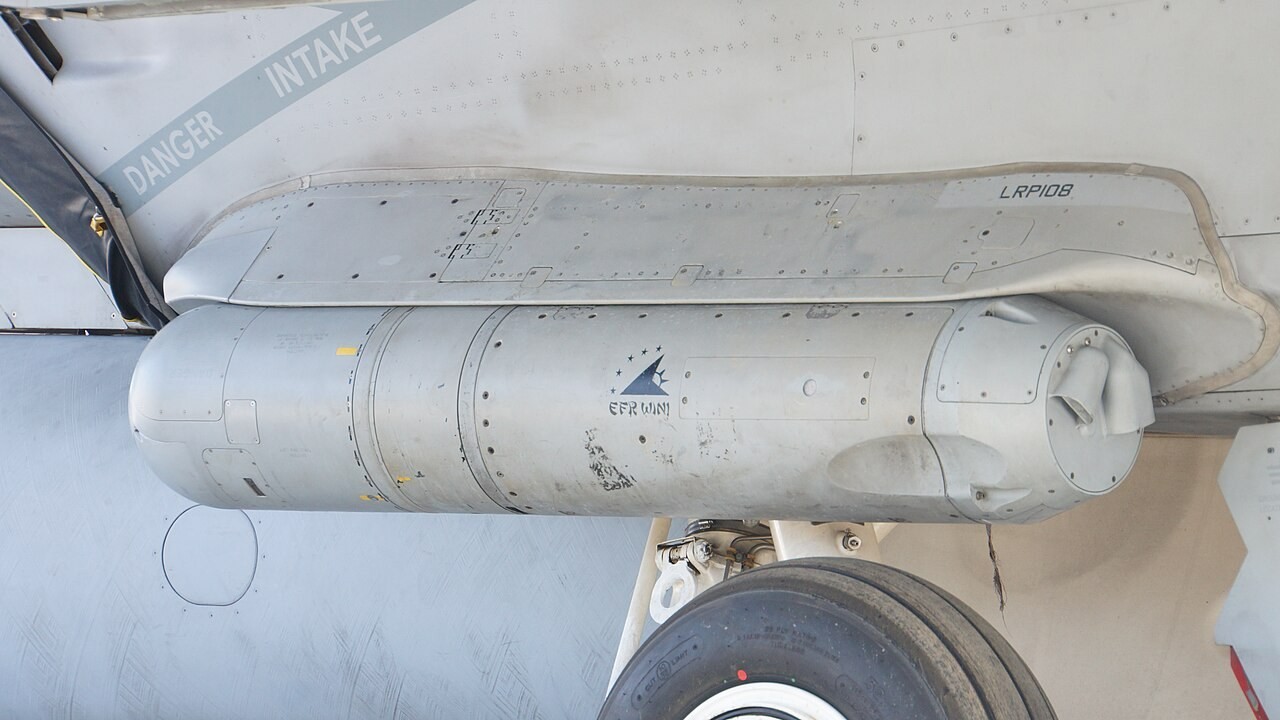
France went its own way. Thales built Damocles, which pairs the pod with a NAVFLIR navigation camera in the pylon fairing above it, and by 2015 had taken 120 orders, two-thirds of them for export. Its successor, TALIOS, short for Targeting Long-range Identification Optronic System, was unveiled in July 2014, is the same shape and roughly the same weight so it can directly replace Damocles, and was qualified by the French procurement agency in late 2018 as part of the Rafale F3R standard.
TALIOS’s headline trick is what Thales calls Vision Permanent: it lays the live camera picture over a 3D map of the area, so the crew is never staring down a narrow tube without context. Thales also claims it provides colour imagery to NATO standards.

Thales on TALIOS, the multi-function pod that succeeded Damocles on the Rafale.
Where targeting pods go next
Two trends are reshaping the pod. The first is that it is turning into a sensor in its own right, not just a bomb-aiming device. Pods are now used for intelligence gathering on missions where nothing is dropped, and for air-to-air work: slaved to the radar, a long-range infrared camera can identify another aircraft at night well before it can be seen. Northrop Grumman’s LITENING Large Aperture upgrade adds short, medium and long-wave infrared, a colour TV and a faster processor intended for future machine-learning functions.
The second is that the pod is being networked. Lockheed Martin pitches its newest Sniper variant with pod-to-pod datalinks and links to fifth-generation fighters, so that an F-35 could find a target and pass precise coordinates to a Sniper-equipped F-16. The F-35 itself carries its targeting system internally, behind a faceted window under the nose, which is the logical end point of the idea: a pod with the drag taken out.
From a TV camera on a Phantom’s wing to a networked, colour, AI-assisted sensor that can talk to a stealth fighter, the goal has not changed since 1968, and it is targeting pods explained in a single sentence. Keep a crosshair on exactly one thing, from far enough away to survive, and make sure the weapon goes there. Everything else is detail. Very expensive detail.
Sources: US Air Force fact sheet, Sniper Pod; Lockheed Martin, Sniper Advanced Targeting Pod product page; National Museum of the US Air Force, Ford Aerospace AN/AVQ-26 Pave Tack; John T. Correll, “The Emergence of Smart Bombs”, Air & Space Forces Magazine, March 2010; Michael J. Bodner and William W. Bruner III, “Tank Plinking”, Air Force Magazine, October 1993; US Central Command Air Forces Public Affairs, “Attack controllers receive 2,000th remote receiver”; 442nd Fighter Wing, “ROVER provides pilot’s-eye view to ground forces”; Armada International, TALIOS qualification (November 2018); AIN, Thales TALIOS and Damocles (November 2015); The War Zone, LITENING Large Aperture (February 2024); Northrop Grumman on X (7 September 2022); Wikipedia, Pave Knife, Pave Tack, LANTIRN, LITENING, AN/ASQ-228 ATFLIR, Sniper Advanced Targeting Pod and Laser designator.


0 Comments