
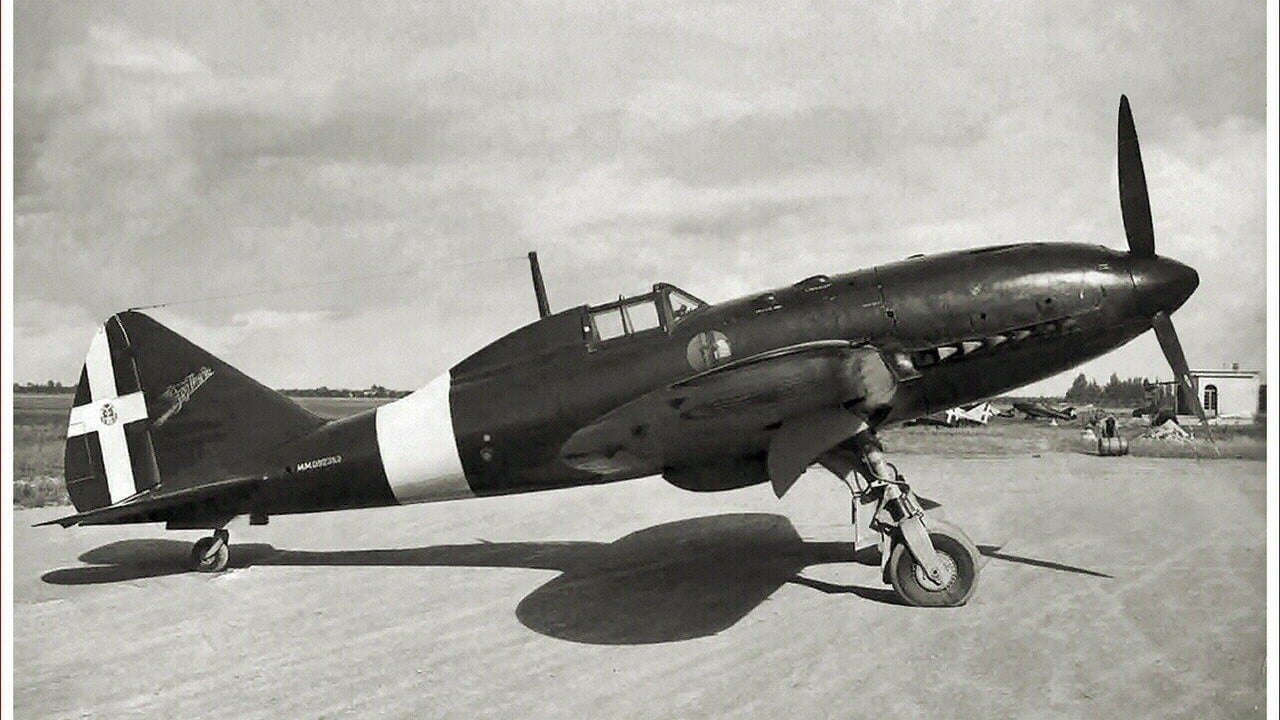
In the spring of 1943, American B-24 Liberators flying over Naples met a fighter few Allied crews had seen before. It was small, slim and dark, with a long nose, a curved wing and a big triangular fin. It climbed well, it turned hard, and it attacked again before the slower Italian fighters around it had finished their first pass.
It was the Reggiane Re.2005 Sagittario, the “Archer”. It was arguably the most refined fighter Italy built in the Second World War, and almost nobody got to fly it. Fewer than fifty were delivered before Italy’s armistice in September 1943, and not one complete example survives today.
Yet the people who met it never forgot it. An RAF Spitfire leader who once dogfought one later called it the best aircraft Italy produced. This is the story of a thoroughbred that arrived too late and in too few numbers to matter, and that still sparks arguments among historians eighty years on.
Quick Facts
- Type: Single-seat fighter and fighter-bomber, Reggiane, Italy
- First flight: May 1942 (prototype MM.494)
- Engine: One Fiat RA.1050 RC.58 Tifone, a licence-built Daimler-Benz DB 605A, about 1,475 hp
- Top speed: 628 km/h (390 mph) at 6,950 m
- Armament: Three 20 mm MG 151 cannon and two 12.7 mm Breda-SAFAT machine guns
- Ordered: 750
- Delivered: Fewer than 50 before the September 1943 armistice
- First unit: 362a Squadriglia, 22° Gruppo, Naples-Capodichino
- Survivors: Rear fuselage only, Caproni Museum, Trento
The Serie 5 contest
Italy entered the war with radial-engined fighters that were outclassed by the best British designs. The cure was German. Licence-built Daimler-Benz DB 605 engines, produced by Fiat as the RA.1050 RC.58 Tifone, were offered to three manufacturers, and each built a fighter around it. These became the so-called Serie 5: the Macchi C.205 Veltro, the Fiat G.55 Centauro and the Reggiane Re.2005.
Reggiane, based in Reggio Emilia, had already built the Re.2000 Falco family. Its design team under engineer Roberto Longhi treated the Re.2005 as a near clean-sheet aircraft rather than another development: a new fuselage, new undercarriage, new wing profiles and new armament. The first prototype, MM.494, flew in May 1942.
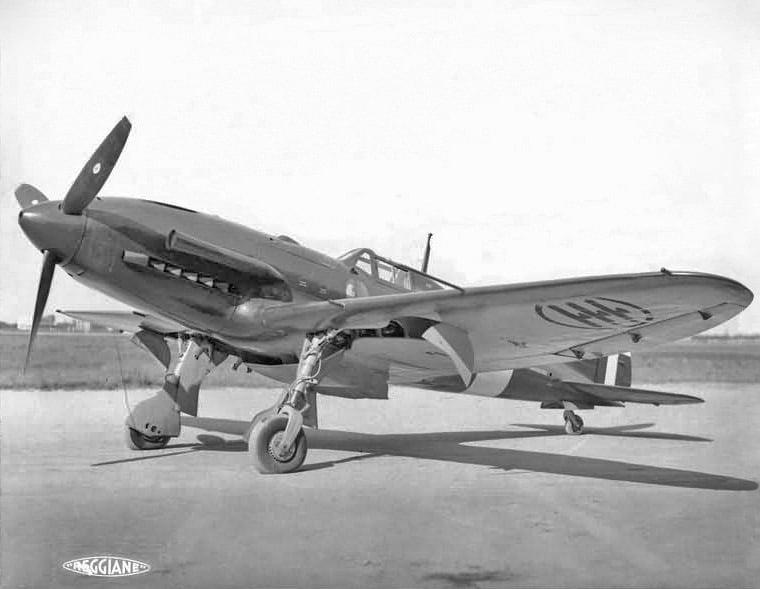
The result was a compact, light-alloy fighter with a semi-elliptical wing that thinned from 15 per cent of its chord at the root to 8 per cent at the tip. It had a wide-track undercarriage that retracted outwards and a fully retractable tailwheel. It was also the only Italian fighter of the war with hydraulically actuated flaps.
The Regia Aeronautica ordered 750, a hugely optimistic figure for wartime Italy. The trouble was that the Re.2005 was also complex and expensive. The G.55, only marginally inferior as a fighter, was judged far easier to build, and that verdict shaped what followed.
Plane Encyclopedia’s profile of the Re.2005 Sagittario, from the Serie 5 competition to the armistice.
Over Naples with 22° Gruppo
The first unit to fly the Sagittario was 362a Squadriglia of 22° Gruppo, defending Naples from Capodichino airfield. Its commander, Maggiore Vittorio Minguzzi, took the prototype up for the first time on 7 March 1943 and soon flew it into combat against American heavy bombers. His report was unusually concrete.
The comparison with the Macchi C.202 mattered. On paper the C.202 was not much slower, but the DB 605 and the larger wing gave the Re.2005 a real advantage at high altitude, exactly where the American bombers flew. 22° Gruppo never had more than about eight of them during that spring.
On 28 April 1943 four Re.2005s scrambled alongside C.202s against a raid of some thirty B-24 Liberators with escorts. Over the following weeks Reggiane pilots claimed several bombers. As with most wartime claims, the numbers rarely matched the losses recorded by the other side, and historians treat them with care.
Sicily, Spitfires and a shaking tail
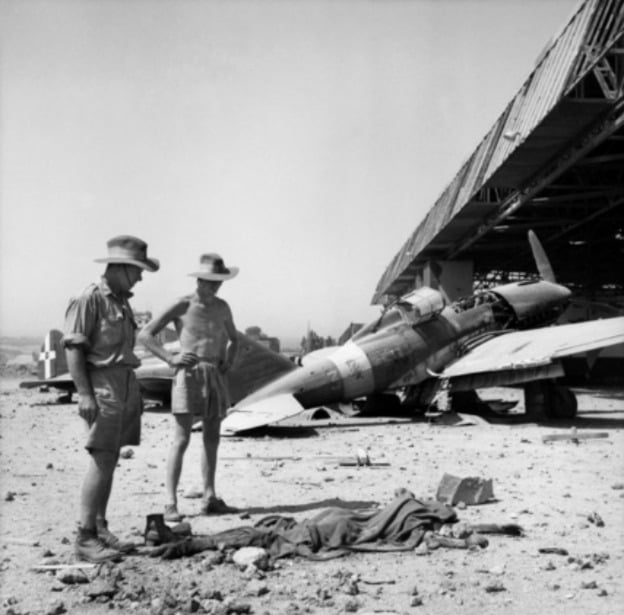
In early July 1943, 362a Squadriglia moved to Sicily to meet the Allied invasion. There the Re.2005s met Spitfires in numbers. They claimed some, but two Re.2005s were destroyed on 11 July and others were bombed or strafed on the ground. A handful of fighters could not change the outcome of a campaign.
That same day, Tenente Eugenio Salvi fought a long duel with a Spitfire Mk IX that clung to his tail through every manoeuvre he tried. He survived. After the war he flew the Spitfire Mk IX as an instructor with the Italian Air Force and, according to the account on Wikipedia, rated the Re.2005 the better turner, though he preferred the Merlin engine.
In August came a scare. Two Re.2005s were damaged or lost in steep dives, and high-speed flying was banned. Test pilot de Prato traced the shaking that began at around 660 km/h true airspeed to poor dynamic balancing of the tail surfaces. Once the balancing was corrected, he dived the aircraft to 980 km/h with no flutter.
AllthingsWW2 looks at the Re.2005, often described as Italy’s most beautiful late-war fighter.
Armistice and a scattered fleet
The armistice of 8 September 1943 broke up the tiny fleet. Some pilots destroyed their own aircraft rather than let them fall to the Germans. A few served the Aeronautica Nazionale Repubblicana in the north, mainly as trainers, and the Germans seized around thirteen.
What happened to the German machines is still argued over. Some accounts have them defending Berlin or the Ploiești oil fields in Romania. Other research suggests they probably never left Italy, and records show five still on strength with a German target-towing and support unit in mid-1944. Sweden, which already built the DB 605 under licence, was interested in 50 Re.2005s, but that order was never finalised.
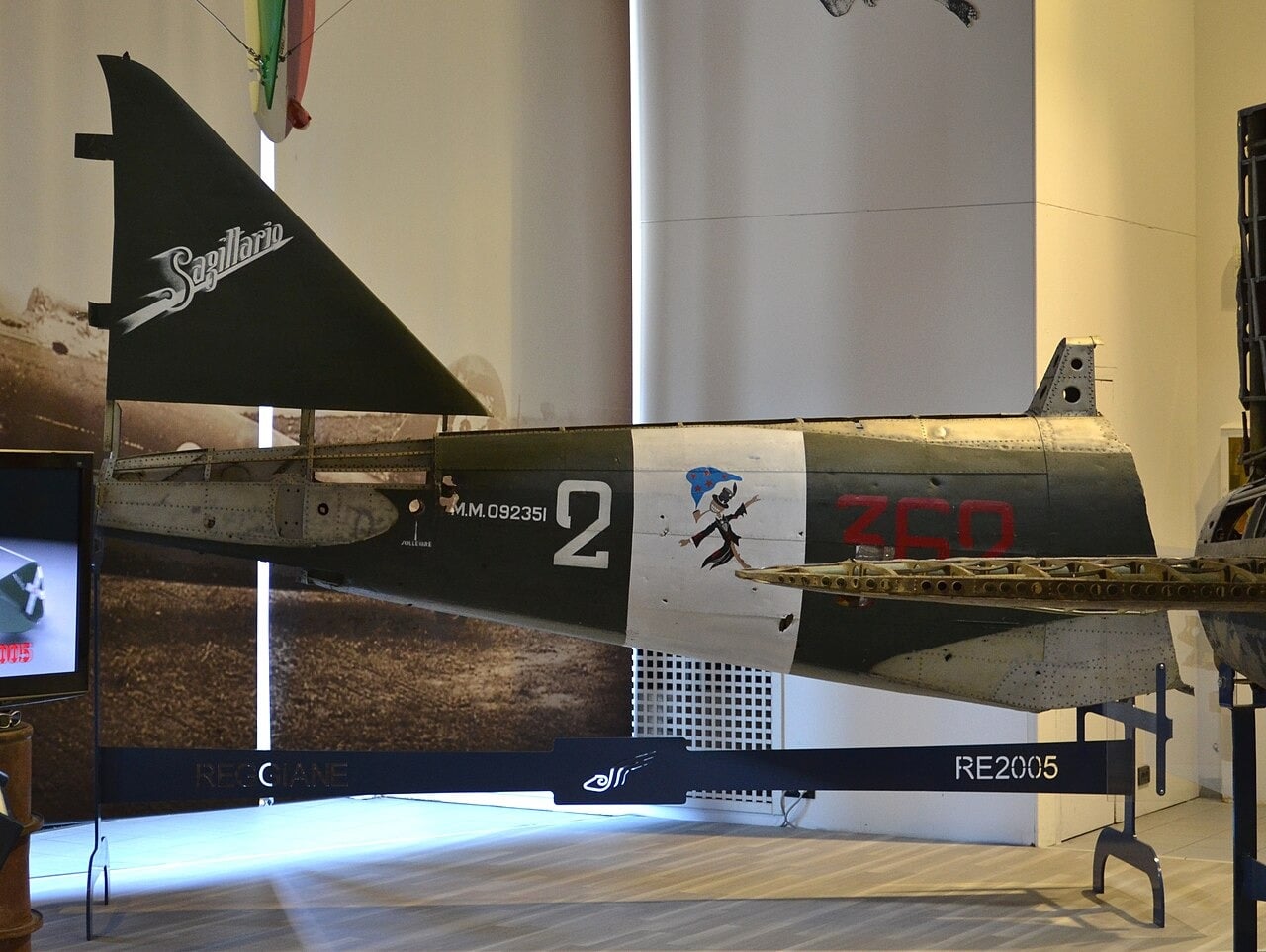
Today the only substantial remnant is a rear fuselage section, with its tail and 22° Gruppo markings, on display at the Gianni Caproni Museum of Aeronautics in Trento. One Re.2005 captured in Sicily is believed to have been shipped to the United States, and then vanished.
The verdict of an RAF ace
The most quoted judgement on the Sagittario came from the other side. Group Captain W. G. G. Duncan Smith, a Royal Air Force fighter leader in the Mediterranean, wrote about it in his memoir Spitfire into Battle.
Not everyone agreed it was the best of the three. The G.55 won the production argument, and a German evaluation commission in early 1943 rated the Fiat and the Reggiane both excellent, while judging the Re.2005 too complex to build. Our earlier story on the Fiat G.55 Centauro tells that side.
The Grand Archive on the Sagittario and the RAF verdict that it was “easily the best” aircraft Italy built.
What nobody disputes is the arithmetic. Seven hundred and fifty ordered, fewer than fifty delivered, and a combat career that lasted roughly six months. The Re.2005 showed what Italian designers could do with a good engine, and it showed it too late to matter.
Sources: Wikipedia (Reggiane Re.2005 Sagittario), aldini.it Re 2005 project history, HistoryOfWar.org, W. G. G. Duncan Smith: Spitfire into Battle

0 Comments