
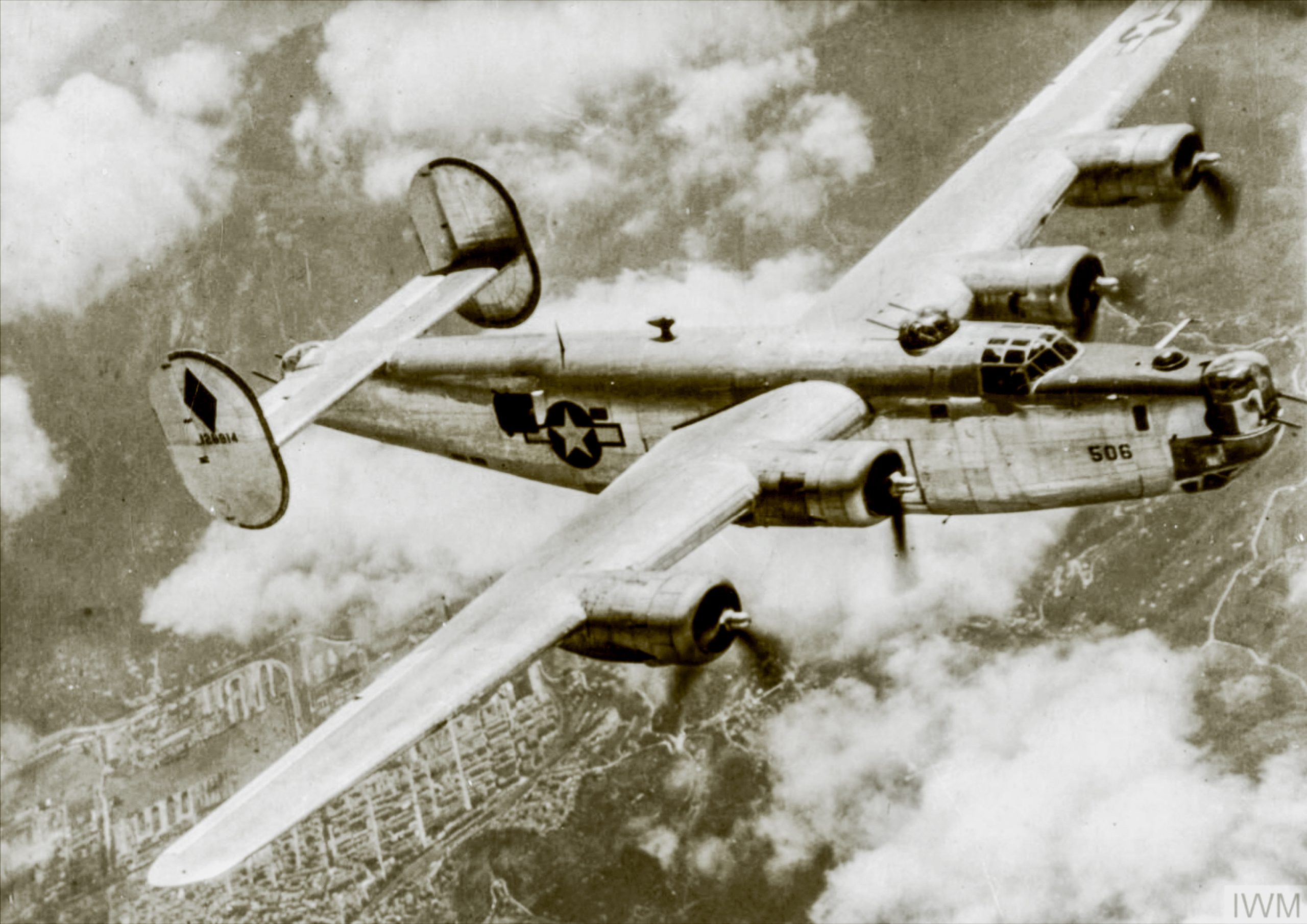
Consolidated B-24
“Liberator”
The most-produced American military aircraft ever built — a long-legged four-engine heavy bomber that carried the war to Ploesti, closed the Atlantic against the U-boats, and rolled out of Ford’s Willow Run at a bomber an hour.
The bomber that out-built everything
When the US Army Air Corps asked Consolidated Aircraft to build Boeing’s B-17 under licence in 1938, the San Diego firm made a bolder counter-offer: it would design a better bomber of its own. The result, first flown on 29 December 1939, was the B-24 Liberator — a slab-sided, twin-tailed four-engine machine wrapped around one radical idea, the high-aspect-ratio Davis wing. That long, narrow, remarkably efficient wing gave the Liberator more range and a heavier bomb load than the Flying Fortress it was meant to complement.
It was never as beloved as the B-17. The shoulder-mounted wing sat the fuselage low and made the aircraft heavy on the controls, tiring to fly in tight formation, and unforgiving when hit — and its slab-doored belly meant it ditched badly. But it flew farther, hit harder, and above all it could be mass-produced. Across a vast consortium — Consolidated in San Diego and Fort Worth, Douglas at Tulsa, North American at Dallas, and Ford’s enormous new plant at Willow Run — more than 18,000 were built, making the B-24 the most-produced American military aircraft in history.
Those numbers let the Liberator do everything at once. It hammered German industry with the Eighth and Fifteenth Air Forces, made the low-level Ploesti oil raid of August 1943, flew the Pacific and China-Burma-India theatres, and — perhaps most decisively — became the Very Long Range patrol aircraft that finally closed the mid-Atlantic “air gap” where U-boats had hunted convoys unseen. No single Allied aircraft was asked to do more.
01The B-24 Liberator vs the B-17 Flying Fortress: which was the better bomber?
The two American heavies split the work of the daylight bombing campaign, and crews argued their merits for eighty years. The B-24 was faster (cruising around 215 mph against the B-17’s 182), flew farther, and carried more bombs — roughly 2,100 miles with a 5,000 lb load, where a B-17 managed about 2,000 miles with 4,000 lb. That reach made the Liberator the natural choice for the Pacific’s vast distances and for ocean patrol.
The B-17, though, was easier and more forgiving to fly, held formation better at high altitude, and earned a legend for absorbing battle damage and still coming home. The Liberator’s shoulder wing and big roller-shutter bomb-bay doors made it more fragile under fire and lethal in a water landing. Both were vital; the honest verdict is that they were complementary tools, and the B-24’s trump card was that it could be built in numbers no other heavy bomber ever matched.
What makes it special
The Davis wing: range and payload
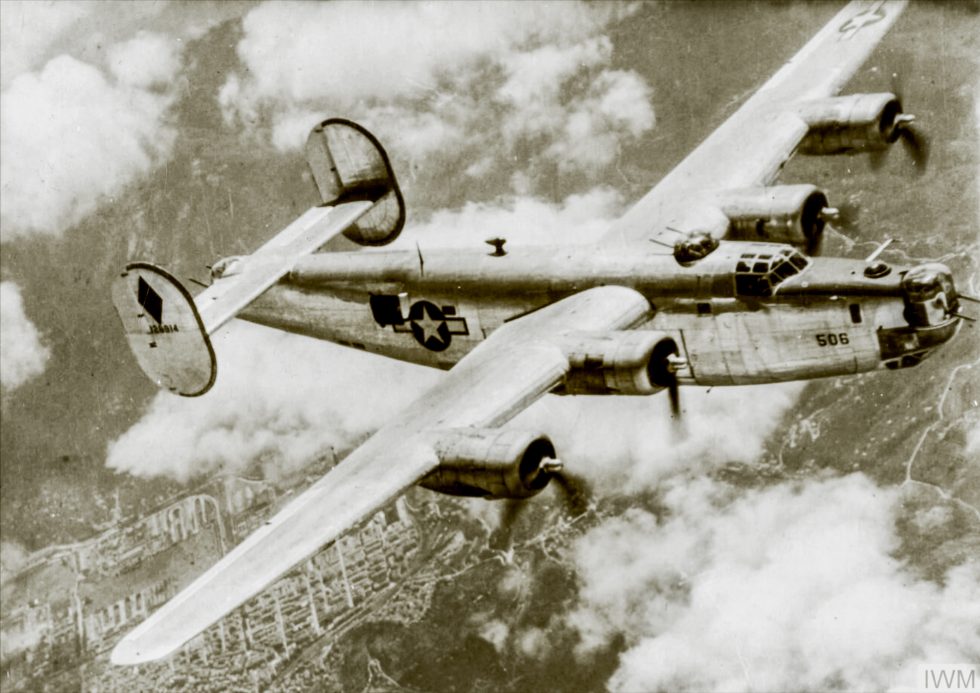
The Liberator’s defining feature was its high-aspect-ratio Davis wing — long, narrow and aerodynamically efficient. It generated lift with less drag than a conventional wing, giving the B-24 its long legs and heavy bomb load. The price was a wing mounted high on the fuselage that made the aircraft demanding to fly and left the belly’s big bomb-bay doors vulnerable.
Built by the thousands: Willow Run
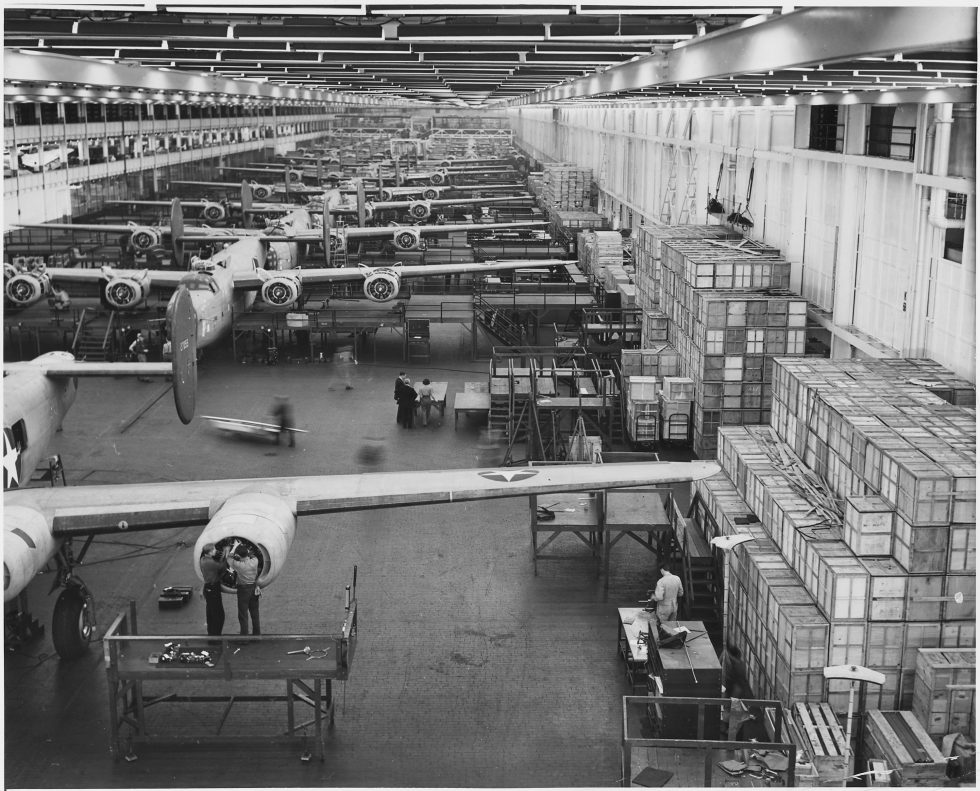
The B-24 was engineered for mass production. Ford’s mile-long Willow Run plant in Michigan applied automotive assembly-line methods to a heavy bomber, and at its 1944 peak it turned out roughly one B-24 an hour. Spread across five plants, output topped 18,000 — more than any other American military aircraft, before or since.
The U-boat killer over the Atlantic
Stripped of armour and packed with fuel, the Very Long Range (VLR) Liberator could patrol far out into the ocean. Fitted with ASV radar and the Leigh light, RAF Coastal Command Liberators closed the mid-Atlantic “air gap” in 1943 — and the type was ultimately credited, in full or in part, with sinking 93 U-boats.
02The B-24 Liberator’s Davis wing: the efficient design that made it hard to love
The Davis wing was a high-aspect-ratio aerofoil that David R. Davis pitched to Consolidated with striking efficiency claims. Wind-tunnel tests bore much of it out: the long, slender wing produced excellent lift-to-drag, and it handed the Liberator the cruise speed, ceiling and range that set it apart. It is why the B-24 could reach targets a B-17 could not, and why it excelled over the wide oceans.
But the same wing had to be mounted on the shoulder of a deep fuselage to clear the bomb bay, which raised the aircraft’s centre of gravity relative to the wing, made it heavy and tiring on the controls, and gave little margin if an engine failed on take-off. Laden and battle-damaged, a Liberator was less able to stagger home than a Fortress — and its shutter-type bomb doors flooded a ditched aircraft in seconds. The Davis wing was a brilliant bet on efficiency that crews paid for in workload and fragility.
03The B-24 Liberator and Willow Run: how Ford built a bomber an hour
Building a four-engine bomber like a car was a genuinely radical idea. Ford broke the Liberator into thousands of sub-assemblies and built a purpose-made factory at Willow Run, near Ypsilanti, Michigan — a single structure so long its final assembly line turned 90 degrees to stay within the county line. Early on the plant struggled; sceptics called it “Will-it-Run.” Once the tooling settled, it became the icon of American war production, employing tens of thousands, many of them women — the real “Rosie the Riveters” — and at its 1944 peak completing a B-24 roughly every 63 minutes. Combined with Consolidated, Douglas and North American lines, the consortium built more than 18,000 Liberators, a total no other American military aircraft has ever approached.
Full specifications
Figures below are for the definitive B-24J, the most-produced variant.
Baseline note: the figures below describe the B-24J, the most-built single version of any American bomber — 6,678 aircraft, and the only mark produced by all five factories that assembled Liberators. Deltas for the earlier B-24D, which was lighter, higher-flying and had a glazed nose rather than a turret, and for the US Navy PB4Y-1 and the fully navalised PB4Y-2 Privateer, are in grey. Two figures here are genuinely contested rather than obscure: total production, which reputable sources put anywhere between 18,188 and 18,500 depending on whether knock-down kits and cancelled airframes are counted, and the ceiling, which fell steadily as the aircraft gained turrets and armour, so a B-24D figure and a B-24J figure describe the same aeroplane two years apart.
Dimensions & weights
- Crew
- 10 (pilot, co-pilot, navigator, bombardier, radio operator, flight engineer/top turret, nose turret, ball turret, two waist gunners and tail gunner — often listed as 11 because the bombardier and navigator doubled as gunners on the earlier glazed-nose marks)
- Length
- 20.47 m (67 ft 2 in); the PB4Y-2 Privateer stretched to 22.73 m (74 ft 7 in) to move the crew stations apart and make room for more radar operators
- Wingspan
- 33.53 m (110 ft 0 in) — 1.83 m (6 ft) more than a B-17G, on 26 per cent less wing area
- Height
- 5.37 m (17 ft 7.5 in) over the twin fins; the Privateer's single fin stood 9.17 m (30 ft 1 in)
- Wing area
- 97.4 m² (1,048 sq ft), aspect ratio 11.55. A B-17G carried 131.9 m² (1,420 sq ft). That single comparison explains most of what follows
- Aerofoil
- Davis high-lift section, 22 per cent thickness at the root falling to 9.3 per cent at the tip — an unusually efficient profile arrived at by David R. Davis through a method nobody at Consolidated fully understood, validated in the wind tunnel because it could not be validated on paper
- Empty weight
- 16,556 kg (36,500 lb); the B-24D, with no nose turret and less armour, came in at 14,790 kg (32,605 lb)
- Gross weight
- 24,950 kg (55,000 lb) at normal loading
- Maximum take-off weight
- 29,480 kg (65,000 lb) and over. At that weight it was among the heaviest aircraft in the world, comparable with an Avro Lancaster
- Internal fuel
- ~8,870 litres (~2,344 US gal; ~1,952 imp gal) in the wing; ~13,680 litres (~3,614 US gal) with ferry cells in the bomb bay, which is how the very-long-range Atlantic aircraft were fuelled
- Bomb bay
- Two bays in tandem, each sized to a full B-17 bomb load, split lengthwise by a catwalk 23 cm (9 in) wide that doubled as the fuselage keel beam. Crewmen crossed it in flight, over open doors, in flying kit, at altitude
- Wing loading
- 256 kg/m² (52.5 lb/sq ft) — 35 per cent higher than the B-17's, and the root of the Liberator's reputation for heavy controls and unforgiving low-speed handling
- Undercarriage
- Tricycle, the first on an American heavy bomber. Steering was by differential braking and differential throttle only, which made taxiing a two-handed wrestle and put the nosewheel — never designed for heavy landings — under strain the transport conversions regularly broke
Performance
- Maximum speed
- 478 km/h (297 mph; 258 kn) at 7,620 m (25,000 ft); the lighter B-24D managed 488 km/h (303 mph). A B-17G did about 462 km/h (287 mph)
- Cruise speed
- 346 km/h (215 mph; 187 kn). In Eighth Air Force formation the Liberator ran roughly 16–24 km/h (10–15 mph) faster than a B-17, which is precisely why mixed formations were a problem and the two types were flown in separate streams
- Stall speed
- 153 km/h (95 mph; 83 kn) clean. Loaded, the aircraft was hard work below 257 km/h (160 mph) and pilots did not linger there
- Service ceiling
- 8,530 m (28,000 ft); a combat-loaded Eighth Air Force B-24J rarely bettered 7,600 m (25,000 ft). The B-24D reached 9,750 m (32,000 ft) and a B-17G 10,850 m (35,600 ft). Flying 900–1,200 m lower than the Fortresses put the Liberator squarely in the best band of the German 88 mm flak envelope
- Rate of climb
- 5.2 m/s (1,025 ft/min) initial
- Time to altitude
- 6,100 m (20,000 ft) in 25 minutes
- Range
- 2,478 km (1,540 mi; 1,338 nmi) at 381 km/h (237 mph) and 7,620 m with normal fuel and a maximum internal bomb load; the B-24D, carrying less, reached 4,587 km (2,850 mi)
- Ferry range
- 5,955 km (3,700 mi; 3,215 nmi). Very-long-range Coastal Command aircraft, stripped of turrets and armour and stuffed with bomb-bay tanks, flew Atlantic patrols of 16 hours and more
- Lift-to-drag ratio
- 12.9 — genuinely good for a 1939 bomber, and the whole point of the Davis wing
- Power-to-mass
- 0.0873 hp/lb (0.144 kW/kg) at gross weight
- Handling
- Heavy on all three axes and heavier still if the control cables were slack, with no boost of any kind. Pilots flew four-hour formation legs by muscle. Getting "on step" — climbing 150 m above cruise altitude, levelling, accelerating to 265–274 km/h (165–170 mph) and then descending back onto height — was a standard technique, because a Liberator flown nose-high burned fuel it did not have to spare
- Icing
- The thick Davis section distorted badly with ice and shed lift fast. Crews put it plainly: "the Davis wing won't hold enough ice to chill your drink". Over the Himalayas the C-87 transport version would spin out of a small accretion
- Damage tolerance and escape
- Poorer than the B-17 on both counts. The high wing carried the fuel and the main spar over the bomb bay; the fuselage broke more readily; and the crew had to reach the bomb bay to get out, over that catwalk, which in a spinning aeroplane many did not. This is the single most consistent complaint in Liberator crew memoirs, and it is not folklore
Propulsion & systems
- Engines
- 4 × Pratt & Whitney R-1830-65 Twin Wasp (R-1830-35 and -41 on other blocks) — 14-cylinder two-row air-cooled radials with General Electric turbo-superchargers
- Power
- 895 kW (1,200 hp) each for take-off, 4 × 895 kW (4,800 hp) total. The Privateer dropped the turbochargers for R-1830-94s of 1,007 kW (1,350 hp), trading altitude it did not need for weight it did
- Propellers
- Hamilton Standard three-blade constant-speed fully-feathering, 3.53 m (11 ft 7 in) diameter
- Fuel and oil systems
- Self-sealing wing cells with four nacelle oil hoppers of 498 litres (131.6 US gal) total. Liberators leaked. Crews flew with the bomb bay doors cracked open to vent petrol vapour, and smoking aboard was forbidden even by pilots who smoked
- Bombing system
- Norden M-series bombsight coupled to a C-1 autopilot on the B-24J — the pairing that defined the J block. Earlier D-model crews used the M-7 without the C-1 link and flew the bomb run manually
- Radar
- H2X "Mickey" ground-mapping radar in a retractable radome replacing the ball turret on pathfinder aircraft; ASV Mk II metric search radar with Yagi aerials, later SCR-717 centimetric sets, on maritime aircraft
- Anti-submarine fit
- Leigh Light — a 22-million-candela carbon-arc searchlight in a retractable nacelle or wing pod, slaved to the radar. Before it, Coastal Command sank nothing at night for five months; with it, U-boat crews began surfacing by day so they could at least see what was killing them
- Electronic warfare
- Carpet radar jammers and chaff dispensers in the 36th and 803rd Bomb Squadrons; the 36th was the Eighth Air Force's only dedicated electronic warfare unit and flew alongside RAF 100 Group
- Turrets
- Emerson A-15 electric nose turret (B-24H) or hydraulic Consolidated A-6 (most B-24J); Martin A-3 dorsal; retractable Sperry ball; Consolidated A-6B tail. RAF aircraft substituted Boulton Paul turrets with .303 in Brownings, which is why a Liberator GR could mount fourteen guns of two calibres
- Armour and protection
- Self-sealing tanks and armour plate at the crew stations from the B-24A onwards; very-long-range maritime aircraft deleted both to buy fuel
- First flight
- 29 December 1939 (XB-24, two days inside a contract deadline that demanded the prototype fly before the year ended)
- Service entry
- 1941 — with RAF Ferry Command and Coastal Command before the USAAF, because Britain bought first and needed it sooner
- Number built
- ~18,480 (figures from 18,188 to about 18,500 are all defensible). More than any other American military aircraft of any type, ever — and more than the B-17, Lancaster and Halifax combined. Ford's Willow Run plant accounted for roughly 8,600 of them, counting knock-down kits
- Retired
- 1968 (Indian Air Force, from airframes abandoned in India in 1945 and rebuilt by Hindustan Aircraft — the reason six of the fourteen surviving Liberators exist at all)
04The B-24 Liberator’s cost: how mass production drove the price down
Like most wartime aircraft, the Liberator had no meaningful “cost per flight hour” in the modern sense — it was a war material produced at national scale, not a leased asset. What is well documented is how sharply its unit cost fell as the assembly lines matured: a B-24 that cost far more early in the programme was being delivered for around $297,000 by 1944 as Willow Run and the other plants hit stride. That collapse in cost per airframe — the direct dividend of building a bomber an hour — was as important to the Allied war effort as any single performance number.
Armament & payload
The Liberator traded altitude and toughness for bomb load and range, and its ten .50-calibre guns were there to buy time, not to win fights
Everything about the B-24's armament follows from the Davis wing. The bomb bays were sized so that each one alone matched a B-17's entire capacity, and the aeroplane could lift 3,629 kg over a short radius — but it could not carry that load to Berlin and back, and the published figures make the trade explicit: 3,629 kg to 644 km, 2,268 kg to 1,287 km, 1,225 kg to 1,931 km. Defensive armament settled at ten .50-calibre M2 Brownings in four powered turrets and two waist positions, which sounds formidable and was, until the Luftwaffe worked out that the glazed-nose D model could not shoot forwards and began attacking head-on.
The nose turret fitted from the B-24H onward fixed that at a cost of about 450 kg on the front of an aeroplane that was already nose-heavy and already short of ceiling. That is the Liberator in miniature: every fix bought survivability and spent performance. By the B-24L and M the Army was going the other way again, deleting the ball turret and lightening the tail mount to claw back altitude. Turret fits varied by block, by factory and by theatre — Fifteenth Air Force aircraft in Italy, RAF Coastal Command Liberators with Boulton Paul turrets and .303 in guns, and Pacific squadrons that removed turrets outright for range all carried different batteries under the same designation.
Gun
- 10 × .50 in (12.7 mm) Browning M2 on the standard B-24H/J: two in the Emerson A-15 or Consolidated A-6 nose turret, two in the Martin A-3 dorsal turret behind the cockpit, two in the retractable Sperry ball, two in the Consolidated A-6B tail turret, and one at each waist window
- The B-24D had no nose turret. It carried a Martin dorsal, a tail turret, a troublesome periscope-sighted Bendix belly turret (deleted after 287 aircraft, then replaced by the Sperry ball), waist guns and two hand-held .50s poking through the glazed nose — the "wiggly ear" mounts, which were close to useless against a head-on pass
- RAF Liberators substituted Boulton Paul Type A Mk IV dorsal and Type E Mk II tail turrets firing .303 in (7.7 mm) Brownings with 2,500 rounds in the tail, giving some Coastal Command aircraft fourteen guns in two calibres
- The PB4Y-2 Privateer carried twelve .50s in six positions: an ERCO ball nose turret, two Martin dorsal turrets, two teardrop waist blisters and a tail turret — the heaviest defensive battery any Liberator variant ever mounted
- Some Coastal Command Liberator GR Mk I aircraft carried a ventral pannier with four fixed forward-firing 20 mm Hispano cannon for strafing surfaced U-boats, the only cannon armament the type ever carried operationally
Air-to-air
- None, in any offensive sense. The Liberator had no air-to-air weapon beyond its defensive machine guns; guided air-to-air missiles did not exist in the Second World War
- Bomber gunners nonetheless claimed enormous numbers of German fighters. Post-war reconciliation against Luftwaffe loss records showed those claims to be overstated by a factor of several — unavoidable when a dozen gunners in a formation all fire at the same aircraft and all see it fall
- The XB-41 was an attempt to turn the Liberator into an escort gunship, with fourteen .50s including a Bendix chin turret and a second Martin dorsal. It could not stay with a bomber formation once the bombers had dropped, and was cancelled in 1943 after a single conversion
- The real answer to head-on attack was not more guns but the P-51 Mustang with drop tanks, which arrived in the winter of 1943–44 and did what no amount of turret weight could
Air-to-surface guided
- Yes, and this is the exception that matters. The B-24 was the principal launch platform for the VB-1 Azon, a 454 kg (1,000 lb) bomb fitted with a radio-commanded tail that let the bombardier steer it in azimuth only — left and right, never long or short
- The Eighth Air Force's 458th Bomb Group flew Azon missions over Europe between June and September 1944; the weapon did its best work in Burma with the Tenth Air Force, where a bomb that could be walked sideways onto a bridge was exactly what was needed
- Azon was crude, weather-dependent and required the bombardier to keep the flare in the tail visible all the way down, but it was among the first guided munitions used in combat by any air force, and the Liberator carried it
- Separately, worn-out B-24s were stripped and converted into BQ-8 radio-controlled flying bombs under Operation Aphrodite. The programme killed more Allied airmen than Germans; Joseph P. Kennedy Jr. died in one on 12 August 1944
- Beyond these, nothing. The standard bomber carried no guided weapon of any kind
Bombs
- Maximum 3,629 kg (8,000 lb) over a 644 km (400 mi) radius; 2,268 kg (5,000 lb) to 1,287 km (800 mi); 1,225 kg (2,700 lb) to 1,931 km (1,200 mi). The bays could physically take 3,629 kg each, but nobody loaded them that way and lived with the resulting range and ceiling
- A typical Eighth Air Force load was ten to twelve 227 kg (500 lb) M43 general-purpose bombs, or incendiary clusters, or a mix; 454 kg (1,000 lb) and 907 kg (2,000 lb) weapons were carried for hardened targets
- Maritime aircraft carried Mk 44 Torpex depth charges shallow-set for attacks on surfaced U-boats, typically six to eight — the weapon that, with radar and the Leigh Light, actually closed the mid-Atlantic gap
- Also carried: naval mines for the Pacific and Adriatic mining campaigns, and fragmentation clusters for airfield attacks
- The roller-shutter bomb bay doors were the Liberator's cleverest detail — four tambour panels that rolled up into the fuselage like a rolltop desk. They added almost no drag when open, so the aeroplane did not slow on the bomb run, and they could be opened on the ground under a fuselage that sat very low
Rockets
- RAF Coastal Command only, and not many. Liberator GR Mk V aircraft were fitted with eight zero-length launchers, four under each wing, for the RP-3 60 lb (27 kg) rocket projectile
- Other GR Mk V machines carried stub pylons on the lower forward fuselage taking eight RP-3 rails, keeping the wing clean
- The solid 25 lb (11 kg) armour-piercing rocket head was preferred against submarines: it punched through pressure hull plating below the waterline rather than exploding against it
- USAAF and US Navy Liberators did not routinely carry rockets. The American answer to the same problem was the depth charge and, later, the Mk 24 "Fido" acoustic homing torpedo
Pods & other stores
- Bomb-bay ferry tanks — the single most important store the type ever carried. Filling one bay with fuel is what turned a medium-radius heavy bomber into the very-long-range patrol aircraft that closed the Atlantic air gap
- Leigh Light in a retractable ventral nacelle or an underwing pod, drawing on its own battery bank, slaved to the search radar for the last few hundred metres of a night attack
- Radar: H2X in a retractable radome in place of the ball turret on pathfinders; ASV Mk II with Yagi aerials and dorsal "stickleback" masts on early maritime aircraft; SCR-717 in a chin or ventral radome later
- Mk 24 mine — the deliberately misleading cover name for the Fido passive acoustic homing torpedo, dropped by PB4Y-1s and RAF Liberators from 1943 and one of the war's better-kept secrets
- Carpetbagger containers: parachute supply canisters and a "Joe hole" cut in the belly for dropping agents into occupied Europe from glossy-black B-24Ds at 120 m at night
Three typical loadouts
- Eighth Air Force deep penetration, 1944 (B-24J)
- Ten to twelve 227 kg (500 lb) M43 bombs in the two bays; full 8,870 litres of internal fuel; ten .50-calibre guns with roughly 500 rounds per gun; a formation take-off weight near 29,000 kg. Bombing altitude 6,700–7,600 m, which is 900–1,200 m below the Fortress groups and inside a better part of the flak envelope.
- Very-long-range Atlantic patrol, 1943 (Liberator GR Mk V)
- Nose and ball turrets deleted, armour stripped, ASV Mk II radar and a Leigh Light fitted, one bomb bay filled with fuel and the other carrying six to eight Mk 44 Torpex depth charges. Endurance sixteen hours and more; radius of action past 1,600 km. This configuration, and no other aeroplane in 1943, is what closed the mid-ocean air gap.
- South-West Pacific night anti-shipping, 1944 (SB-24 "Snooper")
- SCR-717 search radar and low-altitude bombsight, ten guns retained, six to eight 227 kg (500 lb) bombs fuzed for low release, and a single aircraft hunting alone at 300 m over the water at night. The 63rd and 868th Bomb Squadrons flew this profile against Japanese shipping with a hit rate that formation bombing never approached.
Sourcing caveat: bomb-load figures are from the USAAF pilot's manual and Jane's Fighting Aircraft of World War II, and describe the aircraft as delivered, not as flown. Operational loads were set by target, radius and group commander and varied enormously; the B-24 rarely carried anywhere near its structural maximum. Defensive gun counts likewise describe factory configuration, and Pacific and Coastal Command units routinely removed turrets to buy range.
Variants
Five factories built the Liberator and no two blocks were quite the same aeroplane
Consolidated at San Diego and Fort Worth, Ford at Willow Run, Douglas at Tulsa and North American at Grand Prairie all built Liberators, and the differences between their aircraft were large enough that repair depots had to stock several versions of the same part. The problem eased only in mid-1944, when three of the five plants stopped and production consolidated on San Diego and Willow Run.
Willow Run deserves its reputation, and also deserves the qualification usually left off. Ford broke ground in April 1941 and delivered the first aircraft in September 1942 — a slow, painful, much-criticised start, with a workforce that had to be housed in a field and a die-based production method that fought the constant design changes a combat aircraft demands. Then it worked. At peak, Willow Run turned out one B-24 every 59 minutes, 650 a month, on a 325,000 m² assembly line, and by 1945 Ford was making 70 per cent of all Liberators. Aircrews slept on 1,300 cots at the plant, waiting for their aeroplane to come off the line.
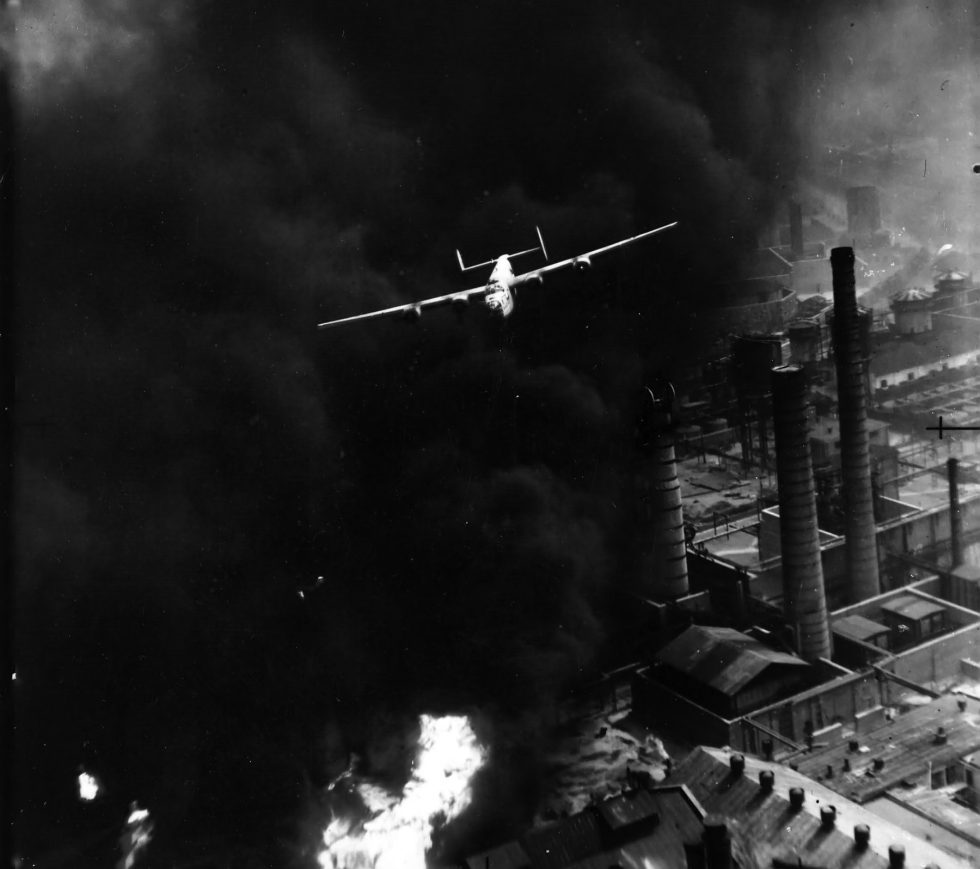
The raid the Liberator is remembered for is the one that went wrong. On 1 August 1943, 177 B-24Ds flew from Libya to attack nine oil refineries at Ploesti in Romania at treetop height — a high-altitude bomber flown low, without escort, against what was by then the most heavily defended target in Axis Europe outside Germany itself. A navigational error at the initial point split the force and gave the defences warning; the bomb run stretched; aircraft arrived over the target singly and out of order, some through the smoke of bombs already dropped. Fifty-three Liberators were lost, 310 airmen killed or missing, 190 captured or interned. Five Medals of Honor were awarded, three posthumously, the most for any single air action in history. And within weeks Ploesti was producing more fuel than before the raid, because the refineries had been running below capacity and the damage was repairable. It was heroism spent on a target that could absorb it.
The B-17 comparison is worth settling honestly, because both camps have overstated it for eighty years. The Liberator carried more, further and faster; the Fortress flew higher, took more damage and was easier to fly and easier to escape from. Crews preferred the B-17 and were right to, on the criteria that mattered to them. Staff officers preferred the B-24 and were also right, on the criteria that mattered to them. The Statistical Control group under Tex Thornton found that Eighth Air Force B-24s were taking lower losses than B-17s — because they were being given shorter, safer missions — and that the B-17s were delivering more bombs to the target. Both facts are true and neither settles the argument. The Liberator was the better aeroplane for the war the Allies actually had to fight, which was global and largely maritime; the Fortress was the better aeroplane for the daylight campaign over Germany that the Eighth Air Force chose to fight.
The other thing worth saying about the Liberator is where its most consequential work was done, which was not over Germany. Liberators are credited in whole or in part with sinking 93 U-boats. In the first months of 1943 a handful of worn very-long-range aircraft of No. 120 Squadron RAF provided the only air cover over the mid-Atlantic gap, because nothing else could reach it. When more arrived, together with escort carriers, better radar and Ultra, the U-boat campaign broke in a single month. That is the Liberator's decisive contribution, and it is the one nobody makes films about.
- XB-24 to Liberator B Mk II (1939–41, 8 prototypes and 165 LB-30s)
- The XB-24 missed its contract top speed by 61 km/h; fitting turbo-superchargers as the XB-24B fixed it and gave every later Liberator its flattened oval nacelles. The first combat-capable version was the British-specification Liberator B Mk II, with a 0.79 m nose plug, a deeper rear fuselage, self-sealing tanks, armour and Boulton Paul turrets. About 75 were requisitioned by the USAAF after Pearl Harbor and flown to Java, Alaska and Midway.
- B-24D (1942–43, 2,696 built)
- First mass-produced version and the Ploesti aircraft. Turbo-supercharged R-1830-43s, ten guns, glazed nose. Lighter and higher-flying than anything that followed, and vulnerable to head-on attack in a way that killed a great many crews before the nose turret arrived.
- B-24H (1943–44, 3,100 built)
- The fix: an Emerson A-15 electrically powered nose turret, a redesigned bombardier's compartment, better tail-turret glazing, enclosed and staggered waist positions, improved bombsight and fuel transfer. Mostly Ford-built. Many consider it the definitive Liberator.
- B-24J (1943–45, 6,678 built)
- The baseline here and the most numerous. Essentially a B-24H with a C-1 autopilot and M-series bombsight; Emerson nose turret shortages meant most J models used a hydraulic Consolidated A-6 instead. The only mark built at all five plants.
- B-24L and B-24M (1944–45, 1,667 and 2,593 built)
- Deliberate weight reduction after the H and J had grown too heavy. The L swapped the Sperry ball for a twin-gun ring mount and lightened the tail; the M went further still. Many M models flew only from the factory to the scrapyard.
- PB4Y-1 (1942–45, 977 to the US Navy)
- Navalised B-24D/J/L/M with an ERCO ball nose turret and, on Atlantic and Coast Guard aircraft, a retractable radome in place of the ventral turret. Flown by Navy and Marine patrol squadrons across both oceans.
- PB4Y-2 Privateer (1944–45, 739 built)
- A properly navalised redesign: 2.3 m longer, a single tall fin, no turbochargers (the mission was low), twelve guns in six positions including teardrop waist blisters. Served into the Korean War and afterwards spent decades as a fire-bomber.
- C-87 Liberator Express and C-109 (1942–45, 287 and 218 converted)
- Transport and fuel-tanker conversions flown over the Hump into China. Both were disliked: leaking fuel systems, an unforgiving nosewheel, cockpit electrical failures and the Davis wing's appetite for ice. Ernest K. Gann nearly flew one into the Taj Mahal and wrote about it.
- Liberator GR Mk I to GR Mk VIII (1941–45, RAF Coastal Command)
- The maritime marks. ASV radar, Leigh Light, depth charges, rocket rails, turrets and armour deleted for fuel. Unglamorous, obscure, and between them the most strategically important Liberators ever built.
- F-7, BQ-8, XB-24N (1943–45, small numbers)
- Photographic reconnaissance conversions with up to six cameras; radio-controlled flying bombs for Operation Aphrodite; and the single-finned redesign that testing showed handled far better. Over 5,000 B-24Ns were ordered in 1945 and all were cancelled at the war's end.
Fourteen complete Liberator airframes survive worldwide, of which exactly one flies: the Commemorative Air Force's LB-30/B-24A, restored as "Diamond Lil", an aeroplane that never reached Britain because it was damaged in a training accident in 1941 and spent the rest of its life as a company hack and then a corporate transport. The Collings Foundation's B-24J "Witchcraft" flew from 1989 to 2019 and was permanently grounded after the Foundation's B-17 crash at Bradley. Six of the fourteen survive only because Hindustan Aircraft rebuilt abandoned airframes for the Indian Air Force, which flew Liberators until 1968. For an aeroplane built in greater numbers than any other American military type in history, that is a startlingly small inheritance — the consequence of a design declared obsolete the moment the war ended, and scrapped where it stood.
From a San Diego gamble to 18,000 bombers
First flight
The prototype XB-24 flies on 29 December, built around the efficient high-aspect-ratio Davis wing.
Into service
The RAF names the type “Liberator” and, with the USAAF, puts it to work — including early Atlantic anti-submarine patrols.
Willow Run tools up
Ford opens its mile-long Michigan plant to build the four-engine bomber on an automotive assembly line.
The Atlantic gap closes
Very Long Range Liberators of RAF Coastal Command help win the Battle of the Atlantic during “Black May.”
Ploesti — Black Sunday
178 Liberators strike the Romanian oil refineries at treetop height on 1 August; 54 aircraft are lost.
A bomber an hour
Willow Run hits its stride, completing a B-24 roughly every 63 minutes as the type reaches every theatre.
War’s end
With victory won, production stops; thousands of surplus Liberators are scrapped almost overnight.
A handful survive
Of more than 18,000 built, only a couple remain airworthy — among the rarest of all warbirds to see fly.
From the war: twelve Liberator stories
Consolidated’s counter-offer
Asked to build B-17s under licence, Consolidated proposed a better bomber of its own.
Read the full story
Why it is called the Liberator
The RAF, not the USAAF, gave the B-24 its enduring name.
Read the full story
A bomber an hour
At its 1944 peak, Ford’s Willow Run plant completed a four-engine bomber roughly every 63 minutes.
Read the full story
Black Sunday
On 1 August 1943, 178 Liberators bombed the Ploesti oil refineries from treetop height.
Read the full story
The Sandman
One B-24 emerging from the smoke at Ploesti became the war’s most famous bombing photo.
Read the full story
Closing the gap
For a year, VLR Liberators were the only aircraft that could cover the mid-ocean U-boat killing ground.
Read the full story
93 U-boats
Liberators were credited, in full or in part, with sinking 93 German submarines.
Read the full story
The Navy’s Liberator
The US Navy flew its own long-range B-24s — and a dedicated single-tail derivative, the Privateer.
Read the full story
Rosie at Willow Run
Tens of thousands built the Liberator — and much of that workforce was women.
Read the full story
Ten men, freezing cold
A Liberator crew of ten worked for hours in unpressurised, sub-zero air.
Read the full story
The Lady Be Good
A lost B-24 flew on into the Sahara — and was found, preserved, sixteen years later.
Read the full story
The rarest warbird
Of more than 18,000 Liberators, only a couple still fly today.
Read the full story
The Liberator in pictures
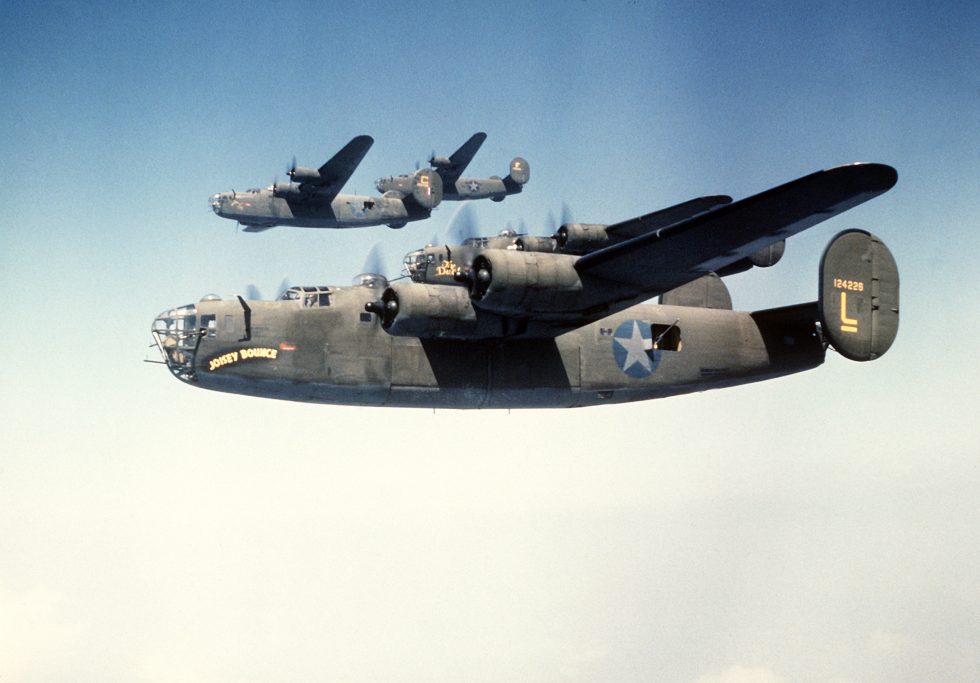
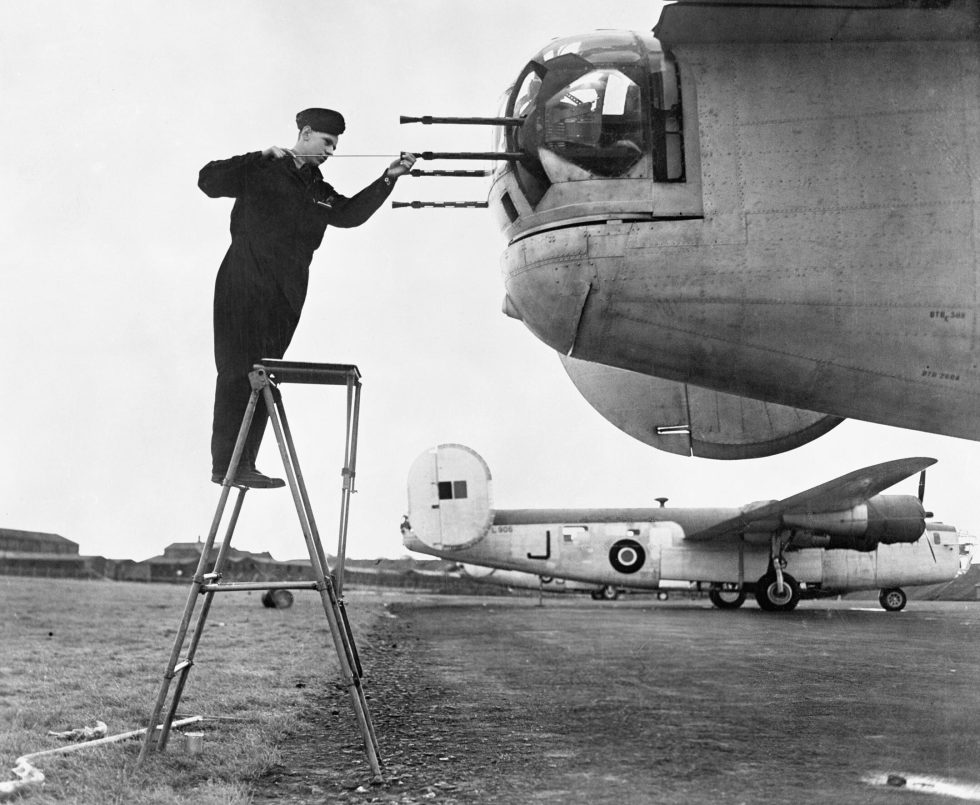

The Liberator in motion
A dedicated B-24 Liberator video feature is coming soon. In the meantime, explore the photo gallery above and the twelve first-hand stories from the aircraft’s wartime career.
Where the Liberator flew
The numbers that define it
The Liberator’s record is not a fighter’s kill tally — it is written in scale, reach and the campaigns it made possible. It was built in greater numbers than any other American military aircraft, it flew in every theatre of the war, and it helped win the Battle of the Atlantic outright.
Compare the combat record of every military aircraft. Figures as of July 2026.
Everything people ask about the B-24 Liberator
Can I fly in a B-24 Liberator?
Why was the B-24 built in bigger numbers than the B-17?
Was the B-24 better than the B-17?
What was the Ploesti raid?
How did the B-24 help beat the U-boats?
What was the Davis wing?
Are any B-24 Liberators still flying?
You can’t fly the Liberator.
These, you can.
Some legends only live in museums — others are fuelled and waiting. MiGFlug has put civilians in real military jet cockpits since 2004.
 Fly the L-39 AlbatrosThe world’s most-flown jet trainer — aerobatics included
 Fly the F-104 Starfighter“The missile with a man in it”
 Fly the MiG-21The Cold War’s most-produced jet
 Fly the T-33 Shooting StarAmerica’s first jet trainer
 Fly the DH VampireA piece of early jet history
 Fly the S.211Agile Italian jet trainer
 Fly the MB-326The classic Aermacchi jet
 Fly the MiG-15The Soviet legend of the Korean War
Continue the tour
Every fact, checked
- National Museum of the US Air Force — Operation Tidal WaveOfficial account of the 1 August 1943 Ploesti raid: 178 aircraft, 54 lost, five Medals of Honor.
- Imperial War Museums — B-17 vs B-24Range, payload, speed and handling comparison of the two American heavy bombers.
- The Henry Ford — Willow Run Bomber PlantFord’s mile-long factory and the “bomber an hour” production story.
- War on the Rocks — The Davis WingHow the high-aspect-ratio Davis aerofoil shaped the Liberator’s range and character.
- Warbirds Resource Group — Liberator in RAF ServiceVLR Liberators, No. 120 Squadron and the 93 U-boat sinkings credited to the type.
- MiGFlug Afterburner — Operation Tidal WaveMiGFlug’s own long-read on the low-level Ploesti mission.
- CAF B-29/B-24 SquadronOperator of “Diamond Lil,” one of the last airworthy Liberators; type history and specifications.
- Military Factory — B-24 LiberatorReference specifications for the B-24J and production totals.