
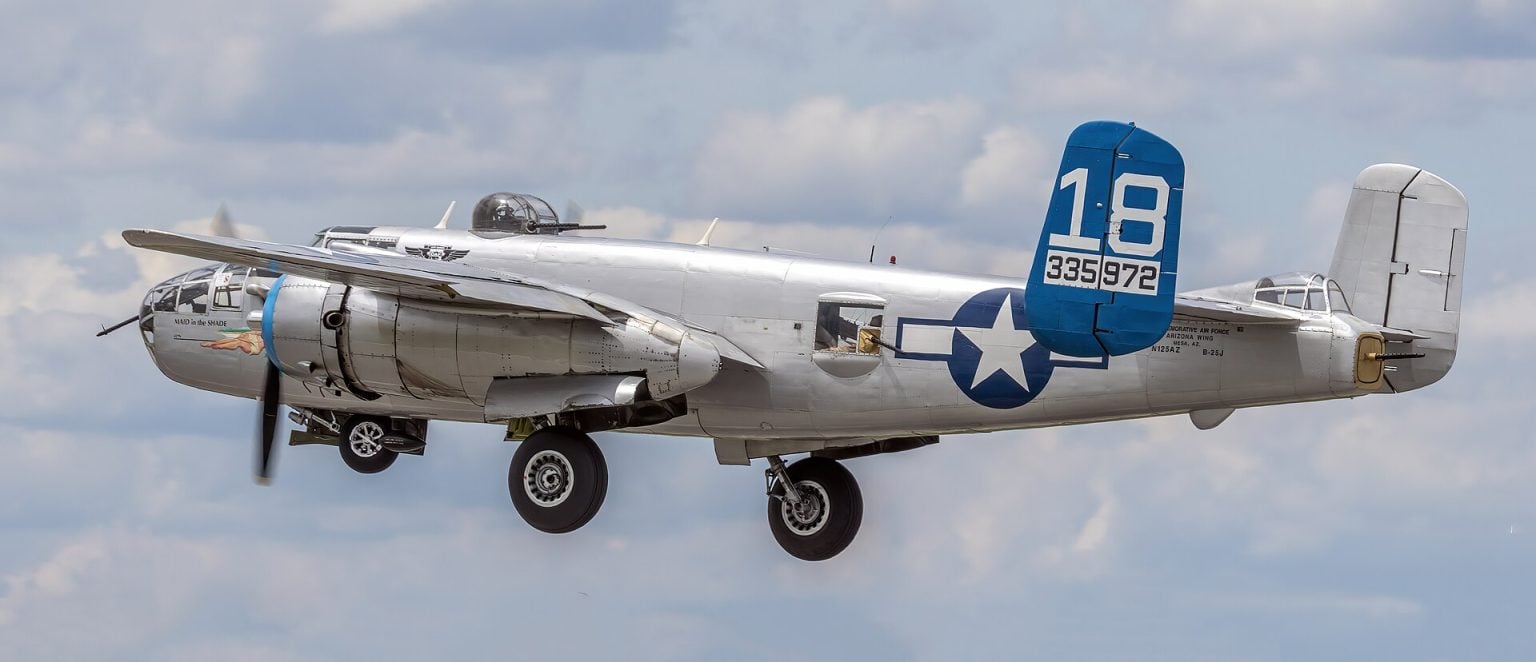
North American B-25
Mitchell
The WWII medium bomber that launched off a carrier deck to hit Tokyo, then turned into the most heavily-gunned low-level strafer of the Pacific war — and one of the best-loved warbirds still flying.
The B-25 Mitchell: the bomber that struck back at Tokyo
When North American Aviation flew the first B-25 on 19 August 1940, the company had never built a twin-engine bomber. What it delivered was one of the most versatile combat aircraft of the Second World War: a rugged, forgiving twin with a distinctive twin tail and tricycle landing gear that could be flown hard by young crews and absorb brutal punishment. It entered US Army Air Forces service in February 1941 and was named after Brigadier General William “Billy” Mitchell, the interwar prophet of American air power — the only US military aircraft named for a specific person.
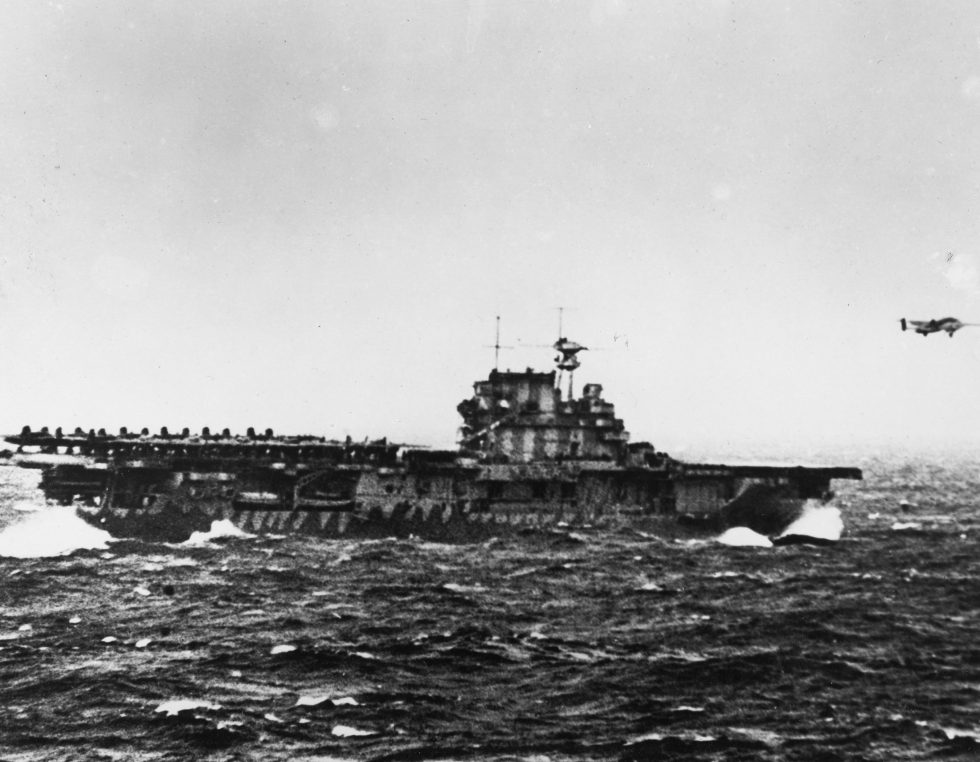
The Mitchell became a legend barely a year into the war. On 18 April 1942, sixteen B-25Bs led by Lieutenant Colonel James “Jimmy” Doolittle rumbled off the pitching deck of the carrier USS Hornet — something no one had thought a land-based medium bomber could do — and bombed Tokyo and other Japanese cities. The physical damage was slight, but the psychological effect was enormous: it proved to a shaken American public that Japan could be hit, and it rattled the Japanese high command into the fateful decisions that led to Midway.
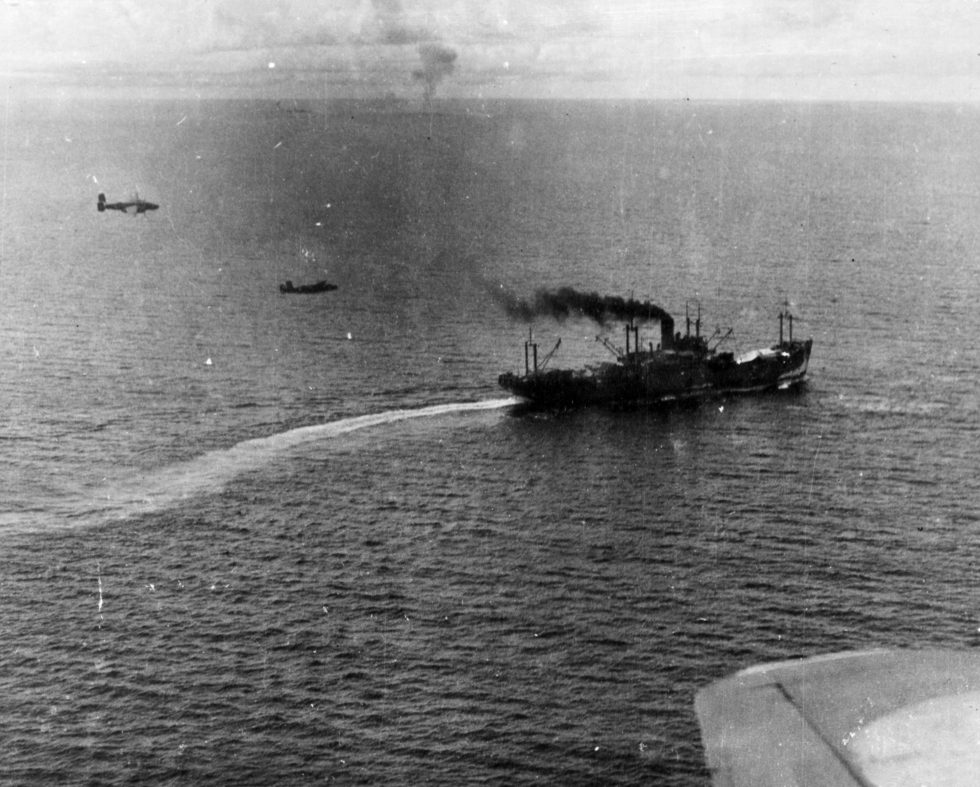
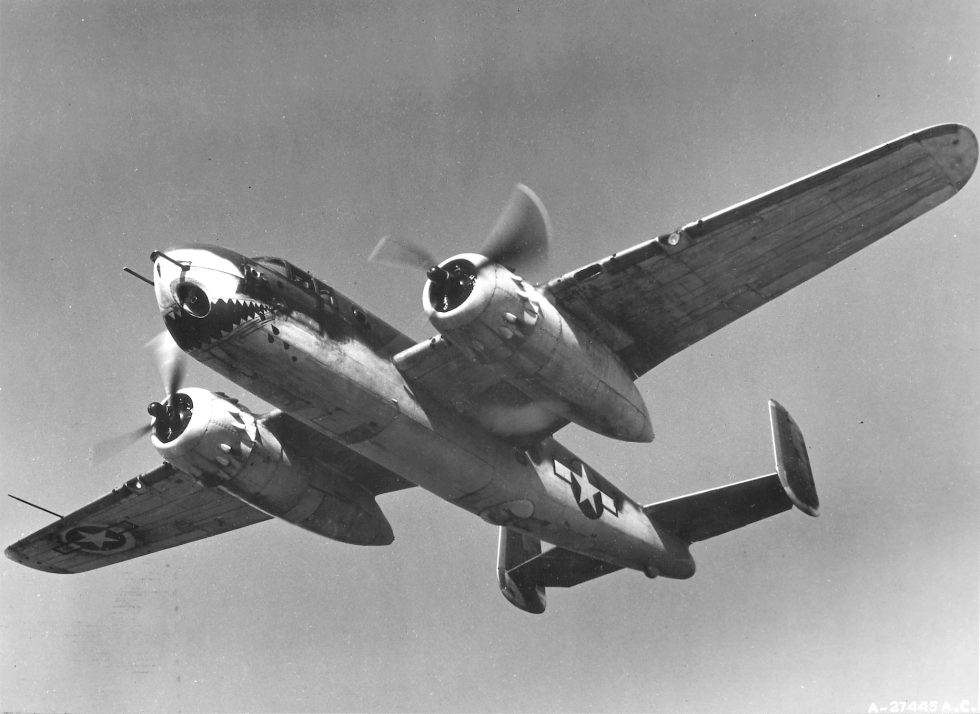
The B-25’s second act was arguably more important than its first. In the South-West Pacific, field engineer Major Paul “Pappy” Gunn and North American reworked the medium bomber into a devastating low-level gunship: the glass bombardier nose was replaced with a solid nose packed with fixed .50-calibre machine guns, and crews perfected skip-bombing and mast-height attacks against Japanese shipping. At the Battle of the Bismarck Sea in March 1943, B-25 strafers helped annihilate a Japanese convoy. Later the B-25G and B-25H even mounted a 75 mm cannon — a field gun in the nose — alongside a battery of machine guns.
Nearly 9,800–9,900 Mitchells were built before production ended in 1945. They served in every theatre of the war and with a long list of Allied air forces under Lend-Lease — the British RAF, the Soviet Union, the Netherlands and others. Cheap, tough and endlessly adaptable, the B-25 outlived the war in many air forces and remains one of the most numerous and best-loved warbirds flying today.
01Why the B-25 Mitchell is named after a court-martialled general
General William “Billy” Mitchell was the most outspoken advocate of American air power in the 1920s. He argued that aircraft could sink battleships and that air power would decide future wars — and proved the first point in 1921 by having bombers sink the captured German battleship Ostfriesland. His relentless public criticism of army and navy leadership led to a famous court-martial in 1925, and he left the service. Vindicated after his death by the very air war he predicted, Mitchell was honoured when North American named its new medium bomber the Mitchell — the only US military aircraft named after a specific individual.
What makes the B-25 Mitchell special
A twin built to be flown hard
The Mitchell paired two Wright R-2600 Twin Cyclone radials of about 1,700 hp each with a twin-tail layout and tricycle landing gear that made it easy to land and take off from rough forward strips. It was famously forgiving and stable — docile enough for Doolittle’s crews to master short-field takeoffs in weeks, yet tough enough to fly home on one engine with large parts of the airframe shot away.
From level bomber to low-level strafer
In the Pacific the B-25 was reinvented as a gunship. Major Paul “Pappy” Gunn replaced the glazed bombardier nose with a solid nose full of fixed .50-calibre machine guns, added “package” guns on the fuselage sides and forward-firing turret guns. Late B-25J strafers could bring twelve to eighteen .50-cal guns to bear — a wall of fire for skip-bombing ships and shredding airfields at treetop height.
A field gun in the nose
The B-25G and B-25H carried a 75 mm M4 cannon — a lightly modified tank/field gun, one of the largest weapons fitted to a production aircraft — hand-loaded by the navigator. Aimed at destroyers, barges and shore targets, it packed a heavy punch but was slow to reload and stressed the airframe. As machine-gun batteries proved more practical against shipping, many cannon were later removed.
02The B-25 Mitchell’s strafer conversion: how ‘Pappy’ Gunn turned a bomber into a gunship
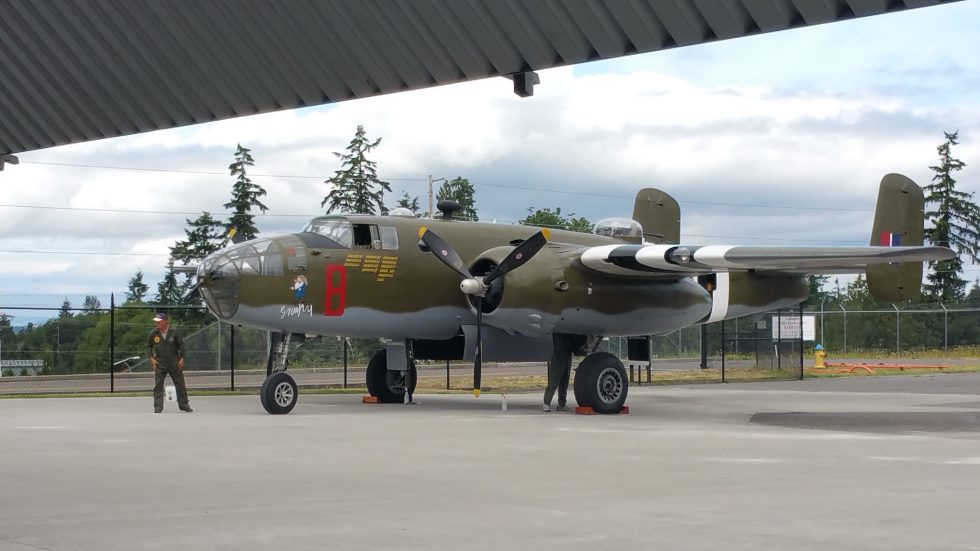
Frustrated that medium bombers dropping from altitude rarely hit ships, Fifth Air Force engineer Major Paul “Pappy” Gunn field-modified B-25s in Australia and New Guinea: he stripped the bombardier station and bolted a battery of forward-firing .50-calibre machine guns into a solid nose, added guns in blisters on the fuselage sides, and cleared the aircraft to attack at masthead height. Crews combined this firepower with skip-bombing — bouncing bombs across the water into a ship’s hull — a tactic developed with RAF and Australian help. North American adopted the changes into factory-built strafer versions of the B-25G, H and J.
03The B-25 Mitchell over Europe and the Eastern Front: Lend-Lease service
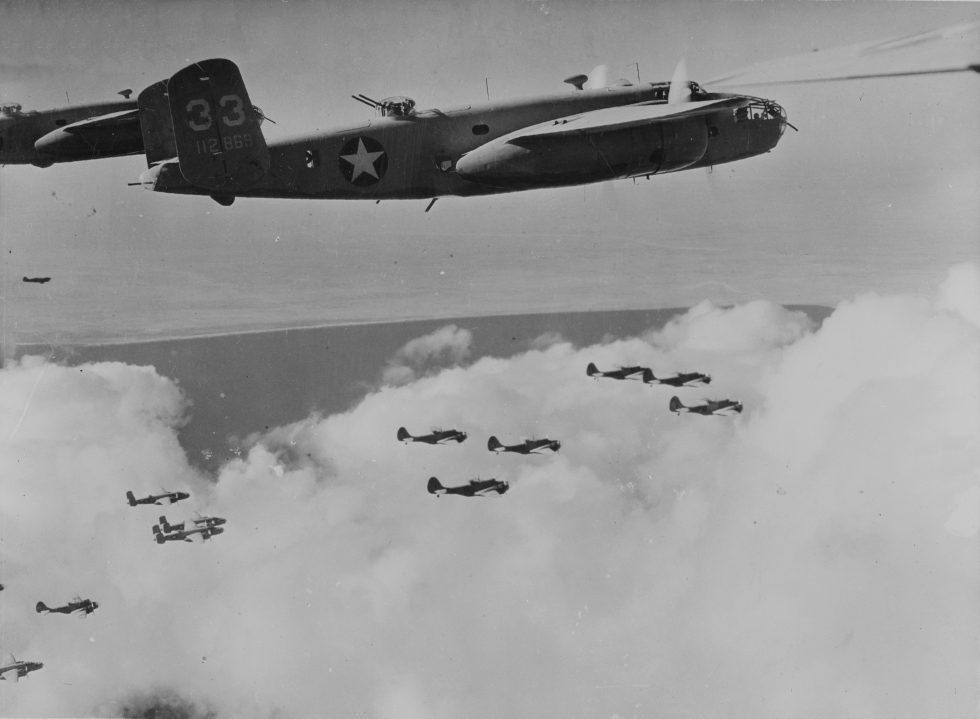
Although the Mitchell is most associated with the Pacific, it fought everywhere. The RAF received nearly 900 Mitchells and flew them with No. 2 Group against targets in occupied Europe from 1943; Dutch crews of No. 320 Squadron flew alongside them. The Soviet Union was a major Lend-Lease recipient, using the B-25 as a long-range and night bomber on the Eastern Front. Mitchells also served US and Allied units across the Mediterranean and North Africa, and with China, Australia, Canada and Brazil — a genuinely global bomber.
Full B-25J Mitchell specifications
Baseline note: the figures below describe the B-25J, the final and by far the most numerous version — 4,318 built, all at Kansas City — in its standard glazed-nose bomber form. Deltas for the B-25B that Doolittle took to Tokyo and for the cannon-armed B-25G and B-25H gunships are in grey. One figure below is more contested than it looks: maximum speed. The light six-gun B-25B is variously published at 483 to 528 km/h; the eighteen-gun J strafer at 438 km/h. Those are the same airframe with the same power, four years and fourteen machine guns apart, and the gap is the honest measure of what the Pacific gunship conversions cost.
Dimensions & weights
- Crew
- 5 to 6 (pilot, co-pilot, bombardier/navigator, turret gunner/engineer, radio operator/waist gunner, tail gunner). The B-25H deleted the co-pilot entirely at Doolittle's suggestion and seated a navigator/cannoneer in a smaller right-hand seat; the J put the co-pilot back
- Length
- 16.13 m (52 ft 11 in) with the glazed bombardier nose; the solid-nose B-25G and B-25H were shorter at about 15.54 m (51 ft 0 in), and the field-converted strafer noses shorter again
- Wingspan
- 20.60 m (67 ft 7 in)
- Height
- 4.98 m (16 ft 4 in) over the twin fins
- Wing area
- 56.7 m² (610 sq ft); some references give 57.4 m² (618 sq ft), the difference being whether the fuselage carry-through is counted
- Aerofoil
- NACA 23017 at the root, NACA 4409-R at the tip
- Wing geometry
- Gull wing: dihedral on the centre section, none on the outer panels. The first nine aircraft had constant dihedral and Dutch-rolled badly. Flattening the outer panels cured it, and gave the Mitchell the cranked planform by which it is instantly recognised. It is a fix, not a styling choice
- Empty weight
- 8,835 kg (19,480 lb); some sources give 9,210 kg (20,305 lb) for a fully equipped J
- Gross weight
- 15,195 kg (33,500 lb) at normal combat loading
- Maximum take-off weight
- 15,876 kg (35,000 lb); the B-25B was cleared to about 13,290 kg (29,300 lb), and the Doolittle aircraft launched from Hornet at roughly 14,000 kg (31,000 lb), well over that
- Internal fuel
- ~3,690 litres (~974 US gal; ~811 imp gal) in self-sealing wing cells, with a further ~1,270 litre (~335 US gal) tank fittable in the bomb bay for ferry work. The Doolittle aircraft were taken from 2,445 to 4,319 litres (646 to 1,141 US gal) with a rubber bladder over the bomb bay and cells in the crawlway and the deleted ventral turret bay
- Bomb bay
- Single ventral bay, 1,361 kg (3,000 lb) normal capacity, plus ventral shackles rated at 907 kg (2,000 lb) for an external Mark 13 torpedo
- Undercarriage
- Hydraulically retracted tricycle. Excellent forward visibility on the ground, which pilots liked and which mattered on the coral and pierced-steel strips the type worked from
Performance
- Maximum speed
- 438 km/h (272 mph; 236 kn) at 3,960 m (13,000 ft) for the B-25J; the National Museum of the USAF publishes 528 km/h (328 mph) for the far lighter B-25B, and other sources 483 km/h (300 mph). Guns, armour and gun-pack drag account for the difference
- Cruise speed
- 370 km/h (230 mph; 200 kn)
- Service ceiling
- 7,375 m (24,200 ft); 6,460 m (21,200 ft) for the B-25B. The Mitchell was a medium bomber and did not pretend otherwise — most of its war was fought between 30 m and 3,000 m
- Range
- 2,173 km (1,350 mi; 1,173 nmi) at combat weight; over 4,800 km (3,000 mi) ferrying on droppable tanks
- Longest combat mission flown
- ~4,170 km (~2,250 nmi) — the Doolittle Raid, still the longest operational sortie ever flown by the type
- Single-engine handling
- Controllable down to 233 km/h (145 mph), with 60° banked turns into the dead engine possible. The one trap was using aileron rather than rudder for directional control at low speed after take-off, which could snap the aircraft out of control
- Take-off run
- Doolittle's aircraft, first off, had 142 m (467 ft) of deck and used it. No B-25 pilot on the raid, Doolittle included, had ever taken off from a carrier before; all sixteen got away in under an hour
- Rate of climb
- Modest — the type climbed to 4,570 m (15,000 ft) in about 19 minutes at combat weight
- Handling
- Forgiving, stable and honest, with no vices that mattered. North American had deliberately designed for easy field maintenance and undemanding pilot conversion, and the Army noticed: the B-25 "placed no special requirements on pilot training programmes", which is exactly what a wartime air force wants and exactly what its rival the B-26 Marauder did not offer
- Damage tolerance
- Outstanding. A 321st Bomb Group B-25C nicknamed "Patches" finished the war with over 300 missions, six belly landings and more than 400 patched holes, so distorted that straight and level flight required 8° of left aileron and 6° of right rudder trim and the aircraft crabbed permanently sideways
- Cockpit noise
- The one universal complaint. The exhaust stacks sat beside the cockpit and a great many B-25 pilots ended the war with permanent hearing loss. The Clayton S collector stack introduced on the B-25C quenched the exhaust flame for night work but cost 14 km/h (9 mph) in fairing drag and, crews said, made the noise worse
Propulsion & systems
- Engines
- 2 × Wright R-2600-92 Twin Cyclone (R-2600-9 on the B-25 to B-25B, R-2600-13 on the C and D) — 14-cylinder two-row air-cooled radials
- Power
- 1,268 kW (1,700 hp) each for take-off, 2,536 kW (3,400 hp) total
- Propellers
- Hamilton Standard three-blade constant-speed fully-feathering, 3.84 m (12 ft 7 in) diameter
- Bombing system
- Norden M-series bombsight for medium-altitude work. The Doolittle crews threw it out: at 450 m over Tokyo the Norden was useless and a security risk, so Capt. C. Ross Greening built a replacement from two pieces of aluminium that cost 20 cents and worked better at low level. They called it the Mark Twain
- Low-altitude sighting
- By the mid-war Pacific squadrons the sight of choice was the pilot's own gunsight and a stopwatch. Skip bombing was aimed by eye down the nose guns, which is why the strafer conversions mattered so much: the same aiming solution served both weapons
- Radar
- AN/APS-3 search radar in a retractable ventral radome or a nose thimble on US Marine Corps PBJ-1D and PBJ-1J night anti-shipping aircraft; ASV sets with transverse-dipole Yagi arrays on early USAAF and RAF machines
- Armour and protection
- Self-sealing fuel cells from the B-25A, crew armour plate, and an airframe that proved able to absorb astonishing punishment. Weight-saving strip-outs were common in the Pacific: Marine PBJs removed the dorsal turret and waist blisters for long-range night work
- Gun installation
- Bendix electric dorsal turret, moved forward to just behind the cockpit on the B-25H and J to counterbalance the new waist and tail positions; Bell M-7 tail mount; conformal "fuselage package" gun pods flanking the lower cockpit
- First flight
- 19 August 1940 (NA-62 prototype, flown by Vance Breese; the roll-yaw problem was noted on that first flight)
- Service entry
- 1941 — and only 130 had been delivered by the attack on Pearl Harbor
- Number built
- 9,816 during the war — the most-produced American medium bomber and the third most-produced American bomber of any class. North American built 6,608 at Kansas City and the balance at Inglewood, while simultaneously producing the T-6 Texan and the P-51 Mustang
- Retired
- 1974 (Indonesia). The last USAF flight was on 21 May 1960; four Doolittle Raiders attended the handover ceremony
- Unit cost
- ~$142,000 in 1944 dollars, against about $215,000 for a B-24 and $639,000 for a B-29. Cost is part of why the Mitchell went everywhere
04The B-25 Mitchell’s operating costs: from wartime bargain to warbird budget
In wartime the Mitchell was prized as much for its price as its performance. Period figures commonly place a late-war B-25 at roughly $96,000–$116,000 — a fraction of a four-engine heavy like the B-29 — though exact numbers vary by source and year and should be read as estimates. No official cost-per-flight-hour figure exists for wartime operations. Today, keeping one of the ~30 airworthy Mitchells flying is a serious undertaking: warbird operators commonly cite something on the order of a few thousand dollars per flight hour in fuel, oil and maintenance for a twin-radial bomber — again, an operator estimate rather than a published figure.
Armament & payload
The Mitchell began as a conventional medium bomber and was rebuilt in the field into the most heavily gun-armed aeroplane of the war
Nothing in the 1939 requirement anticipated what the B-25 became. It was specified to carry 1,361 kg of bombs 3,200 km at over 480 km/h, and as a level bomber over Europe that is roughly what it did. In the South-West Pacific it turned into something else entirely. Jungle and shipping targets made medium-altitude bombing close to worthless, so Major Paul "Pappy" Gunn and North American's field representative Jack Fox began cutting the glazed nose off B-25C and D airframes in Australia and packing the space with .50-calibre Brownings. The factory followed. By the B-25J-2 a Mitchell could mount eighteen machine guns, fourteen of them firing forward.
The other experiment was the 75 mm cannon, and it deserves an honest verdict rather than the usual awe. The B-25G and B-25H carried the largest gun ever fitted to an American production aircraft — first the M4 field piece, then the lighter T13E1 designed for the job — hand-loaded by the navigator, firing a 6.8 kg shell at 720 m/s. It looked like the future of anti-shipping work. In practice a crew got about four rounds off in a firing pass, the recoil punished the airframe, accuracy against anything smaller than a freighter was poor, and squadrons in the field frequently pulled the gun out and fitted two more .50s in its place. The eight forward machine guns did more damage per pass than the cannon ever did. Armament on the B-25 varied more by squadron and by theatre than on almost any other type of the war; field modification was the norm, not the exception, and no single list describes what a given aircraft actually flew with.
Gun
- B-25J bomber, 12 × .50 in (12.7 mm) AN/M2 Browning: two fixed and one flexible in the nose, four in the two conformal fuselage gun packs flanking the cockpit, two in the forward dorsal turret, one in each waist window and two in the tail
- B-25J-2 strafer, 18 × .50 in: eight in the solid nose, four in the fuselage packs, two dorsal, two waist and two in the tail — fourteen of them aimed directly forward. It is the heaviest forward-firing machine-gun battery ever fitted to a production aeroplane
- 75 mm M4 cannon in the B-25G and 75 mm T13E1 in the B-25H, mounted in a tunnel along the lower left fuselage and hand-loaded by the navigator. About 21 rounds carried; roughly four could be fired per attack run; muzzle velocity 720 m/s (2,362 ft/s)
- B-25B (the Doolittle aircraft): two .50s in a Bendix electric dorsal turret, two in a retractable, periscope-sighted ventral turret that nobody could aim, and one .30 in (7.62 mm) in the nose. The Doolittle crews removed the ventral turret to save weight and mounted two broomsticks, painted black, in the tail cone. Doolittle reported afterwards that not one aircraft was attacked from directly behind
- Ammunition ran to roughly 400 rounds per gun on the strafers, which is under half a minute of firing across all fourteen forward guns. Crews reported measurable deceleration and cracked nose glazing when the whole battery was fired at once
Air-to-air
- None as such. The Mitchell had no air-to-air weapon; every gun aboard was either defensive or aimed at the ground and the sea
- The defensive battery did work. Doolittle's raiders claimed three Japanese fighters shot down over Japan on 18 April 1942 and lost no aircraft to enemy action over the target — though only Lt Richard Joyce's aeroplane was even hit
- The forward-firing battery was occasionally used against aircraft on the ground, and a strafer nose emptying eight .50s into a parked airfield was one of the most destructive things in the theatre. Against airborne fighters it was useless: the aircraft could not turn with them
- No guided air-to-air weapon existed in this era, on this or any other aircraft
Air-to-surface guided
- None carried. The B-25 never operationally employed a guided weapon of any kind, in any theatre, with any operator
- This is worth stating plainly because contemporaries did. The USAAF's VB-1 Azon radio-steered bomb went to B-24 Liberators in Europe and Burma and to some B-17s; the Navy's ASM-N-2 Bat radar-homing glide bomb went to PB4Y-2 Privateers. Neither was fitted to the Mitchell
- The nearest thing was the US Navy's post-war rocket work at Inyokern, where PBJs served as test aircraft for spin-stabilised rocket installations including a twin-barrel nose firing ten 5 in rockets in one salvo — unguided, and never operational
- The Mitchell's precision came from flying low enough that precision was not a guidance problem. That is the whole logic of skip bombing
Bombs
- 1,361 kg (3,000 lb) normal internal load; up to 1,814 kg (4,000 lb) overloaded. Typical fits were six 227 kg (500 lb) or twelve 45 kg (100 lb) bombs, or clusters of 10 kg (23 lb) parachute-retarded fragmentation bombs for airfield attack
- Skip bombing was the Mitchell's signature technique: 227 kg bombs with four- to five-second delay fuzes released from about 60 m at masthead height, skipping across the water into a ship's side at the waterline. At the Battle of the Bismarck Sea in March 1943 the Fifth Air Force used it to annihilate a Japanese convoy
- In Burma the Tenth Air Force's 341st Bomb Group developed "glip" bombing, a glide-and-skip hybrid, and became so effective at dropping bridges that the group was known simply as the Burma Bridge Busters
- 1 × Mark 13 aerial torpedo on ventral shackles rated at 907 kg (2,000 lb) — carried mainly by Marine Corps PBJ-1 squadrons, and rarely used, because rockets and skip bombing worked better
- Each Doolittle aircraft carried four 227 kg (500 lb) weapons: three demolition bombs and one incendiary cluster. Physical damage to Japan was slight; that was never the point
Rockets
- 8 × 5 in (127 mm) HVAR on zero-length underwing launchers, standard on late B-25H and B-25J aircraft — fast to fit, accurate enough at short range, and far better suited to anti-shipping work than the 75 mm cannon they largely displaced
- The B-25H was advertised by North American as bringing to bear "10 machine guns coming and 4 going, in addition to the 75 mm cannon, eight rockets, and 3,000 lb of bombs". For once the promotional copy was accurate
- 2 × 11.75 in (298 mm) Tiny Tim rocket-propelled 500 lb-warhead weapons, used operationally by Marine PBJ-1H squadrons in 1945 against hardened and shipping targets
- Marine PBJ-1J night squadrons paired 5 in rockets with AN/APS-3 radar for radar-directed attacks on Japanese coastal shipping from the Philippines, Saipan, Iwo Jima and Okinawa
Pods & other stores
- Conformal fuselage gun packages — two blister pods flanking the lower cockpit, each holding a pair of .50s. Standard on the H and J, and among the first things combat squadrons removed in 1945 once opposition thinned, because they cost speed and the guns were awkward to service
- Bomb-bay ferry tank of about 1,270 litres (335 US gal), and on the Doolittle aircraft a 606 litre (160 US gal) collapsible neoprene bladder strapped over the bomb bay plus cells in the crawlway and the deleted turret well
- Camera fit: 45 B-25Ds became F-10 photographic reconnaissance aircraft with three K.17 cameras — one vertical, two oblique in nose blisters — and all armament, armour and bombing gear stripped out
- AN/APS-3 radar in a retractable ventral radome on Marine PBJs, and Yagi ASV arrays on the nose and wings of early anti-submarine B-25C/D aircraft
- Weather reconnaissance: four B-25Ds were converted in 1944 for the Army Hurricane Reconnaissance Unit, the ancestor of today's Hurricane Hunters
Three typical loadouts
- Fifth Air Force anti-shipping strike, New Guinea 1943 (B-25D1 strafer)
- Eight forward-firing .50s in a field-cut solid nose, dorsal turret manned, six 227 kg (500 lb) bombs with five-second delay fuzes, no bombardier aboard. Approach at masthead height and full throttle, guns suppressing the ship's anti-aircraft crews all the way in, bombs released at about 60 m to skip into the hull. This is the profile that made the Mitchell famous, and it was invented in the field, not in Inglewood.
- Doolittle Raid, 18 April 1942 (B-25B)
- Four 227 kg (500 lb) weapons — three demolition, one incendiary cluster. Ventral turret, liaison radio and Norden bombsight removed; 4,319 litres of fuel; two broomsticks in the tail cone; a 20-cent aiming sight. Sixteen aircraft, eighty men, launched 170 nautical miles further out and ten hours earlier than planned after a Japanese picket boat found the task force. Every aircraft was lost. Three men died in the escape, eight were captured and four of those did not come home.
- Twelfth Air Force interdiction, Italy 1944 (B-25J)
- Twelve .50s, full defensive crew, six 227 kg (500 lb) general-purpose bombs, Norden sight, bombing bridges, marshalling yards and Brenner Pass rail infrastructure from 3,000–3,600 m in eighteen-aircraft boxes. Conventional, unglamorous, and the work that occupied the great majority of Mitchell sorties in the Mediterranean.
Sourcing caveat: gun counts and bomb loads here come from the USAAF pilot's manuals, Swanborough and Bowers, and North American's own documentation. They describe factory configurations. The B-25 was modified in the field more thoroughly and more often than any other American bomber of the war — noses cut off and rebuilt, cannon removed, gun packs deleted, turrets stripped — and the aircraft in any given photograph may match none of these lists.
Variants
North American lost the competition the B-25 was designed for, and built ten thousand of them anyway
In August 1939 the Army Air Corps judged Martin's Model 179 the better proposal and ordered it as the B-26 Marauder. North American's NA-62 came second. It was ordered anyway, 184 of them, partly because the requirement was urgent and partly because Martin admitted it could not deliver 385 aircraft in the time allowed. The second-place design went on to outproduce, outlast and comprehensively outserve the winner — and to be liked by its crews in a way the Marauder, with its high wing loading and lethal reputation in training, never was.
The Doolittle Raid is the moment the Mitchell entered public memory, and it is worth being precise about what it did and did not achieve. On 18 April 1942 sixteen B-25Bs launched from USS Hornet, bombed ten targets in Tokyo and one each in Yokohama, Yokosuka, Nagoya, Kobe and Osaka, and flew on towards China. Physical damage was trivial — around fifty Japanese killed. The consequences were not. American morale, at its lowest point of the war, lifted; the Japanese high command, forced to confront the vulnerability of the home islands, accelerated Yamamoto's plan to take Midway and lost four fleet carriers there seven weeks later. And in China, the Imperial Japanese Army launched the Zhejiang-Jiangxi campaign to punish the provinces that had sheltered the airmen, killing an estimated 10,000 civilians in the immediate search and, by Chinese accounts, more than 20,000 in Quzhou alone, with biological agents deliberately spread through wells and food. The raid's cost was paid overwhelmingly by people who had no say in it. Doolittle expected to be court-martialled for losing all sixteen aircraft; he received the Medal of Honor and promotion by two ranks.
What kept the type in service everywhere was versatility of an unusual kind: not a design that could be reconfigured, but a design robust and simple enough that anyone with a workshop could reconfigure it. Level bomber, low-level strafer, anti-shipping gunship, torpedo bomber, photographic reconnaissance platform, anti-submarine patroller, weather aircraft, trainer, staff transport — Arnold and Eisenhower both used converted B-25Js personally. That adaptability, and an airframe with no bad habits, is why crews liked it and why it is still flying.
- B-25 and B-25A (1940–41, 24 and 40 built)
- Initial production. Three .30 in guns and one .50 in the tail; the first nine had constant dihedral and Dutch-rolled until the outer panels were flattened into the gull wing. The A added self-sealing tanks, crew armour and a better tail-gun station.
- B-25B (1941–42, 120 built)
- Tail gun deleted; Bendix electric dorsal turret and a retractable, periscope-sighted ventral turret added, each with twin .50s. The Doolittle Raid aircraft. Twenty-three went to the RAF as the Mitchell Mk I, which used them only for training.
- B-25C and B-25D (1941–44, 1,625 and 2,290 built)
- The first mass-produced marks, identical but for the factory — C from Inglewood, D from Kansas City. Uprated R-2600-13s, de-icing, a navigator's sighting blister, two .50s in the nose. These were the airframes Pappy Gunn rebuilt into the first strafers, and the ones supplied to Britain, Canada, China, the Netherlands and the Soviet Union.
- B-25G (1943, 463 including conversions)
- The first cannon gunship: solid nose, two fixed .50s and a hand-loaded 75 mm M4 field gun, then the heaviest weapon ever carried by an American bomber. Anti-shipping was the intent. The results were mixed enough that the concept was already being questioned before the H arrived.
- B-25H (1943–44, 1,000 built)
- The gunship perfected and, arguably, the concept disproved. Lighter 75 mm T13E1, four nose .50s, four in conformal packs, dorsal turret moved forward, new waist and tail positions, co-pilot deleted. Fourteen guns plus a cannon plus eight rockets plus 1,361 kg of bombs — and squadrons still removed the cannon.
- B-25J (1943–45, 4,318 built)
- The baseline here: the H's airframe from the cockpit aft, the glazed bombardier nose restored, co-pilot and dual controls back. Factory kits let depots swap in an eight-gun strafer nose to create the B-25J-2. The final and most numerous production series.
- PBJ-1C, -1D, -1H, -1J (1943–45, 706 initially, mostly to the USMC)
- Navy designation for the Mitchell, flown almost entirely by sixteen Marine Corps squadrons in the radar-directed night anti-shipping role, with APS-3 radar, 5 in rockets and Tiny Tims. One PBJ-1H was fitted with arresting gear and flown successfully from USS Shangri-La; the Navy did not pursue it.
- Mitchell Mk I, II and III (1942–45, RAF and Commonwealth)
- Mk I was the B-25B, Mk II the B-25C and D, Mk III the B-25J, of which 316 were supplied. Flown by the RAF's 2 Group over occupied Europe, and by Dutch and Canadian squadrons; the Soviet Air Force received several hundred and used them mainly as long-range night bombers.
- F-10 (1943–44, 45 converted)
- Photographic reconnaissance conversion of the B-25D. Everything removable removed; three K.17 cameras fitted. Built for combat reconnaissance, used mostly for mapping.
- TB-25 series and VB-25J (1943–54, well over 1,000 converted)
- Trainers — AT-24 pilot and navigator trainers, TB-25K and TB-25M fire-control radar trainers, Hayes-rebuilt TB-25L and TB-25N — and VIP transports. Hap Arnold and Dwight Eisenhower each had one. The last VB-25J left active service in 1960.
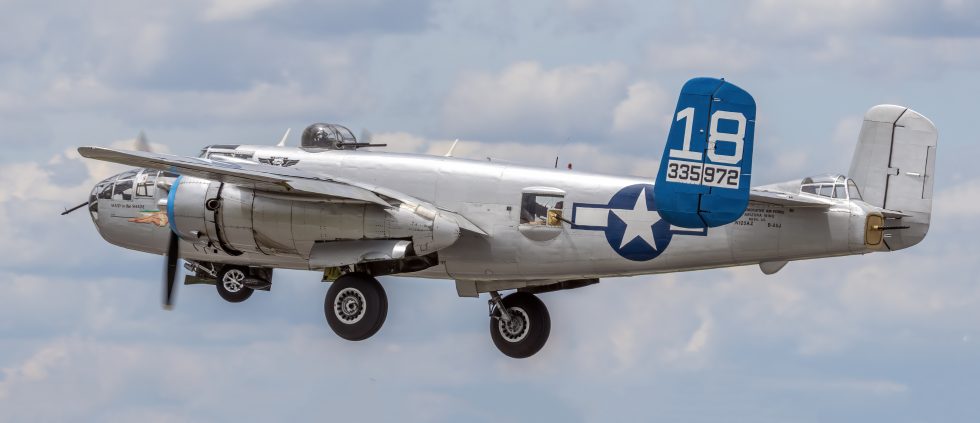
More than a hundred B-25s survive worldwide, and roughly forty-five of them are airworthy — far more than any other Second World War bomber, and more airworthy examples than of most fighters. Several reasons converge: nearly ten thousand were built; the type was surplused in large numbers into a civil market that valued it as an executive transport, survey aircraft, fire-bomber and camera ship; the airframe is simple, the Wright R-2600 is supportable, and the aircraft is genuinely easy to fly. The 1970 film Catch-22 concentrated around eighteen airworthy Mitchells in one place and, by accident, preserved them. On 18 April 2010, seventeen airworthy B-25s flew in formation over the National Museum of the United States Air Force to mark the sixty-eighth anniversary of the Doolittle Raid. Nothing comparable is possible with any other bomber of the war.
From drawing board to warbird icon
First flight
North American’s NA-62 prototype flies on 19 August 1940; the design is named Mitchell after General Billy Mitchell.
Enters service
The B-25 joins the US Army Air Forces in February 1941 as a twin-engine medium bomber.
The Doolittle Raid
On 18 April, sixteen B-25s launch from USS Hornet to bomb Tokyo — a huge morale victory after Pearl Harbor.
Battle of the Bismarck Sea
Low-level B-25 strafers skip-bomb and gun a Japanese convoy to destruction in the South-West Pacific.
The 75 mm gunship
The B-25G and then B-25H enter service with a 75 mm cannon and heavy machine-gun batteries for anti-ship strafing.
Global Lend-Lease
Mitchells serve the RAF, the Soviet Union, the Netherlands and other Allies across Europe, the Mediterranean and Asia.
Production ends
Manufacture stops after roughly 9,800–9,900 aircraft — among the most-produced American bombers of the war.
The warbird era
Retired from front-line service, dozens of B-25s pass into museums and airshow fleets; around 30 remain airworthy today.
From the cockpit: twelve B-25 Mitchell stories
Off the deck of the Hornet
Sixteen medium bombers did what everyone said was impossible — a carrier launch to bomb Tokyo.
Read the full story
The long crash-landings in China
Out of fuel after the raid, almost every crew bailed out or crash-landed over China; most, but not all, survived.
Read the full story
Pappy Gunn’s gunship
A field engineer bolted a wall of machine guns into the nose and rewrote how the B-25 fought.
Read the full story
Minutes that sank a convoy
Skip-bombing B-25s helped destroy a Japanese troop convoy in one of the most lopsided air-sea actions of the war.
Read the full story
The 75 mm cannon in the nose
The Mitchell carried a field gun — one of the biggest weapons ever fitted to a production aircraft.
Read the full story
The 345th Bomb Group
One B-25 group painted Apache heads on their tails and became legends of the low-level war.
Read the full story
Mitchells over occupied Europe
Nearly 900 B-25s served the RAF, striking targets across occupied Europe from British bases.
Read the full story
The Soviet night bomber
The Red Air Force flew hundreds of Lend-Lease B-25s into the night skies of the Eastern Front.
Read the full story
The Marines’ Mitchell
The Navy and Marine Corps flew their own B-25 — the PBJ — on patrol and anti-ship strikes.
Read the full story
The bomber crews trusted
Pilots praised the Mitchell as tough, honest and able to fly home badly shot up.
Read the full story
“Thirty Seconds Over Tokyo”
The Doolittle Raid made the B-25 a movie star, and it has flown in films ever since.
Read the full story
Thirty still fly
Of nearly 10,000 built, around 30 airworthy Mitchells keep the type’s story alive today.
Read the full story
The B-25 Mitchell in pictures
The B-25 Mitchell in motion
A hand-picked B-25 Mitchell video is coming soon — we are selecting a high-authority archive clip worthy of the aircraft. In the meantime, explore the photo gallery above and the twelve stories from the cockpit.
Where the B-25 Mitchell flew
The score that defines it
The B-25 was a bomber, not a fighter, so its record is measured in raids flown, ships sunk and airfields wrecked rather than aerial victories. Its combat legacy rests on two things above all: the audacious Doolittle Raid that struck Japan in 1942, and the low-level strafing campaign that made the Mitchell one of the deadliest anti-shipping aircraft of the Pacific war.
Compare the combat record of every military aircraft. Figures as of July 2026.
Everything people ask about the B-25 Mitchell
Can I fly in a B-25?
What was the Doolittle Raid?
Why is the B-25 called the Mitchell?
Did the B-25 really carry a 75 mm cannon?
How many B-25s were built?
How fast was the B-25 Mitchell?
Which countries flew the B-25?
Are any B-25s still flying?
You can’t fly the Mitchell.
These, you can.
Some legends only live in museums — others are fuelled and waiting. MiGFlug has put civilians in real military jet cockpits since 2004.
 Fly the L-39 AlbatrosThe world’s most-flown jet trainer — aerobatics included
 Fly the F-104 Starfighter“The missile with a man in it”
 Fly the MiG-21The Cold War’s most-produced jet
 Fly the T-33 Shooting StarAmerica’s first jet trainer
 Fly the DH VampireA piece of early jet history
 Fly the S.211Agile Italian jet trainer
 Fly the MB-326The classic Aermacchi jet
 Fly the MiG-15The Soviet legend of the Korean War
Continue the tour
Every fact, checked
- The National WWII Museum — Doolittle’s Raider: the B-25Primary reference for the Doolittle Raid and the B-25’s wartime service.
- Naval History and Heritage Command — B-25J MitchellSource for the B-25J specifications and the naval PBJ variant.
- HistoryNet — How the B-25 Became the Ultimate StraferDetail on Pappy Gunn, the strafer conversion and the Bismarck Sea action.
- History of War — North American B-25 MitchellProduction, armament and the 75 mm cannon variants.
- Smithsonian National Air and Space Museum — B-25JReference for a preserved B-25J and design background.
- Warfare History Network — What Made the B-25 LegendaryOverview of the Mitchell’s versatility and combat record.
- The Armory Life — B-25 Mitchell: Birth of a GunshipThe gunship story, machine-gun batteries and the 75 mm cannon.
- Airplanes Online — B-25 MitchellProduction numbers, surviving aircraft and the Air Apaches.