
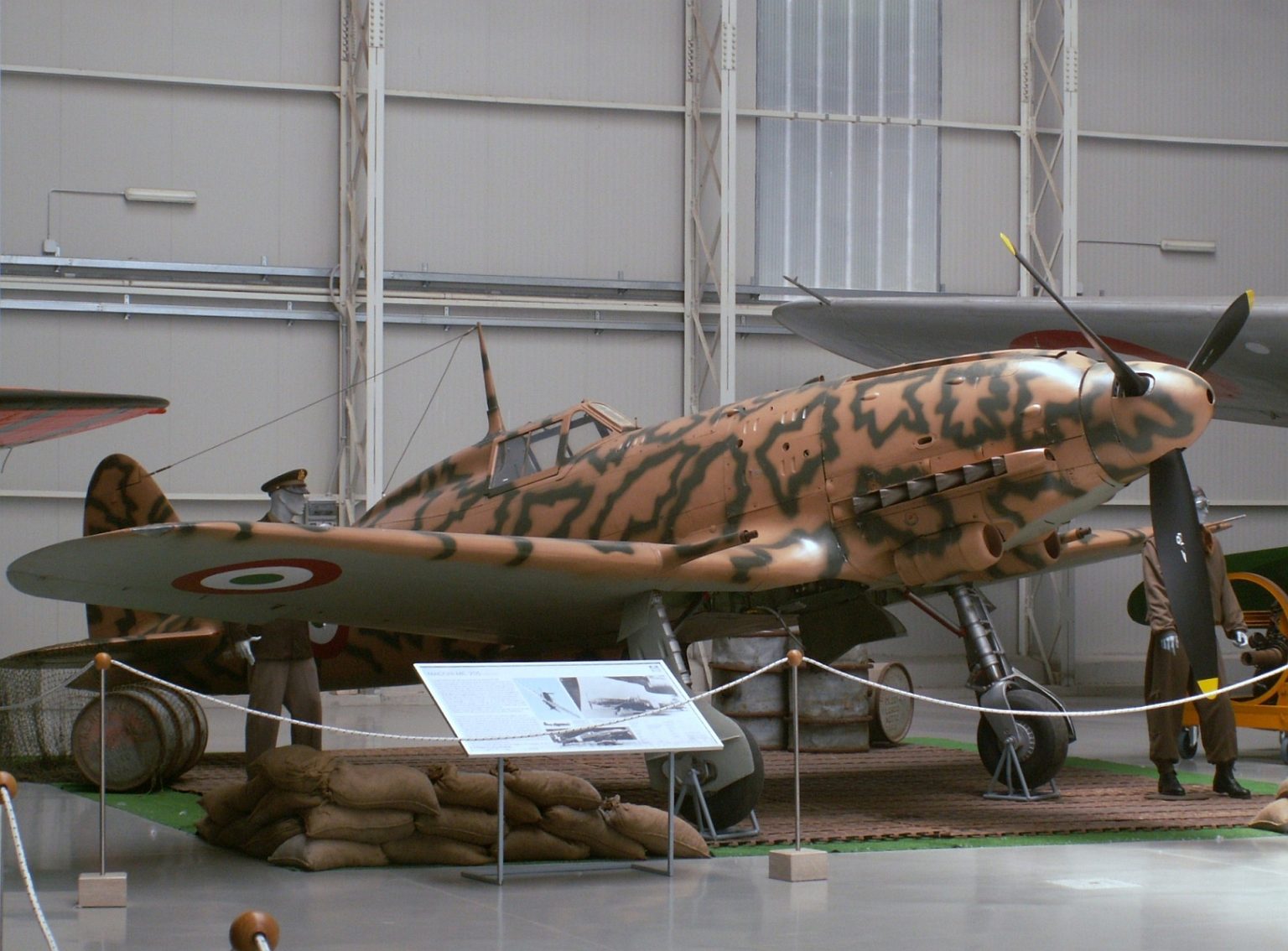
Macchi C.205 Veltro
Italy's "Greyhound" was one of the finest fighters of the Second World War — able to trade blows with the Spitfire and the Mustang — yet it arrived too late and in too few numbers to change the war.
The Macchi C.205 Veltro: Italy's finest fighter, and its great might-have-been
Take the elegant Macchi C.202 Folgore, give it a bigger German heart, and add cannon that finally let it bite — and you get the Veltro, the aircraft many historians rank as the best fighter Italy fielded in the Second World War.
By 1942 the Regia Aeronautica had a problem. Its best fighter, the Macchi C.202 Folgore, was a joy to fly and a match for most Allied aircraft in a turning fight, but it was chronically under-gunned — just two rifle-calibre-to-heavy machine guns firing through the propeller — and its licence-built Daimler-Benz DB 601 engine, while good, was being left behind by newer Allied types. The obvious fix was more power. Daimler-Benz had already produced the larger DB 605, and Fiat took out a licence to build it in Italy as the Fiat R.A.1050 R.C.58 "Tifone" (Typhoon). Bolt that engine onto a refined Folgore airframe and you had the Macchi C.205 Veltro — "Greyhound" — the lead aircraft of Italy's so-called "Serie 5" fighters.
The airframe those engineers were working with was itself a thoroughbred. It came from the drawing board of Mario Castoldi, the Macchi designer whose Schneider Trophy racing seaplanes had made Italy a byword for high-speed flight in the 1920s and 1930s. Castoldi's fighters carried that racing DNA: clean, low-drag lines, light and responsive controls, and a balance in the air that pilots loved. The tragedy of the line was that this world-class aerodynamic talent was for years shackled to engines and factories that could not keep pace. The Veltro is the moment the shackle briefly came off.
The transformation was dramatic. The prototype first flew on 19 April 1942, and the production Veltro reached roughly 642 km/h (399 mph) — competitive with the Spitfire Mk IX and the P-51 Mustang it would soon meet in combat. Just as important, the definitive Veltro finally solved the firepower problem by adding two 20 mm MG 151/20 cannon in the wings alongside the pair of 12.7 mm Breda-SAFAT guns in the nose. For the first time an Italian fighter could hit as hard as it flew.
Give the Folgore a German heart and cannon that finally bite, and you have one of the war's great fighters — and one of its great might-have-beens.
The Veltro entered service in the spring of 1943 and drew immediate praise from the pilots who flew it. In skilled hands it could hold its own against anything in the Mediterranean sky. But it arrived very late in Italy's war, and Italian industry — hammered by bombing, short of materials and never geared for mass production — built only a few hundred. Commonly cited figures put total production at around 262 aircraft, a rounding error next to the tens of thousands of Spitfires, Mustangs and Bf 109s. However good the Veltro was, there were never enough of them, and they came too late to matter strategically.
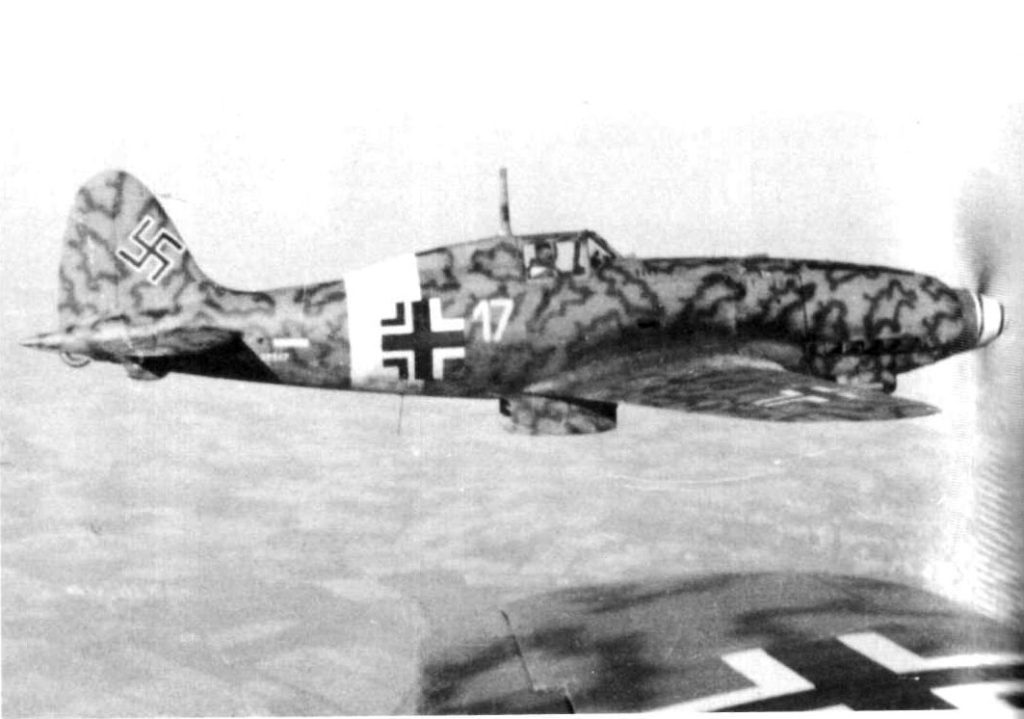
Then history split the aircraft in two. After Italy signed an armistice with the Allies on 8 September 1943, the Veltro found itself flying on both sides of the same war — with the fascist Aeronautica Nazionale Repubblicana in the German-aligned north, and with the Italian Co-Belligerent Air Force alongside the Allies in the south, while the Luftwaffe evaluated and used a handful of its own. After the war, Egypt bought Veltros and flew them in the 1948 Arab-Israeli War, a quiet coda to the career of one of the finest fighters almost nobody got to build in numbers.
01The Macchi C.205 Veltro's family tree: Saetta, Folgore, Veltro
The Veltro is the last and best of a clear line of Macchi fighters, and it is worth keeping the three straight. The Macchi C.200 Saetta ("Lightning bolt") of 1939 was powered by a Fiat A.74 radial engine; it was rugged and manoeuvrable but slow, with a draggy, blunt nose and weak armament. The Macchi C.202 Folgore ("Thunderbolt") of 1941 kept the Saetta's excellent airframe but replaced the radial with a licence-built Daimler-Benz DB 601 inline engine, transforming performance and giving the type its distinctive slim, pointed nose.
The Macchi C.205 Veltro ("Greyhound") of 1943 took the next step: the still more powerful DB 605, licence-built by Fiat as the R.A.1050 R.C.58 Tifone. Airframe-wise the Veltro is a lightly modified Folgore, which is exactly why the two are so easily confused. The quick tell is the engine and the guns: a radial-nosed Macchi is a C.200; a slim inline nose with only cowl machine guns is usually a C.202; a slim inline nose with 20 mm cannon bulges in the wings is the definitive C.205.
02The Macchi C.205 Veltro's engine: a licence-built Daimler-Benz DB 605
The heart of the Veltro was the Fiat R.A.1050 R.C.58 Tifone — not an Italian design but a licence-built copy of the German Daimler-Benz DB 605A, an inverted V12 of about 35.7 litres. In the Veltro it produced roughly 1,475 PS (around 1,455 hp) for take-off, a substantial jump over the DB 601-derived engine of the C.202 Folgore.
Licence production is the key to the whole "Serie 5" story. The same Tifone engine powered the three great Italian late-war fighters — the Macchi C.205, the Fiat G.55 Centauro and the Reggiane Re.2005 Sagittario — which is why they are grouped together. It is also the Veltro's Achilles' heel: Fiat could never build the complex Tifone in the numbers Italy needed, so engine supply, not airframe design, was the real ceiling on Veltro production.
03The Macchi C.205 Veltro's armament: from under-gunned to genuinely dangerous
The single biggest criticism of Italy's earlier fighters was firepower. The C.202 Folgore, and the earliest C.205 airframes built like it, carried just two 12.7 mm Breda-SAFAT machine guns in the cowling (sometimes with a pair of light 7.7 mm guns in the wings). Against armoured, self-sealing Allied bombers and fighters that was simply not enough — pilots could out-fly an opponent and still fail to bring it down.
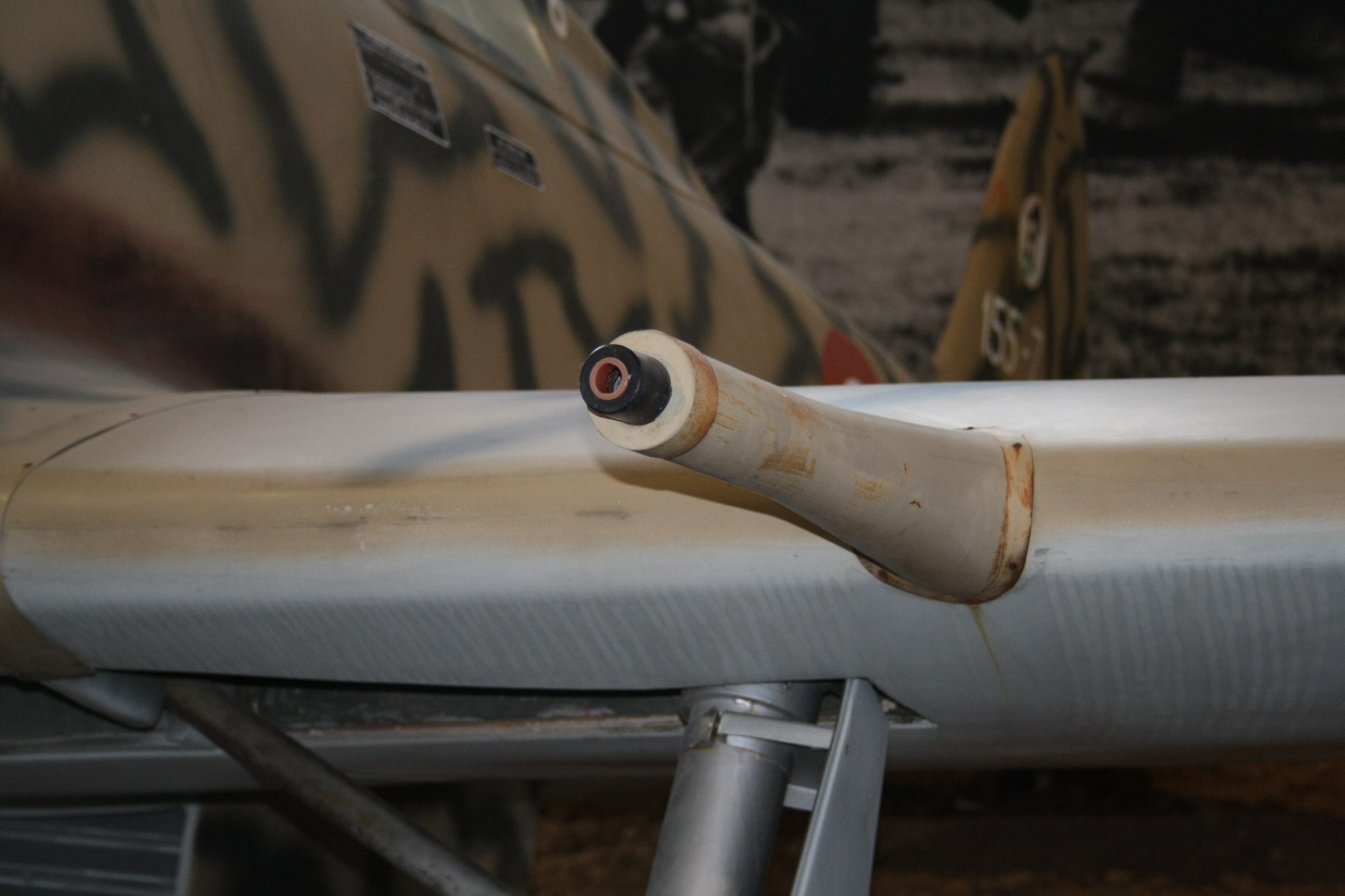
The definitive Veltro fixed this by adding two 20 mm MG 151/20 cannon in the wings, keeping the two 12.7 mm guns in the nose. The MG 151 was the same excellent German cannon carried by the Bf 109 and Fw 190, and it transformed the Veltro from a beautiful but toothless dogfighter into an aircraft that could destroy what it hit. This armament evolution — early two-gun aircraft versus the later cannon-armed version — is one of the most important things to understand about the type.
What made the Macchi C.205 Veltro so good
Three things set the Veltro apart: a clean, honest airframe inherited from the Folgore, a powerful licence-built German engine, and — at last — a hard-hitting cannon armament.
A refined, honest airframe
The Veltro kept the Folgore's beautifully balanced, all-metal airframe: light, strong and free of vices. Pilots consistently praised its handling and its ability to stay with Allied fighters in a turning fight, which made it forgiving to fly and deadly in experienced hands.
The Tifone engine
The licence-built DB 605 gave the Veltro roughly 1,475 hp and a top speed near 642 km/h, closing the performance gap with the Spitfire Mk IX and the P-51. The slim inline installation kept frontal area low and preserved the type's clean lines.
Cannon that finally bit
Two 20 mm MG 151/20 in the wings turned a graceful but under-armed fighter into a genuine killer. For the first time an Italian fighter could match its flying qualities with the firepower to knock down armoured bombers and fighters alike.
04The Macchi C.205 Veltro versus the Spitfire and the Mustang
What earns the Veltro its reputation is that it could genuinely compete with the best Allied fighters it met in 1943. Its top speed of around 642 km/h put it in the same class as the Supermarine Spitfire Mk IX, and it retained the superb low-speed handling and turning ability of the Folgore line. Italian and German pilots who flew it rated it among the best fighters available on the Axis side.
The honest caveats matter, though. The Veltro's climb and high-altitude performance, while good, did not dominate; its radio and some systems lagged; and above all it was available in tiny numbers against Allied air forces that could put up hundreds of Spitfires, Mustangs and Thunderbolts at once. A superb fighter flown by a handful of veterans can win individual dogfights but cannot win command of the sky. That is the Veltro's story in one sentence: excellent, but far too few and far too late.
05The Macchi C.205 Veltro's production problem: why only a few hundred were built
For all its quality, only around 262 Veltros are commonly cited as built (sources differ, and some counts run a little higher or include converted C.202 airframes). Compare that with roughly 34,000 Bf 109s or more than 20,000 Spitfires and the scale of the problem is obvious.
The bottleneck was not the airframe but the engine and the state of Italian industry in 1943. The complex licence-built Tifone engine was slow and difficult to produce; raw materials were scarce; factories were bombed; and the September 1943 armistice threw the whole industrial base into chaos, splitting it between the German-occupied north and the Allied south. The Veltro is the classic example of a war-winning design that a losing industrial situation could never deliver in war-winning quantities.
The Macchi C.205 Veltro's war: 1943 to Egypt
The Veltro's combat career lasted barely two years, but it packed in more twists than most fighters see in a decade — a triumphant debut, an armistice that split it in two, and a strange post-war afterlife.
When the first Veltros reached the Regia Aeronautica in the spring of 1943, Italy was already on the defensive. The Axis position in North Africa had collapsed, Sicily was next, and Allied bombers were ranging ever deeper into Italian airspace. Into this desperate situation came a fighter that Italian pilots had been waiting years for: fast, beautifully balanced and — in its cannon-armed form — finally able to hurt the enemy. Units such as the 1° and 51° Stormo took the Veltro into action over the Sicilian Channel, Pantelleria, Sardinia and the approaches to the Italian mainland, and in the hands of experienced pilots it gave a very good account of itself against Spitfires and American fighters and bombers alike.
But there were never enough. A trickle of a few hundred aircraft, spread thin across a crumbling front, could not stem an Allied air force that operated in the thousands. The Veltro won dogfights; it could not win the air war. And then, on 8 September 1943, Italy signed an armistice with the Allies, and the aircraft's story fractured along with the country.
In the German-occupied north, Mussolini's rump fascist state raised a new air arm, the Aeronautica Nazionale Repubblicana (ANR). Its fighter groups, flying the Veltro and the closely related Fiat G.55, threw themselves against the massive USAAF daylight raids of 1944, fighting alongside the Luftwaffe and almost always outnumbered. Their war was a grinding, attritional defence of northern Italian cities and industry, and it burned through pilots and aircraft alike.
In the Allied-aligned south, meanwhile, the Italian Co-Belligerent Air Force (Aeronautica Cobelligerante Italiana) flew its own surviving Veltros — now, extraordinarily, on the same side as the Spitfires and Mustangs they had recently been fighting. Their numbers were modest and their front-line role limited, but the sight of a Veltro in co-belligerent markings is one of the war's most poignant images of a nation and an air force torn cleanly in half. The Luftwaffe, for its part, evaluated and operated a number of Veltros itself, completing the aircraft's improbable service across all three combatant camps in Italy.
When production finally ended in 1944 with only a few hundred built, it looked like the end of the story. It was not quite. In the late 1940s Egypt turned to the international arms market and acquired Veltros — accounts differ on exactly how many and in what condition, with figures ranging from a dozen or so to several dozen — and flew them in the 1948 Arab-Israeli War. It was a fittingly strange final chapter: an Italian fighter with a German engine, that had fought on every side of Italy's own civil war, ending its combat life in the deserts of the Middle East.
Macchi C.205 Veltro full specifications
Figures are for the definitive cannon-armed C.205V and are drawn from established reference sources; several are approximate and vary between references, so contested values are flagged.
Baseline: a Macchi C.205V Veltro Serie III of mid-1943 — Fiat RA.1050 R.C.58 Tifone, two 20 mm Mauser MG 151/20 in the wings and two 12.7 mm Breda-SAFAT in the cowling. That is the definitive aeroplane, and it is also the minority: of roughly 260 Veltros built, about 100 were Serie I machines whose wing guns were 7.7 mm. Deltas for the Serie I, for the long-range and reconnaissance conversions and for the postwar Egyptian aircraft are in grey. Three warnings before the figures. First, the Veltro is a C.202 Folgore with a bigger engine. The fuselage aft of the firewall, the wing, the tail surfaces and the undercarriage are the Folgore's, and the wing itself dates from the C.200 Saetta of 1937; this is an interim aeroplane, not a clean-sheet Serie 5 fighter like the Fiat G.55 or the Reggiane Re.2005. Second, English and Italian references disagree on weights and on top speed — 642 km/h at 7,200 m against 646 km/h at 8,000 m, empty weights differing by several hundred kilograms — because they copy different Macchi and Regia Aeronautica data sheets, not because the aircraft changed. Third, every figure below assumes a clean airframe on good fuel. Italian petrol in 1943 was frequently neither, and the aircraft that flew for the Aeronautica Nazionale Repubblicana in 1944 were living on German supply.
Dimensions & weights
- Crew
- 1
- Wingspan
- 10.58 m (34 ft 8 in) unchanged from the C.200 of 1937 through the C.202 to the C.205. The two wing panels are not the same length: the port panel is roughly 200 mm longer than the starboard one, Castoldi's standing fix for propeller torque, carried across the whole Macchi fighter line
- Length
- 8.85 m (29 ft 0 in) the same as a C.202. The DB 605 is barely longer than the DB 601 it replaced, so the Veltro is dimensionally almost indistinguishable from the Folgore — the deeper, squarer nose cowling and the wing cannon bulges are the recognition points, not the silhouette
- Height
- 3.04 m (10 ft 0 in)
- Wing area
- 16.80 m² (181 sq ft) the single most important number in the table. Mario Castoldi put three successive fighters and something like 600 extra horsepower on one 1937 wing without ever enlarging it. The C.205N Orione and the projected M.C.206 existed precisely to fix this, and neither was built in numbers
- Empty weight
- 2,581 kg (5,690 lb) against roughly 2,350 kg for a C.202: the Tifone, its coolant and its heavier engine bearers cost about 230 kg before a round of ammunition was loaded. Several Italian tables give figures several hundred kilograms lower and cannot be reconciled with the wing loading those same tables quote
- Normal loaded weight
- 3,408 kg (7,513 lb) full internal fuel, full gun and cannon ammunition, no external stores. This is the weight that yields the usually published wing loading, which is why it is preferred here
- Maximum take-off weight
- 3,900 kg (8,600 lb) with two 160 kg bombs or two drop tanks. Treat this as a paper limit: the Regia Aeronautica had too few Veltros to spend them as fighter-bombers, and the loaded configuration was mostly an Egyptian and Co-Belligerent practice after the war in Italy had ended
- Wing loading
- 202.9 kg/m² (41.6 lb/sq ft) at normal loaded weight. A Fiat G.55 carried about 176 kg/m² on its 21.1 m² wing, a Bf 109G-6 about 196, a Spitfire IX about 150. The Veltro was the most heavily loaded of the three Italian Serie 5 fighters, and the price was paid in the thin air above 8,000 m
- Power loading
- 2.31 kg/CV (5.1 lb/hp) at normal loaded weight. Against the C.202's 2.5 and the C.200's 2.53 this is a transformation, and it is essentially the whole of the C.205 programme
- Structure
- all-metal stressed-skin construction, duralumin plating of 0.50 to 0.75 mm over an oval semi-monocoque fuselage, with a two-spar cantilever low wing carrying 54 ribs. Self-sealing fuel tanks throughout the airframe was strong and was cleared to dive speeds that Italian pilots used freely as an escape manoeuvre; structural failure was never among the Veltro's problems
- Undercarriage
- hydraulically actuated main legs retracting inward into the wing centre section, with a retractable tailwheel. It is a taildragger, notwithstanding at least one widely mirrored reference work that describes it as a nosewheel aircraft the track is narrow and the nose is long, and Luftwaffe pilots briefly given requisitioned Veltros in late 1943 wrote off several on the ground and in the circuit
- Cockpit and protection
- sliding hood, armoured seat back and head armour, armoured windscreen, oxygen for the pilot no pressurisation and no cabin heating worth the name. For a fighter whose war was flown at 7,000 to 9,000 m against American bomber formations in winter, that was an operational limit and not a comfort complaint
Performance
- Maximum speed
- 642 km/h (399 mph) at 7,200 m (23,600 ft). Italian sources give 646 km/h (401 mph) at 8,000 m (26,200 ft). Either figure makes this the fastest Italian fighter to reach squadrons in any number, and puts it within a few km/h of a Bf 109G-6 and a Spitfire IX
- Cruising speed
- 400 km/h (250 mph)
- Time to 5,000 m
- 4 min 47 s (16,400 ft)
- Time to 6,000 m
- 5 min 53 s (19,700 ft) — better than either C.205N prototype managed, which is the whole reason the heavier Orione never displaced the interim aircraft
- Rate of climb
- 17.4 m/s (3,430 ft/min) averaged over the climb to 5,000 m, derived from the time figure. Italian references for this type rarely quote a separate sea-level rate, and English tables that do so are generally back-calculating in the same way
- Service ceiling
- 11,200 m (36,700 ft) some sources give 11,500 m (37,700 ft). The number is honest and the last 2,000 m of it were not usable as fighting height
- Performance above 8,000 m
- this is the Veltro's real weakness and the reason it did not win the Serie 5 competition outright. In the Guidonia comparative trials of early 1943 the C.205 was judged fast, pleasant and the best of the three at low and medium altitude, with excellent dive characteristics, but its performance and especially its handling fell away sharply above 8,000 m the G.55, with a wing a quarter larger, was rated the best-behaved fighter at every altitude and won the tender; the C.205 was ordered alongside it because it was already tooled and could be delivered at once
- Range
- 950 km (590 miles) on internal fuel two jettisonable 100 litre wing tanks extended this, and the dedicated Grande Autonomia conversion traded the cowl machine guns for a 220 litre fuselage tank to extend it further
- Endurance
- roughly two hours clean short, and it defined the tactical problem. A Veltro Gruppo scrambled against a Fifteenth Air Force raid could usually reach the bomber stream once, make one firing pass, and then had neither the fuel nor the height to try again
- Dive
- the aeroplane's best trick. Italian pilots consistently used a steep dive both to close on bombers and to break away from escorts, and the airframe took it this was one of the few areas where a Veltro could match a P-47 or a P-38 on equal terms
- Handling
- light, quick in roll, honest in the turn at medium height, and widely liked. Captain Eric Brown, chief naval test pilot at the Royal Aircraft Establishment, called it a perfect combination of Italian styling and German engineering and reckoned it a match for anything on the Allied programme German pilots of II./JG 77, who flew requisitioned Veltros for two months in late 1943, were less lyrical: they rated it fast and pleasant but noted a tendency to depart in a hard turn, and disliked a throttle that worked the opposite way to a Messerschmitt's
- Contemporaries
- Bf 109G-6 about 640 km/h, Spitfire LF Mk IX about 657 km/h, P-38J about 666 km/h, P-51B about 708 km/h the Veltro was a fair fight against the opposition of 1943 and a losing one against the opposition of 1944, which is precisely the period the surviving airframes had to fly in
Propulsion & systems
- Engine
- one Fiat RA.1050 R.C.58 Tifone: the Daimler-Benz DB 605A-1 built under licence in Italy, an inverted 60° V-12, liquid-cooled, with Bosch direct fuel injection. Fiat took the licence in 1941 and built it at Turin the whole C.205 programme is downstream of that licence. The Regia Aeronautica had spent three years fighting with 840 to 1,175 hp engines because Italy could not build anything better in quantity
- Displacement
- 35.7 litres (2,176 cu in), bore 154 mm (6.06 in) × stroke 160 mm (6.30 in), compression ratio 7.5:1 and 7.3:1 on B4 87-octane fuel
- Take-off power
- 1,475 CV (1,455 hp) at 2,800 rpm at sea level
- Rated power
- 1,355 CV (1,337 hp) at 2,800 rpm at 5,800 m (19,000 ft) — the R.C.58 in the designation is the rated altitude in hundreds of metres
- Supercharger
- single-stage centrifugal blower driven through a barometrically controlled hydraulic coupling — in effect an infinitely variable drive rather than a fixed gear this is why the Veltro held its power smoothly through the altitude band instead of falling off a cliff above one critical height the way the radial-engined C.200 did, and it is the single largest technical import of the war for Italian fighter aviation
- Engine dry weight
- 756 kg (1,667 lb)
- Propeller
- Piaggio P.2001 three-blade constant-speed metal unit, 3.05 m (10 ft 0 in) diameter, built under Hamilton Standard licence heritage
- Fuel
- 433 litres (95 imp gal) internal in four self-sealing tanks — 270 litres in the wing centre section, 40 litres in each wing root and 83 litres behind the cockpit; plus two jettisonable 100 litre wing tanks when fitted some sources give the drop tanks as 150 litres, which was the C.202 fit. Fuel quality, not capacity, was the chronic Italian problem
- Cooling
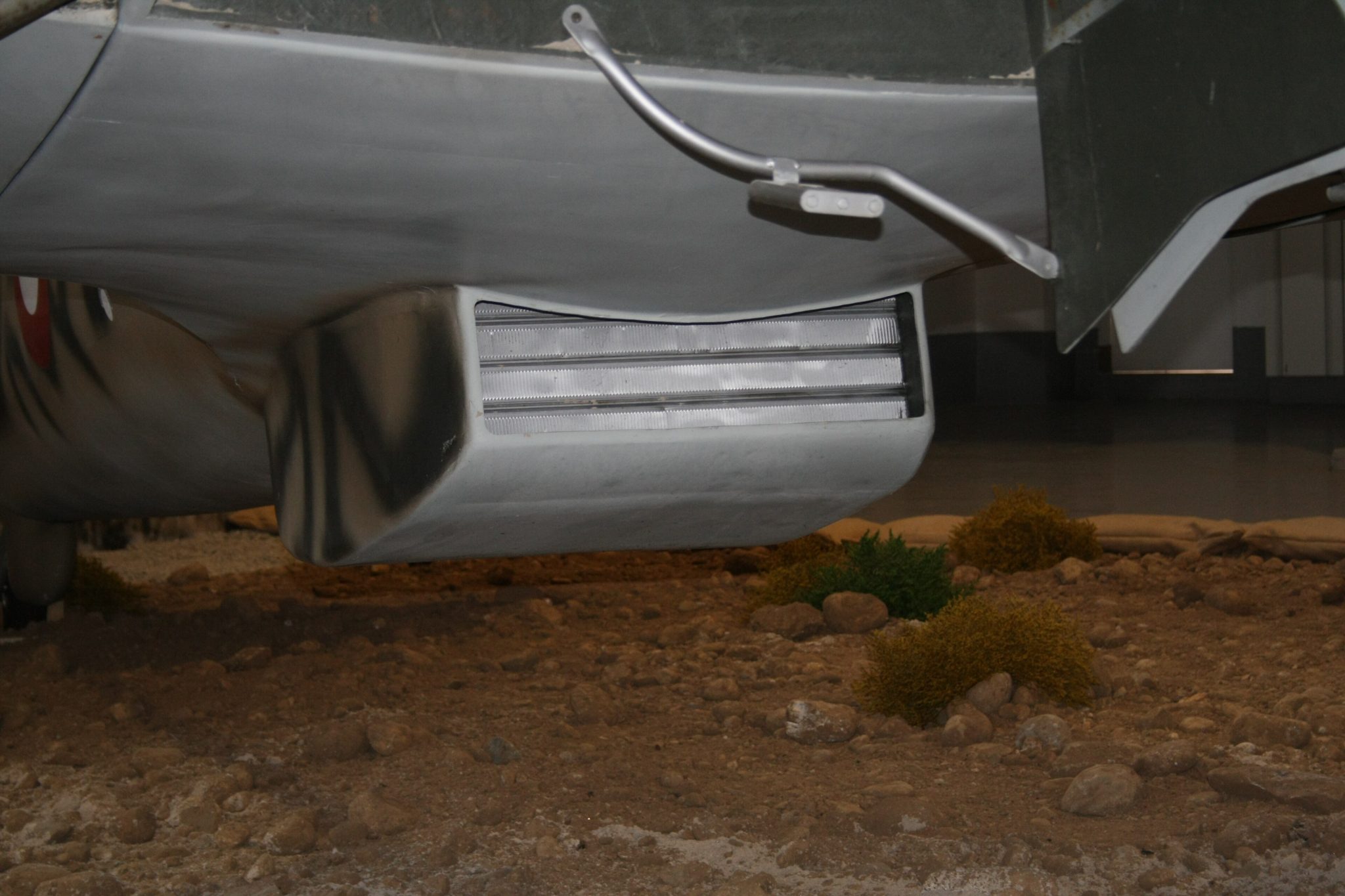
- ventral radiator under the wing centre section with a controllable exit flap, oil cooler in a bath under the nose adequate on the Veltro. The enlarged C.205N Orione overheated in the climb, which is one of the reasons the interim aircraft outlived the intended replacement
- Radio and sight
- an Allocchio Bacchini transmitter-receiver and a San Giorgio reflector sight were the standard fit, though installations varied and serviceability was poor the interesting reversal is that the Veltros of the ANR's 1º Gruppo Caccia in 1944 flew under German Jagdfliegerführer radar direction. For the first time Italian fighter pilots were being vectored properly, in an aeroplane that deserved it, on behalf of a state most of Italy did not recognise
- Manufacture
- roughly 16,000 man-hours per airframe an improvement on the C.202 and still enormous. A Bf 109G took a fraction of that. Italian fighter production was throttled by hand-fitting and by engine supply at least as much as by Allied bombing, and the Veltro's production total is the proof
Values marked "estimate" or "varies" should be treated as approximate. Weight, range and climb figures in particular differ between references and between sub-variants.
06The Macchi C.205 Veltro's variants: Serie I, Serie III and the cannon Veltro
Production Veltros are usually divided into early and late series. The first Veltros (sometimes grouped with the "Serie I" aircraft) were built essentially like the C.202 Folgore, armed with only the two 12.7 mm cowl guns. The later, definitive aircraft (the "Serie III" and similar) added the two 20 mm MG 151/20 wing cannon that define the type in most people's minds.
The Veltro also gave rise to the experimental C.205N Orione, a longer, heavier development with a redesigned airframe intended to improve high-altitude performance and firepower; it did not enter series production. When people say "Macchi C.205" they almost always mean the cannon-armed C.205V Veltro, and that is the aircraft described on this page.
07The Macchi C.205 Veltro's operating costs: why there is no cost-per-hour figure
Unlike the modern jets in the MiGFlug fleet, the Veltro has no meaningful operating-cost figure. Wartime unit costs for Italian fighters were not reliably or consistently recorded, and the currency and economic chaos of 1943–45 Italy makes any single number misleading.
More to the point, there is no airworthy Macchi C.205 anywhere in the world. Every surviving original is a static museum exhibit, so there is no fuel bill, no maintenance cost and no cost-per-flight-hour to quote — the honest entry in the specifications table is simply "not applicable." If you want to know what flying a genuine warbird-era or jet fighter actually costs today, the aircraft MiGFlug operates are a far better guide.
08The Macchi C.205 Veltro's rivals: the Serie 5 fighters G.55 and Re.2005
The Veltro was not the only Italian fighter built around the licence-produced DB 605. It was the lead member of a trio of "Serie 5" designs, and its two stablemates are worth knowing. The Fiat G.55 Centauro was slightly larger and heavier, with an even better high-altitude performance and a heavier standard armament of three 20 mm cannon plus two machine guns; many pilots and engineers — reportedly including German evaluators — rated it the best of the three, though it was more complex and slower to build. The Reggiane Re.2005 Sagittario was the most aerodynamically radical, with a beautiful elliptical wing, but it was built in only tiny numbers.
The Veltro's advantage over both was pragmatic: because it was essentially a re-engined C.202 Folgore, it could be put into production fastest, using existing tooling and an airframe the factories already knew. In a country desperately short of time, that made the Veltro the most numerous of the Serie 5 fighters — even though "most numerous" still meant only a few hundred aircraft.
09How to identify a Macchi C.205 Veltro at a glance
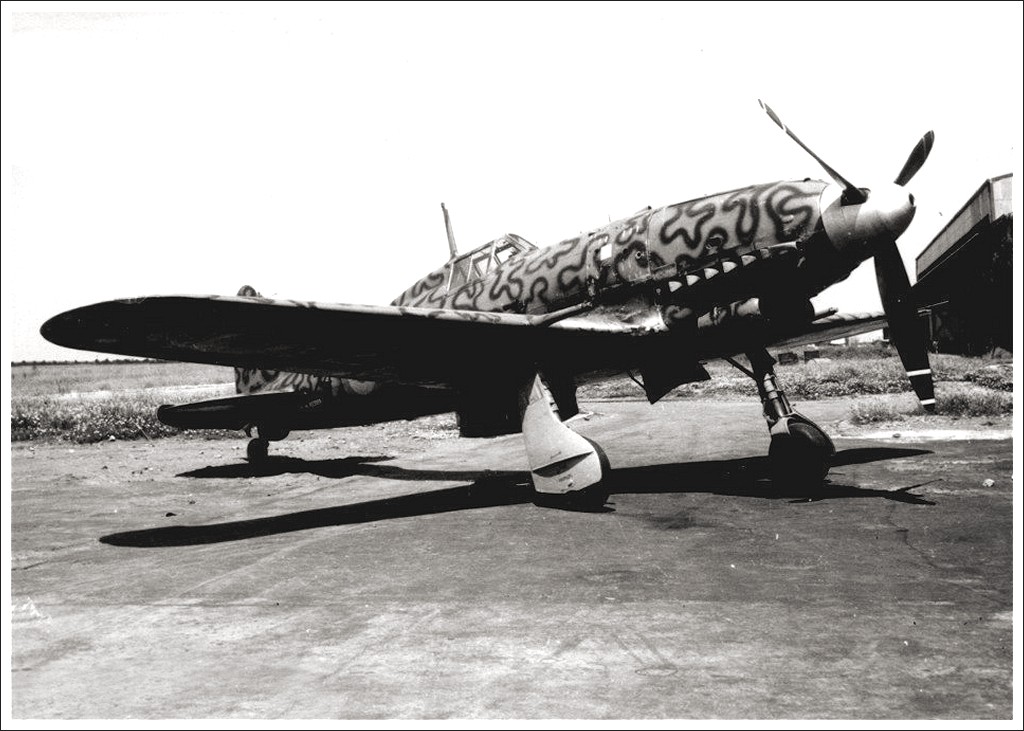
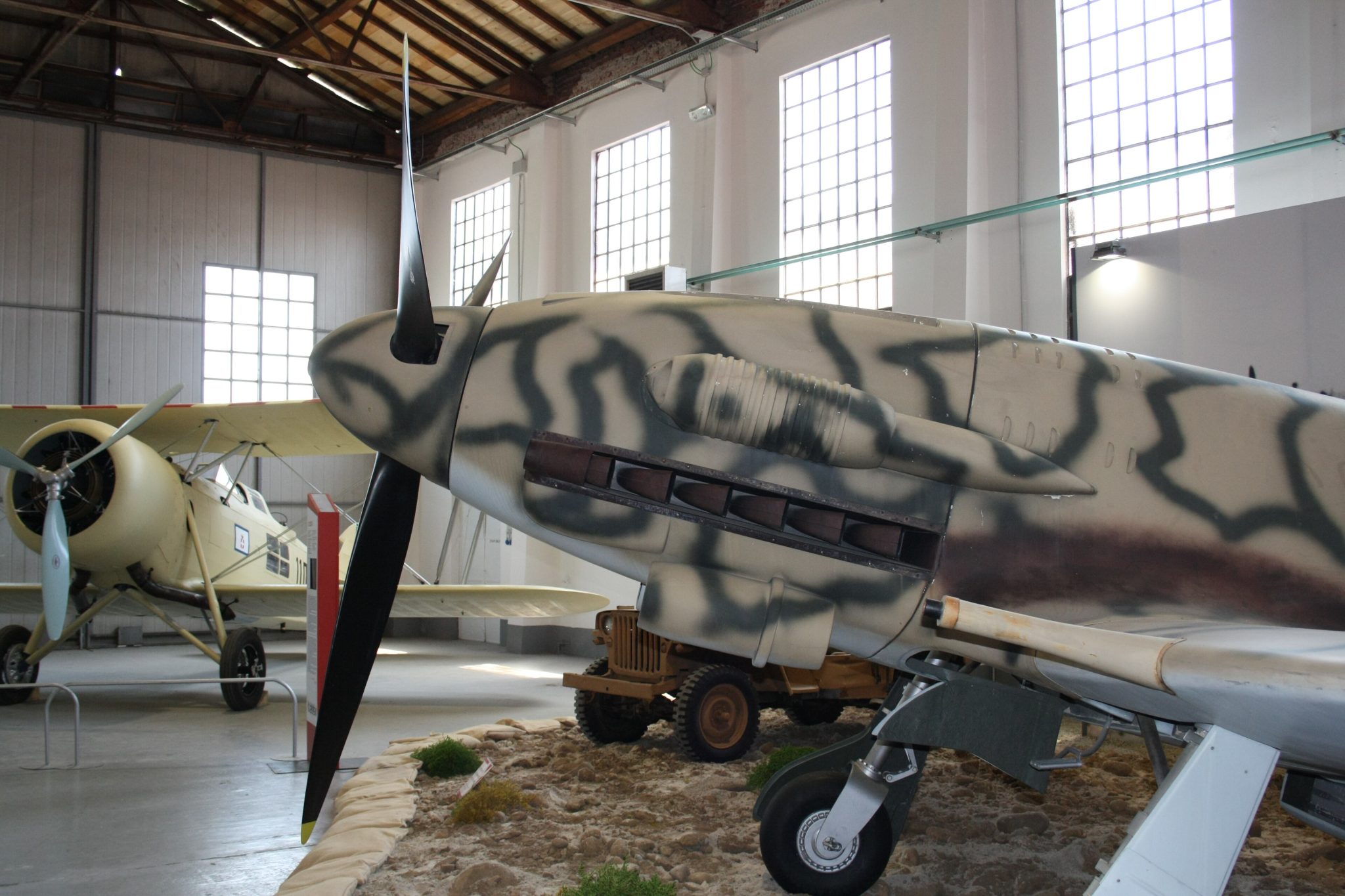
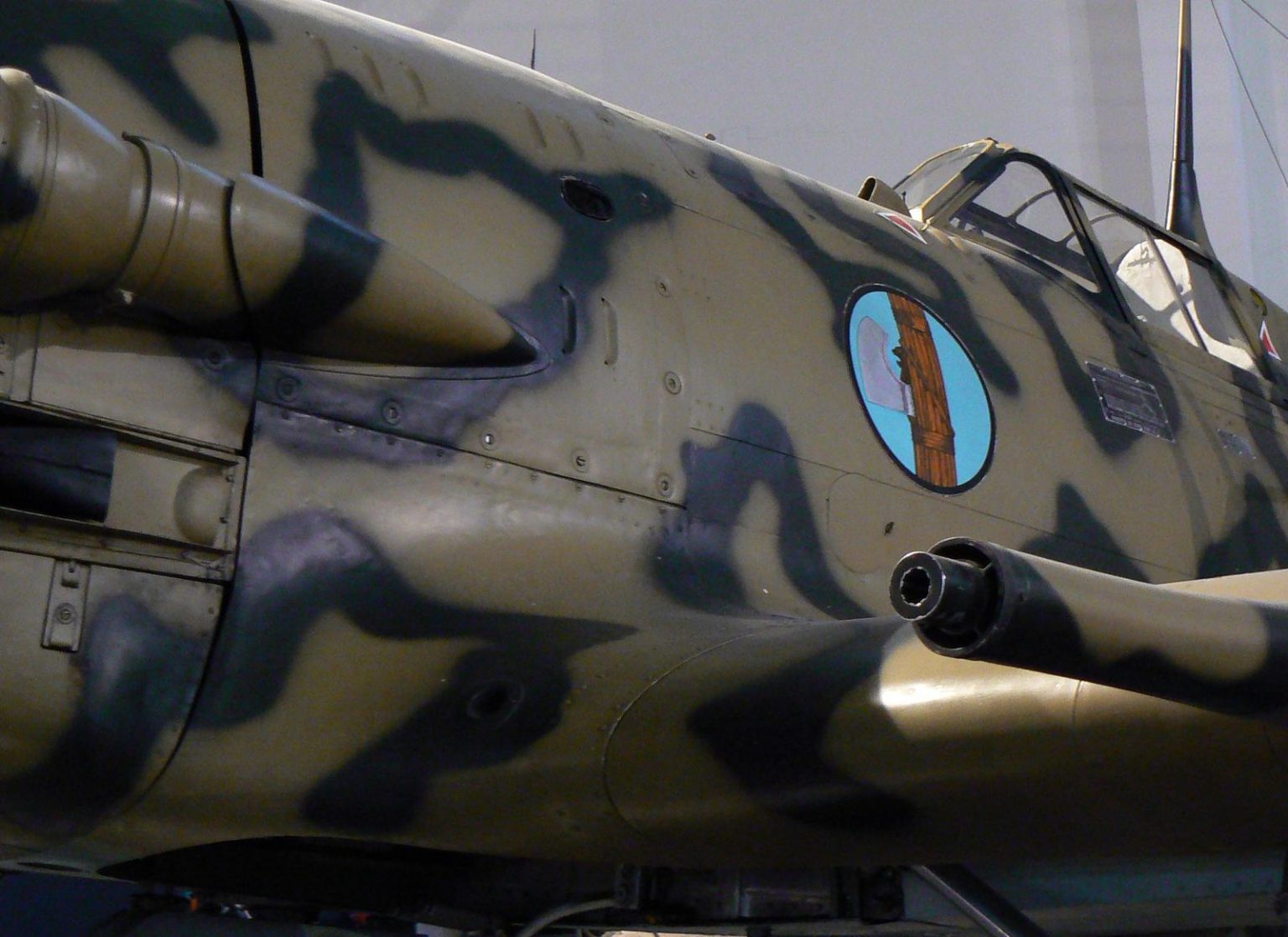
Telling the Veltro apart from its close relatives, and from other wartime fighters, comes down to a few features. First, the nose: the Veltro has the slim, pointed nose of an inline-engined fighter, with a small ventral radiator bath under the belly — nothing like the blunt radial cowl of the C.200 Saetta. Second, the wings: the definitive Veltro carries a 20 mm cannon in each wing, giving it small gun fairings the two-machine-gun C.202 Folgore lacks. From head-on the two 12.7 mm troughs above the engine are also visible.
Against German types the confusion is understandable, because the Veltro shares the DB 605 engine and MG 151 cannon with the Bf 109. The giveaways are the Veltro's more rounded, tapering wingtips and tail, its distinctly Italian proportions, and — on preserved aircraft — Regia Aeronautica, ANR or Co-Belligerent markings rather than Luftwaffe crosses. When in doubt, look for the greyhound's clean, elegant lines: the Veltro was one of the best-looking fighters of the war as well as one of the best.
10The pilots and units who flew the Macchi C.205 Veltro
The Veltro was concentrated in Italy's most experienced fighter units. The 1° Stormo Caccia Terrestre was among the first to convert, taking the type into action over the central Mediterranean in 1943, and other front-line Stormi and Gruppi followed. Because it went to elite units, the Veltro was often flown by veteran pilots who could exploit its qualities to the full — one reason its combat reputation stands so high relative to the small numbers involved.
After the armistice, the aircraft's pilots were divided as surely as the aircraft themselves. In the north, ANR fighter groups — men who had chosen to keep fighting alongside Germany — flew the Veltro and G.55 in the desperate defence of 1944. In the south, former comrades flew surviving Veltros for the Co-Belligerent Air Force. It was, for many Italian airmen, a war fought against people they had trained with, in aircraft they knew intimately — a human dimension that makes the Veltro's story unusually poignant.
11The Macchi C.205 Veltro's legacy: why an obscure fighter is so admired
By any measure of impact, the Veltro was a minor aircraft: too few, too late, on the losing side. And yet it is remembered and admired out of all proportion to the numbers built. The reason is that it represents a genuine "what if" — proof that Italian designers and engineers, given the right engine, could build a fighter as good as anything in the sky. Historians reach for the Veltro when they want to show that Italy's aeronautical talent was never the problem; industrial capacity, strategy and timing were.
For enthusiasts, the Veltro's appeal is also aesthetic and emotional. It is a beautiful aircraft with a dramatic, tragic story — a thoroughbred that arrived at the finish just as the race was lost, and then found itself flying for every side of a broken nation. That combination of excellence and might-have-been is exactly why the Macchi C.205 Veltro earns a place in a museum devoted to the greatest aircraft ever flown, even though only a handful survive and none has flown for decades.
Armament & payload
The Veltro is where Italian fighters finally got cannon, about three years after they needed them
For six years the Regia Aeronautica sent its fighters to war with two rifle-calibre or heavy machine guns and no cannon, and the Veltro Serie III is where that finally stopped. Two German MG 151/20 in the wings with 250 rounds each, two 12.7 mm Breda-SAFAT in the cowling with 370 to 400 rounds each, and a combined throw weight on the order of 3 kg of projectile a second — more than a Spitfire IX and more than a standard Bf 109G-6 carried without gondolas. Against the B-17s and B-24s of the Fifteenth Air Force that mattered enormously, because the Mauser cannon fired the thin-walled Minengeschoss high-explosive shell and the Breda-SAFAT's 12.7 × 81 mm SR round did not meaningfully hurt a four-engined bomber. The bitterness in the story is the timing: the guns Italy needed in 1940 arrived in the summer of 1943, on an aeroplane built in numbers that would have embarrassed a single Luftwaffe Geschwader. Ammunition loads are quoted variously as 370 or 400 rounds per cowl gun; the Serie I fit and the number of Serie I airframes retrofitted with cannon are both poorly documented, and the postwar Egyptian aircraft were a different animal again.
Gun
- Serie III, the definitive fit: two 20 mm Mauser MG 151/20 in the wings with 250 rounds each, plus two 12.7 mm Breda-SAFAT in the upper cowling, synchronised through the propeller disc, with 370 to 400 rounds each
- Serie I: two 12.7 mm Breda-SAFAT in the cowling and two 7.7 mm Breda-SAFAT in the wings with 500 rounds each — the late C.202 battery carried over unchanged. Many Serie I aircraft were later retrofitted with the MG 151/20 in place of the 7.7 mm guns at least one widely copied English reference states that the Serie I carried four 12.7 mm guns. It did not; that armament belongs to the C.205N/1 Orione prototype
- The MG 151/20 fired at about 700 to 750 rounds/min at roughly 700 m/s muzzle velocity. It was German-supplied and German-made throughout: Italy never manufactured it, and cannon deliveries were a real constraint on how fast Serie III aircraft could be completed
- The 12.7 mm Breda-SAFAT was reliable, accurate and thoroughly obsolete by 1943 — about 700 rounds/min unsynchronised and nearer 575 through the gear, 760 m/s, and a high-explosive incendiary round Italian pilots openly considered ineffective. It survived in the cowling because the synchronising gear and the mounting already existed
- A San Giorgio reflector sight was the normal fit. Gun cameras were not standard, which is one reason Italian and ANR victory claims of 1943 to 1945 are so difficult to audit against Allied loss records
Air-to-air
- None in the guided sense. No air-to-air missile existed in any air force during the Veltro's entire career, and the first operational example was more than a decade away
- Interception meant a climb to 7,000 m or more, one pass through a bomber box, and a dive away before the escorts arrived. The Serie III battery was well suited to exactly that and to almost nothing else
- 3 January 1944, Villar Perosa: the ANR 1º Gruppo Caccia's first action — Veltros led by Capitano Adriano Visconti against B-17s and their P-38 escort. Visconti was credited with a P-38 south of Cuneo, his first ANR victory the Gruppo claimed three P-38s that day for no loss; Allied records do not corroborate the total
- 18 March 1944: around 30 Veltros of the 1º Gruppo flew alongside some 60 Bf 109s against an Allied raid of roughly 450 bombers over northern Italy. That ratio is the honest measure of the aeroplane's war
- What the Veltro never got, and needed, was a heavy bomber-destroyer weapon — a 30 mm cannon, a hub gun, or the Werfer-Granate 21 rocket mortar the Luftwaffe was firing into bomber boxes from 1943. Two 20 mm cannon was a good fighter armament and a thin anti-bomber one
Air-to-surface guided
- None. No Italian single-seat fighter of the war carried a guided air-to-surface weapon of any kind
- The guided weapons in Axis service during the Veltro's career — the Fritz X and the Henschel Hs 293 — were German anti-shipping weapons carried by twin- and four-engined bombers, and were never released for Italian fighter use
- Ground attack in a Veltro meant a shallow dive, iron bombs from two wing racks, and the guns held on the target. The Regia Aeronautica did almost none of it, because it had too few aircraft to risk that way
- The type's significant ground-attack career happened somewhere else entirely: Egyptian Veltros flying against Israeli positions and columns in the Negev and Sinai in the winter of 1948 to 1949
Bombs
- Two underwing hardpoints, each rated for one 160 kg (353 lb) bomb — about 320 kg (~710 lb) maximum external load
- Smaller 50 kg and 100 kg bombs and spezzoni fragmentation containers could be substituted on the same racks
- There were no dive brakes and no dedicated bombsight. Delivery was a shallow dive and the pilot's eye, exactly as it had been on the C.200 four years earlier
- In Regia Aeronautica and ANR service this capability was almost theoretical. Veltros were rare, and every one was wanted as an interceptor
- Egypt, 1948–49: No. 2 Squadron of the Royal Egyptian Air Force flew Veltros from El Arish on ground-attack sorties with the wing racks fitted. This is the only sustained bombing use the type ever saw
Rockets
- None. No air-launched rocket was fitted to a C.205 in Regia Aeronautica, ANR, Co-Belligerent or Egyptian service
- This was a real gap and not a period limitation. The Luftwaffe was firing 21 cm Werfer-Granate mortars into American bomber formations from 1943, the RAF had the RP-3, and the Soviets had been carrying RS-82 rockets since before the war
- Italy had no service air-to-ground or air-to-air rocket of its own, and German weapons were not released to Italian fighter units even after the ANR was flying under Luftwaffe operational control
- For an aeroplane whose defining task in 1944 was breaking up heavy bomber boxes, the absence of a stand-off weapon meant closing to within the defensive gunners' effective range every single time
Pods & other stores
- Two jettisonable 100 litre wing tanks on the bomb racks some sources give 150 litres, the C.202 size
- Grande Autonomia conversion: a 220 litre fuselage tank in place of the two cowl machine guns, leaving the aircraft with wing cannon only. Roughly 15 Serie III airframes were so modified — a deliberate trade of a third of the firepower for reach
- M.C.205S Scorta: the long-range escort conversion. Sources conflict badly on both the tank size and the quantity, with figures ranging from three aircraft carrying jettisonable wing tanks to eighteen fitted with a 200 litre fuselage tank replacing the cowl guns the two accounts may describe the same programme at different dates
- Reconnaissance: at least a dozen airframes took a German Zeiss Reihenbildner RB 50/30 camera; eight more were fitted with an FM-62 CineAvia cine camera for gun-and-mission filming, and served with the 310ª Squadriglia. Six were still on strength at the armistice
- No gun pods, no external electronics, no night-fighting equipment of any kind. The Veltro was a clear-weather day fighter and nothing was ever developed to make it anything else
Three typical loadouts
- Bomber interception, defence of Rome, July–August 1943
- Clean Serie III of the 3º Stormo at Cerveteri or the 1º Stormo: 500 rounds of 20 mm, 740 to 800 rounds of 12.7 mm, full internal fuel. Scramble on a warning that came late, climb to meet B-17s and B-24s at 7,000 m, one pass, dive out. Sergente Maggiore Luigi Gorrini flew this profile for six weeks and was credited with three Liberators, two Fortresses, three Lightnings and two Spitfires.
- Radar-directed interception, Po valley, spring 1944
- ANR 1º Gruppo Caccia Serie III, clean, vectored by German ground control onto Fifteenth Air Force formations crossing the Alps. Full cannon and machine gun ammunition, no external stores, and no realistic prospect of a second engagement on the same sortie.
- Ground attack, Negev and Sinai, winter 1948–49
- Royal Egyptian Air Force Veltro of No. 2 Squadron out of El Arish, two bombs on the wing racks and full guns. Many Egyptian machines were re-engined C.202 airframes carrying only the two 12.7 mm cowl guns, which made them the fastest and the feeblest Veltros ever flown.
Sourcing: ammunition loads, the Serie I fit, the number of Serie I aircraft retrofitted with MG 151/20 cannon and the scale of the Scorta and Grande Autonomia conversions all vary between Italian archival summaries, Macchi data sheets and English-language secondary works. Where they conflict the Italian figures are preferred here. Victory claims quoted are unit claims and have not been reconciled against Allied loss records; where a claim is known to be unsupported, that is said in the text rather than quietly omitted.
Variants
The Veltro was the aeroplane Macchi could build while the one it wanted was still being drawn
The C.205 exists because of an engine licence. In 1941 the Regia Aeronautica arranged for Fiat to build the Daimler-Benz DB 605A in Italy as the RA.1050 R.C.58 Tifone, and Mario Castoldi — the Schneider Trophy designer whose M.C.72 still holds the piston seaplane speed record — did the obvious thing. The DB 605 was close enough in size to the DB 601 already in the C.202 Folgore that he could hang it on the existing airframe and leave the fuselage identical aft of the firewall. The project was authorised on 16 December 1941 as the M.C.202bis; the first prototype flew from Lonate Pozzolo on 19 April 1942 with Guido Carestiato at the controls, and the designation became C.205 to place it among the Serie 5 fighters built around the new engine.
That placement flatters it. The true Serie 5 aircraft — the Fiat G.55 Centauro and the Reggiane Re.2005 Sagittario — were new designs with new wings drawn around the Tifone from the start. The Veltro was a 1937 wing, a 1940 fuselage and a 1942 engine, and the Guidonia comparative trials of early 1943 said so plainly: the G.55 was the best-handling of the three at every altitude and won the tender, the Re.2005 was the fastest high up and the most exquisite and least buildable, and the C.205 was the best at low and medium height, excellent in the dive, and visibly out of ideas above 8,000 m. It was ordered anyway, alongside the G.55, for the reason interim aircraft always are: the tooling existed and it could be delivered now.
Castoldi knew exactly what the aeroplane needed and drew it. The C.205N Orione put the same engine on a wing of 19 m² with an 11.25 m span and a longer fuselage; 1,200 were ordered from Macchi and Breda. On 20 March 1943 that order was cancelled and converted into more C.205Vs, partly because the heavier Orione was slower and less agile than the aircraft it was meant to replace and overheated in the climb, and partly because Italy in 1943 could not afford to stop a running production line. The larger-winged M.C.206 and the DB 603-engined M.C.207 got no further than incomplete airframes. The Veltro remained the interim solution until there was no longer an Italian state to build a replacement for.
Then the armistice of 8 September 1943 split the type in two, and the split is the most interesting thing about it. Only a handful of Veltros reached Allied airfields in the south; the Italian Co-Belligerent Air Force built its holding up slowly and used the type largely in southern Italy and on supply and escort work over the Balkans for Yugoslav partisans, with the 4º, 9º and 10º Stormi and eventually the 155º Gruppo, which still had about 30 Veltros and 19 of them serviceable on 8 May 1945. The far more active career belonged to the other side: the Aeronautica Nazionale Repubblicana's 1º Gruppo Caccia at Campoformido, which took over 25 airframes the Luftwaffe had requisitioned plus new production, fought the Fifteenth Air Force over northern Italy from 3 January 1944, and re-equipped with Bf 109Gs during that summer once Allied bombing of Varese and Milan had killed the spare parts supply. Italians shot at Italians in the same aeroplane type over their own country for eighteen months.
- M.C.205V prototypes (1942 / 2)
- MM.9287 was a C.202 airframe re-engined with the Tifone; first flight 19 April 1942 from Lonate Pozzolo with Guido Carestiato, a second prototype following on 19 August 1942. Macchi had undertaken to deliver the first aircraft three months after receiving the engine, and very nearly did.
- M.C.205V Serie I (Oct 1942–Jun 1943 / 99)
- MM.9288 to 9386. Two 12.7 mm cowl guns and two 7.7 mm wing guns — the late Folgore battery. Deliveries began in September 1942 and the first three reached the 71ª Squadriglia of the 17º Gruppo at Pantelleria on 6 February 1943. Many were later retrofitted with 20 mm wing cannon.
- M.C.205V Serie III (1943–44 / ~150 ordered, roughly 120–150 completed)
- MM.92153 onward. Two MG 151/20 cannon replacing the wing machine guns: the definitive Veltro. Around 100 had been delivered by the armistice; Macchi built a further 72 or so for the ANR before Allied bombing stopped production in the spring of 1944.
- Fiat-built Serie II (1942 / 300 ordered, none built)
- The second and much the largest production batch was to come from Fiat. RAF raids on Turin on the nights of 9 to 12 December 1942 destroyed the tooling and the order was abandoned. That single week is why the Veltro is a footnote in production terms rather than Italy's standard 1943 fighter.
- M.C.205V G.A. and M.C.205S Scorta (1943 / roughly 15 and 3–18)
- Long-range conversions. The Grande Autonomia carried a 220 litre fuselage tank in place of the cowl guns, leaving cannon only; the Scorta escort variant is variously described as carrying jettisonable wing tanks or a 200 litre internal tank. The sources do not agree and may be describing one programme at two dates.
- M.C.205V R.F. and Cinematografici (1943 / ~12 and 8)
- Reconnaissance conversions with a Zeiss RB 50/30 camera, and a cine-camera fit using the FM-62 CineAvia, both serving with the 310ª Squadriglia. Six were operational at the armistice, three of them at Decimomannu.
- M.C.205N Orione (1942–43 / 2 prototypes)
- MM.499 and MM.500, first flown 1 November 1942. A 19 m² wing, 11.25 m span, 9.65 m fuselage; the N/1 with four 12.7 mm guns and an MG 151/20 firing through the propeller hub, the N/2 with three 20 mm cannon and two 12.7 mm. An order for 1,200 was cancelled on 20 March 1943. Both prototypes were destroyed, one in the bombing of Guidonia.
- M.C.206 and M.C.207 (1943 / neither completed)
- The M.C.206 took a new wing of about 21 m², cutting wing loading to around 190 kg/m² and aiming at 700 km/h; the single airframe was damaged by an accidental explosion on 22 October 1943, damaged again in the bombing of 30 April 1944, and scrapped. The M.C.207 was to have the 1,750 hp DB 603A and four 20 mm cannon; a fuselage was begun and the armistice ended it.
- Luftwaffe requisitioned aircraft (Oct–Dec 1943 / ~23–25)
- II./JG 77 flew seized Veltros for about two months from bases in northern Italy, with 23 on charge and only 11 combat-ready. German pilots liked the aeroplane and lost at least five to accidents, including two killed near Albenga on 27 September 1943. The survivors passed to the ANR's 1º Gruppo Caccia on 31 December 1943.
- Royal Egyptian Air Force C.205V (1948–49 / 42 ordered)
- The postwar export order, and a partly fictitious one: a minority were genuine new or refurbished Veltro airframes and the majority were surplus C.202 Folgores re-engined with the Tifone and left with only their two 12.7 mm cowl guns. Ten went on from Egypt to Syria, which flew them until jets arrived in September 1952.
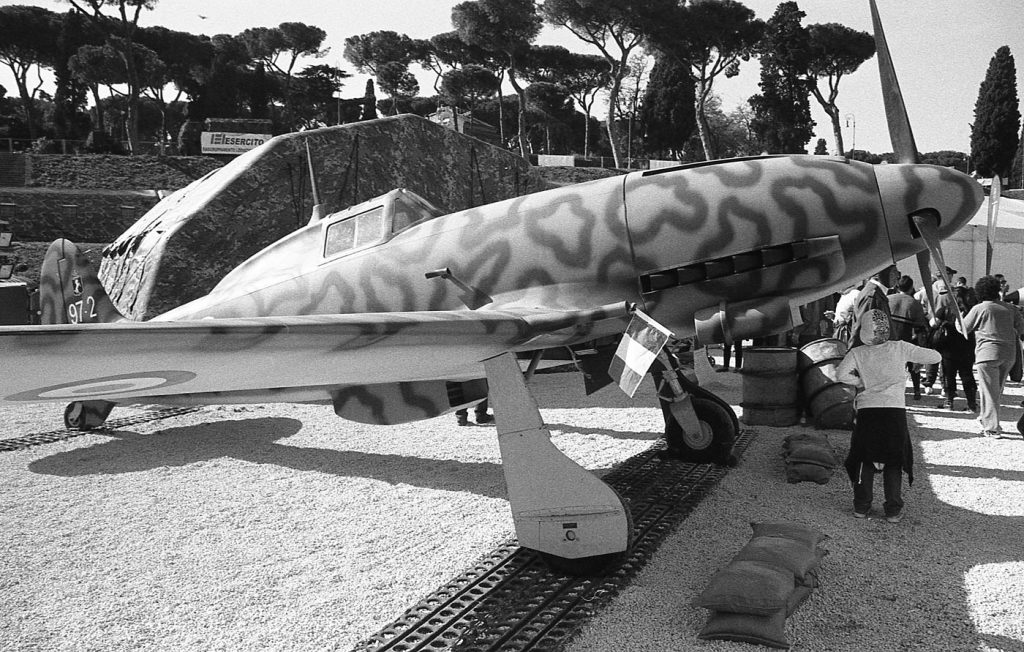
Production, the Egyptian episode and survivors. Totals depend entirely on what is counted. Roughly 177 Veltros had been completed by the armistice of 8 September 1943, of which about 146 had reached Regia Aeronautica units and only 66 were serviceable on the day; Macchi built perhaps 72 more for the Aeronautica Nazionale Repubblicana before bombing ended production, giving a wartime figure usually stated as about 250 to 265 including prototypes. Postwar the picture blurs deliberately. Around 30 survivors went to the 5º Stormo in Puglia and then to the flying school at Lecce-Galatina until about 1951. Egypt ordered 42 aircraft in 1948 and was sold a mixture: published accounts range from eight to twenty-one genuine Veltro airframes, with the balance — most credibly 31 of the 42 — being surplus C.202 Folgores re-engined with the Tifone and delivered with only two 12.7 mm guns, the lightest and fastest and least useful version of the type ever built. Deliveries ran from four aircraft on 16 September 1948 through further batches on 6 and 26 October and 24 November, so only a part of the order arrived before the fighting stopped. They flew from El Arish with No. 2 Squadron against Israeli forces; at least three were lost in combat between 28 December 1948 and 5 January 1949, one Veltro was credited with an Israeli P-51D Mustang on 7 January 1949, and Israeli pilots claimed two or three in return. Shalabi al-Hinnawi, later commander of the Egyptian air force in 1967, had his Veltro badly shot up by a Spitfire IX. Israeli agents also attacked the supply at source, destroying one C.205 and three MB.308s in sabotage at Venegono on 18 September 1948. Twenty undelivered Egyptian machines were taken onto Italian Air Force charge between February 1950 and May 1951 and sent to Lecce. Survivors: three airframes are usually listed and not one of them is an unaltered wartime-built Veltro. MM.91818, displayed at the Museo Nazionale della Scienza e della Tecnologia in Milan, began life as a Breda-built C.202 and was rebuilt to C.205V standard by Aermacchi; it flew again on 5 December 1980, appeared at the 1981 Paris Salon, and was permanently grounded after a take-off accident at Venegono on 23 July 1983, though some accounts have it flying at displays as late as 1986. MM.9546 at the Museo Storico dell'Aeronautica Militare at Vigna di Valle is a Breda-built C.202/C.205 composite shown as a Veltro. MM.92166 is a Serie III airframe associated with the Egyptian contract, held for many years by Aermacchi at Venegono and last publicly shown in 1998; sources disagree on where it is now and on whether it is currently presented as a C.202 or a C.205. The full-size aircraft outside the Palazzo dell'Aeronautica in Rome and the machine at Volandia at Vizzola Ticino are reproductions, not original airframes. Engine and cockpit wreckage of a crashed Veltro was recovered from eight metres down at Correzzola near Padua in November 2006. No Veltro is airworthy, and the only postwar flying done by the type was done by a converted Folgore.
The Macchi C.205 Veltro: a short, dramatic career
The predecessors. The radial-engined C.200 Saetta and the DB 601-powered C.202 Folgore establish Macchi's line of clean, fine-handling but under-armed fighters.
First flight. The C.205 prototype takes to the air, essentially a Folgore airframe fitted with the more powerful licence-built DB 605.
The Tifone. Fiat begins licence production of the DB 605 as the R.A.1050 R.C.58 Tifone, the engine shared by the whole "Serie 5" of Italian fighters.
Into service. The first Veltros reach Regia Aeronautica units; the definitive version adds two 20 mm MG 151/20 wing cannon.
Combat debut. Veltros fight over the Sicilian Channel, Pantelleria, Sardinia and southern Italy, defending against Allied raids and escorting.
The armistice. Italy changes sides. The Veltro fleet is split between the German-aligned north and the Allied south.
A fighter on both sides. The fascist ANR flies the Veltro in the north; the Italian Co-Belligerent Air Force flies it alongside the Allies in the south; the Luftwaffe evaluates and uses a handful.
Production ends. With only a few hundred built, Veltro manufacture winds down as Italian industry collapses.
The Egyptian coda. Egypt acquires Veltros and flies them during the 1948 Arab-Israeli War (reported fleet figures vary widely).
Survivors. A small number of original Veltros survive in Italian museums; none is airworthy.
Twelve things worth knowing about the Macchi C.205 Veltro
Scroll through the episodes and details that make the Veltro one of the most interesting fighters of the war.
A German engine on an Italian thoroughbred
The Veltro was born from a simple, powerful idea: take the excellent but under-powered C.202 Folgore and give it the bigger Daimler-Benz DB 605. Macchi's chief designer Mario Castoldi — the same engineer behind Italy's record-breaking Schneider Trophy seaplanes — had already given the Folgore its superb aerodynamics. Adding the more powerful engine unlocked the airframe's full potential and launched Italy's "Serie 5" of late-war fighters.
"Greyhound," and a family of hunters
Veltro means greyhound. It sat in a menagerie of evocative Italian fighter names — Saetta (lightning bolt), Folgore (thunderbolt), and the rival Fiat G.55 Centauro and Reggiane Re.2005 Sagittario. The naming captured the speed and grace Macchi's designers built into a fighter that looked fast standing still, all slim nose and clean, tapering lines.
19 April 1942
The prototype flew for the first time in April 1942. On paper and in the air it was a clear step up over the Folgore. But it would take almost a year of engine licence-production and factory tooling before Veltros reached front-line units — a delay that would prove costly, because by the time the aircraft was ready in numbers, Italy's strategic position had already collapsed.
Over Sicily and Pantelleria, 1943
The Veltro first saw combat in the spring of 1943, defending the central Mediterranean and escorting over the Sicilian Channel and the fortress island of Pantelleria as the Allies closed in on Italy. The first unit to receive it, the 1° Stormo, took it into action almost immediately, and pilots quickly found they finally had a fighter that could meet the latest Spitfires on equal terms.
A match for the best
Pilots and historians rate the Veltro among the finest Axis fighters of the war, able to hold its own against the Spitfire Mk IX and the P-51 Mustang. It combined the Folgore's beautiful handling with real speed and, at last, heavy firepower. In skilled hands it could win the individual dogfights that mattered — the problem was never the aircraft, but how few of them there were.
Beautiful, but under-gunned
Early Veltros inherited the Folgore's great flaw: an armament of just two 12.7 mm Breda-SAFAT machine guns. Against armoured, self-sealing Allied aircraft that was marginal — a pilot could out-fly an enemy, get on his tail, hit him repeatedly and still watch him fly home. Italian fighters had suffered from this "beautiful but toothless" problem since the start of the war.
Cannon in the wings
The definitive Veltro added two 20 mm MG 151/20 cannon in the wings — the same hard-hitting German weapon carried by the Bf 109 and Fw 190. At a stroke the Veltro went from a graceful dogfighter that struggled to score, to a fighter that could tear apart what its flying qualities let it catch. This armament evolution is the single most important thing to understand about the type.
At war with itself
After the 8 September 1943 armistice, the Veltro suffered a fate almost unique in aviation history: it fought on both sides of the same war. Some aircraft ended up with the fascist ANR in the German-aligned north, others with the Italian Co-Belligerent Air Force in the Allied south — the same fighter, in the same national markings-turned-enemy, over the same country.
The ANR's defenders
In the German-aligned north, Aeronautica Nazionale Repubblicana pilots flew the Veltro against the overwhelming daylight bomber streams of the USAAF and their fighter escorts, almost always heavily outnumbered. ANR Veltro and G.55 units fought a bitter, losing defensive battle over northern Italy in 1944, and their pilots earned respect even from the Luftwaffe alongside which they flew.
Co-belligerent Veltros
In the Allied-aligned south, the Italian Co-Belligerent Air Force operated surviving Veltros — including aircraft such as MM 92289, preserved to this day — now flying on the other side of the front. Their role was more limited and their numbers small, but they are a vivid reminder of how completely the armistice tore Italy's air force in two.
Evaluated by the Luftwaffe
The Luftwaffe took a serious interest in the Serie 5 fighters and used or evaluated a number of Veltros in Italy after the armistice. It is a striking curiosity: a German air arm flying an Italian-built fighter powered by a licence-built German engine and armed with German cannon — the DB 605 and MG 151 having come full circle back into Luftwaffe service.
Egypt and the 1948 war
After the war Egypt acquired Veltros — a mix of refurbished and, by some accounts, newly completed airframes (reported totals vary widely) — and flew them during the 1948 Arab-Israeli War. It was a final, obscure combat chapter for a fighter that had already fought on every side of Italy's own war, and it kept a handful of Veltros flying into the late 1940s.
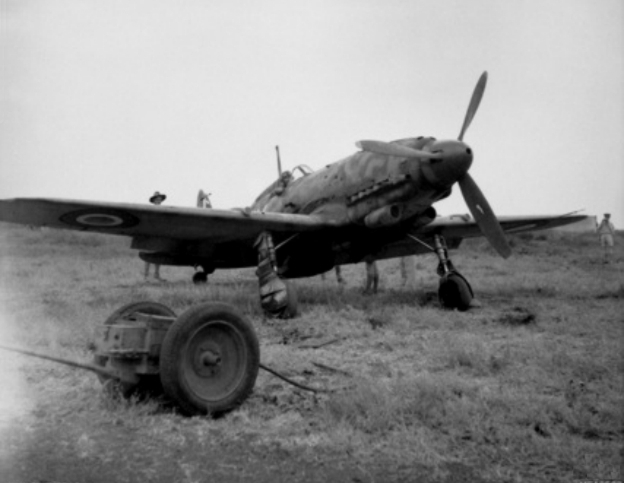
Macchi C.205 Veltro in photographs
Wartime images and surviving museum aircraft. Click any photograph to enlarge. All images are public domain or Creative Commons, credited in the captions.
The Macchi C.205 Veltro on video
A focused, well-produced history of the Veltro from the aviation channel IHYLS, covering the type's development, armament and short combat career.
"The (Short) Peak of Italian Fighters: Macchi C.205 Veltro" — IHYLS (aviation history channel), published March 2024, ~106,000 views at time of writing. The Veltro is an obscure type, so no single documentary reaches the millions of views a Spitfire video might; this is among the best dedicated treatments available.
Where the Macchi C.205 Veltro flew
Origin and manufacture, wartime operators and theatres, the post-war export to Egypt, and where surviving airframes are preserved. Hover (or tap on mobile) a country for details; use the buttons to toggle categories.
The Macchi C.205 Veltro by the numbers
The Veltro's story is not one of huge totals but of quality against scarcity: a first-rate fighter available in tiny numbers, flown in 1943–45 by the Regia Aeronautica, the ANR, the Italian Co-Belligerent Air Force and the Luftwaffe, and post-war by Egypt.
Macchi C.205 Veltro: your questions answered
Can I fly in a Macchi C.205 Veltro?
No. There is no airworthy Macchi C.205 Veltro anywhere in the world — every surviving original is a static museum exhibit, and MiGFlug does not offer flights in this aircraft. However, you can fly in several genuine military jets and warbird-era fighters today. MiGFlug flies aircraft such as the Hawker Hunter, MiG-29 Fulcrum, MiG-15, L-39 Albatros, F-104 Starfighter and T-33 Shooting Star. See the full list and prices at migflug.com/flights-prices.
Was the Macchi C.205 Veltro a good fighter?
Yes — it was excellent. The Veltro is widely regarded as one of the best Axis fighters of the war, able to hold its own against the Supermarine Spitfire Mk IX and the North American P-51 Mustang. Its weakness was not quality but quantity and timing: it entered service only in 1943 and was built in very small numbers, so it had little strategic impact.
What engine did the Macchi C.205 Veltro use?
The Fiat R.A.1050 R.C.58 Tifone, which was a licence-built copy of the German Daimler-Benz DB 605 inverted V12. It produced roughly 1,475 hp and gave the Veltro a top speed of about 642 km/h. The same engine powered the other "Serie 5" Italian fighters, the Fiat G.55 and Reggiane Re.2005.
How many Macchi C.205 Veltros were built?
Commonly cited figures put total production at around 262 aircraft, though sources vary and some counts run a little higher or include converted C.202 airframes. Either way it was a very small number — a few hundred against the tens of thousands of Spitfires, Mustangs and Bf 109s built during the war.
How fast was the Macchi C.205 Veltro?
Its top speed was about 642 km/h (399 mph) at around 7,200 m. That put it in the same performance class as the best Allied fighters it faced in 1943, such as the Spitfire Mk IX.
What was the Macchi C.205 Veltro's armament?
It changed during production. Early Veltros carried only two 12.7 mm Breda-SAFAT machine guns, like the C.202 Folgore, and were under-armed. The definitive version added two 20 mm MG 151/20 cannon in the wings, greatly improving hitting power and turning the Veltro into a genuinely dangerous fighter.
Did the Veltro really fight on both sides of the war?
Yes. After Italy's armistice with the Allies on 8 September 1943, the Veltro served with the fascist Aeronautica Nazionale Repubblicana (ANR) in German-aligned northern Italy and with the Italian Co-Belligerent Air Force alongside the Allies in the south. The Luftwaffe also evaluated and used a number of them.
What is the difference between the Macchi C.205, C.202 and C.200?
They are three generations of the same Macchi fighter line. The C.200 Saetta had a Fiat radial engine; the C.202 Folgore replaced it with a licence-built DB 601 inline, giving the slim pointed nose; and the C.205 Veltro used the more powerful DB 605 (built as the Tifone) and, in its definitive form, added 20 mm wing cannon.
Are there any surviving Macchi C.205 Veltros?
Only a small number of originals survive, all in Italian museums — for example the Italian Air Force Museum (Museo storico dell'Aeronautica Militare) at Vigna di Valle, with others and reproductions elsewhere in Italy. None is airworthy, so the Veltro can only be seen as a static exhibit.
What does "Veltro" mean?
Veltro is Italian for "greyhound." It fits Macchi's tradition of fast, evocative fighter names alongside the C.200 Saetta ("lightning bolt") and C.202 Folgore ("thunderbolt"), and it suited an aircraft whose slim, tapering lines really did look like a hound built for speed.
Who designed the Macchi C.205 Veltro?
It was developed by Aeronautica Macchi around the earlier work of designer Mario Castoldi, famous for Italy's Schneider Trophy racing seaplanes. The Veltro was essentially his C.202 Folgore airframe fitted with the more powerful licence-built Daimler-Benz DB 605 engine and, in definitive form, heavier cannon armament.
Where can I see a Macchi C.205 Veltro today?
The best-known original is at the Italian Air Force Museum (Museo storico dell'Aeronautica Militare) at Vigna di Valle, near Rome. A C.205 is also displayed at the Museo della Scienza e della Tecnologia in Milan, and components and a reproduction are held at the Volandia museum near Milan Malpensa. All are static exhibits — there is no flying example anywhere.
Fly a real fighter with MiGFlug
The Macchi C.205 lives only in museums now. But the thrill of a fast military aircraft is very much bookable today — from Cold War jets to warbird-era classics, flown with professional pilots.