
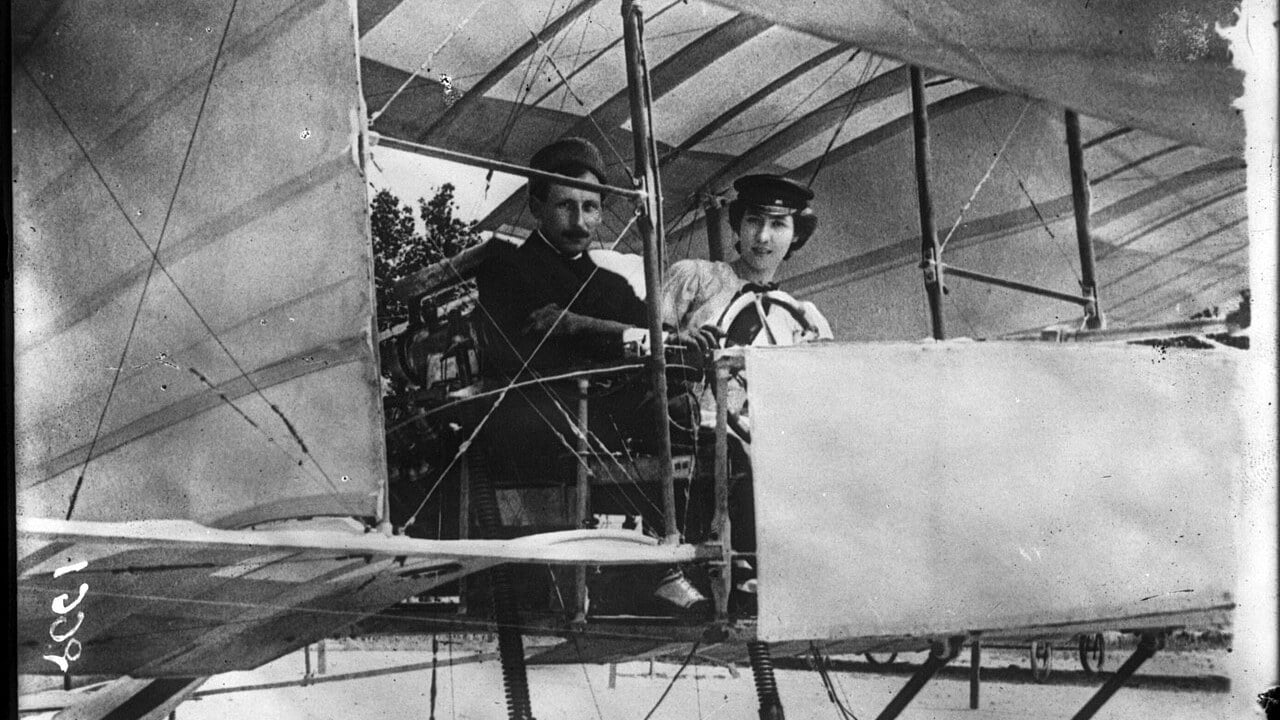
It was already eight o’clock on the evening of 8 July 1908 when Léon Delagrange decided to try something new on the Piazza d’Armi in Turin. His Voisin biplane had flown well that day, one of the few days of his Italian tour without a thunderstorm. His mechanic topped up the fuel and water, a handful of helpers pushed the machine back out, and Delagrange climbed aboard.
Beside him sat a French sculptor named Thérèse Peltier. The biplane rolled slowly down the field, lifted near the end of the straight, and stayed in the air for something like 200 to 250 metres before skimming back to the hangar. By most accounts, Peltier had just become the first woman to fly in an aeroplane.
Quick Facts
- Who: Thérèse Peltier (née Cochet), French sculptor, 1873-1926
- First flight: 8 July 1908, as passenger of Léon Delagrange, Piazza d’Armi, Turin (by most accounts)
- Distance: Roughly 200-250 metres
- Aircraft: Delagrange’s Voisin biplane
- Earlier claim: Henri Farman at Ghent, late May/1 June 1908, with Mlle P. Van Pottelsberghe (disputed)
- Solo: Reportedly September 1908, about 200 m in a straight line (Turin or Issy, accounts differ)
- Licence: Never; Raymonde de Laroche became the first licensed woman pilot on 8 March 1910
A sculptor from Orléans
She was born Thérèse Cochet in Orléans on 26 September 1873. As Madame Peltier she lived in Paris, where she studied sculpture, exhibited at the salons and won a prize from the Union des femmes peintres et sculpteurs, France’s society of women painters and sculptors.
Delagrange was a sculptor too, and a friend from childhood. In her own words, the two had known each other since they were children and had stayed together for twelve years. When he swapped the studio for the flying field and became one of France’s leading pioneer aviators, Peltier followed him.
In the spring of 1908 a group of Italian enthusiasts persuaded Delagrange to bring his Voisin to Italy. He made the first aeroplane flight in the country in Rome on 24 May, flew ten laps of the Piazza d’Armi in Milan on 23 June, and moved on to Turin, where engine trouble and bad weather dogged him. Then came 8 July.
First, with a footnote
Peltier was soon being called “la première aviatrice du monde”, the first woman aviator in the world. Historians add a caveat. A few weeks earlier, around the end of May or 1 June 1908 at Ghent in Belgium, Henri Farman tried to take a woman aloft, a Mlle P. Van Pottelsberghe. Some accounts say he succeeded; others say his attempts never got off the ground.
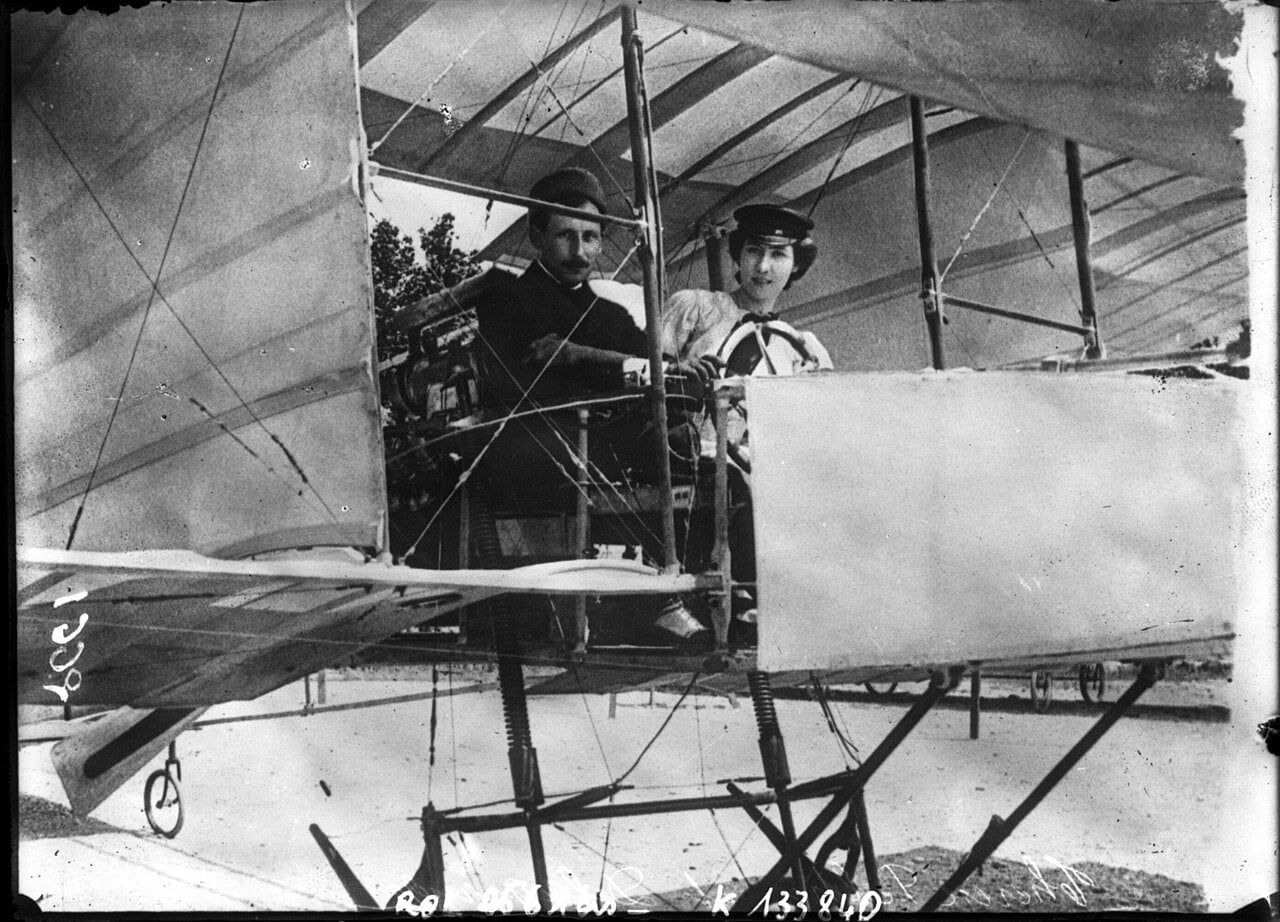
There is a smaller puzzle too. A French press-agency photograph of Peltier and Delagrange seated in the Voisin, dated 8 July 1908, is captioned “Milan”. Delagrange had left Milan for Turin at the end of June, and the detailed contemporary reports of the passenger flight place it in Turin.
France 3 Pays de la Loire on Wilbur Wright’s first flight at Le Mans on 8 August 1908, a month after Peltier’s first flight (in French).
What is not in doubt is that 1908 was the summer aviation came of age in Europe. Wilbur Wright began flying at Le Mans in August, and in October he took Mrs Hart O. Berg aloft there, a flight some count as the first real flight by a woman. Peltier had been in the air three months earlier.
From passenger to pilot
Peltier was not content to ride along. Delagrange offered a cash prize for the first woman to fly an aeroplane for one kilometre, and she began to learn. There were no flying schools in any modern sense: she watched, flew with him, sat in the seat while he explained the controls, and then tried for herself.
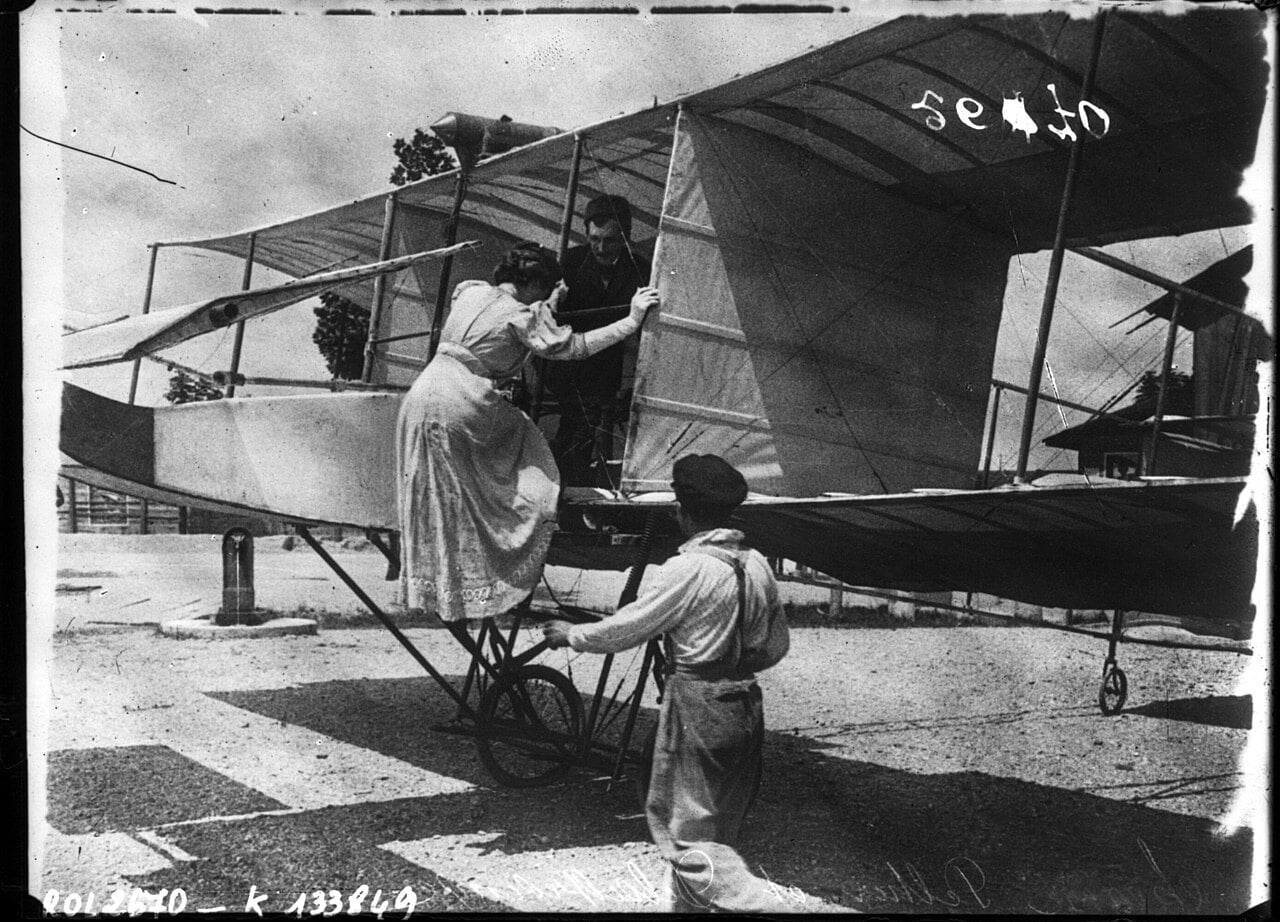
Exactly when and where she first flew alone is uncertain. According to the aviation history site Historic Wings, it happened in mid-September 1908 on the military square in Turin, and the Italian weekly L’Illustrazione Italiana reported it in its issue of 27 September. The Paris 15th arrondissement history society instead places the first flight by a woman at Issy-les-Moulineaux, near Paris, in September 1908. A press photograph shows her climbing into Delagrange’s Voisin at Issy on 17 September.
The flight itself, as Historic Wings describes it, was modest: about 200 metres in a straight line, never more than 2.5 metres above the ground, with no attempt to turn. The Voisin had neither ailerons nor wing warping and could only be skidded around on its rudder, a skill she had not yet mastered. It was still, by most reckonings, the first time a woman had piloted an aeroplane alone.
The end of the dream
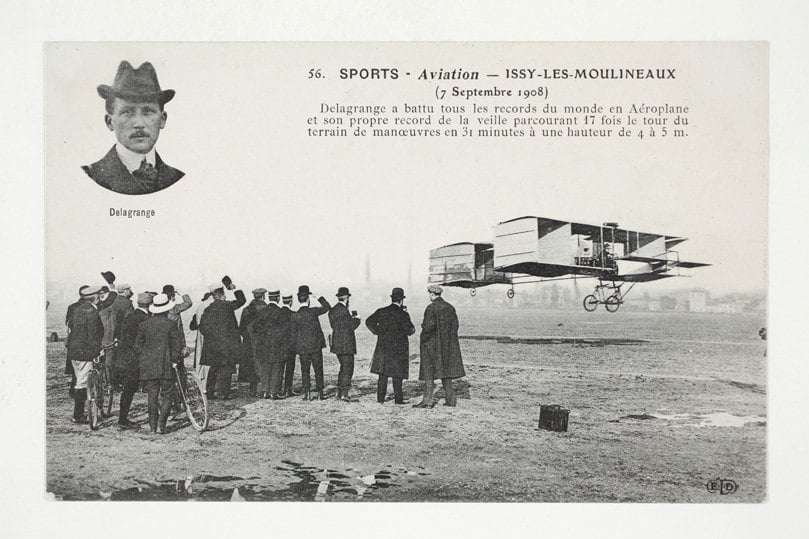
She never took a pilot’s licence, and she never claimed Delagrange’s prize. On 4 January 1910 Delagrange was killed in a flying accident at Bordeaux. Peltier was there and saw him fall. She abandoned aviation for good.
Two months later, on 8 March 1910, Raymonde de Laroche became the first woman in the world to receive a pilot’s licence, a story told here on Afterburner. It is de Laroche, with her official certificate, whom many lists call the first woman pilot. Peltier’s claim rests on newspaper reports and photographs.
Radio Classique’s Franck Ferrand on Raymonde de Laroche, who in 1910 became the first woman to hold a pilot’s licence (in French).
In a letter to the aviation patron Henri Deutsch de la Meurthe, Peltier described the loss of the friend who had brought her into the air.
Thérèse Peltier died in Paris on 18 February 1926. Her flights lasted seconds and covered a few hundred metres. But on a July evening in 1908 she climbed into a machine that most people still thought was madness, and a few weeks later she flew it alone. Every woman who has taken a pilot’s seat since has followed her.
Sources: Cose Nostre (Caselle Torinese, 2018, quoting the 1908 Turin press), Historic Wings, Société historique du 15e arrondissement de Paris (Christiane Magnin), Air Journal, Agence Rol / Bibliothèque nationale de France
0 Comments