
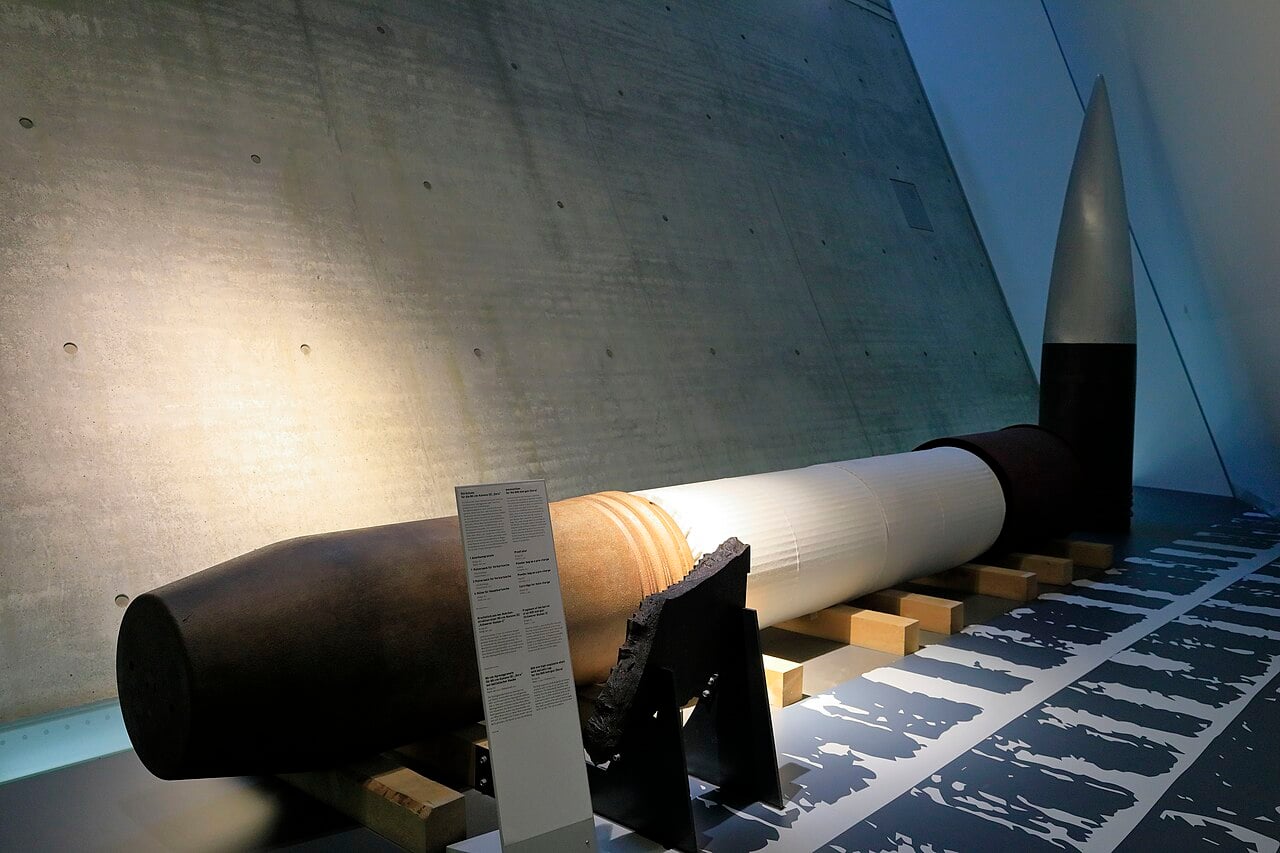
It is the fifth of June, 1942, in the Crimea. In a cutting in the hills near Bakhchisaray, at a spot the Germans call Duvanköy, a crew of gunners stands back from the largest rifled gun ever built. Its barrel is more than 30 metres long, and it sits on a carriage spread across two parallel railway tracks. Sevastopol, the Soviet naval fortress, lies some 25 kilometres to the south-west. Then the gun fires. A concrete-piercing shell weighing about seven tonnes climbs into the sky, and it takes well over a minute and a half to come down.
That morning the gun, officially the 80 cm Kanone (E) and nicknamed Schwerer Gustav, fired eight shells at Soviet coastal batteries. Above it, the sky belonged to someone else. Since 2 June, the bombers and dive bombers of the Luftwaffe’s VIII. Fliegerkorps had been pounding Sevastopol, flying hundreds of sorties a day. Gustav was the climax of a century of German heavy artillery, but it was firing at the start of a new age. Over the next four weeks the gun and the aircraft overhead would show, side by side, which way war was going.
Quick Facts
- Official name: 80 cm Kanone (Eisenbahn), known as “Schwerer Gustav” (Heavy Gustav); also widely called “Dora”
- Maker: Fried. Krupp AG, Essen
- Calibre: 80 cm (800 mm), the largest rifled gun ever used in combat
- Weight in firing position: About 1,350 tonnes
- Mounting: Carriage on two parallel railway tracks (four rails), moved by diesel locomotives
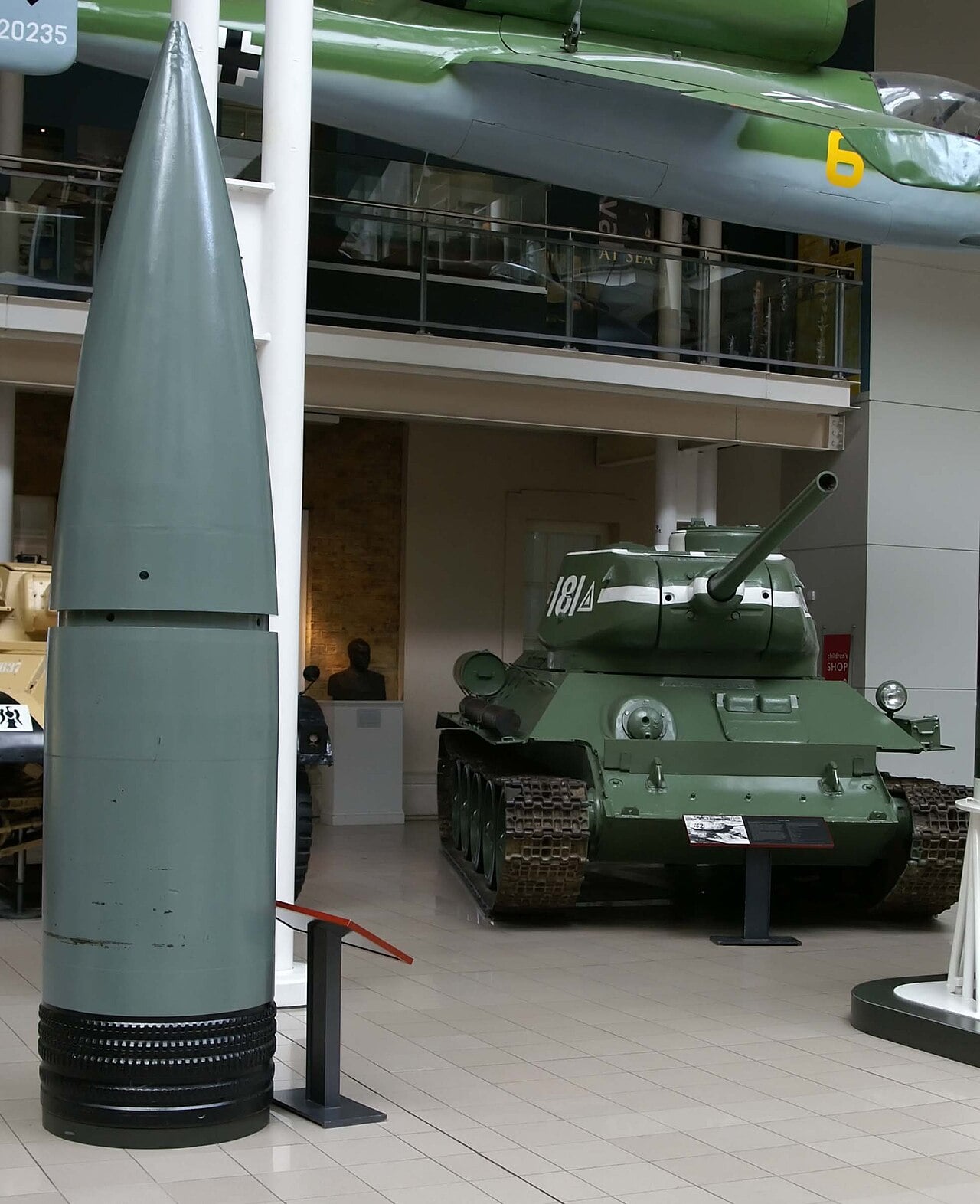
- Shells: High explosive about 4.8 t (range about 47 km); concrete-piercing about 7.1 t (range about 38 km)
- Men: About 250 to serve the gun; its unit, Abteilung (E) 672, numbered about 1,420; thousands more prepared the site
- Combat use: Sevastopol, 5–17 June 1942: 47 or 48 rounds, depending on the source
- Fate: Destroyed in April 1945; remains found by US troops in Bavaria and scrapped
A gun built for the Maginot Line
Gustav was born out of a French problem. In the mid-1930s the German Army wanted a weapon that could smash the heaviest forts of the Maginot Line, the chain of concrete and steel defences along France’s eastern border. Krupp was asked to design a gun that could pierce about seven metres of reinforced concrete or a metre of armour steel. According to Krupp-based accounts, Hitler asked about such a gun on a visit to the works in Essen in 1936. Design work began, and the army ordered three guns, planned for delivery from 1940.
The engineering was extreme. To push a seven-tonne shell 38 kilometres, the barrel had to be over 30 metres long, with a breech and carriage on the scale of a small building. Nothing that size could travel assembled on an ordinary railway. The gun had to be taken apart, carried in pieces on dozens of rail wagons, and rebuilt on site with two large gantry cranes. A firing position meant laying a special curved double track, because the gun was aimed left and right by moving along the curve.
By the time the first barrel was ready, at the end of 1940, the Maginot Line was already in German hands. It had been bypassed in May and June 1940 by panzers and Ju 87 dive bombers, not broken by guns. Gustav was tested at the Hillersleben and Rügenwalde ranges, and Hitler and Albert Speer watched a demonstration at Rügenwalde on the Baltic coast. A plan to use it against Gibraltar came to nothing. The army needed a new target, and it found one in the Crimea.
Sevastopol: the fortress and the siege
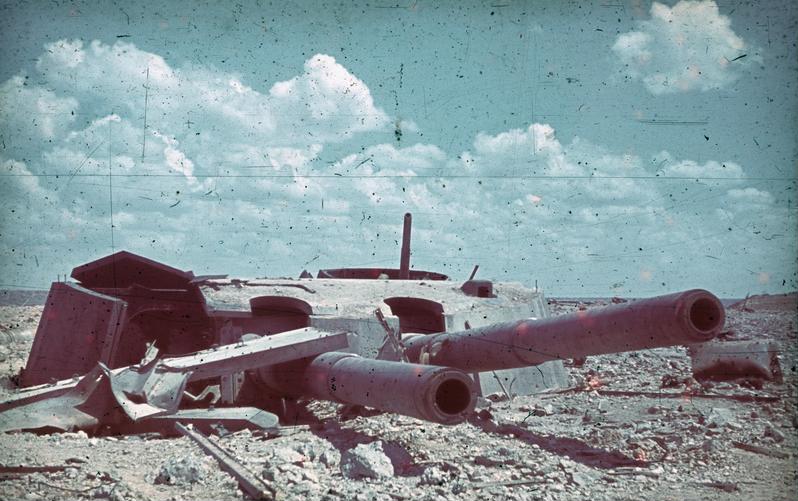
Sevastopol was the base of the Soviet Black Sea Fleet and one of the strongest fortresses in the world. Its defences included rings of bunkers and two great coastal forts, which the Germans called Maxim Gorky I and II. Their armoured turrets held 30.5 cm naval guns. General Erich von Manstein’s Eleventh Army had failed to take the city in late 1941. In June 1942 it tried again, in an assault code-named Störfang, or Sturgeon Catch.
Manstein gathered more heavy artillery than Germany had massed anywhere in the war. In his memoir he counted 208 batteries, not including anti-aircraft guns, along a front of about 22 miles. They ranged from 19 cm cannon to 42 cm howitzers, two 60 cm Karl self-propelled mortars and, at the top of the list, Gustav. He was impressed by the gun and honest about it.
Getting the gun into position was a small campaign of its own. Its unit, Schwere Artillerie-Abteilung (E) 672, had about 1,420 men, including an anti-aircraft detachment. Thousands more, among them Soviet prisoners and local labourers, dug the cutting and laid the track in May 1942. Figures based on the historian Steven Zaloga’s work give about 1,500 Soviet and 1,000 German workers prepared the site. Manstein remembered that sixty trains had been needed and that two anti-aircraft regiments had to stay with the gun. The pieces arrived by 1 June, and the gun was ready to fire on 5 June.
Forty-eight shells
Between 5 and 17 June, Gustav fired at seven targets. A widely used firing log, published by the South African Military History Society from German records, lists eight rounds against coastal batteries on 5 June. Next came Fort Stalin, Fort Molotov and the “White Cliffs”, an underground ammunition store on the northern shore of Severnaya Bay. Later targets were the south-west strongpoint, Fort Siberia on 11 June and Fort Maxim Gorky on 17 June. The log adds up to 47 shells. Other sources give 48, the figure often quoted for the ammunition available.
The results were mixed at best. A shell weighing seven tonnes, fired from 25 to 40 kilometres away, had to land almost exactly on a small target to crack a fort. Some shells did. According to the firing log, the ninth round at the White Cliffs hit the magazine. Manstein, too, believed that one of Gustav’s shells destroyed “a big enemy ammunition dump buried 90 feet deep in the natural rock on the northern shore of Severnaya Bay.” Many shells, however, are recorded as misses, including all five fired at Fort Maxim Gorky. Later historians have been more sceptical than the gunners were.
By mid-June the barrel was worn out. Counting its trials, it had fired around 300 rounds, and the rifling could not take much more. Gustav went back to Germany for a new barrel. It never fired in battle again. Sevastopol fell in early July, but by then the gun had been silent for more than two weeks.
The sky over Sevastopol
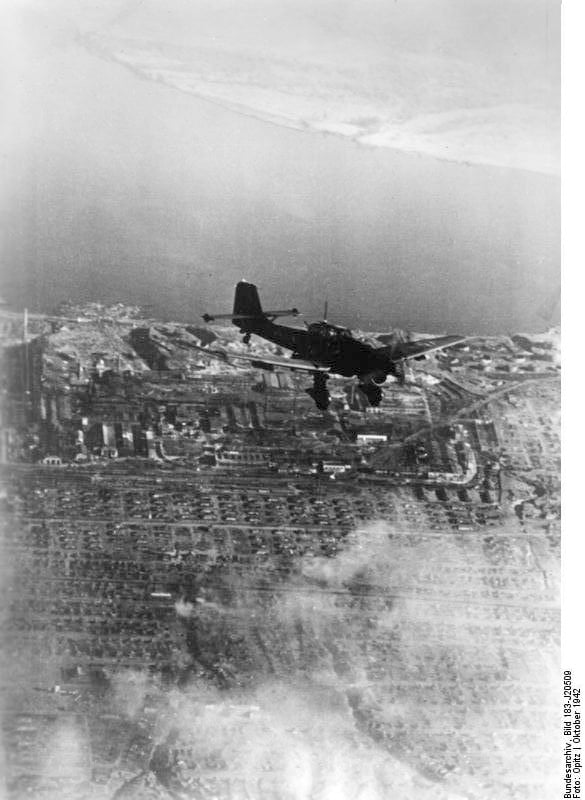
While Gustav was firing a few shells a day, the Luftwaffe was delivering explosive on a scale no gun could match. VIII. Fliegerkorps, under Generaloberst Wolfram Freiherr von Richthofen, had about 600 aircraft for the assault. It flew Junkers Ju 87 Stuka dive bombers, Ju 88 and Heinkel He 111 bombers, and Messerschmitt Bf 109 fighters. According to the historian Joel Hayward, they flew 723 sorties on 2 June alone and dropped 525 tonnes of bombs.
The numbers kept climbing. Christer Bergström and Andrey Mikhailov give a total of 23,751 sorties from 2 June to 3 July, and about 20,500 tonnes of bombs. Crews flew up to 18 short sorties a day, because the targets were only minutes from their airfields. The Soviet air units inside the fortress began the battle with no more than 53 serviceable aircraft. Stuka crews of StG 77 alone flew more than 7,700 sorties.
Set those figures beside Gustav’s. Even if every one of its 48 shells had been a 7.1-tonne concrete-piercer, the gun fired about 340 tonnes of steel and explosive in total. By MiGFlug’s arithmetic, the bombers dropped roughly 60 times that weight in the same battle. They could also strike anywhere in the fortress, return the same day and hit the target again. Manstein, an infantry officer to the core, gave the airmen their due.
A giant that needed the sky to itself
There was a second lesson, less obvious than tonnage. Gustav could only work because the Luftwaffe owned the sky. A gun that took weeks to set up, stood on a fixed track and could be traced by its own railway was the perfect target for bombers. That is why two anti-aircraft regiments guarded it, and why it was placed only where German air superiority was assured. At Sevastopol the Soviet air units were too weak to find it, let alone destroy it.
Gustav was, in other words, a weapon that depended on the very thing that made it unnecessary. If you controlled the air, your bombers could do its job. If you did not, the gun and its long trains of parts could not survive. Air reconnaissance, which had already changed artillery spotting in the First World War, made such a large fixed target easy to find. For more on that, see MiGFlug’s chapter on military reconnaissance, from aircraft to satellites.
Mark Felton tells the story of Schwerer Gustav, from Krupp’s drawing board to Sevastopol and the wreckage of 1945. Video: Mark Felton Productions.
Leningrad, Warsaw and the end in Bavaria
After Sevastopol, Gustav was sent north to the Leningrad front, where it was assembled but never fired. Even the number of guns is debated. Some historians count two finished guns, Gustav and Dora, while others treat “Dora” as a nickname for Gustav itself; Manstein called the Sevastopol gun Dora. Either way, no second gun has a confirmed combat record. Stories that it was sent towards Stalingrad, or that either gun shelled Warsaw during the 1944 uprising, have not been confirmed. The heavy guns that did fire on Warsaw were the smaller 60 cm Karl mortars. A third gun was never completed.
In April 1945, with American forces advancing into Bavaria, the guns were blown up, according to most accounts by German troops, so that they could not be captured. US troops found the wreckage near Auerbach and Grafenwöhr, photographed it, and the remains were later broken up for scrap. Shells, cartridge cases and scale models can be seen today in museums such as the Militärhistorisches Museum in Dresden and the Overloon War Museum in the Netherlands. Gustav takes its place beside the other giant projects described in MiGFlug’s feature on Nazi wonder weapons, from Gustav to the P1500.
Ten tonnes from the sky
Two years after Sevastopol, the Royal Air Force showed what aircraft could do with a single huge weapon. Barnes Wallis, designer of the bouncing bomb, built the Tallboy, a 12,000 lb (about 5.4 tonne) deep-penetration bomb. On the night of 8 June 1944, No. 617 Squadron’s Avro Lancasters used it for the first time, blocking a railway tunnel at Saumur in France. Later Tallboys shattered E-boat pens, damaged U-boat pens and wrecked V-weapon sites. On 12 November 1944 they capsized the battleship Tirpitz in Norway.
Then came Grand Slam: 22,000 lb, or about 9,980 kg, the heaviest conventional bomb used in the Second World War. It was first dropped on the Bielefeld railway viaduct on 14 March 1945, when a near miss brought down two spans. In 1945, 41 were dropped. Each one was heavier than any shell Gustav ever fired. It was carried by a single modified Lancaster, from bases in Lincolnshire hundreds of kilometres from the target. Gustav could reach about 47 kilometres, and only from a track that took weeks to build.
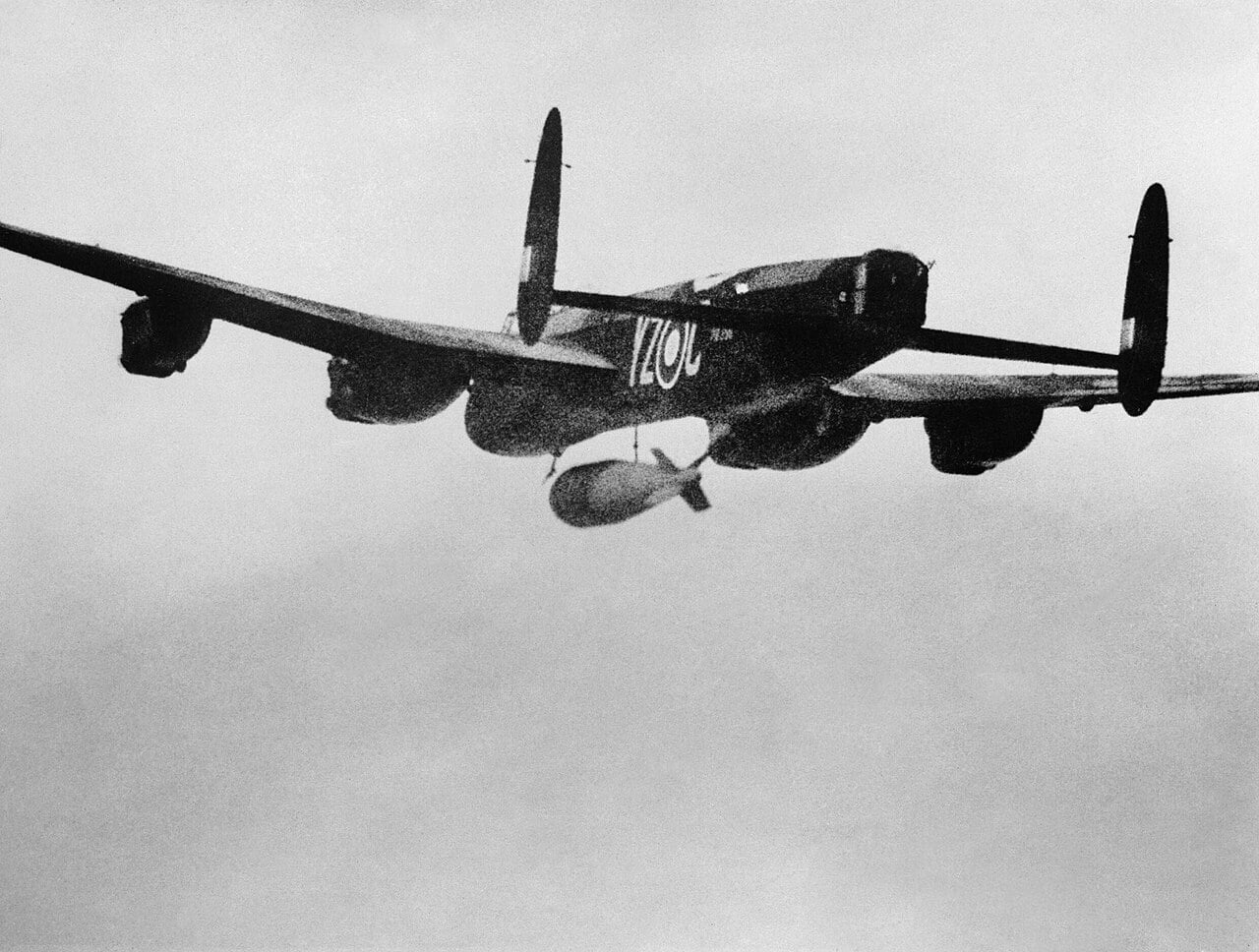
Aircraft were not perfect. Bombers were shot down, and bombs missed. To hit with Tallboy, 617 Squadron marked its targets at low level, with its commander, Leonard Cheshire, at one point flying a P-51 Mustang to do it. Their historian put the point plainly.
A 1945 British Movietone newsreel on the RAF’s ten-ton Grand Slam bomb and the Lancasters that carried it. Video: British Movietone.
Why there was never another Gustav
Gustav was a triumph of engineering and a dead end in military thinking. It weighed about 1,350 tonnes, needed well over a thousand soldiers and weeks of work for each firing position, and fired fewer than 50 shells in combat. In the same battle, aircraft delivered around 60 times the explosive, at any point in the fortress, day after day. By 1945 a single Lancaster could carry a bomb heavier than Gustav’s heaviest shell deep into Germany.
The trend Sevastopol hinted at has never reversed. Artillery remains vital on the battlefield, but the job of breaking the hardest targets far behind the lines passed to aircraft and, later, to guided bombs and missiles. Modern laser-guided and satellite-guided bombs put a few hundred kilograms of explosive within metres of their aim point, an accuracy Gustav never had. That story is told in MiGFlug’s Wings of War chapter on the precision revolution. The biggest gun ever fired in anger was not beaten by a bigger gun. It was overtaken by the aeroplane.
Sources: Erich von Manstein, Lost Victories, translated by Anthony G. Powell (Methuen, 1958); South African Military History Society, Heavy Gustav: The Story of a Gun, Military History Journal Vol. 12 No. 4; Steven J. Zaloga, Railway Guns of World War II (Osprey, 2016); Gerhard Taube, Eisenbahngeschütz DORA: Das größte Geschütz aller Zeiten (Motorbuch, 1979); Ian V. Hogg, German Artillery of World War Two (Greenhill, 1997); Robert Forczyk, Sevastopol 1942: Von Manstein’s Triumph (Osprey, 2008); Joel S. A. Hayward, Stopped at Stalingrad: The Luftwaffe and Hitler’s Defeat in the East, 1942–1943 (University Press of Kansas, 1998); Christer Bergström and Andrey Mikhailov, Dueling Aces in Sevastopol, Warfare History Network; Christer Bergström, Stalingrad: The Air Battle (Ian Allan, 2007); J. Rickard, 80cm Kanone (Eisenbahn), History of War (25 July 2018); Forces News, Hitler’s 1,350-tonne super gun intended to destroy France in WW2 (25 November 2023); Robert Owen, After the Dams Raid, Royal Air Force Museum podcast transcript (2013); Guinness World Records, Largest conventional bomb by weight; Imperial War Museums, photographs CH 15375 and CH 15378; Bundesarchiv, photographs N 1603 Bild-117 and Bild 183-J20509; Militärhistorisches Museum der Bundeswehr, Dresden, 80 cm Kanone (E) ammunition display.
Frequently Asked Questions
What was Schwerer Gustav?
How heavy were Schwerer Gustav’s shells?
How many shots did Schwerer Gustav fire at Sevastopol?
How many men did it take to operate Schwerer Gustav?
Was Schwerer Gustav used at Stalingrad or Warsaw?
Why did aircraft make giant guns like Gustav obsolete?
Related Posts


0 Comments