
The landing ship off Iwo Jima in February 1945 had no flight deck, no catapult and no runway. What it had was a long steel boom swung out over the side, a cable strung beneath it, and a small observation plane hanging from that cable by a hook on its roof.
This was the Brodie landing system, one of the strangest pieces of aviation hardware of the Second World War. Instead of landing on something, the aircraft flew underneath a wire, snagged it with an overhead hook and came to a stop dangling in mid-air. To take off, it simply ran along the wire and let go.
It sounds like a cartoon contraption. It worked, it went to war, and its inventor received the Legion of Merit for it.
Quick Facts
- What: Overhead-cable launch and recovery system for light aircraft
- Inventor: James H. Brodie, US Army officer from New Orleans
- Aircraft: Piper L-4 Grasshopper, Stinson L-5 Sentinel and the Marine OY-1
- First sea trial: September 1943, merchant ship City of Dalhart: ten successful launches and recoveries
- Ships: Tank landing ships including LST-776, LST-393 and LST-325
- Combat: Iwo Jima (first combat trial 27 February 1945, per the CAF) and Okinawa, 1945
- Patent: US 2,435,197, filed 4 October 1944, granted 3 February 1948
- Award: Legion of Merit for Brodie and test pilot Raymond Gregory, 1945
A runway that hangs in the air
The system was devised by James H. Brodie, a US Army officer from New Orleans who served in the Transportation Corps before moving to the Army Air Forces. His starting problem was simple: light liaison aircraft such as the Piper L-4 Grasshopper and the Stinson L-5 Sentinel were invaluable for spotting artillery and carrying messages, but they still needed somewhere to land.
Those little planes did far more than their size suggested. Army liaison squadrons used them to deliver people, intelligence and supplies to the front line and to carry wounded soldiers back to field hospitals, while Marine Corps observation squadrons flew them over the Pacific islands. Giving them a home where no airstrip could exist was a real military prize.
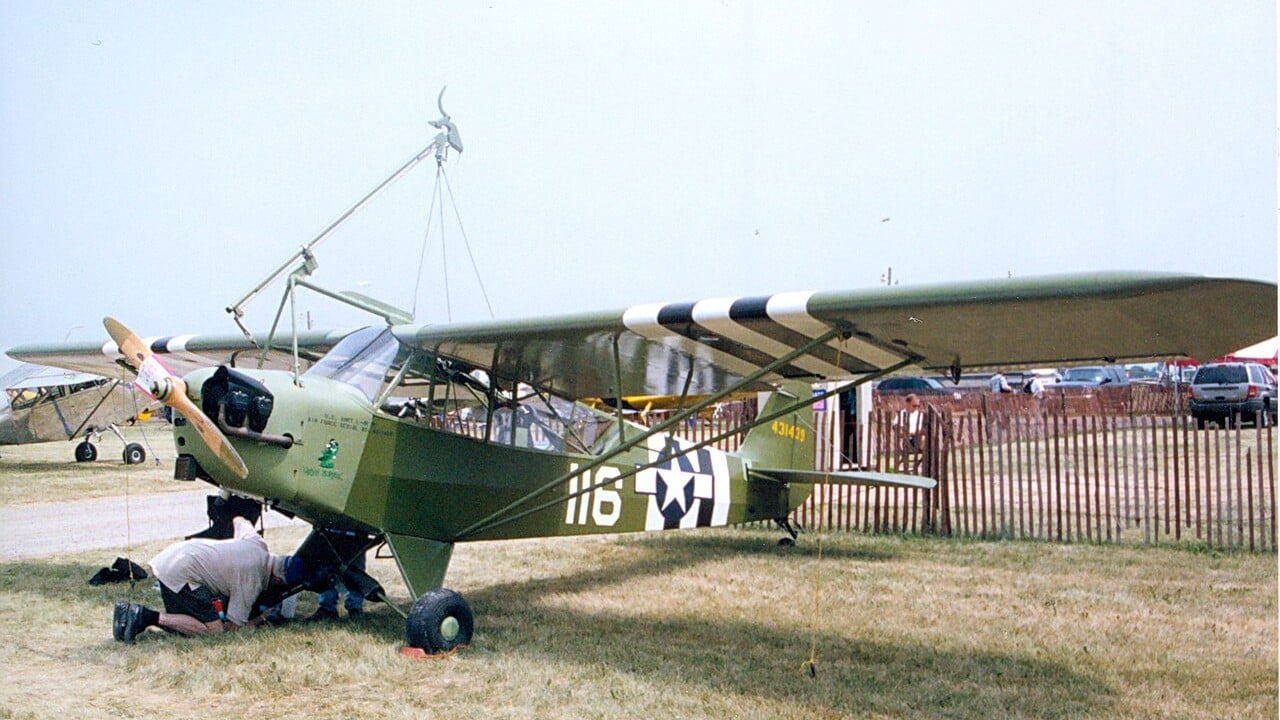
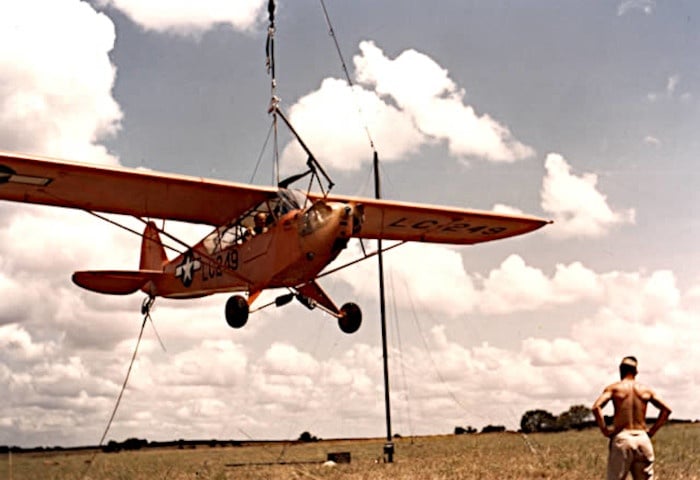
Brodie’s answer was to replace the runway with a cable stretched between towers. A trolley ran along it, and a sling hung beneath. The aircraft carried a hook frame mounted above the wing. The pilot flew in low and slow beneath the cable, caught the sling with the hook, and the trolley’s braking brought the plane to a halt.
Take-off reversed the process. Hanging from the trolley, the aircraft accelerated along the cable under its own engine power until it was flying, then released. Brodie’s 1944 patent application stressed that no separate source of power was needed to launch the plane, unlike other launching devices of the day.
From convoys to jungle clearings
Brodie originally envisioned the rig as a way to give Atlantic convoys anti-submarine air cover without converting ships into carriers. It also promised to let liaison planes work from dense jungle or mountain terrain where no airstrip could be built.
His patent, filed on 4 October 1944 and granted in February 1948, set out the case. The apparatus could be installed on a ship or set up in almost any terrain, it could be knocked down, moved and even dropped by parachute into inaccessible places, and for military use it was hard to see from above, easy to camouflage and a difficult bombing target.
The Piper Aviation Museum’s film on testing the Brodie device with a Piper Cub.
After a demonstration at Moisant Field in New Orleans, the system went to sea. In September 1943 it was installed on the merchant ship City of Dalhart, and Staff Sergeant R. A. Gregory made ten successful take-offs and hook-ups with a Stinson L-5, although in ideal weather and calm seas. Land rigs were also tested by the Army in Louisiana, the Navy in California and the Office of Strategic Services in Maryland, and the system was demonstrated to the British in India, who did not adopt it.
Off Iwo Jima and Okinawa
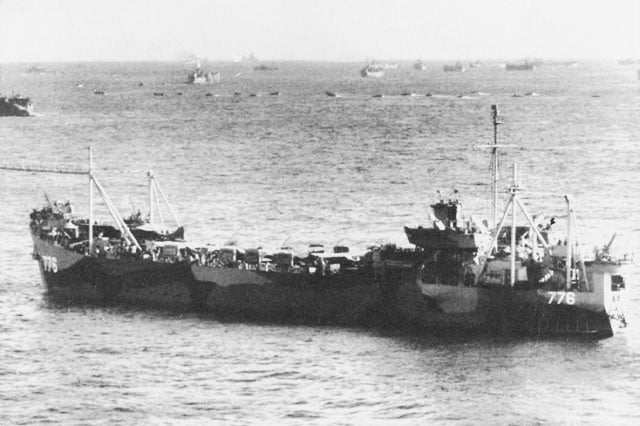
The Navy fitted the Brodie rig to tank landing ships, LST-776, LST-393 and LST-325 among them. The rig ran along one side of the ship, so planes could be launched and recovered without using any part of the deck.
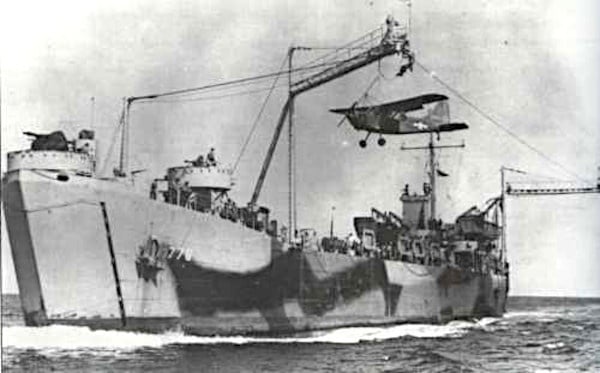
Its combat debut came at Iwo Jima. The Commemorative Air Force dates the system’s first trial in combat to 27 February 1945, with Marine Corps OY-1 Sentinels, the Navy version of the L-5, operating from LST-776 as artillery spotters.
The Commemorative Air Force on the Brodie system’s first trial in combat, on 27 February 1945.
A few weeks later, during the Okinawa campaign, Army L-4 Grasshoppers flew missions from the same ship. The Smithsonian’s National Air and Space Museum credits the Brodie system with a notable contribution in the run-up to the assault on Okinawa.
Why it did not last
The sea was the problem. A cable rig that worked beautifully on land or in calm water was far harder to use when a landing ship was pitching and rolling, and several OY-1s were lost to the motion of the ship. The Navy concluded that the device was better suited to fixed installations ashore.
For the planned invasion of Japan, the Navy ended its Brodie programme and allocated escort carriers to carry liaison planes instead. The war ended before that invasion ever came.
Brodie and his test pilot, Flight Officer Raymond Gregory, were awarded the Legion of Merit in 1945. Brodie kept working on the idea and imagined bigger versions able to catch aircraft as heavy as 7,000 pounds. He received several US patents for variations of the landing system.
The Smithsonian National Air and Space Museum shows the first production Stinson L-5, fitted with the Brodie system, at the Udvar-Hazy Center.
Still hanging at Udvar-Hazy
The very first production Stinson L-5, now at the Smithsonian’s Steven F. Udvar-Hazy Center in Virginia, still wears its Brodie hook frame above the cabin. It is one of the few places where anyone can see the hardware up close. Afterburner told the wider story of that aircraft in Stinson L-5 Sentinel: The Flying Jeep That Carried the Wounded, and of the Cub family behind the L-4 in Piper J-3 Cub: The Yellow Trainer That Taught America to Fly.
The Brodie system never became a standard tool. But the problem it attacked, how to put aircraft to sea without a full carrier, kept coming back, from the CAM ships that came before it to the helicopters and drones that fly from small ships today. For a few weeks in 1945, the answer was a wire, a hook and a great deal of nerve.
Sources: US Patent 2,435,197 (James H. Brodie, Landing and Launching Apparatus for Aircraft), Smithsonian National Air and Space Museum, Smithsonian Institution Archives, Commemorative Air Force, Piper Aviation Museum, US Navy
Header photo: FlugKerl2 / Wikimedia Commons, CC BY 3.0

0 Comments