
Every airborne early warning aircraft in the world looks broadly the same: a transport or an airliner with an enormous rotating dish balanced on struts above the fuselage. The Hawkeye does it. The Sentry does it. Even GlobalEye, which uses a fixed array rather than a spinning dish, puts it on top of the fuselage.
The Antonov An-71 put the dish on the tail fin. Not near it, not beside it: bolted to the top of a vertical fin that had been swept forward specifically so it could hold a radar.
NATO called it Madcap. Three were built. It is one of the strangest-looking aeroplanes of the Cold War, and every element of that shape is the logical answer to a problem the designers were handed.
Kurzinfo
| Flugzeug | Antonov An-71, NATO reporting name Madcap |
| Rolle | Tactical airborne early warning and control |
| Developed from | Antonov An-72 transport |
| Development began | 1982 |
| Erster Flug | 12 July 1985, flown by Alexander Tkachenko |
| Gebaut | Three prototypes |
| Crew | Six mission operators plus flight crew |
| Radar | Vega-M Kvant, reportedly tracking up to 120 targets with a range around 200 km against a 2 m² target |
| Motoren | Two Progress D-436K turbofans |
| Maximum speed | 650 km/h (400 mph) |
| Service ceiling | 10,800 m (35,400 ft) |
| Schicksal | Cancelled with the collapse of the Soviet Union; one preserved at the Ukraine State Aviation Museum, Kyiv |
Why the Soviet Union needed a second AWACS
The reason the An-71 exists at all is bureaucratic rather than technical, and it is the sort of thing that only happens in very large military organisations.
Soviet air power was split. Frontal Aviation flew tactical fighters and attack aircraft supporting field armies. The PVO, the Air Defence Forces, was a separate service entirely, responsible for defending Soviet territory, and it was not part of the air force. Because it had a continent to watch, the PVO got the big radar aircraft: first the Tupolev Tu-126, then the Beriev A-50 that Russia still flies.
Frontal Aviation had none. It watched the PVO field the A-50 and decided it wanted its own, smaller, tactical version. Whether that was a genuine requirement or an interservice land grab is not documented, and reasonable people have suspected both.
Work began in 1982. The airframe chosen was the An-72, then in advanced development, and that choice is where the aeroplane's appearance comes from.
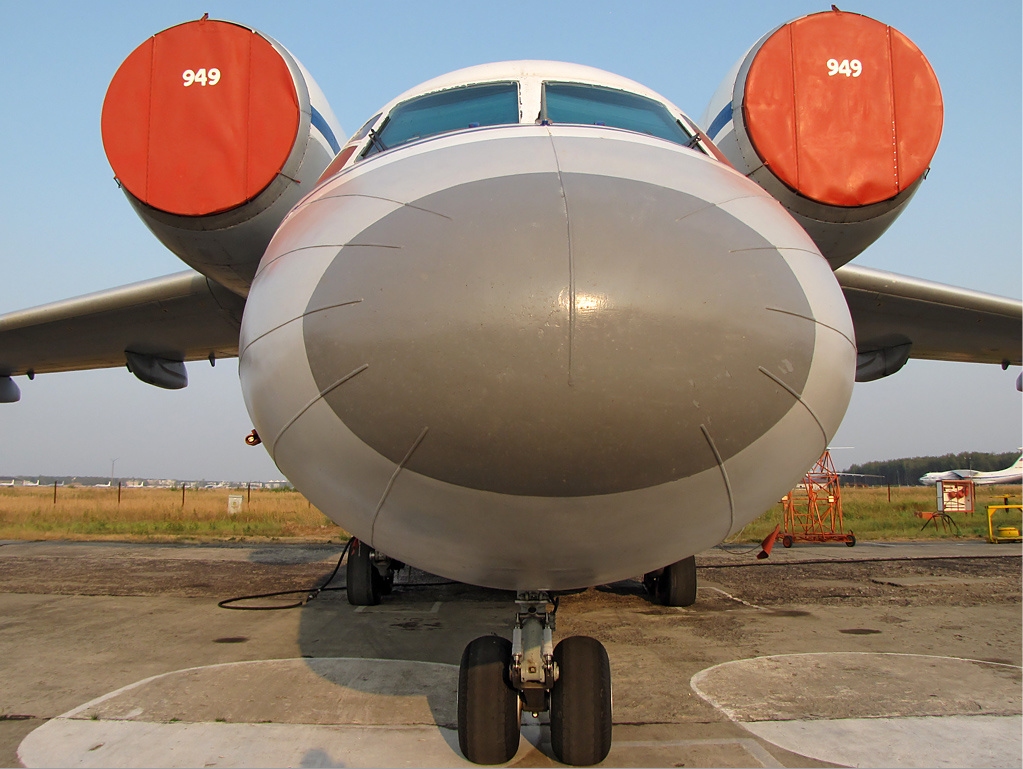
The engines were in the way
The An-72 mounts its two turbofans above the wing rather than under it. That is deliberate and clever. It keeps the intakes away from stones and debris on the rough airstrips the aircraft was designed for, and it lets the exhaust blow across the upper wing surface, using the Coandă effect to increase lift and shorten the take-off run dramatically.
It also puts two jet efflux streams exactly where an AWACS rotodome wants to be.
A dish on pylons above the mid-fuselage of an An-72 would sit in hot, turbulent exhaust, with the engine nacelles and pylons blocking the beam at precisely the angles you most want to see. You would have an early warning aircraft with blind spots pointing forwards.
So the designers moved the radar as far aft and as high as they could get it. The rear fuselage was completely redesigned. The vertical fin was rebuilt as a broad-chord, forward-swept structure strong enough to carry a rotodome at its tip, which put the antenna above and behind everything else on the aircraft with a clean view all round.
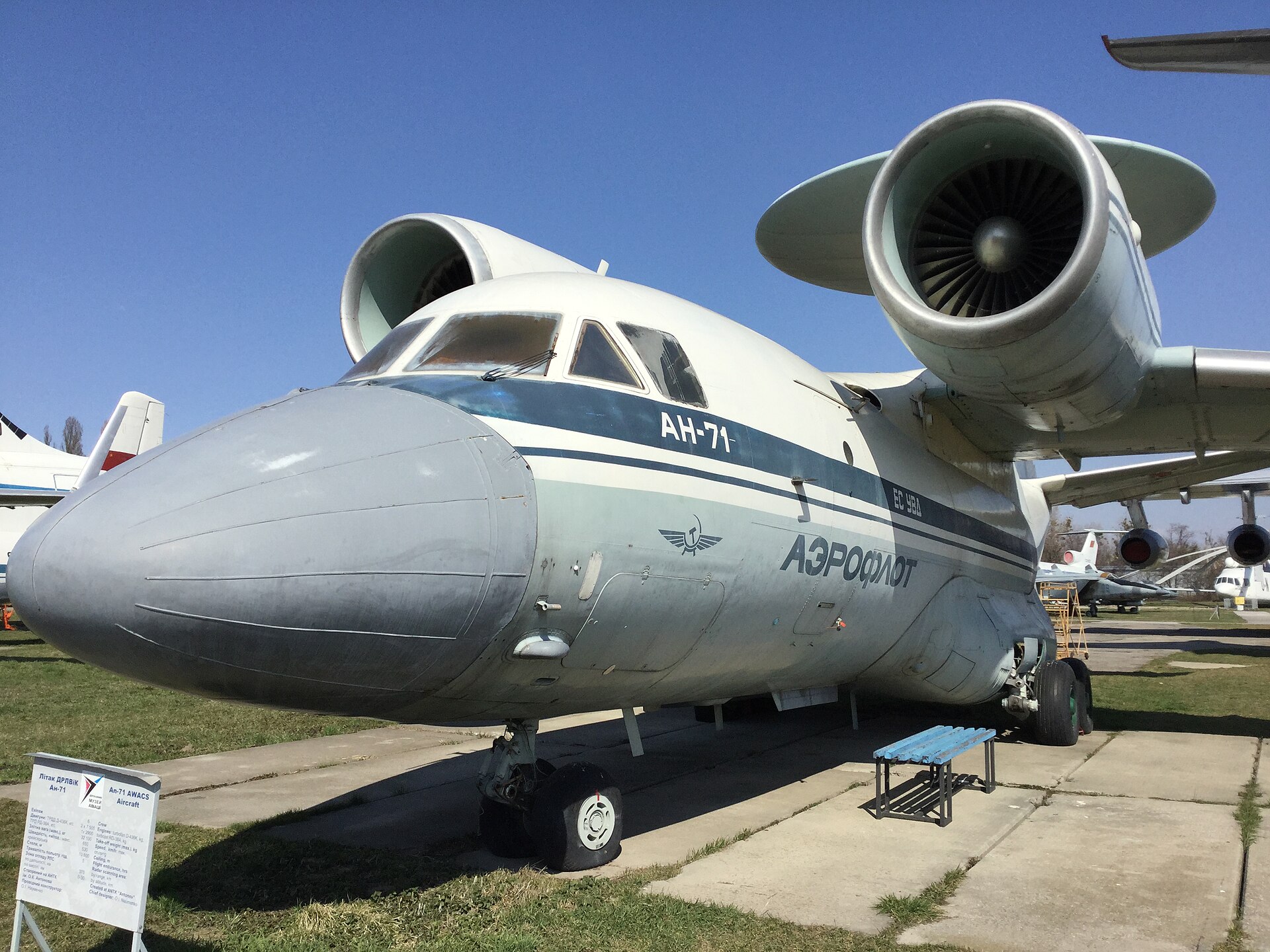
Forward sweep on a fin is unusual but not arbitrary. Sweeping it forward moves the mass of the rotodome ahead of where a conventional swept fin would put it, which keeps the centre of gravity manageable and shortens the structural load path. It is an ugly solution that is doing several jobs at once, which is generally the definition of good engineering.
Inside, and what it could do
The An-72's cargo hold became the mission compartment, with six operator stations. The radar was the Vega-M Kvant, reportedly capable of tracking up to 120 targets simultaneously with a detection range in the region of 200 kilometres against a target with a two square metre radar cross-section.
Those are respectable numbers for a tactical aircraft of the mid-1980s, and the concept was sound: a short-field-capable radar aircraft that could operate from the same rough forward strips as the fighters it was directing, rather than from a long runway hundreds of kilometres to the rear.
The first aircraft flew on 12 July 1985, with Alexander Tkachenko at the controls. A second joined the programme the following year, and testing of the radar and electronic systems began in May 1986.
The radar never worked properly
Details of what went wrong are thin, and Soviet development programmes did not generate public post-mortems. What is consistently reported is that the Kvant radar's problems could not be resolved, and that development dragged on for years while engineers worked at them.
This is not surprising. The hard part of an AWACS has never been the aeroplane. It is the radar's ability to pick a low-flying aircraft out of the enormous return coming back off the ground beneath it, and then to keep track of it while the antenna, the target and the clutter are all moving. The Soviet electronics industry was not where it needed to be for that, and the An-71's tactical role over land was the hardest version of the problem.
Then the Soviet Union dissolved, and the programme dissolved with it. Antonov was in Kyiv; the customer had ceased to exist.
The carrier myth
You will read in a great many places that the An-71 was built as a carrier-borne AWACS for the Soviet Navy. It was not, and the error is old enough to have its own history.
Western analysts saw a small, short-field radar aircraft appear at the same moment the Soviet Union was building its first proper aircraft carriers, and drew the obvious conclusion. The obvious conclusion was wrong. The An-71 was a Frontal Aviation aircraft designed to work overland with tactical fighters.
There was a naval derivative, briefly. The An-75 was proposed for the carriers under construction, with the engines moved beneath the wing rather than above it and a long list of other structural changes. Soviet Naval Aviation worked out that so little would be left of the original design that it was not worth doing, cancelled it, and went looking for a purpose-built aircraft instead.
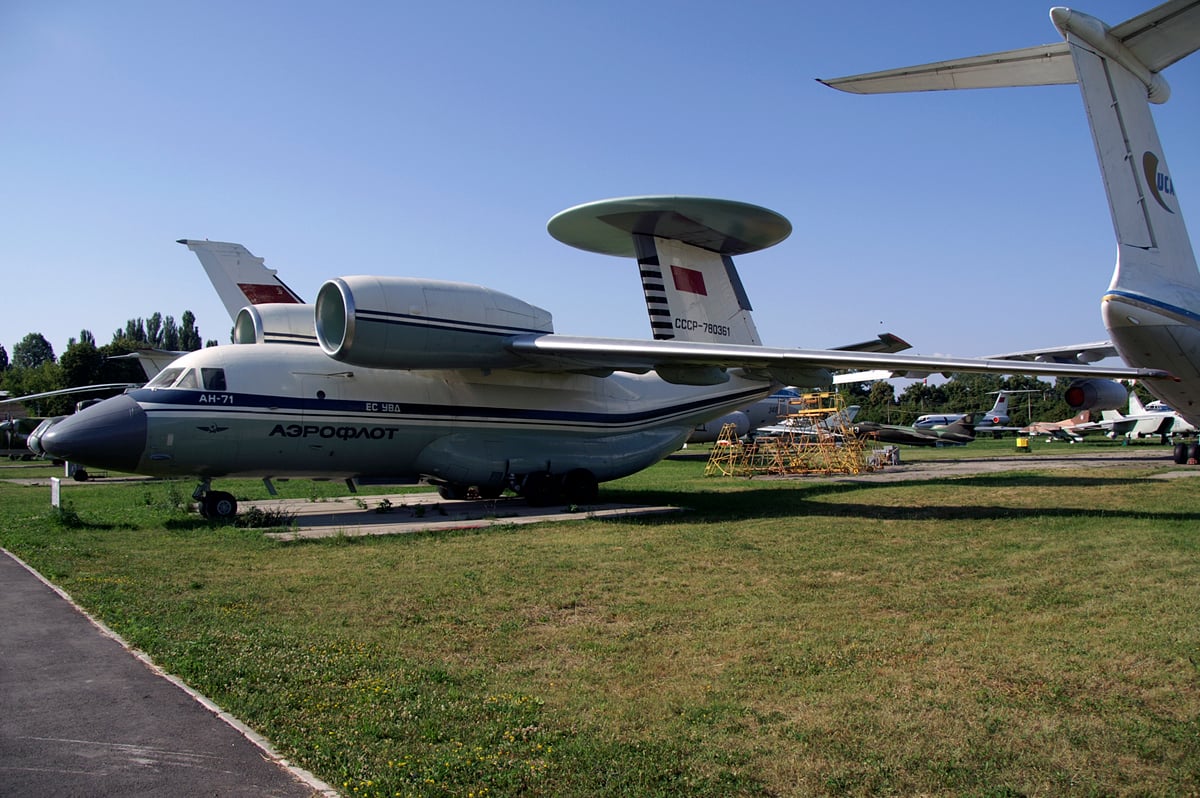
One An-71 survives on display in Kyiv, sitting on its nosewheel with that improbable fin above it, looking like an aircraft designed by somebody who had heard an AWACS described but never seen one.
It was not madness. It was what you get when you take a very good short-field transport, hand it an incompatible payload, and refuse to start again.
Häufig gestellte Fragen
Why did the Antonov An-71 have its radar on the tail fin?
Was the An-71 Madcap designed for aircraft carriers?
How many An-71s were built?
Why did the An-71 programme fail?
Why did the Soviet Union need the An-71 when it already had the A-50?
What radar did the An-71 carry?
Does any An-71 still exist?
Sources: Yefim Gordon and Dmitriy Komissarov, Soviet/Russian AWACS Aircraft (Red Star Vol. 23); Military Matters; Vintage Aviation News; Ukraine State Aviation Museum.
0 Comments