
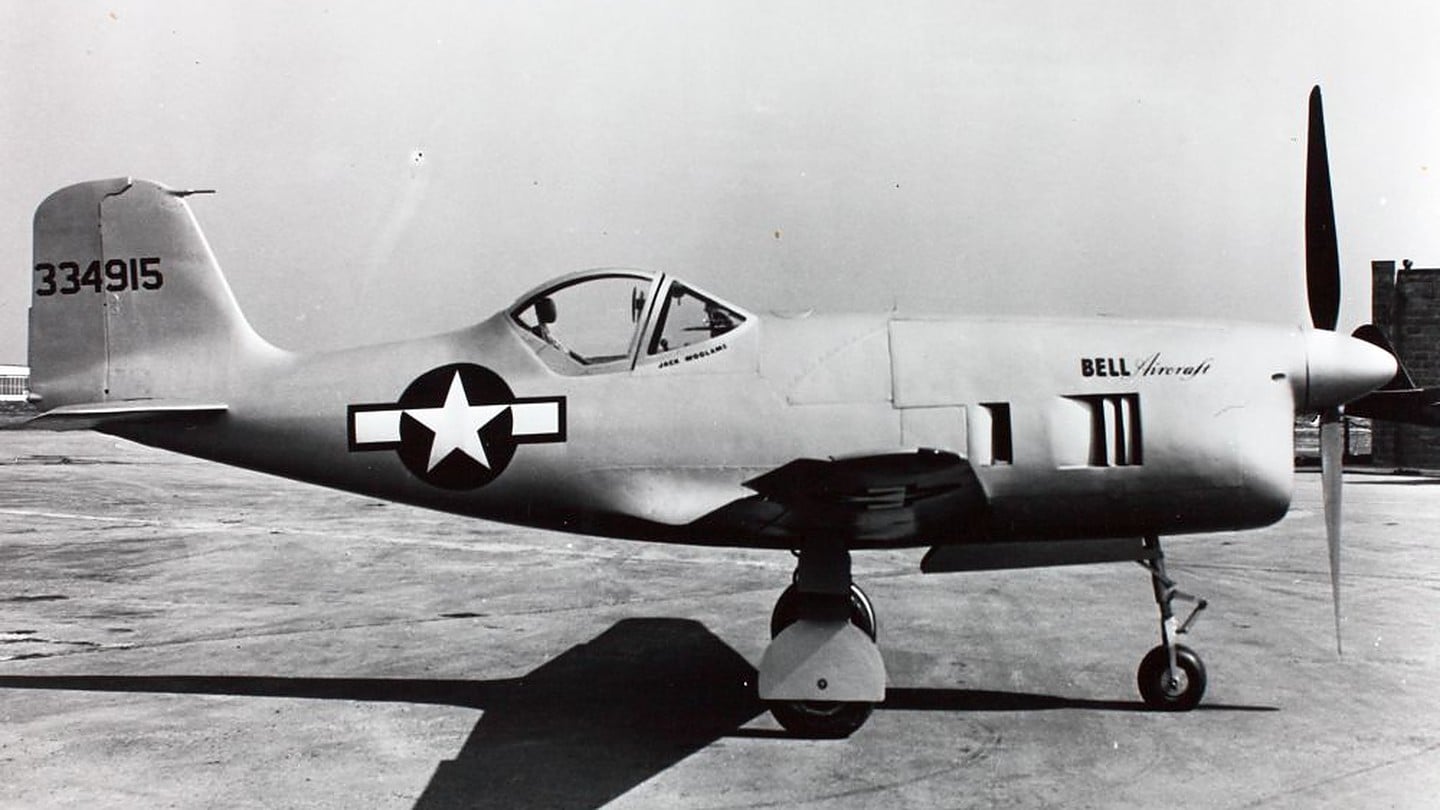
In 1941 the US Army Air Forces asked a sensible question. What if aluminium ran short, and what if the enemy could be fought with something small, cheap and made of wood?
Bell answered with the XP-77: a fighter the size of a racing aeroplane, built largely of timber, weighing about as much as a loaded family car. Two were built. One of them killed itself over Florida while attempting an Immelmann.
Kurzinfo
| Flugzeug | Bell XP-77 (company designations Tri-4, later D-6) |
| Konzept | “Very light” interceptor of non-strategic materials — principally wood |
| Project started | October 1941 |
| Originally ordered | 25 aircraft, recommended 16 May 1942; cut to two |
| Erster Flug | 1 April 1944, at Wright Field |
| Motor | Ranger V-770-7 inverted V12, 520 hp, unsupercharged |
| Spannweite | 27 ft 6 in (8.38 m); empty weight 2,855 lb (1,295 kg) |
| Höchstgeschwindigkeit | 330 mph (530 km/h) |
| Schicksal | Second prototype destroyed 2 October 1944; programme ended December 1944 |
A fighter modelled on an air racer
The XP-77 was explicitly conceived in the mould of the 1930s Thompson Trophy racers: tiny, clean, and built around the idea that if you keep the aeroplane small enough you do not need much engine.
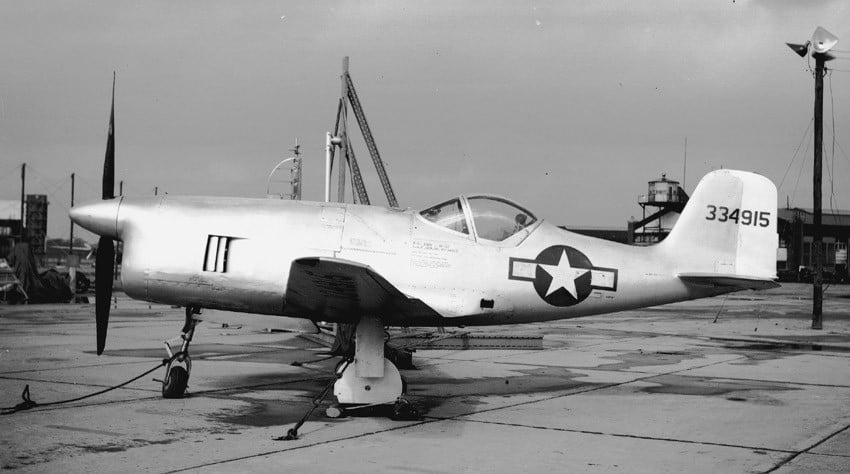
It was a low-wing monoplane of mainly wooden construction, with tricycle landing gear — a Bell signature, shared with the P-39 Airacobra — and a bubble canopy set well back behind a long nose. The planned armament was a 20 mm Hispano cannon firing through the propeller hub, in the Airacobra manner, plus two .50 calibre Brownings.
On paper it was charming. In the metal, or rather in the plywood, everything went wrong slowly.
The engine that never arrived
The design assumed a supercharged Ranger XV-770-9 of 500 hp. That engine slipped by roughly eighteen months, so the prototypes flew with the unsupercharged XV-770-7 instead. An interceptor without a supercharger is a contradiction in terms: superchargers are what let a fighter keep making power at the altitude where interception happens.
Meanwhile the airframe was gaining weight against a 3,700 lb design limit, and Bell had subcontracted the woodwork because its own shops were full of Airacobras. A change of wing subcontractor turned ugly when the first refused to release parts. Then came doubts about the glue, and whether wooden structures could be trusted to hold together.
At the mockup inspection in September 1942 the concerns were serious enough that Bell asked to cut the order from 25 aircraft to two. The USAAF agreed, and from that point the programme existed only to learn whether wooden combat aircraft were viable at all.
Dark Skies on the XP-77, America’s wooden emergency fighter.
Two and a half years late, and shaking
The first XP-77 finally flew on 1 April 1944 at Wright Field, by which time the aluminium shortage that justified it had not materialised and the war was being won with metal aeroplanes.
It vibrated badly, because the engine had been bolted directly to the airframe with no vibration isolation. The long nose and rear-set cockpit made it awkward to see out of. And it was slow. Even stripped of guns and armour it did not reach its predicted performance, for the simple reason that it was underpowered.
An Immelmann too far
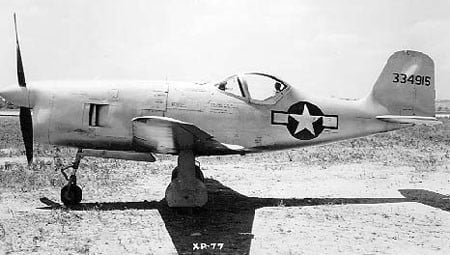
Testing moved to the USAAF Proving Ground at Eglin Field with the second aircraft. On 2 October 1944 it entered an inverted spin while attempting an Immelmann turn and did not recover. The pilot bailed out. The aeroplane was destroyed.
All development stopped in December 1944.
The surviving prototype had the saddest ending available to an aeroplane. It went from Wilbur Wright Field to Eglin and back to Wright, appeared at airshows, and was eventually posted to an air base as a gate guard. It stood outside for years, slowly rotting, until somebody burned it.
What the XP-77 was actually for
It is easy to read this as a straightforward failure, and by any performance measure it was. But the lightweight-fighter idea it embodied has never gone away. It came back as the Folland Gnat, as the F-5, as the whole lightweight fighter mafia argument that produced the F-16, and it is back again now in the form of cheap attritable drones designed to be built in large numbers from unexotic materials.
The XP-77 failed on execution, not on premise. Its engine never showed up, its structure was contentious, its cockpit was in the wrong place, and the emergency it was designed for never happened. Every one of those is a reason to cancel an aircraft. None of them is a reason to stop asking the question.
Sources: Richard K. Schrader, “Bell’s Wooden Warrior”, Air Classics, May 1999; William Green, War Planes of the Second World War, Volume Four: Fighters; Jane’s Fighting Aircraft of World War II (1946); Tony Buttler, American Experimental Fighters of WWII (2024).
0 Comments