
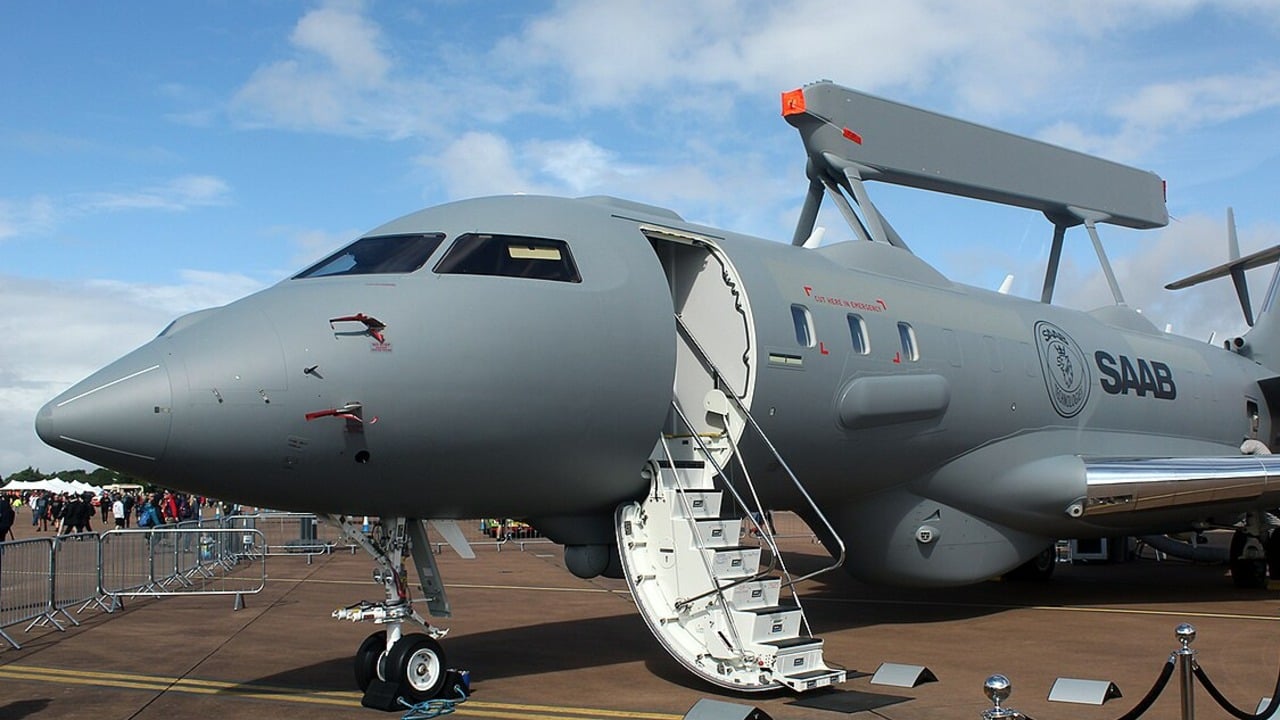
Ottawa put out a press release on Thursday morning with the word capability in the headline and four ministers queued up to welcome it. Read past the quotes and the document Canada actually signed is a term sheet — a written agreement about what the two sides are going to negotiate. Both Saab and the Canadian government say, in near-identical language, that it commits nobody to buying anything.
That is not nothing. Canada has wanted an airborne early warning aircraft for years and has never owned one, borrowing the capability through NATO’s shared E-3A fleet instead. A country with the world’s second-largest landmass, an Arctic approach it cannot watch from the ground, and a continental air defence commitment to NORAD has been flying without its own radar picture in the sky.
What it is not is a purchase. And the gap between the announcement’s tone and its legal content is the story.
Kurzinfo
Unterzeichnet: 25 September 2026, Saab and the Canadian Defence Investment Agency
Status: Non-binding term sheet. Not a contract, and not an order.
Flugzeug: Six Saab GlobalEye AEW&C, plus associated systems, training and support
Value: Not disclosed by either party
Platform: Bombardier Global 6500 — a Canadian-built business jet
Radar: Saab Erieye ER active electronically scanned array, 10 m antenna
Ausdauer: 12 hours (Saab figure)
Preferred supplier since: 27 May 2026, announced by Prime Minister Mark Carney at CANSEC
What Ottawa actually signed
Saab’s release opens by saying the company has signed a non-binding term-sheet agreement with the Canadian Defence Investment Agency, establishing the scope and foundation for detailed negotiations on a GlobalEye acquisition for the Royal Canadian Air Force. The Canadian release uses the same construction. Both then go further and rule out the interpretation everyone reaches for: the agreement, in Saab’s words, does not constitute a contract or commitment to procure aircraft.
The counterparty matters too. This was signed with the Defence Investment Agency, Canada’s new procurement body, rather than with National Defence or Public Services and Procurement Canada. The DIA is the named source on the government release.
Six aircraft, no price, no date
The number is firm in both releases: Canada intends to acquire six GlobalEye aircraft with associated systems, training and support. Neither document mentions options, a follow-on tranche, or an “up to” qualifier. Six.
Everything else is missing. No value appears in either release. No contract-signature date, no delivery schedule and no in-service target appears anywhere. The Canadian Press and CBC both report that the government has provided neither a cost nor a timeline, and the stated next step is simply detailed negotiations.
For scale, Saab’s published order history gives some idea of what six airframes might represent. France contracted for two in December 2025 at approximately SEK 12.3 billion, with deliveries between 2029 and 2032. An undisclosed Middle Eastern customer ordered two in July 2026 for about SEK 10.1 billion. Canada wants three times as many aircraft as either, in a bespoke configuration, so the arithmetic does not transfer cleanly — but it is the only anchor Saab has put on the record.
A Swedish radar on a Canadian airframe
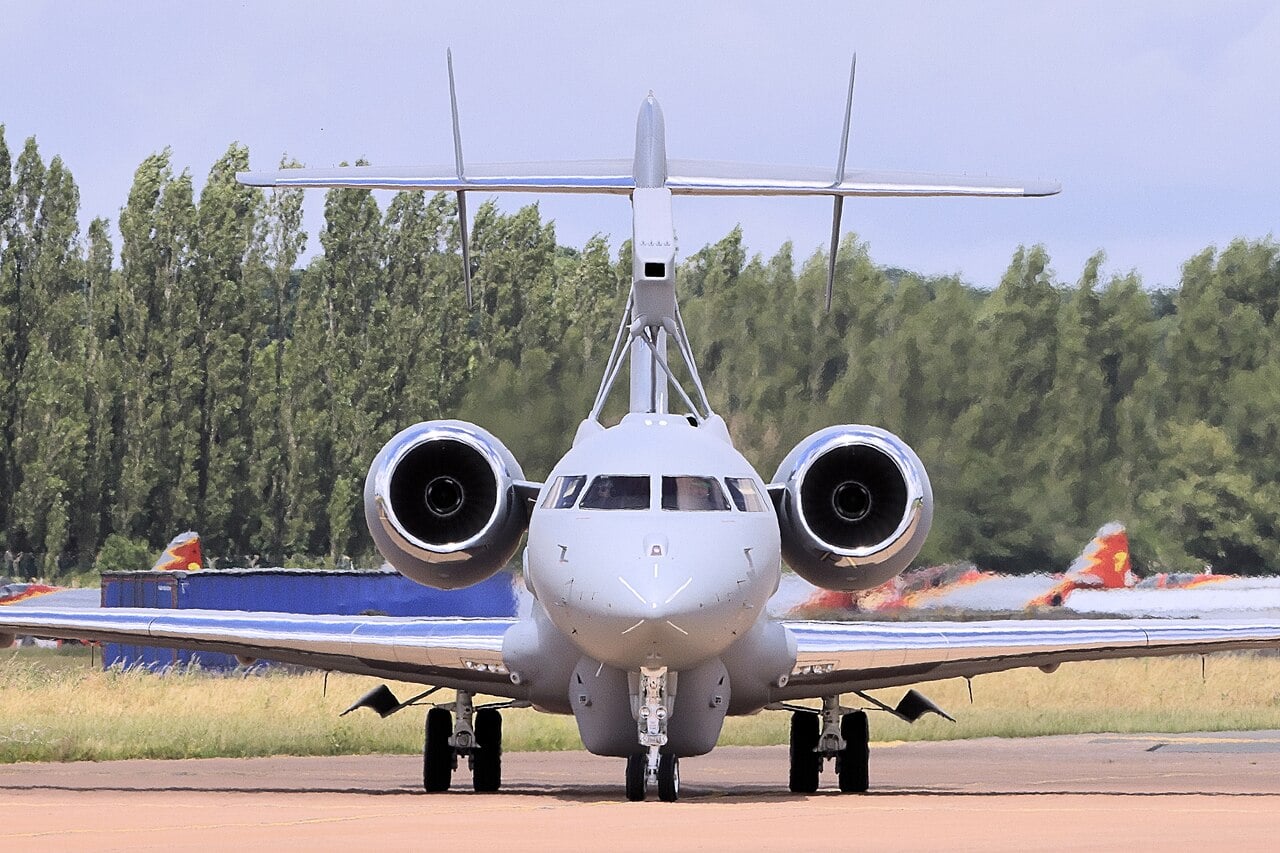
The GlobalEye is a Bombardier Global 6000 or 6500 with a Saab Erieye ER active electronically scanned array bolted to its spine in a ten-metre dorsal fairing. Canada’s would be built on the 6500. Bombardier is Canadian, and Ottawa has noticed.
Saab publishes an instrumented range of 350 nautical miles, about 650 km, and says the sensor suite detects low-flying threats beyond 400 km when the aircraft is operating at 35,000 feet. Those are two different claims about two different target sets, and they are routinely collapsed into one number in coverage of the aircraft. Endurance is twelve hours, and Saab quotes a 6,500-foot runway requirement — useful in a country whose northern airfields are short.
The industrial argument is where the Canadian release does its heaviest lifting. It describes a key objective as establishing Canada as a centre for future missionization and support activities — missionization being the business of installing mission systems into a bare airframe — building on what it calls the Canadian-manufactured Bombardier Global 6500 platform, with an eye on exporting Canadian-built GlobalEyes later.
Worth noticing: Saab’s own release the same day does not mention Bombardier, Canadian assembly, or missionization at all. It refers only to industrial participation as one of the topics negotiations will cover. The Canadian-content narrative is Ottawa’s framing, and every part of it is conditional.

The part the press release skips
This is not a clean good-news story. The Conservatives have written to the Auditor General and the Parliamentary Budget Officer asking them to examine whether proper process was followed, objecting that no competitive tender was run before Saab was named preferred supplier in May. CBC and The Canadian Press have both reported the referral.
Separately, CBC has reported — citing unnamed sources, and this has not been confirmed on the record — that the GlobalEye met only a limited share of the military’s stated requirements and would need significant modification, including additional radar sets in the nose and tail for all-round coverage, more crew stations, and work on connectivity into the NORAD network. The aircraft also has no aerial refuelling capability, which matters for Arctic coverage.
The government’s procurement office has pushed back on the record. Sofiya Sapeha, spokesperson for the Secretary of State for Defence Procurement, told CBC that conversations about which additional capabilities could be added beyond the Saab baseline are normal discussions and do not indicate Saab’s aircraft had shortcomings or failed to meet the government’s requirements, and that the aircraft meets the government’s requirements. Readers may notice that the phrase is the government’s requirements, not the military’s.
It lands in a wider mess. The Carney government has still not concluded the review of Canada’s 88-aircraft F-35 buy that it launched more than a year ago.
Where GlobalEye actually stands
Canada is joining a queue, not a fleet. The United Arab Emirates took delivery of five aircraft between 2020 and 2024 and is so far the only air force flying the type. Sweden has three on order with deliveries from 2027, under the designation S 106. France contracted for two in December 2025. An unnamed Middle Eastern customer ordered two in July 2026.
Beyond that it thins out into intent. NATO announced in July 2026 that it would open formal negotiations with Saab for up to ten aircraft to replace its E-3A fleet — negotiations, not an order. The Netherlands signed a letter of intent for one aircraft in September, and Saab’s own release on that occasion stated plainly that no contract had been signed and no order received.
Ottawa’s release rolls all of this together, noting that many allied organizations and nations have selected the GlobalEye or intend to do so, and listing NATO, Sweden, France, the Netherlands and the UAE in one breath. Only one of those five has the aircraft.
Which is a fair description of Canada’s own position today. It has signed a document saying what it will talk about. That is a real step, and it is the step before the step that counts.
Saab’s own presentation of the GlobalEye AEW&C system.
Sources: Saab press release, 25 September 2026; Government of Canada / Defence Investment Agency news release, 25 September 2026; Saab GlobalEye press kit and product data; Saab and Government of Canada releases of 27 May 2026; CBC News; The Canadian Press.

0 Comments