
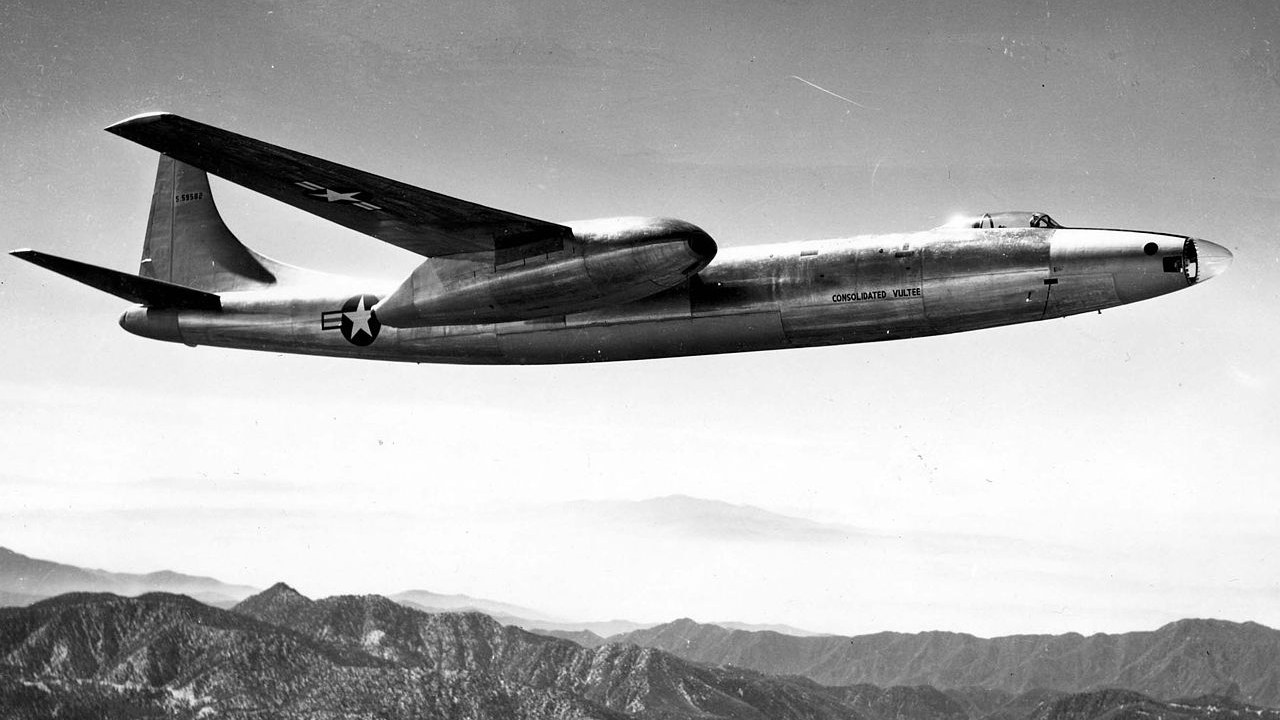
It looked like the future: a long, polished needle of a fuselage, four jet engines tucked into two slim nacelles, and a tandem bubble canopy perched on top. On 2 April 1947, the Convair XB-46 took off from San Diego and flew for 90 minutes to Muroc Army Airfield in the Mojave Desert. Four months later, it was cancelled.
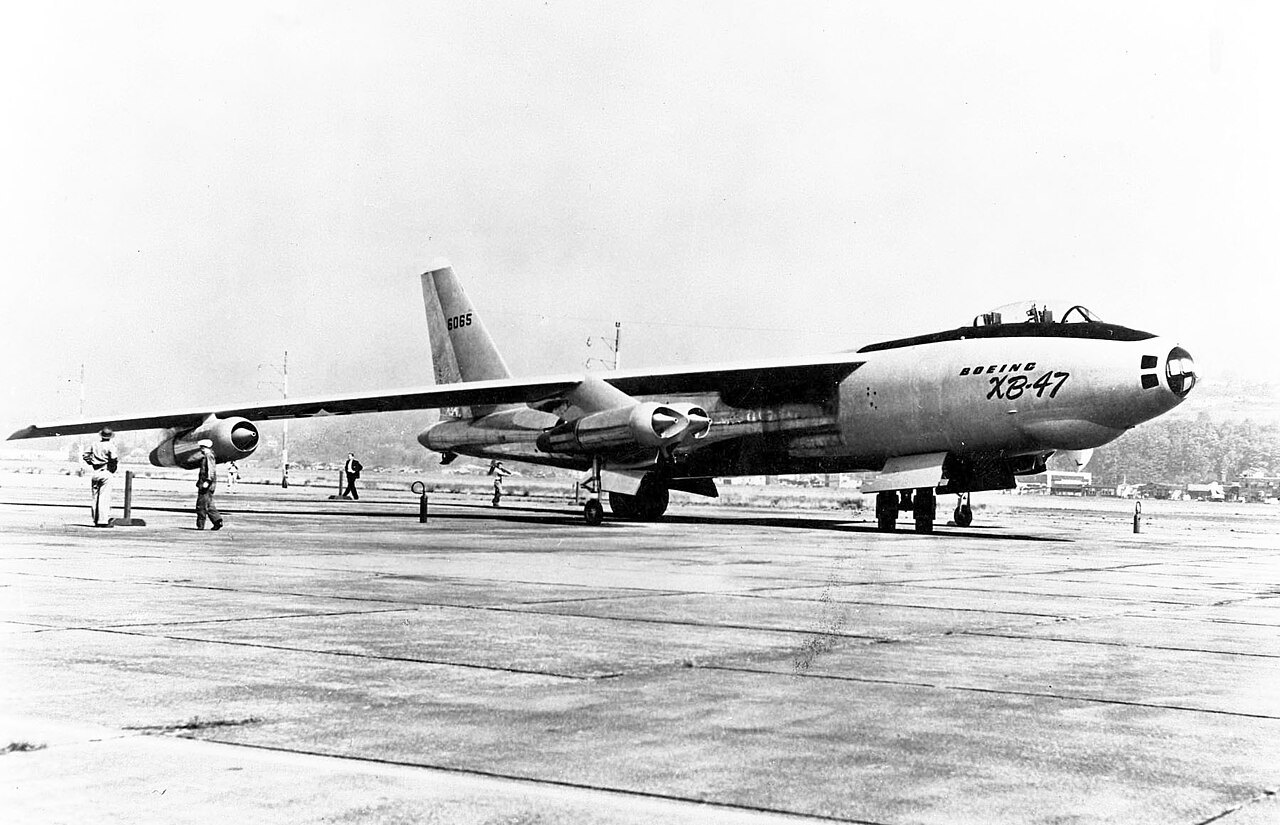
The XB-46 did nothing wrong. Its pilots liked how it flew. It was simply overtaken, in a matter of months, by a jet bomber from Seattle with swept wings: the Boeing XB-47, which made every straight-winged design of its generation look old.
Kurzinfo
- Flugzeug: Convair (Consolidated Vultee) XB-46, serial 45-59582
- Rolle: four-engine jet medium bomber prototype
- Erster Flug: 2 April 1947, San Diego to Muroc Army Airfield
- Gebaut: one (three were ordered)
- Motoren: four Allison J35 turbojets in two paired nacelles
- Größe: length 105 ft 9 in (32.2 m), wingspan 113 ft (34.4 m)
- Crew: three
- Abgesagt: August 1947; nose section preserved by the US Air Force Museum
The Class of 1945
In 1944, aware of how far German jet development had come, the US War Department called for a new generation of jet medium bombers. Four companies answered with four very different designs: North American's XB-45, Convair's XB-46, Boeing's XB-47 and Martin's XB-48. Convair received a letter contract on 17 January 1945, and three prototypes were ordered on 27 February 1945.
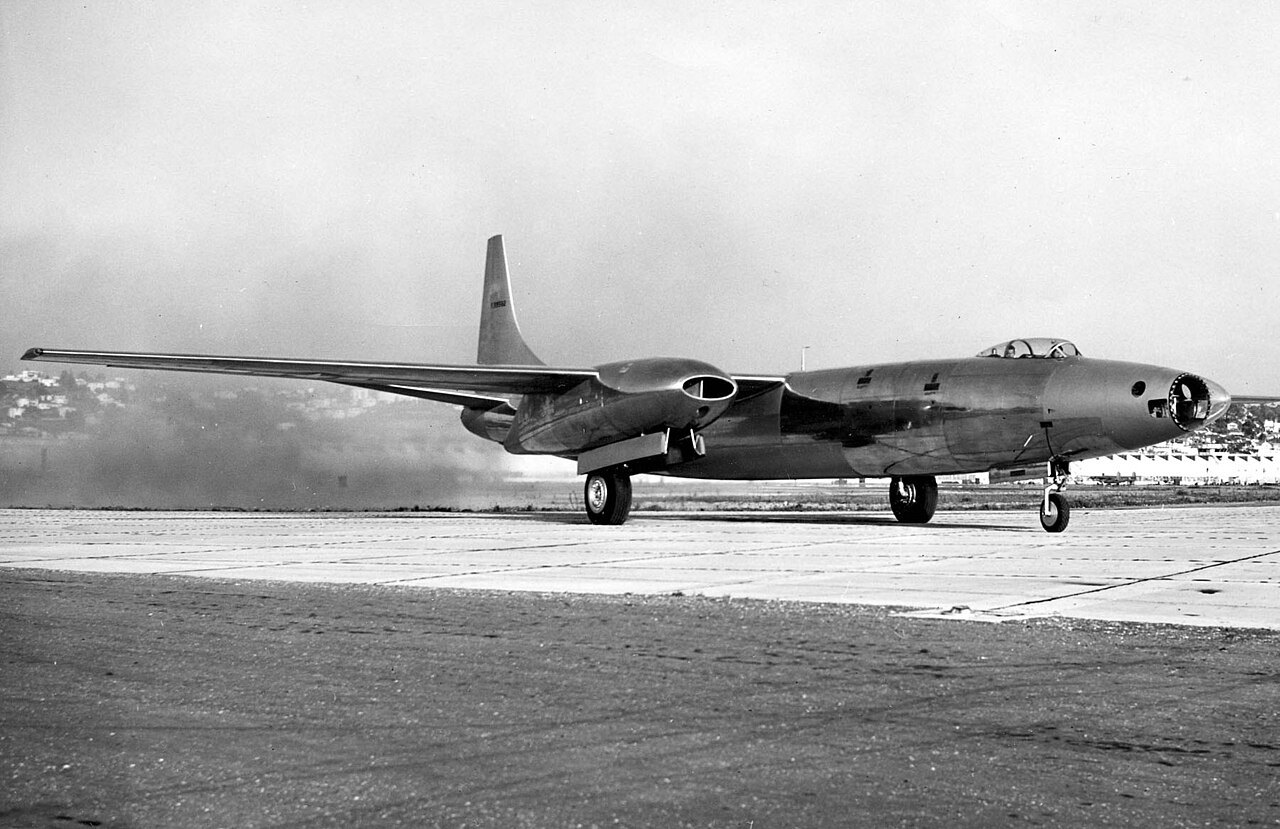
Convair's answer was elegant and conventional. A long, slender fuselage carried a straight, high-aspect-ratio wing, with Fowler flaps along more than 90 per cent of the span. Four Allison J35 turbojets, built by Chevrolet, sat in pairs in two nacelles under the wing. The two pilots sat in tandem under a fighter-style canopy, and the bombardier-navigator rode in the glazed nose.
One feature was genuinely unusual. Instead of hydraulic or electric systems, many of the XB-46's systems were operated pneumatically, with compressed air carried through piping around the airframe. The Air Force found it unusual enough to test in the cold-weather climatic facility at Eglin Air Force Base in 1950, years after the programme itself had ended.
Five Good Months
The budget had already shrunk the programme before the first flight. In 1946 Convair proposed to finish just one XB-46 as a stripped-down testbed, and the Army Air Forces agreed. That single aircraft flew from San Diego to Muroc, now Edwards Air Force Base, on 2 April 1947.
Convair and Army Air Forces pilots flew it for about five months. By September 1947 it had logged 127 hours in 64 flights, and its stability and control were described as excellent. The problems were the kind any prototype has: engine de-icing, the cabin air system, a vertical oscillation caused by resonance in the wing spoilers, and doubts about how the crew would get out in an emergency.
Overtaken by the B-47
None of that is what killed it. The programme was cancelled in August 1947, before flight testing was even finished, because the design was already obsolete. North American's B-45 Tornado already had production orders as the interim jet bomber, and the swept-wing Boeing B-47 Stratojet, which first flew in December 1947, promised far better performance than any straight-winged rival.
The Air Force still accepted the XB-46 in November 1947 and used it as a research aircraft. From 1948 to 1949 it flew another 44 hours at Palm Beach Air Force Base, studying noise, tail vibration and stability, before high support costs and a lack of spare parts grounded it. Its last job was the cold-weather pneumatic tests at Eglin in 1950.
On 13 January 1951, the nose section went to the US Air Force Museum. The rest of the airframe was scrapped on 28 February 1952. Four years after its first flight, the most beautiful bomber of its class was gone, beaten not by a flaw but by a better idea.
Dark Skies' documentary below tells the story of the XB-46, the aircraft some called the Needle.
Sources: Wikipedia (Convair XB-46), citing Marcelle Size Knaack, Post-World War II Bombers (1988), and Steve Ginter, Consolidated Vultee XB-46 (2016); National Museum of the US Air Force


0 Comments