
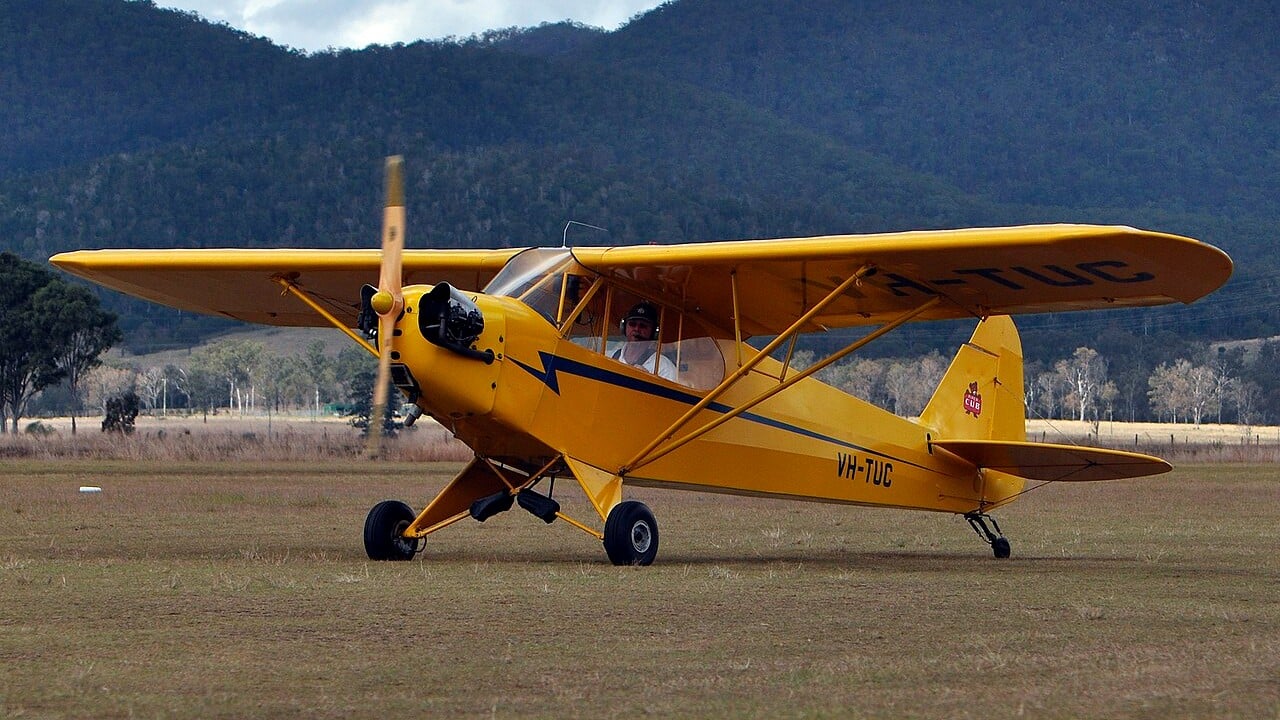
Most pilots today learn on aeroplanes with a nosewheel. They taxi like a shopping trolley that wants to go straight. Then one day they climb into a Piper Cub, a Super Decathlon or a P-51 Mustang, and discover that the little wheel at the back changes everything.
In the United States you cannot simply jump in and go. Since 1991 the Federal Aviation Administration has required a tailwheel endorsement before a pilot may act as pilot in command of a tailwheel aeroplane. Here is what the rule actually says, why taildraggers behave the way they do, and what the training involves.
Kurzinfo
- Regel: 14 CFR 61.31(i), additional training for tailwheel airplanes
- Required: Flight training from an authorised instructor and a logbook endorsement
- Must include: Normal and crosswind takeoffs and landings, wheel landings, go-arounds
- Minimum hours: None specified in the rule
- Exemption: Pilots who logged tailwheel pilot-in-command time before 15 April 1991
- Also called: Conventional gear, or taildragger
What the regulation says
The requirement is short. To fly a tailwheel aeroplane as pilot in command, a pilot must receive and log flight training from an authorised instructor in a tailwheel aeroplane, and get a logbook endorsement from an instructor who finds them proficient. The rule names three things the training must cover, and notably sets no minimum number of hours: the instructor decides when the pilot is ready.
The endorsement does not apply to pilots who already had tailwheel experience. Anyone who logged pilot-in-command time in a tailwheel aeroplane before 15 April 1991 is exempt.
Why a taildragger fights back
The reason for the rule is geometry. On a tailwheel aeroplane the two main wheels sit slightly ahead of the centre of gravity, so the aircraft rests nose-high on a triangle of main wheels and tailwheel. The FAA's Airplane Flying Handbook says this arrangement creates three big differences from a nosewheel aircraft: directional instability on the ground, a wing that is already at an angle of attack while taxiing, and a strong tendency to weathervane into a crosswind.
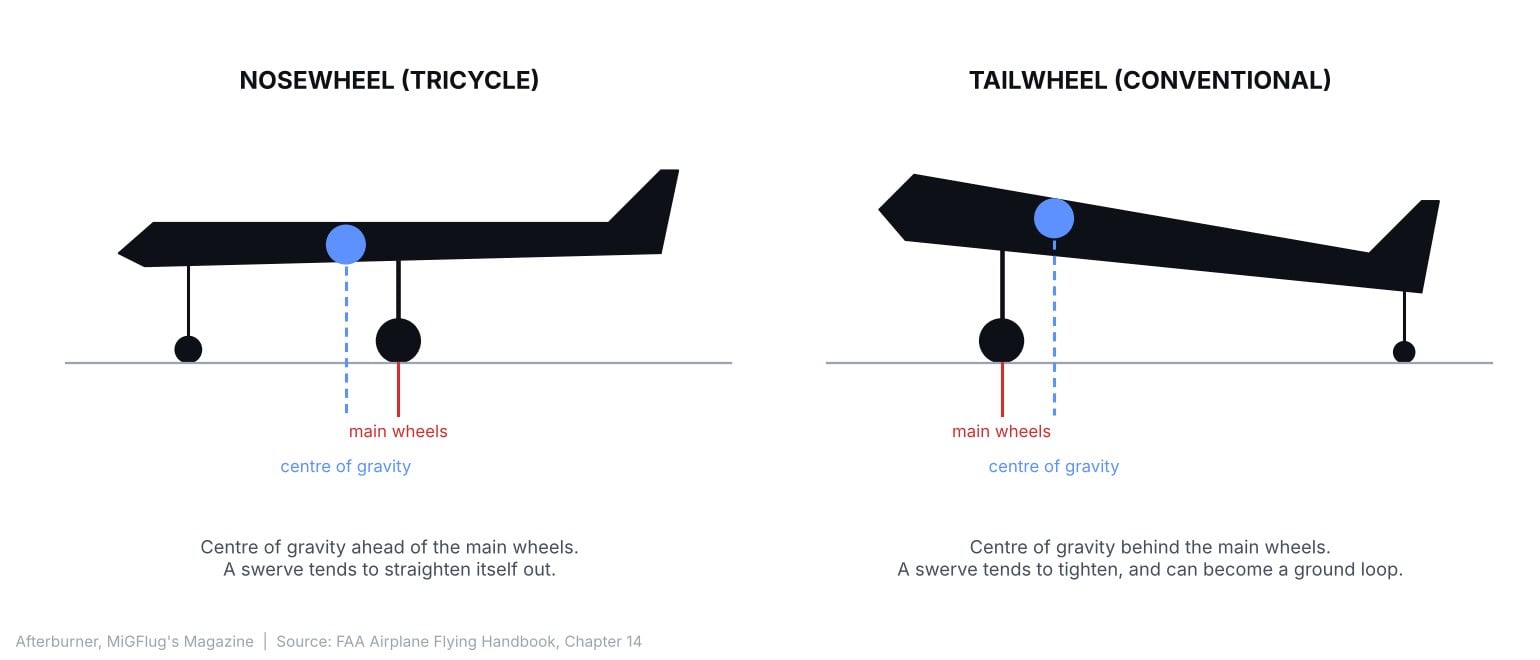
The instability is the big one. Start a turn on the ground and the aircraft pivots on a main wheel. With the centre of gravity behind that pivot, momentum keeps the turn going and even tightens it, without any further input.
Releasing the rudder does not stop it; the pilot has to apply opposite rudder to bring the aeroplane back to a straight line. A nosewheel pilot's instincts are exactly wrong, which is why early taxi attempts in a taildragger are often comically wobbly.
Left unchecked, a swerve becomes a ground loop: an uncontrolled turn during taxi, takeoff or the landing roll. It can start from a side-load on landing, a taxi turn taken too fast, an overcorrection, or even a soft patch that drags one main wheel.
The handbook warns that the forces can grow until the aeroplane tips towards the outside of the turn and a wingtip hits the ground. The cure is to catch any swerve early with firm rudder, using differential braking if needed, and then to take the correction out promptly before it starts a swerve the other way.
Grimshaw Aviation on the ground loop and crosswind tailwheel landings.
Three-point and wheel landings
Tailwheel pilots learn two ways to land. In a three-point landing the pilot holds the aeroplane off just above the runway and keeps raising the nose as it slows, so that the main wheels and the tailwheel touch at the same moment, at a low speed and a steep fuselage angle. With the tailwheel down, the aircraft cannot pitch up further, so it stays on the ground.
A wheel landing is the other technique, and the regulation requires it to be taught unless the manufacturer advises against it. The pilot touches down on the main wheels only, flatter and faster, with the tail still up. That keeps more control authority in gusty or crosswind conditions, but it needs a soft touchdown and a slight relaxation of back pressure, because a tail that drops too early will push the aeroplane back into the air.
Aerobatic champion Patty Wagstaff demonstrates a tailwheel wheel landing for Sporty's.
The gateway to warbirds
The nose-high attitude has one more consequence: on the ground, the engine cowling can hide what is straight ahead. On a long-nosed aeroplane the view forward while taxiing is very limited, which is why taildragger pilots learn to look out to the sides and taxi with care.
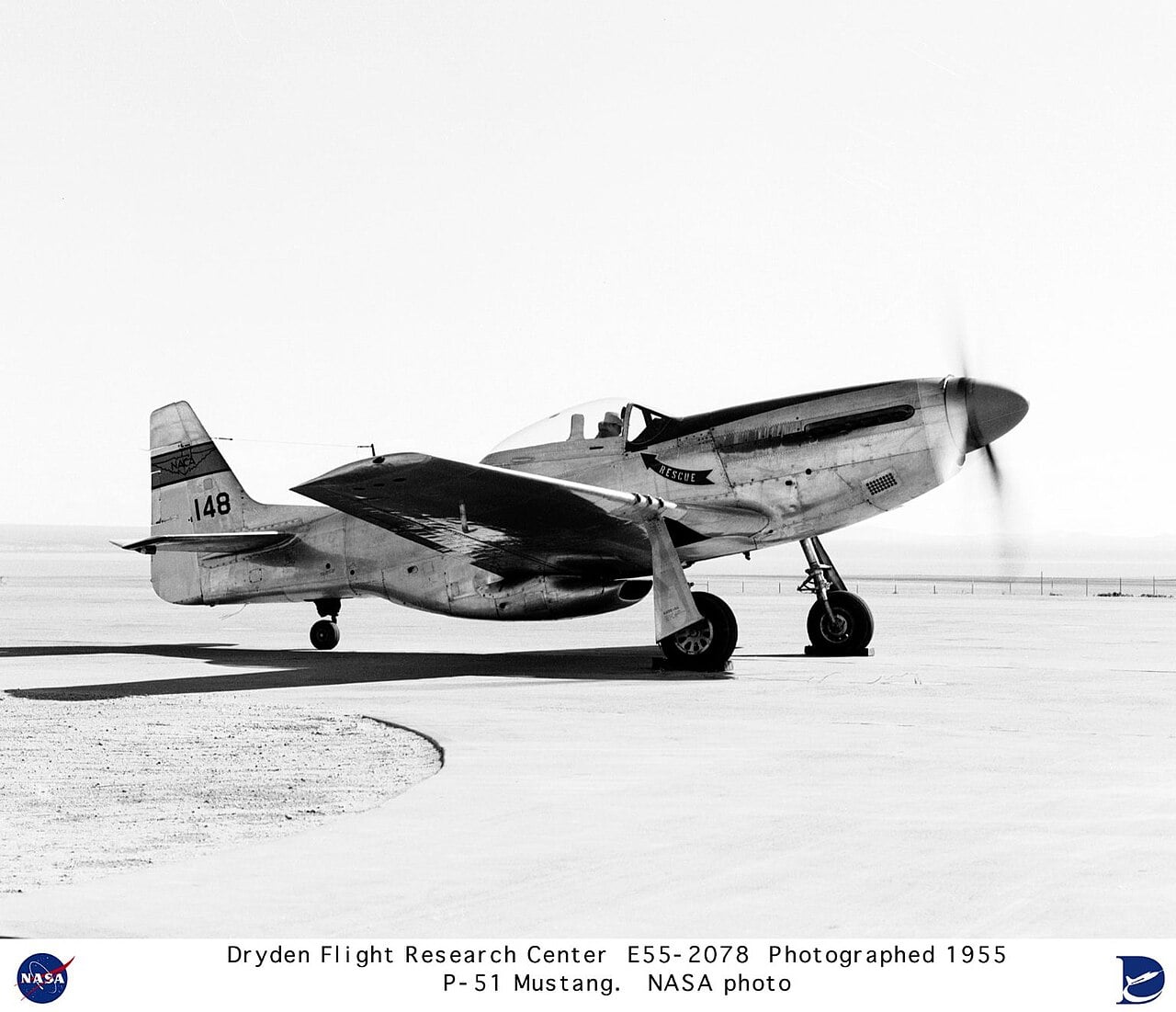
It is also why the tailwheel endorsement is the first step towards flying warbirds. Most piston fighters of the Second World War, from the Spitfire to the Mustang, sit on a tailwheel, as do classic trainers such as the Stearman and the Tiger Moth.
A typical endorsement is a handful of hours of dual instruction, but the regulation does not set a number and it depends on the pilot and the aeroplane. The skills it builds, above all precise and timely use of the rudder, carry over to every other aircraft a pilot flies.
So if a taildragger has been on your list, start with slow taxiing, keep your feet busy, and never let a swerve grow. The little wheel at the back will do the rest of the teaching.
Aviation101's first lesson in landing a tailwheel aeroplane.
Sources: 14 CFR 61.31(i) (eCFR), FAA Airplane Flying Handbook FAA-H-8083-3C, Chapter 14
0 Comments