
Afterburner recently left you with a cliffhanger. In our guide to major and minor alterations, the advice for a major repair with no approved data behind it was to contact a local FAA office and speak to an aviation safety inspector. Lovely. Which office? Who picks up? And is the person on the other end there to help you, or to write you up?
The answers live in a four-letter acronym that most pilots learn the way they learn about carburettor icing: suddenly, and slightly too late. The Flight Standards District Office, or FSDO, is where the FAA keeps the people who certify, inspect, investigate and, when they must, enforce. Its aviation safety inspectors are the FAA employees who might actually walk into your hangar.
So here is the field guide: what an FSDO does, how many there are after the 2017 shake-up of Flight Standards, what an aviation safety inspector can sign, how that differs from the private designees who do much of the FAA's legwork, and why "can I just ring the FAA?" has two honest answers.
Kurzinfo
- What an FSDO is: A local office of the FAA Flight Standards Service, aligned under the Office of General Aviation Safety Assurance
- Wie viele: 76 offices in the FAA's own FSDO locator dataset (updated August 2026); AOPA counted 77 at the 2017 reorganisation
- The 2017 change: On 20 August 2017 Flight Standards dropped its regional structure for four functional offices
- Who works there: FAA aviation safety inspectors in operations and airworthiness (maintenance and avionics) specialties, among others
- What they cover: 14 CFR Parts 43, 61, 65, 91, 107, 133, 135, 137, 141, 142, 145, 147 and 183, according to the FAA
- Designees: Private persons and organisations acting for the FAA under 14 CFR Part 183, such as DPEs, DMEs, DARs, DERs and ODA holders
- Airlines: Part 121 carriers are overseen by the separate Office of Air Carrier Safety Assurance and its certificate management offices
The Office With the Least Glamorous Name in Aviation
An FSDO is the local branch of the FAA's Flight Standards Service, the part of the agency that, in its own words, sets the standards for certification and oversight of airmen, air operators, air agencies and designees. Flight Standards lists its day job as certification, inspection, surveillance, investigation and enforcement. The FSDO is where that job meets people with grease under their fingernails.
The FAA's own list of reasons to contact an FSDO reads like the plot of every hangar story ever told: low-flying aircraft, accident reporting, aircraft maintenance, aircraft permits, airmen certification for pilots, mechanics, repairmen, dispatchers and parachute riggers, certification and modification issues, enforcement, and illegal air charter. If it involves a general aviation aircraft, a certificate or a complaint, it probably lands on an FSDO desk.
The regulatory reach is just as wide. According to the FAA's Office of General Aviation Safety Assurance, its FSDOs are responsible for certification, oversight and management under 14 CFR Parts 43, 61, 65, 91, 107, 133, 135, 137, 141, 142, 145, 147 and 183. Translated: maintenance, pilots, mechanics, general operating rules, drones, external loads, charter, agricultural flying, flight schools, training centres, repair stations, maintenance schools and the designees themselves.
How Many FSDOs Are There?
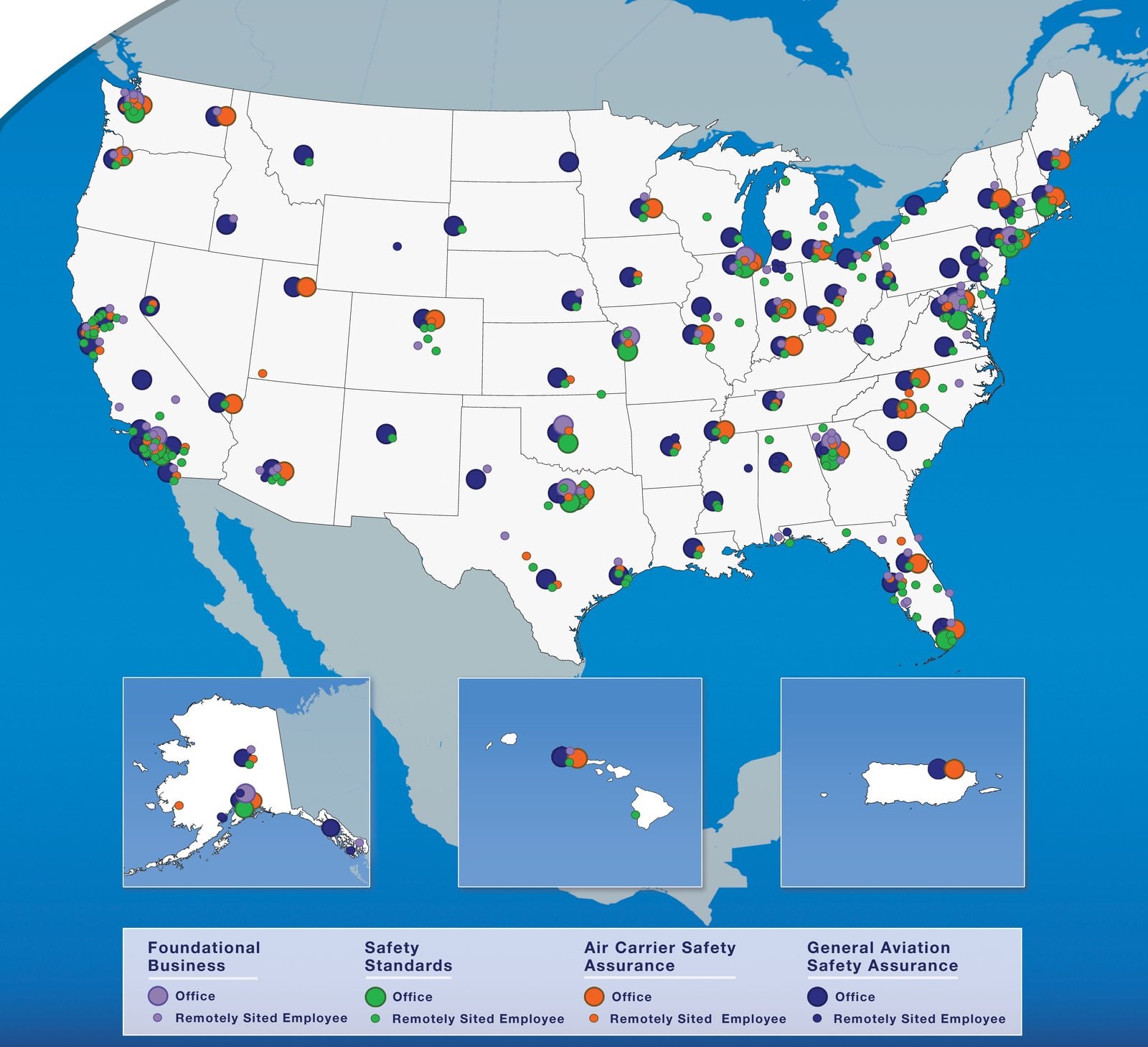
The FAA does not print a headline number on its FSDO page, but its own "Find your FSDO" locator dataset, last updated in August 2026, contains 76 offices. They run from Fairbanks, Anchorage and Juneau to Honolulu and San Juan, and each one covers a defined geographic patch that can span one or more states or parts of states. When AOPA reported the 2017 reorganisation, it counted 77, so the network has barely moved in a decade.
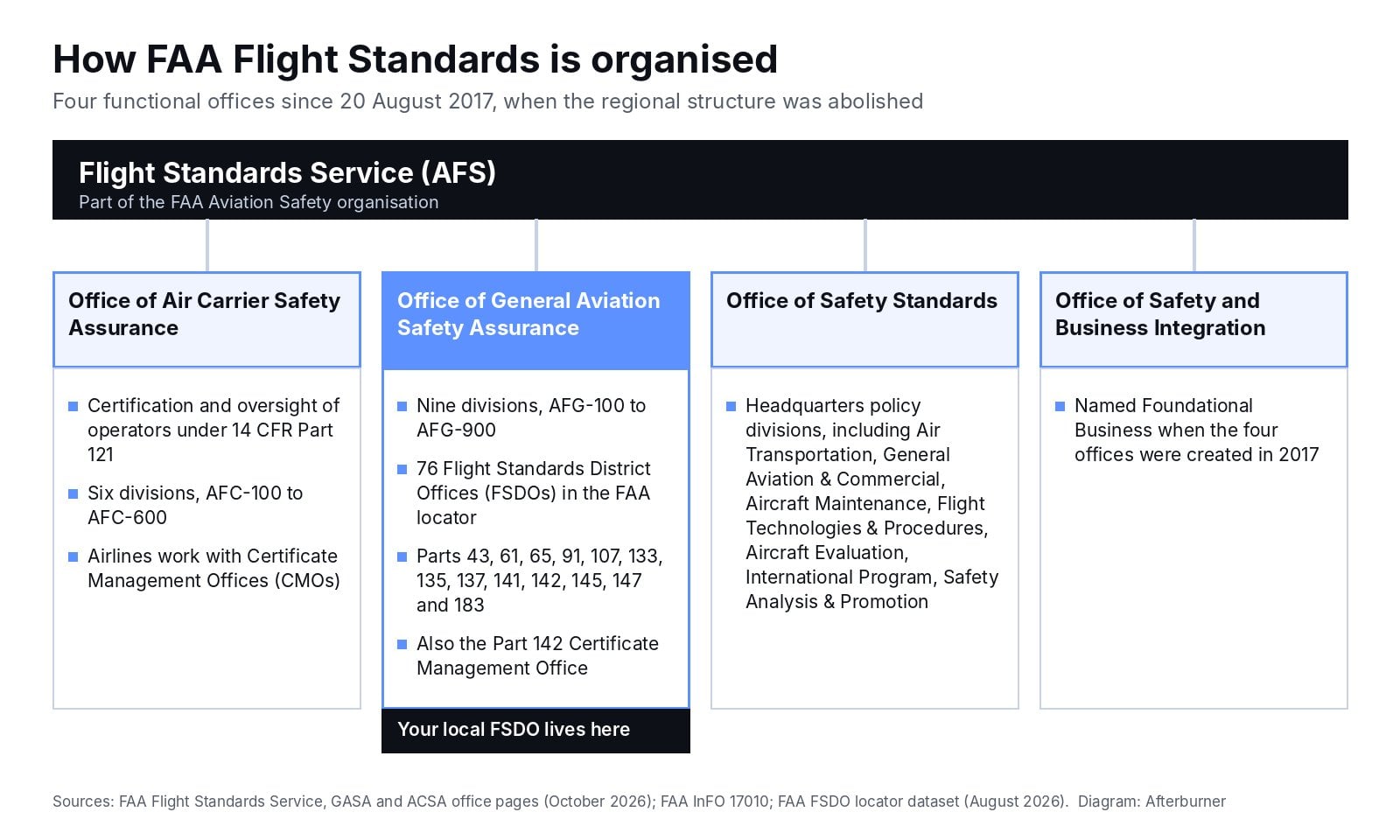
What did move was everything above the offices. Until 2017 Flight Standards was organised by region. Under what the FAA called the Future of Flight Standards initiative, it abolished the regional offices and created four functional organisations: Air Carrier Safety Assurance, General Aviation Safety Assurance, Safety Standards and Foundational Business. The switch happened on 20 August 2017, and the man in charge was at pains to tell the industry it would hardly notice.
Nine years on, the FAA's Flight Standards page still lists four offices, though the fourth is now called the Office of Safety and Business Integration. The FSDOs sit under General Aviation Safety Assurance, which the FAA says manages a network of nine functional divisions, the FSDOs, the Part 142 Certificate Management Office and several support offices. Airlines flying under Part 121 are a separate world, handled by Air Carrier Safety Assurance through certificate management offices.
Meet the Aviation Safety Inspector
An aviation safety inspector, or ASI, is an FAA employee in the 1825 job series. The FAA describes the role as developing, administering or enforcing regulations and standards on civil aviation safety: the airworthiness of aircraft and their systems, the competence of pilots, mechanics and other airmen, and the safety of facilities, equipment and procedures. In Flight Standards the specialties are operations, airworthiness maintenance and airworthiness avionics; manufacturing inspectors work for the separate Aircraft Certification Service.
Here is the bit that surprises people. The inspector who asks to see your logbook is not a clerk with a clipboard. To be hired as a general aviation operations ASI, the FAA requires a flight instructor certificate with single-engine, multi-engine and instrument airplane ratings, at least 200 hours of flight instruction given, a minimum of 1,500 total flight hours and a valid second-class medical. In other words, the inspector has often spent more hours teaching in the right seat than many owners have spent flying at all.
What can an inspector actually approve? Plenty. An ASI certificates and oversees flight schools, repair stations and charter operators, investigates accidents and complaints, and runs enforcement. For a major repair or alteration with no approved data, an inspector who holds field approval authority can approve the data for that one aircraft. That is the phone call our Form 337 article sent you to make.
There are hard limits, though. The FAA's advisory circular on data approval says the field approval route is not available for every major repair or alteration, and a major change to type design needs a supplemental type certificate under 14 CFR 21.113(a). No amount of charm at the FSDO front desk turns a field approval into an STC.
Inspector or Designee? The Difference That Confuses Everyone
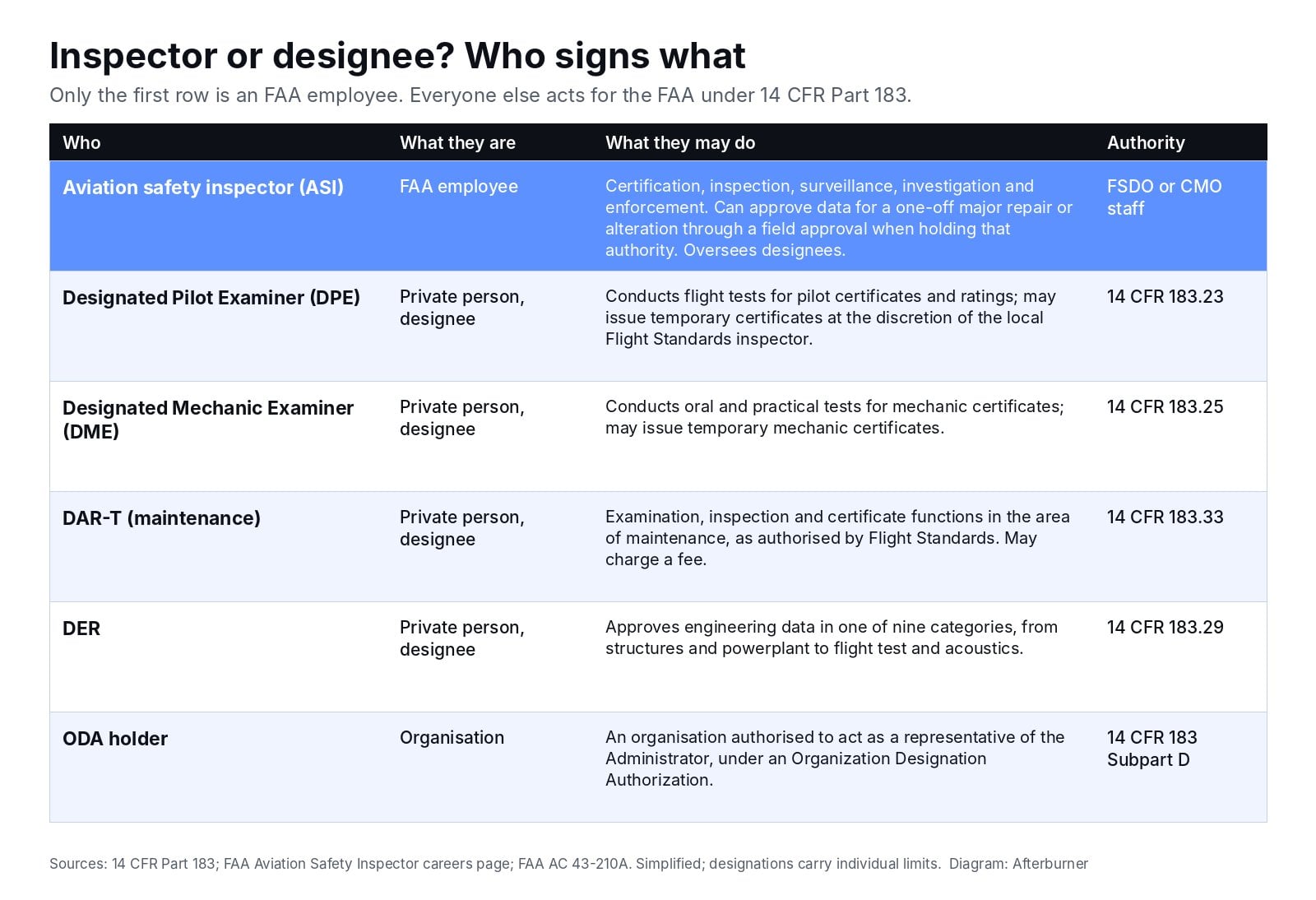
Many of the people who act "for the FAA" are not FAA employees at all. The FAA defines designees as individuals and organisations in the aviation industry authorised to conduct examinations, perform tests and issue approvals and certificates on its behalf. The legal machinery is 14 CFR Part 183, which opens by describing the designation of private persons as representatives of the Administrator.
The alphabet is long. A Designated Pilot Examiner (DPE) conducts your checkride under the general supervision of the local Flight Standards inspector. A Designated Mechanic Examiner (DME) tests would-be mechanics. A Designated Airworthiness Representative (DAR) works in maintenance as authorised by Flight Standards, or in manufacturing and engineering as authorised by Aircraft Certification, and the rule explicitly lets a DAR charge a fee. A Designated Engineering Representative (DER) approves engineering data within one of nine categories of designation, and an Organization Designation Authorization lets a whole company act for the FAA. Afterburner has a full guide to the designee system.
That sentence is the "aha" of the whole system. The inspector is the FAA employee; the designee is the private multiplier the inspector oversees. It is also why a system that is chronically short of examiners can leave students waiting for checkrides: the FAA delegates much of the volume work, and the inspectors keep the oversight.
The two groups learn from the same playbook. When the FAA publishes outreach on new policy, it is often aimed at inspectors and designees at once, as with this briefing on risk assessments for experimental aircraft operating limitations, made for aviation safety inspectors, designees and ODA unit members.
So Can You Just Ring the FAA?
Yes. Every FSDO publishes a phone number and email address, and the FAA actively tells people to contact one for everything from accident reports to modification questions. The Columbus FSDO, to pick one, keeps office hours of 7:30 a.m. to 4:00 p.m. on weekdays. There is also the national line, 866-TELL-FAA. What you should not do is turn up unannounced: Columbus and Portland both state that office visits are by appointment only.
And also no, in three ways. You do not choose your inspector, because your FSDO is set by geography. Many things you want are not done by inspectors at all: your checkride, for example, may well be with a designated pilot examiner rather than an inspector. And the person helping you with a modification is the same agency that enforces the rules, which is exactly why some owners never call.
That last fear is less justified than hangar folklore suggests. Since 2015 the FAA has run what it now calls its Compliance Program, renamed from the Compliance Philosophy in October 2018. The FAA says that if you are qualified and both willing and able to cooperate, an unintentional deviation will generally be fixed with a Compliance Action such as counselling or extra training. Intentional or reckless behaviour still gets the full enforcement treatment.
The practical rule is simple: call early. Ring the FSDO before the panel comes out, not after the new wiring is in, and treat the inspector as the person who can tell you which door to knock on, whether it opens onto a field approval, a designee or an STC. The FAA is, in the end, recruiting these people at its own stand at Oshkosh. Better to meet one there than across an enforcement file.
Which brings us back to that cliffhanger. "Contact a local FAA office" means your FSDO. "Speak with an ASI" means a seasoned pilot or mechanic on the FAA payroll, with a designee network behind them and an office that is one of 76. Now you know who is coming to the hangar.
Sources: FAA Flight Standards Service, FAA Office of General Aviation Safety Assurance, FAA Office of Air Carrier Safety Assurance, FAA InFO 17010, FAA Flight Standards realignment letter to stakeholders (August 2017), FAA FSDO locator dataset, FAA Aviation Careers, FAA Designees and Delegations, FAA Compliance Program, 14 CFR Part 183, FAA AC 43-210A, AOPA, EAA.
Header photo: FAA office - Hillsboro, Oregon by M.O. Stevens, CC BY-SA 3.0, cropped, via Wikimedia Commons

0 Comments