
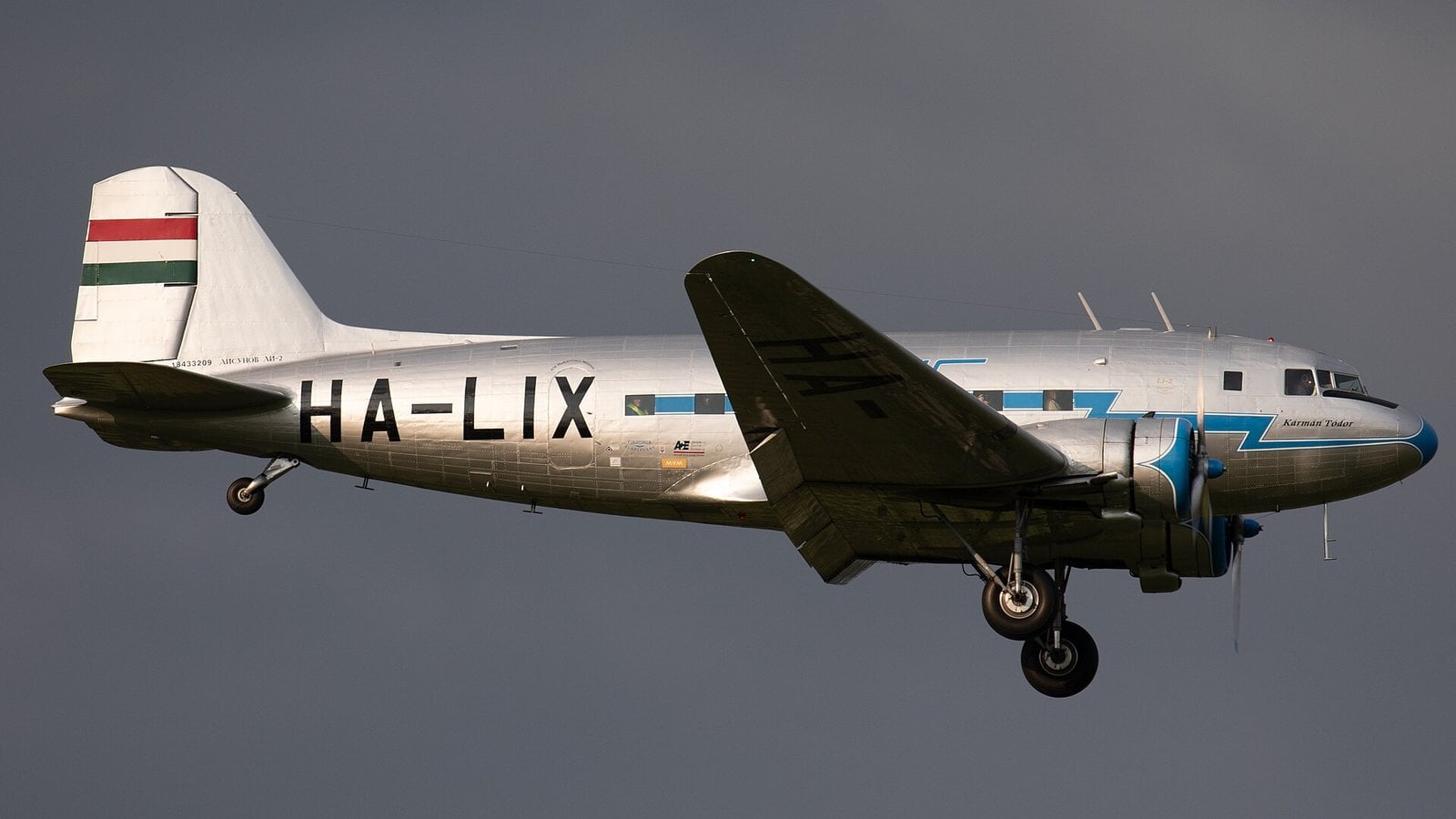
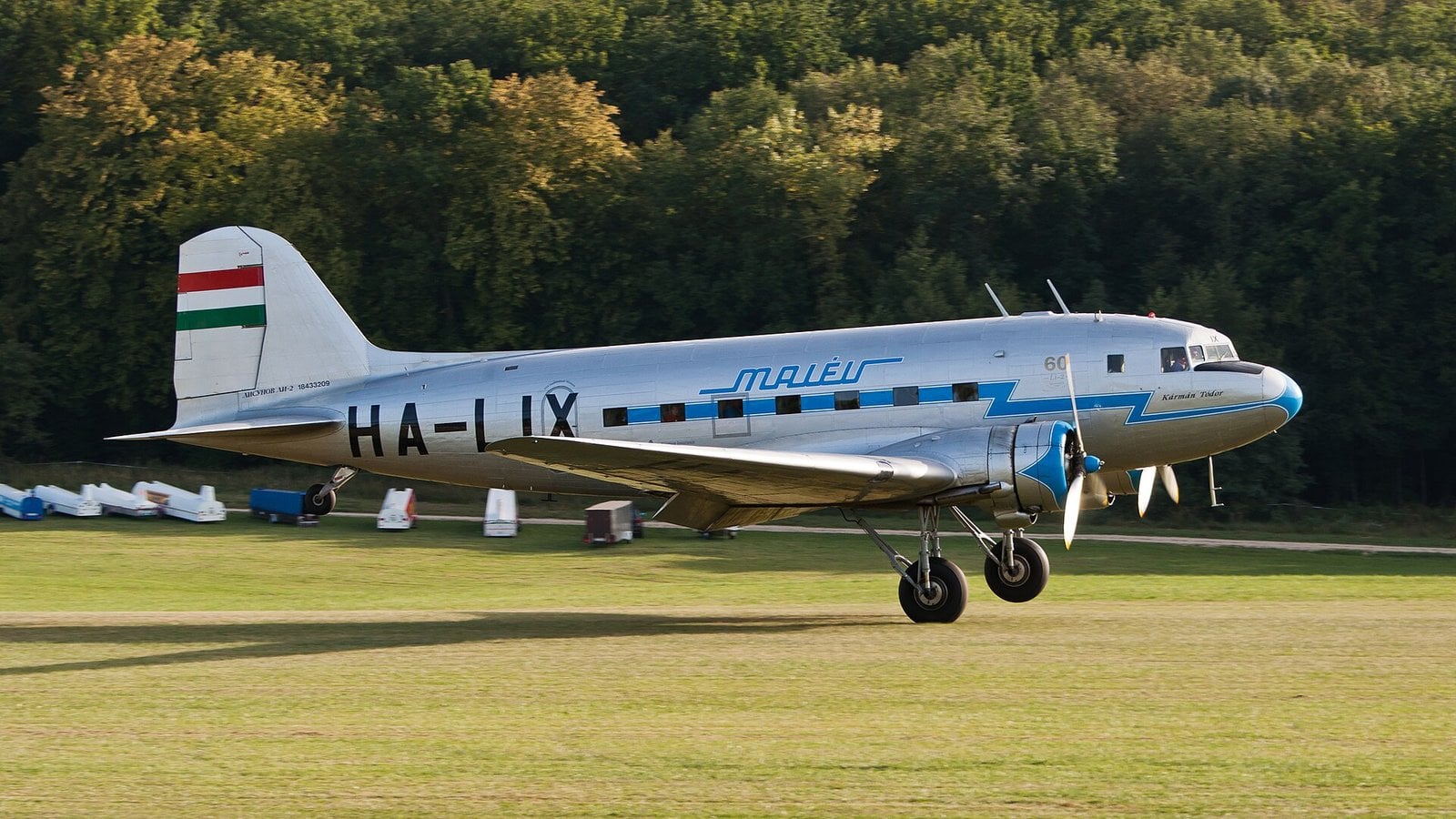
On a spring Saturday at Budörs airfield on the edge of Budapest, a polished silver airliner in 1950s Malév colours coughs its two nine-cylinder radials into life and taxies out across the grass. Most onlookers would call it a Douglas DC-3. Look closer and the details are wrong: the passenger door is on the right-hand side, the cockpit instruments read in metres and kilometres, and the type name stencilled on the rear fuselage is in Cyrillic.
This is HA-LIX, a Lisunov Li-2, and its operator believes it is the last one of its kind still flying. The Soviet Union bought the right to build the American airliner in 1936, redrew it in metric units and turned out roughly 4,900 of them by the most careful modern count. It flew Aeroflot’s routes, dropped bombs on the Eastern Front, and carried passengers from Budapest to Beijing for decades after the war.
Kurzinfo
- Typ: Soviet licence-built version of the Douglas DC-3, originally designated PS-84
- Licence: Bought from Douglas in 1936; engineer Boris Lisunov studied the type at Santa Monica
- Motoren: Two nine-cylinder Shvetsov radials, the M-62IR and later the ASh-62IR, developed from the Wright R-1820 Cyclone; about 1,000 hp (735 kW) each for take-off in ASh-62IR form
- Produktion: About 4,900 by the most careful modern count, from 1939 into the early 1950s; older estimates range from about 2,000 to more than 6,000
- Wartime roles: Transport, paratroop and supply aircraft and night bomber, often fitted with a dorsal machine-gun turret
- Bediener: Aeroflot and the Soviet air force, plus airlines and air forces in Hungary, Poland, Czechoslovakia, Bulgaria, Romania, Yugoslavia, China and others
- Überlebende: HA-LIX, built in Tashkent in 1949, has flown again since 2001; its operator, the Goldtimer Foundation, calls it the only airworthy Li-2
A Licence From Santa Monica
By the mid-1930s Aeroflot badly needed modern passenger aircraft. After the Central Aerohydrodynamic Institute (TsAGI) had tested a Douglas DC-2, Moscow decided to buy the newer Douglas DC-3 instead, and in July 1936 it signed a licence agreement with Douglas. The deal covered more than paperwork: it included complete aircraft and training for Soviet specialists at the Douglas works. Around 20 American-built DC-3s were delivered to the USSR between late 1936 and 1939.
The man sent to learn the aeroplane was Boris Pavlovich Lisunov, a Soviet air force engineer. He spent long stretches at the Douglas plant in Santa Monica, California, by most accounts from November 1936 until the spring of 1939, documenting the airframe, its tooling and its production methods. Back home, the job of putting the type into production went to State Aircraft Factory No. 84 at Khimki, just outside Moscow.
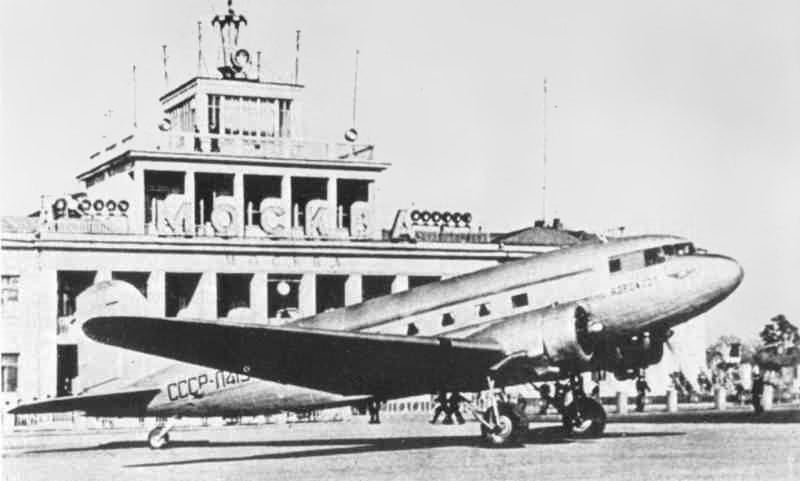
The first production aircraft built from Soviet materials appeared in 1939 and were designated PS-84: passazhirskiy samolyot, passenger aircraft, of factory 84.
Inches Into Millimetres
The licence came with drawings dimensioned in inches, and a Soviet factory could not work from them as they stood. Every dimension had to be converted to metric, and the structure was recalculated to Soviet strength standards. American sheet gauges, fasteners and steel fittings had no exact Soviet equivalents, so skins, engine mounts, landing gear, wheels and hardware were all reworked around what Soviet industry could supply. The original chief designer for the project, Vladimir Myasishchev, was arrested by the NKVD in the middle of this work, and Lisunov, by then the factory’s chief engineer, carried the programme forward.
The result looked like a DC-3 but was not quite one. The airframe came out heavier; the Goldtimer Foundation, which maintains the surviving example, puts the difference at more than 100 kg (220 lb). The span was slightly shorter at 28.81 m (94 ft 6 in), the main passenger door moved to the right-hand side, and the engines were Soviet: Shvetsov M-62IR radials, later ASh-62IR, a nine-cylinder family developed from the Wright R-1820 Cyclone that had powered the earliest DC-3s. Rated at about 1,000 hp (735 kW) for take-off, they gave the Soviet aircraft a little less performance than its American parent.
Moscow would go through the same exercise on a much larger scale a decade later, when Tupolev reverse-engineered the B-29 Superfortress as the Tu-4. That story, told here on Afterburner, began with stolen aircraft. The PS-84 began with a contract.
From Khimki to Tashkent
Khimki built fewer than 300 PS-84s before the war reached it, and the factory at Kazan added only about ten. When Germany invaded on 22 June 1941, the PS-84s already with Aeroflot were swept into military service. In the autumn of 1941, with German armies approaching Moscow, the Khimki plant was evacuated to Tashkent in Soviet Central Asia, and production restarted there in January 1942.
On 17 September 1942 the type received the name by which history knows it: Li-2, after Lisunov. Tashkent became its home for the rest of its production life, building the overwhelming majority of all Li-2s.
An Airliner With a Gun Turret
Unlike the unarmed C-47, the wartime Li-2 often went to the front with guns. Many were fitted with a dorsal turret, initially with a 7.62 mm ShKAS machine gun and later with a 12.7 mm (.50 in) UBT heavy machine gun, and further ShKAS guns could fire from the rear cabin windows or hatches.
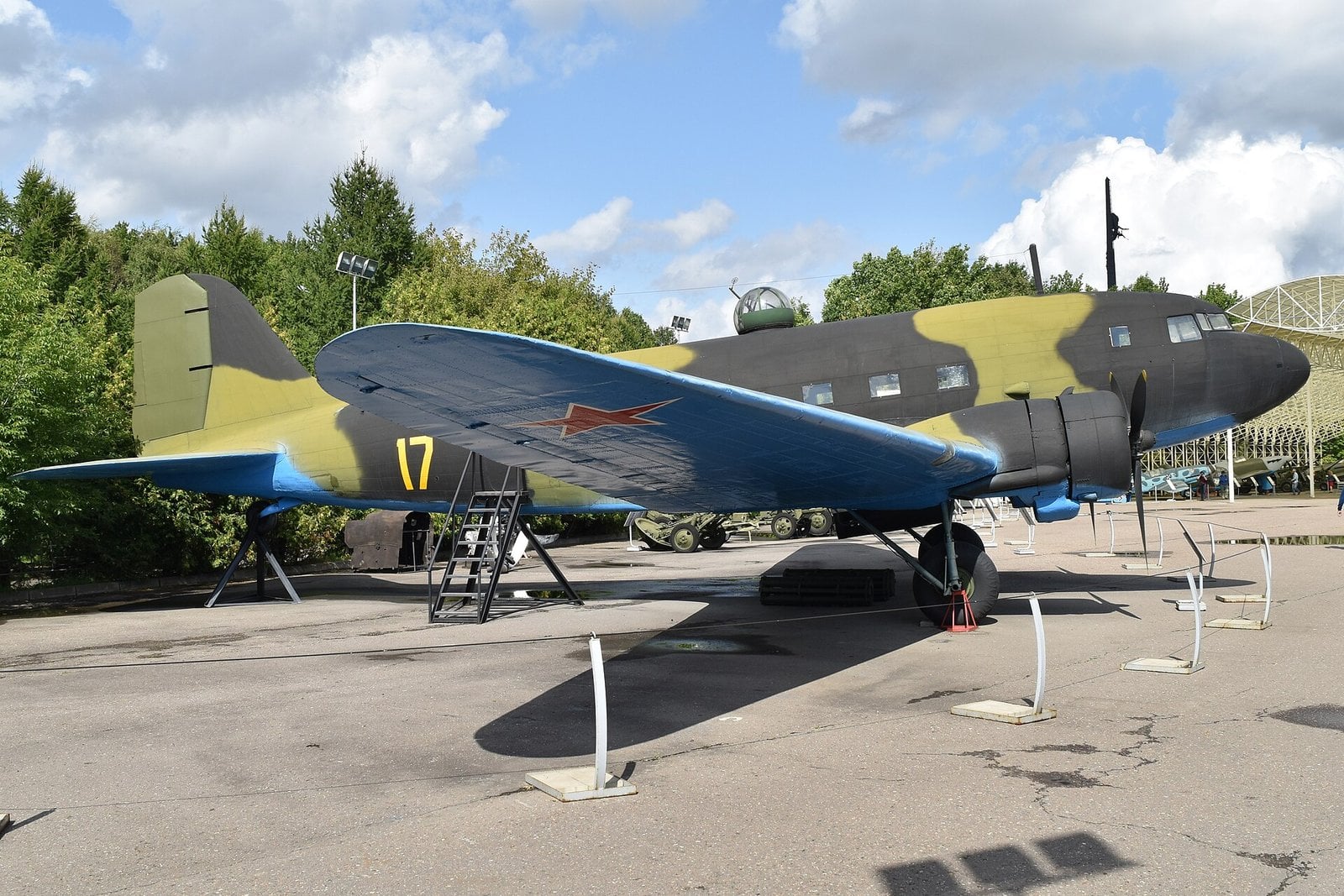
When the Soviet Union built up its Long Range Aviation force from 1942, the Li-2 was pressed into service as a night bomber. Early on, crews simply rolled bombs out of the cabin door by hand; later aircraft carried racks for four bombs under the centre section. In their history of the type, Yefim Gordon and Sergey and Dmitriy Komissarov describe the Li-2 as the main equipment of several bomber regiments.
Bombing was only part of the job. Li-2s dropped paratroopers, flew supplies to partisans behind the lines and brought wounded soldiers back, often without fighter escort.
Aeroflot’s Postwar Workhorse
After the war most Li-2s went back to civil work, and the type became the backbone of Aeroflot through the late 1940s and into the 1950s. Standardised passenger and transport versions appeared in the mid-1940s, and a second production line at Komsomolsk-on-Amur in the Soviet Far East built several hundred between 1946 and 1950. A high-altitude Li-2V with turbocharged engines served in mountain and weather-reconnaissance roles.
Production at Tashkent wound down in the early 1950s as the Ilyushin Il-14 took its place on the line. The Li-2 stayed in Aeroflot service much longer: according to Russian accounts, the last scheduled passenger flights with the type in the Soviet Union ended only in the mid-1970s.
Aeropark Budapest takes a walk-round and flight in the surviving Li-2 (in Hungarian).
Pilots who could choose generally preferred the American original. Gordon and the Komissarovs compare the Li-2 with the Lend-Lease C-47s the Soviet Union also flew, and judge the Li-2 second best, held back by lower build quality, less powerful engines and simpler Soviet radio and navigation equipment.
From Budapest to Beijing
Wherever Soviet influence reached after 1945, the Li-2 followed. In Hungary, the Soviet-Hungarian airline Maszovlet received five Li-2Ps in August 1946 and began domestic services that October. According to the Goldtimer Foundation, 31 Li-2s served in Hungarian civil and military aviation; Malév flew them until 1964, and the Hungarian air force used them, mainly for parachute training and target towing, until 1975.
Poland’s LOT, Czechoslovakia’s ČSA, Bulgaria’s TABSO and Romania’s Tarom all flew the type, as did the air forces of the Eastern Bloc, Mongolia, North Korea and North Vietnam. Yugoslavia re-engined some of its aircraft with Pratt & Whitney R-1830 Twin Wasps, the engine of many American DC-3s, and called them Li-3s.
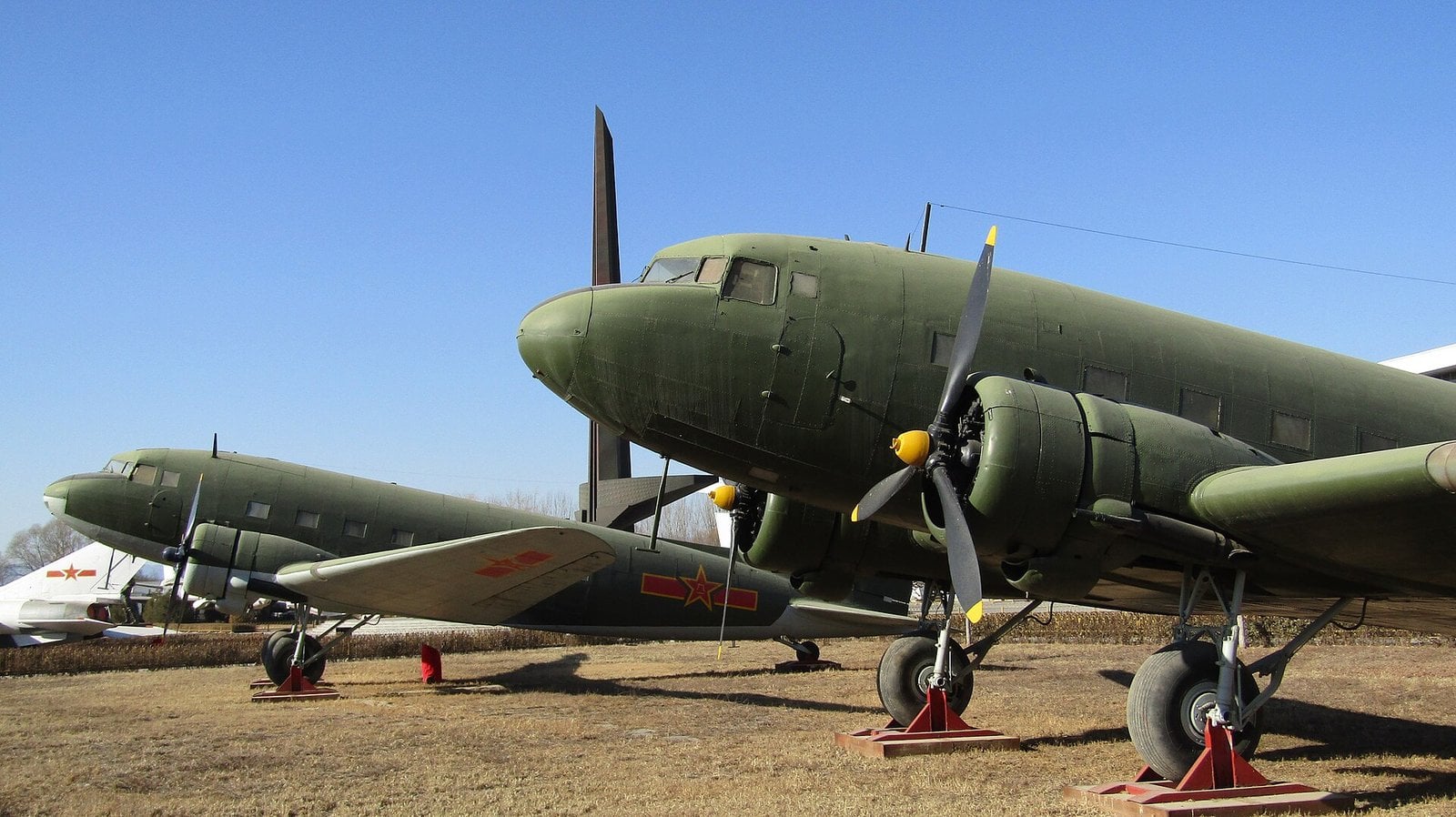
China was among the largest users of all, with Li-2s in its air force and civil fleet from the late 1940s onward. Some of the very last Li-2s in regular service were still flying in China and Vietnam in the 1980s.
How Many Were Built?
For decades nobody in the West knew. Before the 1990s the most commonly quoted estimates were around 2,000 to 2,800 aircraft, while some reference books gave more than 6,000. Air-Britain’s 2006 production history of the DC-3 family settled on 4,937, and factory-by-factory tables published in Russia arrive at almost exactly the same figure.
That makes the Li-2 by far the most numerous foreign-built member of the DC-3 family, and puts the Soviet Union’s output at roughly half the number of military C-47s and C-53s built in the United States.
HA-LIX: The Last One Flying
HA-LIX, construction number 18433209, was built in Tashkent in 1949 and delivered the same year to the Hungarian army. It moved to Malév in 1958, returned to the military at the end of 1964, and was retired to a museum collection at Szolnok in January 1974. In 1997 the Goldtimer Foundation took it to Budörs to begin a restoration that stripped every metal part of its layers of paint and fitted Soviet ASh-62IR engines and modern avionics.
The Goldtimer Foundation looks back on twenty years of flying the Li-2, from the first idea to the finished restoration (in Hungarian).
The Li-2 flew again on 21 September 2001 and received its certificate of airworthiness in April 2002. It took the name Kármán Tódor in 2002, in honour of the Hungarian-born aerodynamicist Theodore von Kármán, and has worn its original Malév livery since August 2008. It has since toured air shows across Europe.
It has not always been alone. According to the DC-3/Dakota Historical Society, Russian amateur aviators restored another Li-2, RA-01300, in 1993 and flew it to Western Europe in the mid-1990s, including to the 50th anniversary commemorations of Operation Market Garden in the Netherlands. Today the Goldtimer Foundation and other sources describe HA-LIX as the only Li-2 still airworthy.
The foundation’s own video shows the aircraft at the 75th anniversary of the Normandy landings in 2019. It still flies at home, too. The foundation’s 2026 programme opened the season at Budörs on 25 April with 15-minute pleasure flights in the Li-2, sold as a donation to the foundation.
The Goldtimer Foundation’s report from the 75th anniversary of the Normandy landings (in Hungarian).
Nine decades after Lisunov travelled to California, the result of his work can still be booked for a seat. Sit inside and it feels like a Dakota until you look at the instruments.
Sources: Goldtimer Foundation, li-2.hu (Malév Flight and Operations History Circle), DC-3/Dakota Historical Society, Yefim Gordon, Sergey and Dmitriy Komissarov, Lisunov Li-2: The Soviet DC-3 (Midland), via Modeling Madness review, Air-Britain (Gradidge, 2006), Virtual Aircraft Museum (aviastar.org).
Header photo: HA-LIX ZRH 30.08.23 by Michael Steffen, CC BY-SA 2.0, via Wikimedia Commons
0 Comments