
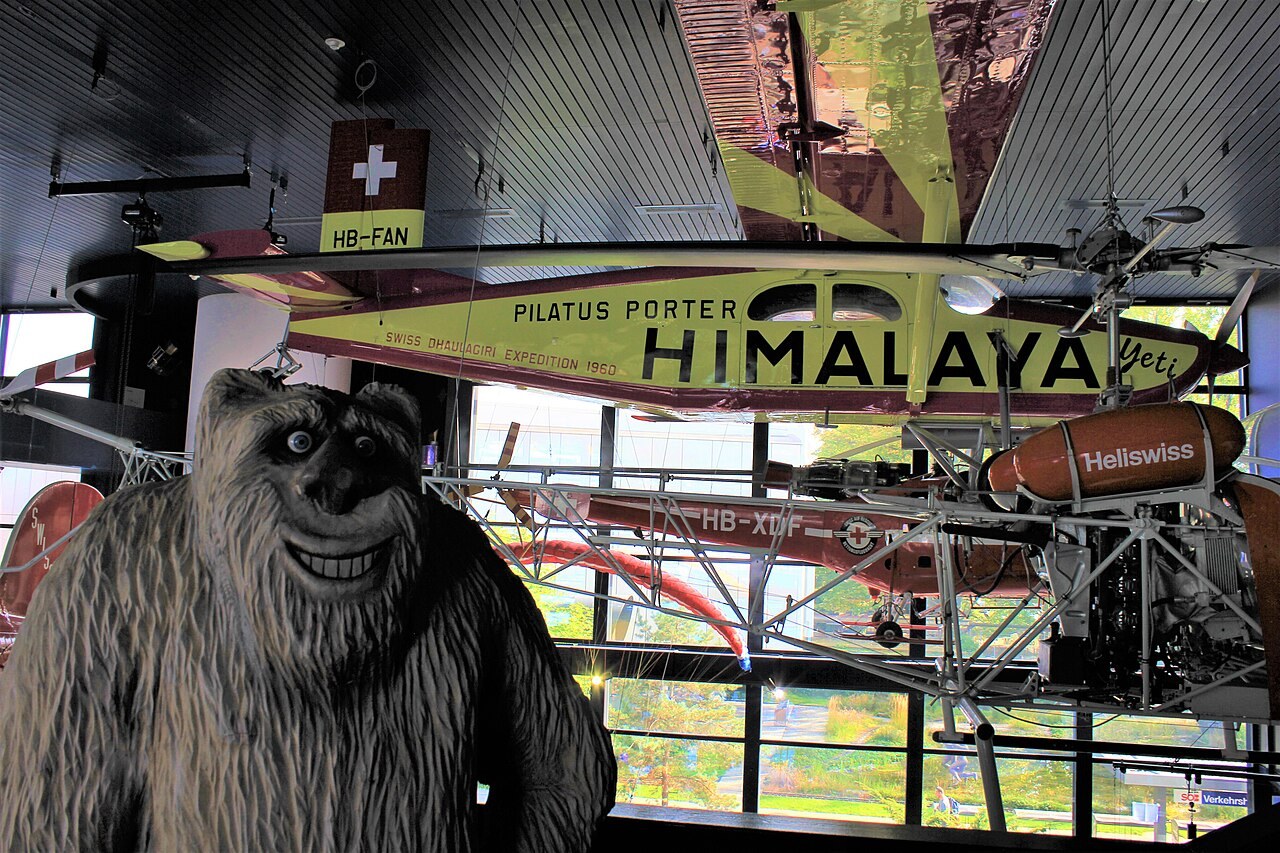
In 1960, a Swiss expedition set out to make the first ascent of Dhaulagiri, at 8,167 metres one of the giants of the Himalaya. Its secret weapon was not an oxygen set or a new kind of rope. It was a small, boxy aeroplane called “Yeti”, which ferried men and supplies onto the mountain’s glaciers and set down at around 5,700 metres, a record for the highest landing by an aeroplane.
“Yeti” was a prototype of the Pilatus PC-6 Porter, and the expedition set the tone for everything that followed. For more than six decades, the Porter went where runways did not: onto glaciers and jungle strips, into the secret war in Laos, out of the side door with skydivers, and into the service of air forces from Switzerland to Austria.
Kurzinfo
- Typ: Single-engine STOL utility aircraft
- Hersteller: Pilatus Aircraft, Stans, Switzerland; licence-built by Fairchild Hiller in the US
- Erster Flug: 4 May 1959 (piston Porter); May 1961 (first Turbo Porter)
- Motor: Most built with one Pratt & Whitney Canada PT6A turboprop; early versions Lycoming piston, Turbomeca Astazou or Garrett TPE331
- Kabine: Up to ten passengers or around a tonne of freight
- Aufzeichnen: Landing at around 5,700 m in the Himalaya, 1960 Dhaulagiri expedition
- Produktion: 604 built over 63 years; last delivered 12 December 2022
- Famous users: Air America, Swiss Air Force, Austrian Air Force, skydiving clubs worldwide
A jeep with wings from Stans
The Porter was born out of an empty order book. In the late 1950s, series production of the Pilatus P-3 trainer for the Swiss Air Force was coming to an end, according to the Neue Zürcher Zeitung, and no follow-on orders were in sight. Pilatus decided to build a civil utility aircraft instead: rugged, simple, able to carry a big load and to operate from almost anywhere.
The first prototype flew from Stans on 4 May 1959, powered by a 340-horsepower Lycoming piston engine. The recipe was deliberately plain: a high wing, a slab-sided all-metal fuselage with big sliding doors, and a tailwheel undercarriage that kept the propeller and wings well clear of rocks and rough ground. The NZZ has described it as a jeep with wings with the versatility of a Swiss Army knife.
The piston engine was not powerful enough for what customers wanted the aircraft to do. In May 1961 the first Turbo Porter flew with a French Turbomeca Astazou turboprop, and later versions switched to American turbines: the Garrett TPE331 and the Pratt & Whitney Canada PT6A, which first flew in a Porter in May 1966 and powers most of them today. Because a turbine is lighter than a piston engine, the nose had to grow to keep the centre of gravity in place, giving the Turbo Porter its unmistakable long snout.
Built for places without runways
The Porter’s whole reason for existing is its short-field performance. The NZZ quotes around 300 metres to take off and less than 150 metres to land, on asphalt, sand, grass or gravel, with reverse thrust from the propeller to help stop. The aircraft does not stall until it slows below about 96 km/h. Speed, on the other hand, was never a priority: depending on the version, it cruises at a leisurely 220 to 240 km/h.
It is also remarkably adaptable. The cabin takes up to ten passengers or around a tonne of freight, and the Porter can be fitted with skis for glaciers, floats for water, a trapdoor in the cabin floor for supply drops, or spray and firefighting equipment. One early-1990s estimate put around 40 per cent of all PC-6s flying in Europe in the hands of skydiving operators.
A Pilatus Porter shows off the short take-off and landing performance that made its name.
Air America’s secret workhorse
The Porter’s most famous chapter was written in South-East Asia. In the 1960s and 1970s, the CIA-owned airline Air America flew up to 23 PC-6s at a time in Laos, Thailand and South Vietnam. According to the Air America history compiled by Joe F. Leeker for the University of Texas at Dallas, the Porter gradually took over from the smaller Helio Courier as the airline’s STOL aircraft of choice, because it could carry nine passengers instead of five.
The early Astazou engines did not like the climate of Laos, and Air America had its Porters converted to Garrett power in 1966. From then on they carried everything from CIA case officers and indigenous troops to weapons and medicine, landing on mountain strips in support of the CIA’s Hmong programme in Laos. A damaged Porter could even be slung under a Sikorsky UH-34D helicopter and carried home.
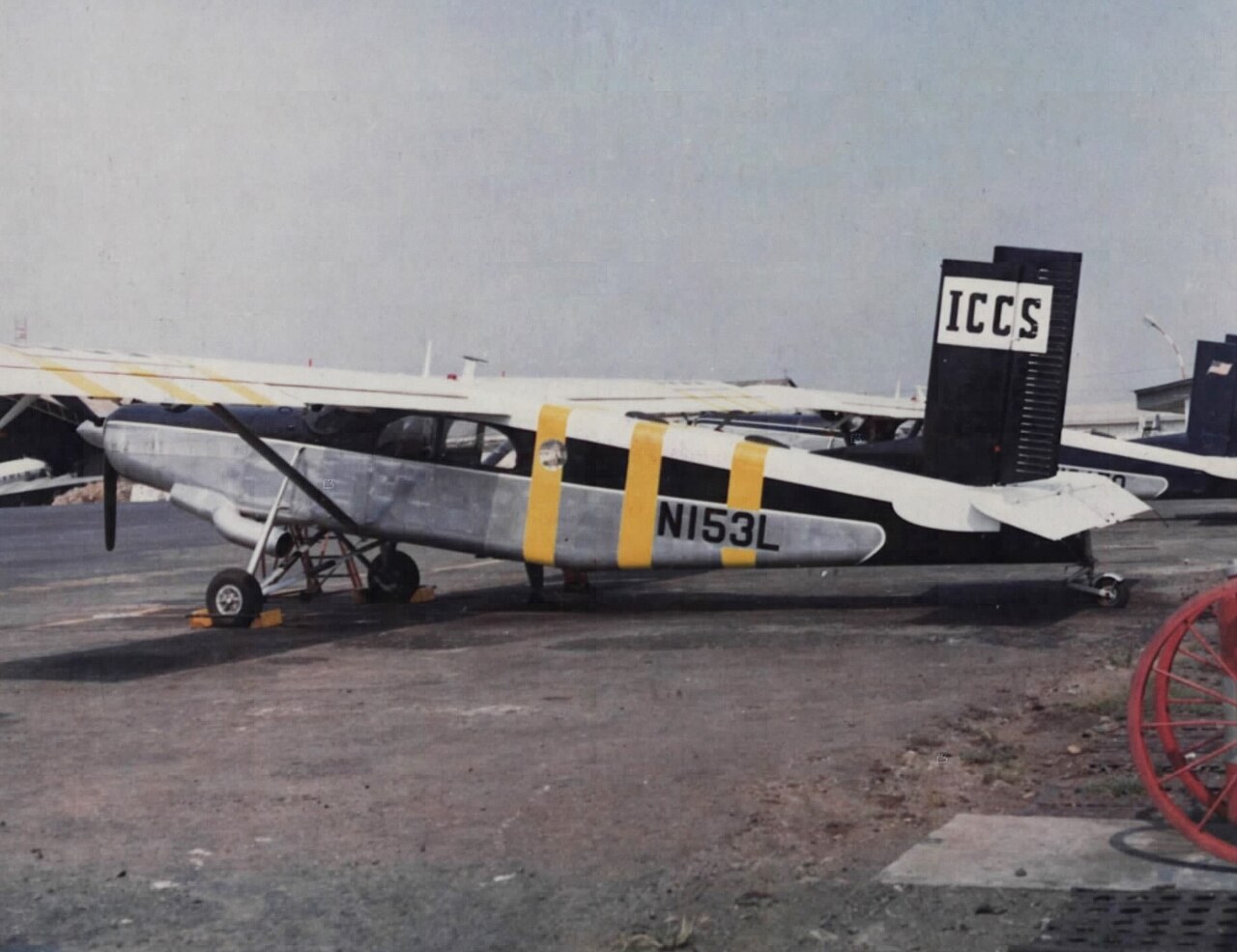
The work was relentless. Pilots stayed at upcountry bases for a week at a time, and in 1973 some Porters flew for ICCS Air Services, carrying personnel of the International Commission of Control and Supervision that monitored the Vietnam ceasefire. When Saigon fell in 1975, a group of crated Porters could not be shipped out and had to be abandoned.
Fairchild Hiller also built the Porter under licence in the United States from 1965, around 90 aircraft in all; the NZZ puts the figure at 92. It was the first Swiss aircraft built under licence abroad. The US Air Force even tried an armed version, the AU-23A Peacemaker, with a side-firing 20 mm cannon, but it proved troublesome and the aircraft were later sold to Thailand.
Swiss and Austrian soldiers’ favourite taxi
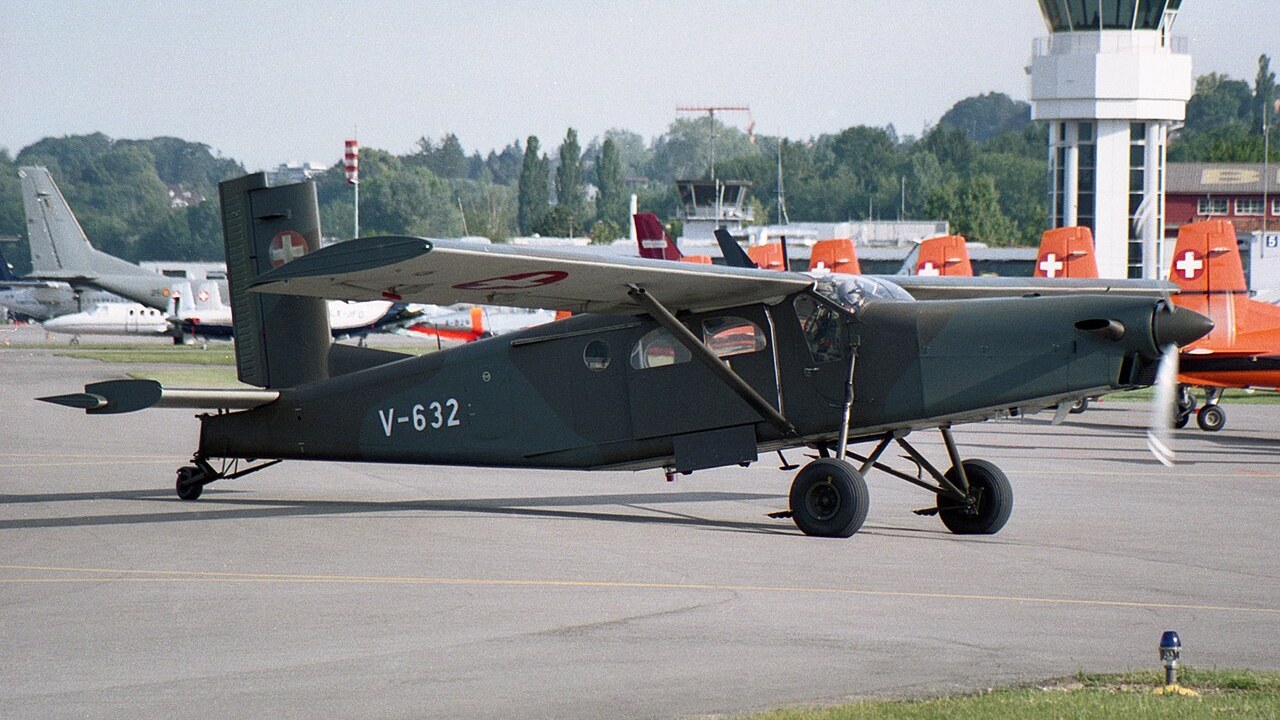
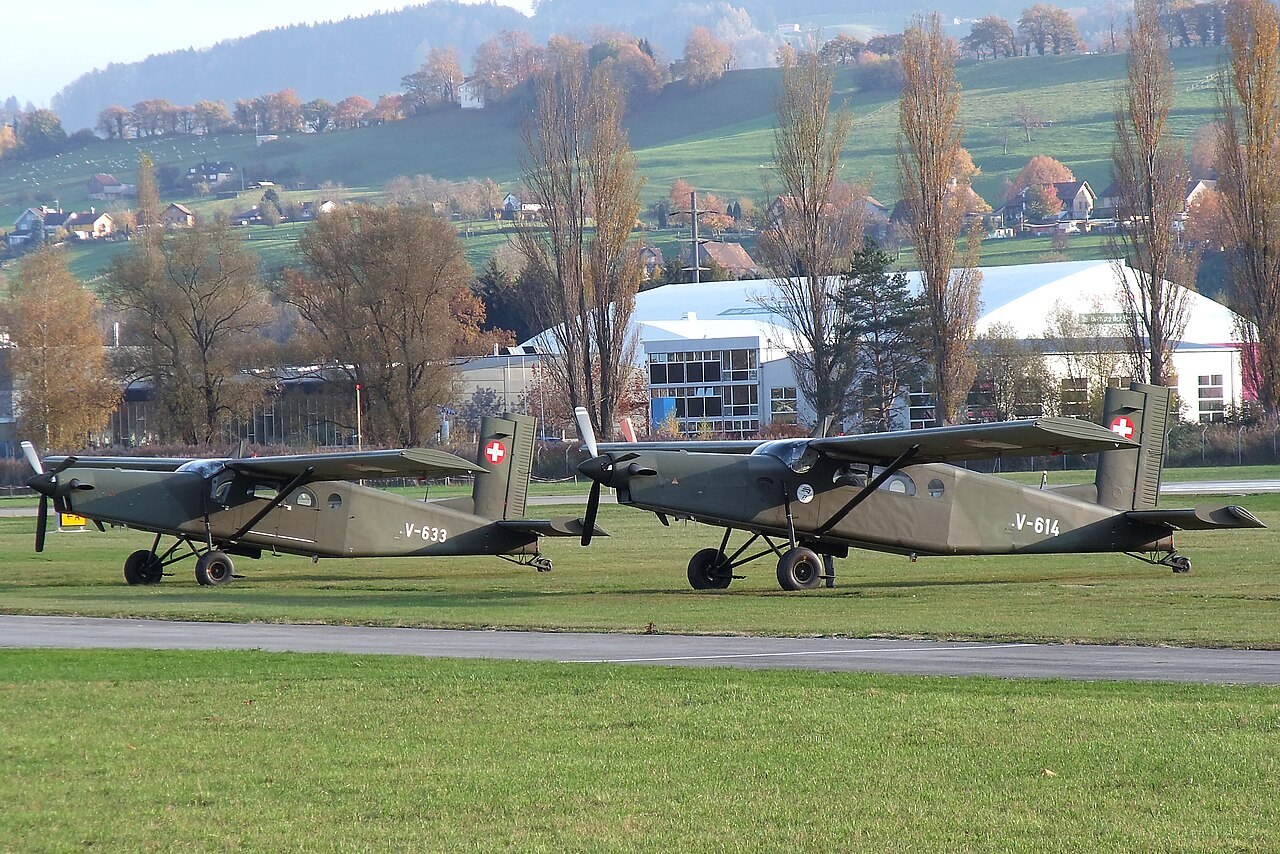
At home, the Porter became a fixture of the Swiss Air Force, wearing dark olive camouflage and the white cross on the tail. Swiss military pilots have used it for training and to drop parachutists, and its ability to land on short Alpine strips and meadows made it a natural fit for a mountain country.
Next door, the Austrian Air Force bought 12 Porters in 1976 and has flown them ever since for transport, liaison, search and rescue and paradropping. In July 2026, the Austrian Bundesheer marked 50 years of the PC-6 at Langenlebarn with special colour schemes. According to Austrian Wings, eight are still in service.
A Swiss Air Force PC-6 landing away from any airfield, the kind of flying the Porter was built for.
The Porter also found a second career in China, where Pilatus set up a joint venture in Chongqing that built PC-6 fuselages. AIN reported in 2016 that around 20 Porters were operating in the country, often as a cheaper, jet-fuel-burning replacement for the ageing Antonov An-2 biplane.
The end of the line
Nothing lasts for ever, not even a jeep with wings. In 2017 Pilatus announced it would stop building the PC-6, citing the type’s age and ever tougher certification requirements, and freeing capacity for its PC-24 business jet. The plan was to end in 2019, but the pandemic and other delays stretched the run. The very last Porter, serial number 1019, was handed over to Indonesia’s Smart Aviation on 12 December 2022.
That brought production to 604 aircraft over 63 years, a run Pilatus counts among the longest of any aircraft in the world. Pilatus promised to support the fleet for at least another 20 years. Many Porters are still out there, dropping skydivers, serving armies and flying into strips that would make most pilots turn back.
The Porter even had a film career, starring in the 1990 comedy Air America and in the opening sequence of the 1995 James Bond film GoldenEye. But its real legacy is quieter. Wherever there was a glacier, a jungle clearing or a mountain meadow and someone who needed to get there, the little Swiss utility aircraft was usually the answer.
Sources: Neue Zürcher Zeitung, SRF, AIN (Aviation International News), Joe F. Leeker / University of Texas at Dallas (Air America: Pilatus / Fairchild PC-6 Turbo Porters), Austrian Wings
Header photo: Martin Oertle / Wikimedia Commons, CC BY-SA 2.0
0 Comments